One warm afternoon in early June, the churchgoers at Montreal’s Chapelle historique du Bon-Pasteur (a room built for the Sisters of the Good Shepherd in the 19th century) all turned in unison, as if choreographed by an unseen force. They didn’t turn toward the altar, which is what we’re supposed to do in houses of worship. Instead they faced the entrance, where a performer had begun a slow walk across the aisle in an outfit made of shells and beads that demanded to be seen.
The Zapotec performer, Lukas Avendaño, seemed to take forever to cross that room. By the time they reached the altar, I couldn’t help but think about how long Indigenous cultures have been making the very same walk, through five centuries of colonizing practices and exclusion. The show was Bardaje, conceived by Avendaño, a muxe (third-gender) artist who celebrates their culture without the need to over-explain or provide anthropological footnotes to those who encounter their work.
There was something moving and profoundly transgressive about seeing this Indigenous body performing in front of the crucified Jesus above the altar of the church. Avendaño covered themself with ash, and as they danced and moved, the venue filled with the sound of rain coming from the shells shaking up and down. The ash made its way toward us, traveling across the beam from a spotlight; I could see the particles drifting through the light. When Avendaño left the stage, the sound of rain kept reverberating and echoing until it disappeared. It was beautiful, like a haunting. Before going into any ancient space, I always ask myself: Is it haunted? That afternoon, the answer was yes.
The Chapelle that housed Bardaje sits at the foot of Mount Royal, the hill that gave Montreal its name. The day after the show, I walked up toward the cross at its summit as if I was completing a pilgrimage the show had prompted in me. The climb was hot, lonely, and dusty. The fine ash that had crossed the stage toward us that afternoon had followed me up a mountain.
Bardaje set the tone for my first experience at the Festival TransAmériques, which turned 20 last year. FTA, as it’s lovingly known throughout Montreal, started in 1985 as the Festival de théâtre des Amériques. Its co-directors, Martine Dennewald and Jessie Mill, framed this edition as running “from Turtle Island to Abya Yala,” citing two common Indigenous names for the Americas. This year’s FTA asked the question: How do we celebrate the artistic power that survived, and grew out of, colonization? The answers this year came from Argentina, Bolivia, Brazil, Chile, Guadeloupe, Haiti, Mexico, the U.S., Quebec, English Canada, and Europe.
Beats in Sync
I walked nearly everywhere during the week I visited the festival, sometimes dancing a few steps to the beats I’d caught in Braids & Heritage, Stacey Désilier and Jossua Satinée’s duet, in which they mirror each other’s moves while delivering an Afrofuturist take on the history of Black dance—the city and the festival trading rhythms in complete sync.
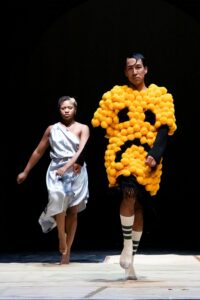
One of the liveliest beats from the festival came from The Romeo, created by Trajal Harrell and performed by Zürich Dance Ensemble, a show for anyone who, like me, once put on their mom’s heels and clothes and staged their own fashion show when no one was watching. The dancers built tableaux that fused runway walking and voguing with poses that look like Greek reliefs come to life. I kept waiting for Basement Jaxx’s eponymous song to kick in; it never did, the score sticking instead to Philip Glass and Alberto Iglesias, which gave the hedonism on display a more ethereal quality. Among the dancers, there was the impossibly beautiful Thibault Lac, with a face that would have made Fellini cast him in Satyricon; the scene-stealing Christopher Matthews, who was born to strut down the catwalk; and the stunning Nasheeka Nedsreal, all of whom reminded me of times I once spent dancing the night away with drunk, sweaty strangers in Istanbul. Pure pleasure.
Small Wins

It was so freaking hot in the pool where Dana Michel’s You Cannot Can took place. To get there, you entered through the ground floor of the UQAM sports complex, past a room full of bulky bodies working out, the smell of sweat and the grunts of mostly men lifting late on a Friday night filling the air before you even found the stairs down. We all sat on the edge of the pool, the humidity adding dread to the protagonist’s unspoken fear of water.
The dialogue-free show featured Michel struggling to get in the pool in the most outlandish ways. It kept making me think of the SNL sketch where Liza Minnelli, as played by Kristen Wiig, tries to turn off a lamp and continuously fails. By the time Michel actually hit the water, the show became a celebration of small achievements that can feel enormous. It’s about how memory works like a melting pot of the places and people that made us, and the ones that made them.
In attendance I noticed a young white man accompanied by a young Black woman. While the show unraveled, he kept moving all around the pool, standing up, sitting back down, angling for a closer look at the action. She stayed exactly where she’d been sitting when the show started, remaining still the entire time. The white man ended up making the show feel almost like it was about him, and his need to understand and get closer to it.
Desire as a Drug
The water followed me to Théâtre Prospero, in the Village, a few streets from the gay saunas the next show was actually about. Éric Noël and Philippe Cyr’s Ces regards amoureux de garçons altérés is a monologue where we learn about a young gay man’s drugs of choice: methamphetamine, GHB, and Manu, a narcotic in human form. The nameless protagonist, played by Gabriel Szabo, proceeds to explain how his desire for Manu consumes him just as completely as the drugs that are ubiquitous in the saunas.
Szabo moved with a tightness that resembled a dark ballet, muscles held taut with the same discipline the drugs demand of a body trying to stay upright. It was haunting, and sometimes so real I wanted to look away. We never actually saw Manu, only glimpses of him, conjured through a speed-fueled, sex-filled series of tales. The more we learned about him, the less perfect he seemed. But, as Noël puts it at one point, “Shame of the desire is stronger than the desire.” As the lights went up when the show ended, I noticed Szabo’s wet footprints slowly vanishing from the floor.
Manuel Roque’s Sweet Rodeo, a work in progress which I saw the next day, made an unexpected companion piece to Ces regards amoureux in spirit, if not by design: It was another study in the inevitability of wanting to be close to someone, that same pull toward intimacy and proximity. Two dancers spend the piece being drawn toward each other by something that feels like an unseen, unstoppable force of gravity, close as pendulums finding a shared center, only to be pushed apart again.
The Scent of Poppers
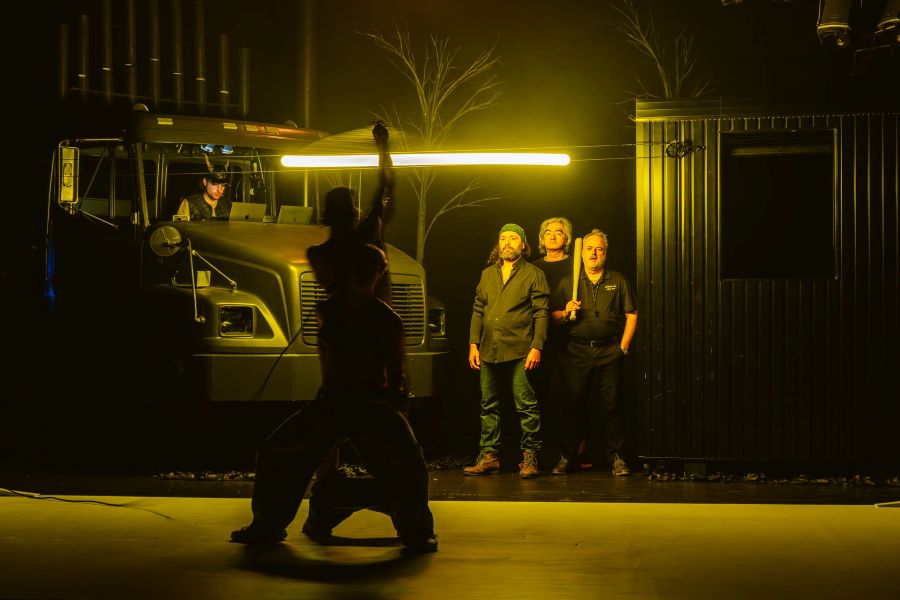
Jockstraps kept appearing throughout the festival, too, uninvited and recurring, like a rhyme scheme of their own. Olivier Arteau and Kev Lambert’s Querelle de Roberval, adapted from Lambert’s novel in the lineage of Jean Genet, is set during a strike at a sawmill, where Querelle (Philippe Thibault-Denis), a worker who is impossibly handsome and dangerously free, becomes the object of a hunger that curdles into violence.
The play asks who gets to be the scapegoat when a community needs someone to blame. It works in images more than argument: Querelle holding a lightbulb attached to the end of a long cable, beginning to lasso it slowly through the air, lit and unlit, until he resembled a Saint Sebastian about to be pierced with arrows.
Another jockstrap, beefier and hairier, showed up in Émile Pineault’s Bottommost, a duo built out of scent and proximity, performed by Pineault with Paco Lepecha Costa. It’s difficult not to notice, watching a white performer (Pineault) direct a trans body of color (Lepecha Costa) into subjugation, that there’s a history embedded in who gets to stage whose submission.
But I don’t want to flatten a show this defiant and richly textured into that observation alone. At one point during the performance a neon sign lit up with the word “open,” and each of us found a small bottle of fake poppers waiting (if anyone knows what that scent actually was, tell me!). Echoing the mystical unison of Bardaje, the entire room opened the tiny vessels at once, and we inhaled together, dance and theatre functioning as a kind of collective prayer. By the end, the two performers disappeared offstage together into a void, still holding on to each other, proximity winning out over what had appeared as nothing but destruction.
Pay for Pain
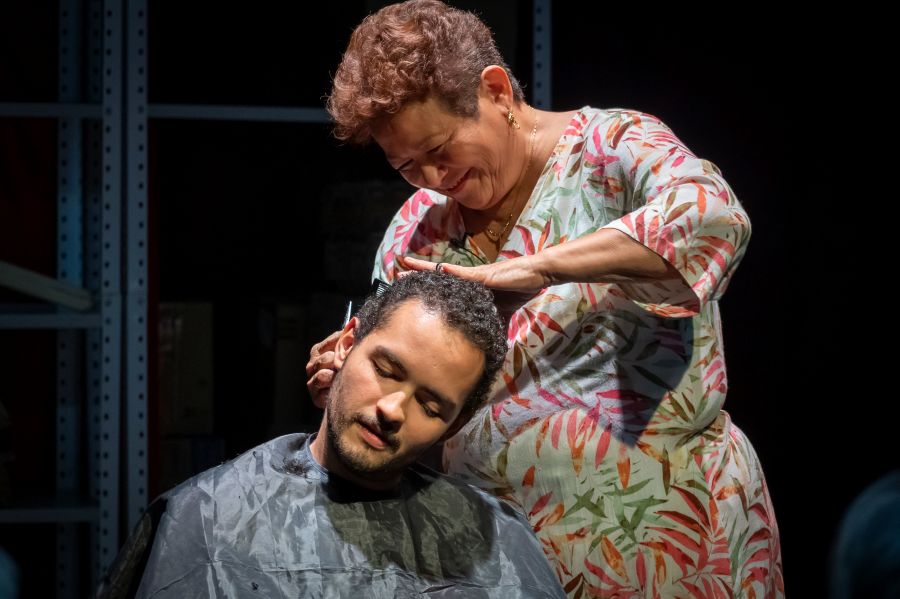
Proximity turned into commerce a few nights later, in Anacarsis Ramos’s astonishing Mi madre y el dinero, staged in one of the spaces at Place des Arts. This was autobiography and documentary theatre at once, with Ramos’s real mother playing herself accompanied onstage by her son.
Ramos knows exactly what he’s doing in staging his own working-class Mexican mother’s story for rooms full of white audiences in Europe and North America, who pay to watch her sell them her pain, then making the sale itself the joke, quite literally, as mother and son cook and sell real chorizo to the audience mid-performance. The show is queer, but it’s just as interested in patriarchy and in an economy that forces women like Ramos’s mother to keep reinventing themselves professionally just to survive, working as a beautician, a saleswoman, and a performer of her own life, always meeting the moment.
Car, Tree, Cave
Marie Brassard, a legend of Quebec performance, built L’éther around mortality and the people we lose, and she plays three characters: a version of herself, a male taxi driver, and a dead friend, shifting between them with voice effects alone. At one point she recalls being asked to remember three words at a doctor’s appointment, “car, tree, cave,” words that dissolve no matter how many times you repeat them under your breath.
The show made me think about my parents, how I’ll remember them once they’re gone, and what will actually remain. Brassard sang a version of “Águas de Março,” the Elis Regina and Jobim standard, in French, and it filled me with melancholy, because it’s the same song my father used to sing to my siblings and me. The song itself is a collage, fragments strung together into something closer to a life than a plot. Maybe that’s how memory actually works: as a series of things that happened to be lying around when someone we loved was still there to name them, like the objects and images in the song.
FTA is now over, but I have repeated the words from L’éther daily.
Car, tree, cave.
Voiture. Arbre. Caverne.
I keep repeating them, on purpose, the same way I hold onto the memories of ash clinging to a path up Mount Royal, of wet footprints drying on a stage built to look like a sauna, of a mother’s vibrant landscapes sold in the same breath as her chorizo, of my father’s song, sung perfectly in Portuguese, mistranslated only by us as children into something we made all our own. All of it begs to be remembered, and I do so purposely, in much the same way I intend to remember my parents once they’re gone: carrying forward everything they gave me while they were still here to give it.
Jose Solís is a Honduran cultural critic, activist, and educator, and a doctoral candidate at Universidad Carlos III de Madrid. He is the founder and director of the BIPOC Critics Lab.