
The following is from Beyond and Before: The Land’s Original Storytellers, a series of works and excerpts by Native theatremakers that originally appeared in our Summer 2026 issue. To open the original print version in a new full-screen tab, click here.
Antíkoni’s setting has moved from the polis to the museum, where Kreon has risen through the ranks to become museum director. A chorus of Aunties advised the family by telling traditional Nez Perce stories of wit, adventure, and profound wisdom. In this scene, the sisters Ismene and Antíkoni debate the proper course of action in response to Kreon’s acquisition of the remains of the Cayuse brothers, who died fighting on opposite sides of a 19th-century war between the Nez Perce-Cayuse and the U.S. Cavalry.
ACT TWO/Scene 1
Spotlight is up on the crate. ANTÍKONI hastens to the crate and pulls a crowbar from the roll of her yoga mat.
As she moves her hand across the crate, she cuts herself. She draws her hand to her mouth, sucking the blood.
ISMENE enters.
ISMENE
Néne’, I came as quickly as I could. What is so urgent?
ANTÍKONI
An open grave—you soon will see.
ANTÍKONI pries at the crate.
ISMENE
Sister—we shouldn’t be here. By our Uncle’s word, this place is forbidden.
ANTÍKONI
What are you—a child? Why fear him so, who has no authority?
ISMENE
Surely he has all the authority he needs.
He could call the guards on us, who would hand us over to the police.
And then we would be at the mercy of the law. A law that increasingly confines.
If that were not enough: Kreon is our uncle. We owe him our respect.
ANTÍKONI
We share the same blood, but not the same heart.
ISMENE
And is it your heart that is bleeding so?
ANTÍKONI pries open the crate
ANTÍKONI
Look in this crate and you will see.
ISMENE
No. I cannot look, lest I disturb—
Listen, were it not for you, I would not come here.
ANTÍKONI
Ayi, if you came here for me, then you must surely know why I came here for them. These are our ancestors, the Cayuse brother and the Crow.
ISMENE
Néne’, you worry me. Why have you come here?
ANTÍKONI
I’ve come to rescue them. I want to carry them home.
ISMENE
You cannot! It must be done through the law.
ANTÍKONI
The law! NAGPRA1 will not redeem them. Or us. It might not even stand.
ISMENE
Be patient. The tide will turn, in time.
ANTÍKONI
The moon commands the tides. The tides do not command the moon.
Surely you do not dispute that law.
ISMENE
Antíkoni, there is only one way to ransom, and it isn’t by your hand.
Do you not recall what price was paid, when medicine singers gathered around the Ancient One, and afterwards a bone was missing?
There was one who did this before you.
And he was punished, and our People as well, as they locked the Ancient One away.
No one could sing for him then. And thus our losses spread, like blood from a wound.
ANTÍKONI
And what is loss?
Is this not a life of loss to see our ancestors reduced to property?
To lose their names to numbers?
To see them sold and stripped to the bone?
And then even their bones are pulled apart.
What cruel inventory is this, that makes our families into things.
(Points at crate) Look at this! Show me you have the courage to see.
(ISMENE turns away)
I thought so. You can’t.
ISMENE
Néne’, don’t bully me. I see the matter most clearly.
This is a curse under which we have been born.
Listen: Our father is dead by his own hand, our mother by disease.
Both could not bear their own living flesh.
Our grandmothers and grandfathers were forced to boarding schools,
beaten and assailed by brutes.
Our great grandparents survived the war,
And then survived much more: imprisonment in Leavenworth, then the Hot Place—
prison camps for children, elders, all.
Not many generations back our people were slaughtered.
Surely you know how little they care for our lives.
If we defy their law, they will make examples of us.
We are women and have more to lose: our lifegiving, our blood.
You know this: They take away children, they sterilize mothers.
These things they have done.
You know the stories of women.
Listen, Néne’, their power is greater than ours on this land.
We have no choice but to live with captivity.
Yet we can choose how to live with it.
ANTÍKONI
How to live with it?
Ayi, there is no living with it. Not in this world or the next.
ISMENE
My sister, our lives are short and this problem is long.
Did our ancestors survive so that you could throw your life away?
ANTÍKONI
I would rather die with dignity than live as you do—though you bear your chains lightly.
ISMENE
Don’t talk like that. Don’t say you’d rather die.
ANTÍKONI
I stake myself with my Ancestors’ lot.
ISMENE
Néne’, be careful. Don’t let the dead pull you from the other side.
You must leave them in the Shadowlands.
Stay here among the living. Among those who love you.
ANTÍKONI
How do you say you love me, when you leave me to pursue this alone?
When you will not join me in heart or hand?
ISMENE
I cannot break the law.
ANTÍKONI
Break the law? Break their law.
We are not bound to that law that makes us less than human.
We are bound to eternal laws, to the turning of the Earth, to our tamalwit, from the beginning of time to its end.
ISMENE
It is life that animates tamalwit! Our greatest obligation is to live.
To live a good life!
Give your life to those to come, not to those who have passed.
ANTÍKONI
Ayi, I cannot betray them.
ISMENE
But you will go against our uncle? The one who raised you?
I fear you love the dead more than you love the living.
ANTÍKONI
It’s not a choice as you would have it; it is one and the same.
What is done to the dead is done to the living, ten times again.
When you turn your heart from them you turn your heart from me.
ISMENE
Ugh! You are pulling my bones apart!
ISMENE exits. ANTÍKONI exits.
Stage turns to twilight/NIGHT SKY.
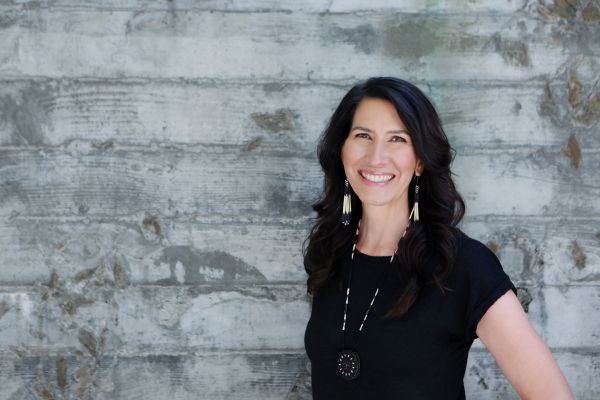
Beth Piatote is an award-winning Nez Perce playwright, poet, writer, and scholar. She is the author of three books and several plays, including Antíkoni, which premiered in Los Angeles with Native Voices in November 2024, and had a production in Hillsboro, Oregon, in June. Her scholarly work, poems, essays, and short stories have appeared in numerous journals and anthologies. She is an associate professor of English and Comparative Literature at the University of California, Berkeley.