
The following is from Beyond and Before: The Land’s Original Storytellers, a series of works and excerpts by Native theatremakers that originally appeared in our Summer 2026 issue. To open the original print version in a new full-screen tab, click here.
They will celebrate 250 years of a country that insists on calling itself new.
There will be fireworks. Pageantry. Rehearsed speeches. Familiar talk of freedom and revolution. Documents held aloft like sacred texts, the Declaration, the Constitution, paper shields hiding what has always been here.
But outside of that celebration, the world is louder now.
Languages are being reclaimed in classrooms and kitchens. Land acknowledgments are pushing toward land back. States are cutting inclusion programs, while communities build their own tables and gather anyway. Reports disappear. Histories are rewritten in real time.
And still, we are here.
Before ink met parchment, before 13 colonies declared themselves into being, there were already nations. There were systems of governance, of care, of story,
of theatre.
And when those “founding fathers” imagined themselves into nationhood, they did not do so in a vacuum. They studied the governance of people already here: confederacies, consensus, balances of power that did not
rely on kings. They “borrowed” from Indigenous nations to legitimize their own independence from empire.
They invoked freedom while standing on land governed by peoples they would not recognize as sovereign.
They wrote themselves into existence using frameworks they would later work to erase.
This is part of the story too.
I come from people who understand sovereignty not as declaration, but as practice. Not as a document, but as a daily act of relationship to land, to language, and to each other. Sovereignty is not granted; it is remembered.
It is lived.
We predate the myth of beginning.
And yet we are still asked to locate ourselves in relation to it, to measure our stories against timelines that erase us, to justify our presence in rooms that were never built for us.
What does it mean to make theatre in a moment when even naming injustice is being legislated against?
It means we remember differently.
It means we refuse to begin where they tell us to begin. What if we begin where we have always been?
In the circle.
In matriarchy—not patriarchy’s opposite, but balance, where leadership is responsibility and listening, where power is tended, not wielded.
In consensus, not as inefficiency, but as commitment. A refusal to move forward unless we move together. A belief that time is not something to conquer, but something to honor.
In Gadugi, the Cherokee principle of working together for the common good, not charity or branding, but the understanding that our well-being is bound together.
Especially now.
The structures we were told to trust are shifting. Funding disappears. Institutions retreat. Theatres that pledged commitment to Native stories quietly reprogram their seasons. The language of inclusion is softened, then erased.
But our ways do not depend on institutional permission.
They never have.
These are not abstract ideals. They are dramaturgies.
Western theatre centers the individual, the lone hero. In our ways, story emerges from the collective. It shifts depending on who is telling it, where it is being told, and who is listening.
There is no final draft.
There is only the ongoing act of telling.
And right now, that act feels urgent.
While some narrow the country’s narrative, we widen it. Some erase truths; we live them. Some cut programs; we build new spaces, sometimes with less, but with deeper roots.
We are not waiting to be invited back into the room.
We are remembering that we never left.
In my own work, I return to questions of home, of belonging, of what it means to come back to something that was taken, only to realize it was never fully lost.
These questions feel sharper now. Because “home” is contested. Land is still fought over. Representation is still treated as a favor rather than a responsibility.
Because even now, Native sovereignty is treated as theoretical by systems that continue to benefit from its denial.
But sovereignty is not theoretical.
It is in the way we gather.
Gathering, in our tradition, is never just about the present. It is about those who came before and those who will come after. It is about responsibility.
So what does it mean to gather now, as the country prepares to celebrate itself while unraveling parts of its own commitments?
It means telling the truth, even when it is inconvenient.
It means holding contradiction without rushing to resolve it.
It means refusing to flatten our stories into something easily digestible.
It means insisting that Native sovereignty is not a footnote, but an ongoing reality—one that continues to challenge the foundations of the nation-state itself.
And it means recognizing that the systems we carry—matriarchy, consensus, Gadugi—are not relics, but vital frameworks for navigating the present.
Because if this moment has revealed anything, it is that dominant systems are not as stable as they claim.
But we have lived through instability before.
We have survived policies designed to erase us, the silencing of stories, and the disappearance of truths from official records. We have watched history rewritten without us, and we have kept telling it anyway.
That is theatre too.
Not just performance, but persistence. Resistance.
So let them prepare their celebration.
Let them mark 250 years with fireworks and fanfare.
We will mark this moment differently. We will gather in circles. We will listen. We will argue and come to consensus. We will show up for one another in the spirit of Gadugi. We will center those who carry the knowledge of how to move us forward.
We will make theatre that does not ask permission to exist.
Because we are not new to this stage.
We have always been here. Adapting, resisting, creating, remembering.
And as the world shifts around us, we are not looking for a place within the narrative.
We are reminding everyone that the narrative was never singular to begin with.
So let the fireworks come.
We will still be here after the smoke clears.
Not waiting to be remembered.
Not asking to be named.
Rooted inside something far older.
Something ongoing.
Something that does not disappear when the lights go out.
Something sovereign.
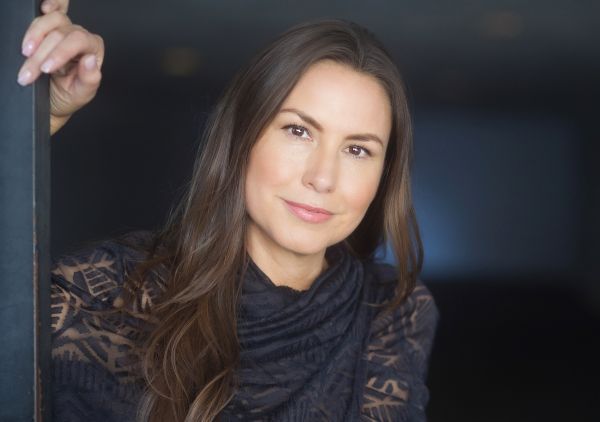
DeLanna Studi (Cherokee Nation) is an actor, writer, and artistic director of Native Voices. Her credits include the Broadway tour of August: Osage County and productions at Oregon Shakespeare Festival, Portland Center Stage, and Geva Theatre. Her play And So We Walked, based on retracing her family’s Trail of Tears journey, premiered Off-Broadway and was recorded for Audible. Film/TV credits include Edge of America, Dreamkeeper, Goliath, Shameless, General Hospital, Reservation Dogs, and Disney’s The Roof. She is a 2022 United States Artists Fellow, a 2023 AGE Legacy Playwright, Geva Theatre’s Resident Artist, and the first Native American finalist for the 2026 Susan Smith Blackburn Award.