What does it mean to build a truly new era in theatre, one that doesn’t just react to crisis, but confronts the roots of harm and chooses a different path forward? This section explores the cultural and historical touchpoints that made it possible for Antiracist Theatre to emerge, and what it takes to sustain that emergence beyond moments of public outcry. From clarifying what we mean by ART to examining the complexity of progress within entrenched systems, this era invites us to think critically and collectively about the future we’re shaping.
The Power of Artistic Space
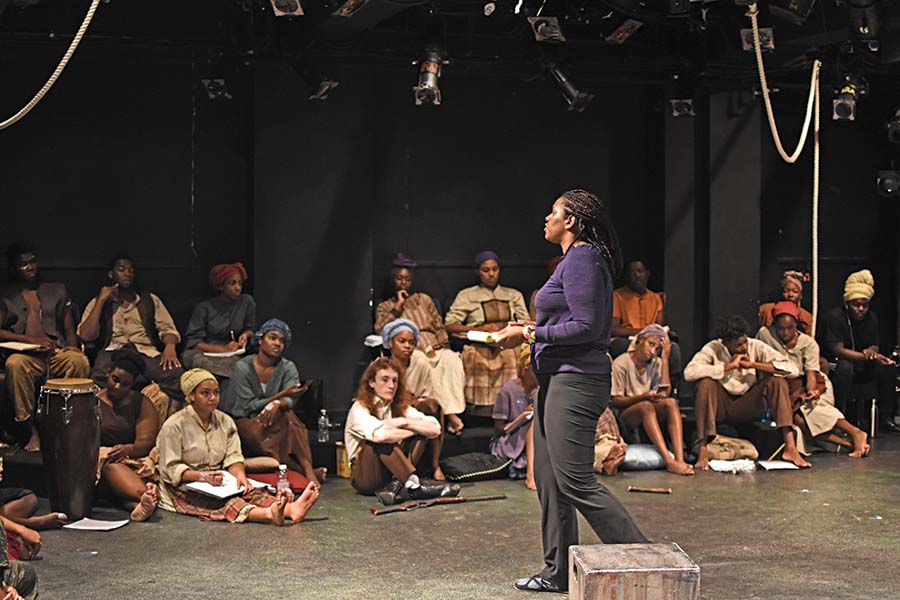
Antiracist Theatre took root not in grand institutions but in intimate, intentional spaces where experimentation, vulnerability, and redefinition of tradition could flourish. I’m grateful for the artistic space Rachel Jett, artistic director of the National Theater Institute, provided me between the winter of 2016 through 2019 to refine ART. The time spent on the O’Neill campus working with NTI students gave me a unique opportunity to spread my work to small cohorts of theatremakers. These students returned to their home institutions and advocated for those spaces to bring me in for a workshop. Through NTI, I met a cherished Black U.K. theatremaker, Anna Maria Nabirye, who was instrumental in the spreading of ART to the United Kingdom.
One of my fondest memories from the early development of ART was a conversation with a student who admitted that the approach had completely shifted their perspective on collaboration. They realized how often they had prioritized tradition over inclusivity. Feedback like that made it clear to me how necessary it was to continue to nurture a neo-antiracist tradition of theatremaking, one that can be fluid enough to tend to the needs of the artists and the audience witnessing the final phase of the work.
ART’s Rise Amid Crisis

The pandemic and the subsequent shuttering of the industry, along with the racial reckoning of 2020, formed a trinity of circumstances that propelled ART to the mainstage revealing both the hunger for change and the seeming endurance required to sustain it. Given the previous field-wide lukewarm reception to my work, I could never have anticipated the response my Antiracist Theatre Foundational Workshop would garner during the shutdown.
Throngs of people and organizations clamored for antiracism
in theater. It was beautiful! Even the problematic aspects were less daunting because, for a time, the fear of retaliation was temporarily shelved. I worked almost every day for 18 months, trying to keep up with demand and share the approach with as many people as possible.
The biggest lesson that emerged from that time was that people are tired of hurting and ready for something different. People were exhausted from watching their dreams be usurped by oppressive systems. Theatermakers were finally ready to change the quality of the relationships they had with themselves, the field, and each other.
Today, ART continues to ripple outward, steadily embedding itself into the broader consciousness of the industry. We’re no longer in the fever pitch of 2020, but that hasn’t meant the work has faded; it’s deepening. As more people gain clarity around how to apply ART in small, consistent ways, they become more willing to deviate from the norm, to disrupt business as usual. At the same time, those who were never truly committed to this work have become more visible, their performative gestures harder to hide in a climate that is learning to demand more than optics. These everyday shifts are where the experiential phase of this work is beginning to take root. The momentum may feel slow, but it’s also intentional, less about urgency and more about integration.
To make your ART practice a lived and lasting reality, you must contend with what stands in the way: internally, systemically, and relationally.
Defining Antiracist Theatre
Antiracist Theatre is a healing technology that reorients theatremaking toward liberation, care, and structural transformation by centering those most impacted by harm. It centers the well-being of historically disadvantaged people through practices and policies that actively acknowledge and interrogate racism, anti-Blackness, and other discriminatory practices. This analysis is then used to promote antiracist ideas, values, and policies that center the most marginalized in decision making and culture building, which can ultimately reduce the oppression felt by everyone throughout the process. ART is practiced in reciprocity with an anti-oppressive analysis, generating space to dismantle interwoven oppressive constructs such as ableism, paternalism, transphobia, discrimination based on sexual orientation, bias against First Nations people, religious discrimination, patriarchy, sexism, and more.
The goal of ART is to use healing as the catalyst to transform individual creative practices and organizational collaborative culture to become more fully inclusive, multicultural, anti-oppressive, and antiracist.
The Complexity of Progress
Although this definition may seem cut and dry, it is important to note that progress in antiracism is rarely linear. It is layered and often painful, but it remains essential, not just for personal betterment but as a gift to future generations of theatremakers. As a person of color, you may easily be drawn into an apathetic response of “same old shit, different day” that absolves you from trying to heal your wounds. If you feel confident in your analysis of racism, great! But how deep and wide is your analysis of anti-Blackness? As people of color, we are not immune to engaging in a spectrum of anti-Black attitudes toward one another.
The truth is, we’ll never live long enough to experience what it’s like to exist in an antiracist society. Knowing that the struggle and sacrifice we endure today won’t immediately benefit us shouldn’t stop us from doing the work anyway. We all owe a great debt to the elders and ancestors who sacrificed, endured, and worked to heal the wounds of their time, many of whom didn’t benefit from their efforts in their lifetime. Now we are being called to heal what we can for future generations of theatremakers. Keep reaching for the empty space; possibility resides there.
Nicole Brewer is a director and author. You can learn more about her work at nicolembrewer.com or on IG @antiracisttheatre.