
Ask 10 theatre leaders whether subscriptions are dying and you’ll get 10 defensible answers. Some organizations have watched their base erode for a decade. Others will tell you, accurately, that their numbers have held steady or grown, and that the eulogies say more about which institutions get written about than about the field as a whole. All things are true at once, which is exactly the problem: It means that the health of any one organization’s subscription program tells you almost nothing about the health of subscriptions as a category.
So I’d rather not argue about the category. I want to offer a way to interrogate your own numbers instead. Before concluding that patrons have simply changed their minds, I’d ask two different questions:
1. What did the organization stop doing?
2. What did it never build in the first place?
Start with the first. An organization decides, reasonably, that today’s patrons want more flexibility than a rigid five- or six-show package allows. So it builds a flexible or choose-your-own package—something between the full season and a single ticket—and prices it competitively. Then, when it’s time for existing full season subscribers to renew, the flexible option shows up as a lower-commitment alternative, right next to the full season renewal ask in the same communication.
Many subscribers downgrade, not because they’ve reconsidered a full season of theatre, but because the easier option was placed in front of them at the exact moment they were being asked to commit again. The organization looks at the downgrade and concludes: See, we were right—they wanted flexibility. Nobody stops to ask whether the timing caused the outcome.
This is the part that makes this pattern so durable: The data genuinely can’t tell the difference. A decline in full season sales looks identical whether patrons changed their minds or the organization simply mistimed the ask. Both produce the same chart. Only one of them is a decision you made on purpose.
The reason timing matters so much comes down to a basic shift in how the choice feels. When a subscriber’s only options are “renew” or “let it lapse,” most people who’ve been happy with five years of a theatre will renew; walking away from something they value is a hard decision, and inertia favors staying. But the moment a third option appears—renew, lapse, or downgrade—the calculus changes completely. Downgrading doesn’t feel like a loss the way lapsing does; it feels like a reasonable adjustment. So the fix isn’t to hide the flexible option from existing subscribers; it is to stop putting it in front of them in the same breath as the renewal ask.
Over-discounting does similar damage, more quietly. If a patron buying three or four shows individually can land close to what a full season subscriber pays, a major incentive to commit early disappears. Nobody decided to take away the subscriber discount. They just kept adding other ways to reach roughly the same price—a bundle discount here, a last-minute deal there—until the discount stopped being much of an incentive to commit early.
That answers the first question. Bad renewal timing and over-discounting do most of the damage: two specific, fixable habits, neither of them about what patrons actually want. The second question—what did we never build?— usually comes down to one answer: a real middle tier between a single ticket and the full season. That absence cuts in two directions.
In one direction, it’s the bridge a patron needs to step up into deeper commitment, and the order matters. Once a patron has bought two or three shows individually, full season is still the right first offer to make. But for the ones who don’t take it, flex is the offer that comes next—it should not be silence, nor should it be just single tickets again. And this bridge works: Patrons who’ve already stepped up from single tickets to flex packages convert to full season subscription at a meaningfully higher rate than those still buying single tickets. Skip that middle rung, and there’s no second offer waiting for the patron who may not have been ready for the full leap but who had already shown they wanted more than one ticket.
That’s exactly what the strongest programs build around. A regional theatre we work with tracks conversion into full season subscription from three specific pathways: existing choose-your-own subscribers, patrons who’ve bought multiple shows individually in a season, and recently lapsed subscribers. Since they started actively working those pathways, conversion climbed across all three. The choose-your-own tier wasn’t competing with the subscription base—it was feeding it, because someone built the bridge on purpose.
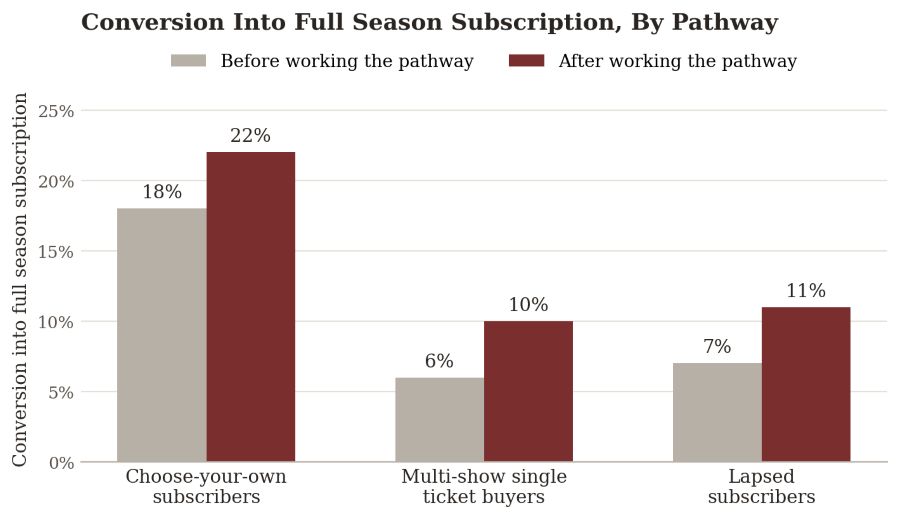
The same theatre’s most recent season makes the counter-case even sharper, if unintentionally. A leadership transition, a box office staffing gap, and a ticketing system conversion meant the pathway work went unstaffed for a season at that theatre. Full season renewal still held at 79 percent; loyalty, once built, doesn’t evaporate overnight. But lapsed subscriber recovery, the pathway most dependent on someone actively working it, fell back from 13 percent to 7 percent, and new full season acquisition dropped right back to the organization’s pre-pandemic average—both of them pathways nobody was actively promoting that season. Revenue held at 94 percent of pre-pandemic levels rather than collapsing—proof that the loyalty base can absorb a bad year, but not prevent one. Patron preferences didn’t shift in the space of a year. Attention did.
In the other direction, the same missing tier means leaving revenue on the table from patrons who would commit to something, if that something existed and was worth taking. The same theatre didn’t always have a middle option to offer. Before a three-show choose-your-own package existed, a patron’s only choices were the five-show season or single tickets, nothing in between.
Once it launched, the new tier grew quickly. Full season package counts softened over the same two seasons, since a real number of patrons who might once have bought the full season now had an alternative—but full season revenue still grew, and the two tiers combined held almost steady. The patrons the full season package didn’t retain, the new tier did.
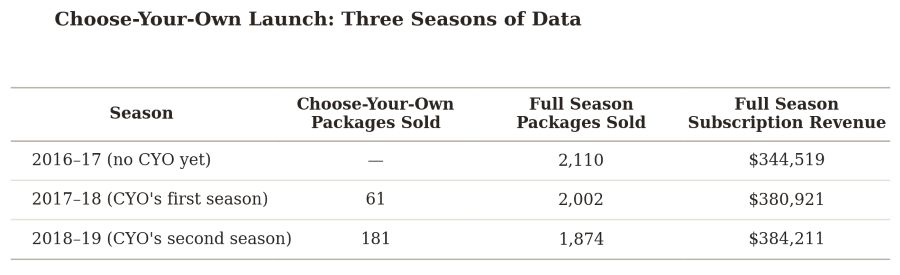
In this case, patrons didn’t need to be talked out of flexibility. They needed the option to exist in the first place.
So before an organization concludes that its patrons don’t want to make full season commitments anymore, I would audit four things first:
1. Are existing subscribers handed the flexible option in the same breath as their renewal ask?
2. How steep is the discount ladder between tiers?
3. Is the pathway from a first-time flexible buyer up to full season something your organization is actively building, or is this being left to chance?
4. Is there a real middle tier between single tickets and the full season at all?
In my experience, most of the “decline” clears up right there, not because the diagnosis was wrong, but because the patient was never actually sick. Someone had just stopped giving them the medicine, or never prescribed it in the first place.
None of this is an argument against the middle option—it’s an argument for using it on purpose. For a patron working their way up, or an existing subscriber who needs an alternative to lapsing altogether, flex is exactly the right tool. What’s never right is handing it out in the same breath as the renewal ask, or treating it as whichever package happens to be easiest to sell in the moment.
If subscriptions are dying at your organization, perhaps the first question is not whether patrons walked away, but whether we slowly taught them to, one mistimed renewal ask, one blurred incentive, one missing middle rung at a time.
J.L. Nave III is principal of Nave Strategies, a management consulting firm serving small and mid-sized nonprofit performing arts organizations.