“When you do well in theatre, someone’s going to compliment you by saying, ‘Why are you still here?’” said director and Indianapolis resident Chris Saunders. In Indiana’s capital, and perhaps many other similar cities around the country, this question can start to become a recurring refrain. After all, if you’re obviously talented, those poor innocent souls think, why make theatre in a Midwestern city when New York or the much closer Chicago are where people go to be theatre “professionals”?
“They mean well,” Saunders said. But a friend of his, when asked the same question, would simply reply: “Don’t we deserve good theatre?”
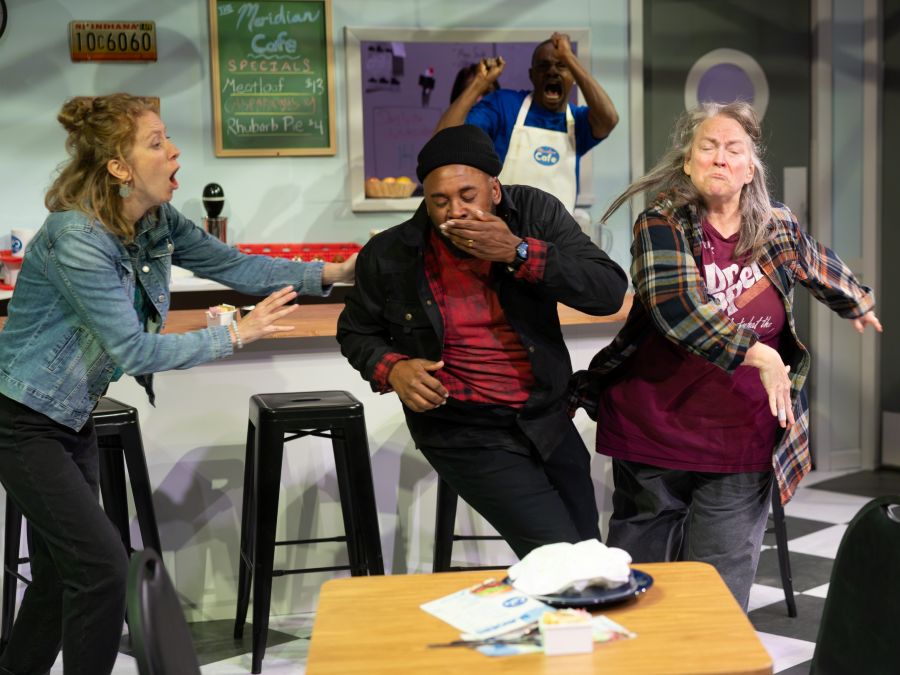
That was the crux of what led Saunders to founding American Lives Theatre in Indianapolis in 2019. Now, in the company’s seventh season, Saunders is doubling down on this local-focused vision with the company’s first commission, The Meridian Cafe. This new work from Obie-winning playwright Lucy Thurber, developed with local Indianapolis actors around the people, places, and ideas that feel meaningful to Hoosiers, is running through Nov. 8. Set over a single night at a fictitious neighborhood diner, the play, according to Saunders, is about “strangers who come from very different parts of life finding themselves in one communal place where they’re seeking refuge for the night.”
“There’s a lot of theatres out there doing contemporary work,” said Saunders, who also directs The Meridian Cafe, “but what I was intrigued by was the work that speaks to the heartbeat of America right now, as experienced in the Midwest, specifically where we are in Indianapolis.”
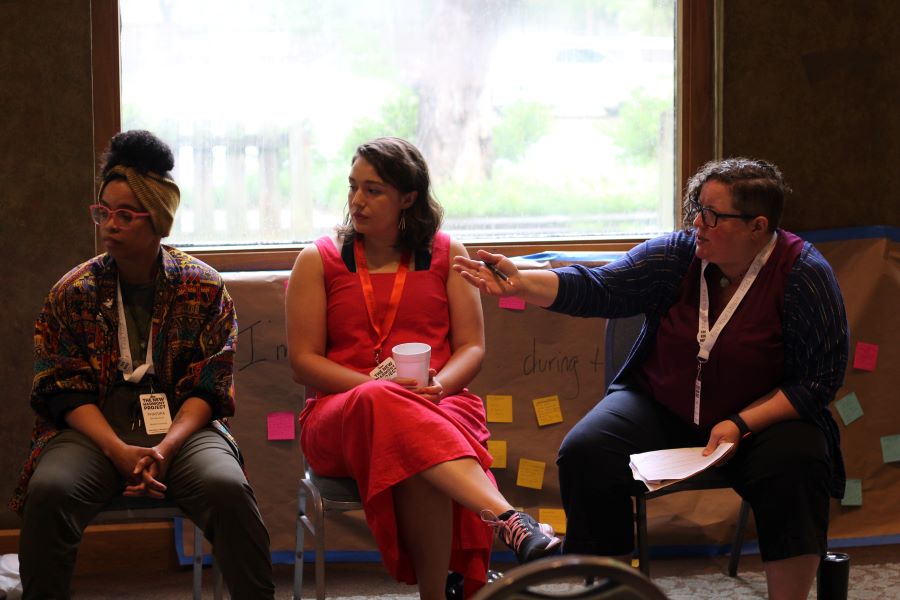
The seeds for the idea were planted two years ago when American Lives worked with Thurber as part of New Harmony Project’s inaugural PlayFest, also based in Indianapolis. Saunders recalled seeing Thurber’s name as an option and being excited to work with her on a developmental reading after seeing her work in New York, where Thurber is based. After a week getting to know each other, the day of the reading came and Thurber told Saunders that, while the play they were working on at the time didn’t seem like quite the right fit for American Lives, she loved what the company was doing and was intrigued by the idea of working together more.
Thurber originally grew up in rural Western Massachusetts with a common idea —that you must leave the rural place and go find a metropolitan area where folks are “serious” about the art. During her time in Indianapolis, Thurber said she was impressed by city efforts to support new work and build a theatrical infrastructure for professionals: folks like Saunders, who moved back to Indianapolis after living in Chicago, and American Lives literary director Andrew Kramer, whose plays have been produced in Chicago, New York, and Washington, D.C., but who still chooses to call Indianapolis home.
“The fact that they had gone and come back and wanted to create a thriving theatrical new-works community where people could choose to stay was really thrilling to me,” Thurber said. She added that these efforts provide at least one counter to the ingrained feeling that, because of “the financial stranglehold” the industry is currently facing, “there’s ‘acceptable’ places that new-work voices come out of.”
Thurber added that she admires the bravery it takes, especially at a time when funding to create art seems to be at its tightest, to choose “to come back to a place that is complicated, like all of America, where you’re in rural America in two seconds, and say, ‘I choose here. This is my community and I want to make theatre for these people.’”
So Thurber and Saunders agreed on an idea: a play written for the company, with local artists, and grounded in local stories. Thurber called the process a cousin to Williamstown Theatre Festival’s Community Works program (which Thurber helped create), in which the creation of the work involves thoughtful conversations with the community about what is important to them.
“I know Western Mass like the cells in my skin,” Thurber said. “I don’t know Indianapolis; I don’t know Indiana. I have told Chris and everybody that Indy is literally the strangest place I’ve ever been in my life—the ‘Crossroads of America.’ If you asked me to define it, I wouldn’t—I literally have no idea how to define this place, except that it is its own strange, beautiful, original, heartbreaking, strange creature.”
Indeed, it can be tough to explain my hometown to folks, and honestly, I don’t claim to know it as well as the folks who still live there (I’m based in Chicago now). Still, it surprises, well, everyone when I mention that Indianapolis is actually the 16th most populous city in the country, with more people than San Francisco, Seattle, Denver, or Boston. Every election cycle, many observers note that the country’s 17th most populous state continues its reign as the most consistently red state of all its neighbors. But in the middle, the blue dot that is Indianapolis somehow keeps on ticking.
“It’s got a lot of great things about it,” Saunders said of the city. “It’s trying to do a lot of things. It’s got a lot of great things about it, but it is a weird city in a lot of ways.”
To develop the play, Thurber asked the actors—Ian Cruz, Matt Kraft, Morgan Morton, Lynne Perkins, Allen Sledge, and Joshua Short—to give her a loose autobiographical sketch of their lives. Then she asked them to take her somewhere in the city that meant something to them. Everyone in the project was invited along on these trips, and conversation flowed about the locations and the city in general.
“We told her all the way there, we were like, ‘Get ready, this place is weird as hell,’” Saunders said of one of their stops. “So of course we had to show her the statues.”
It’ll come as no surprise to fellow Hoosiers that that stop was Carmel, Indiana, the Indianapolis suburb where you take one step into it and the median income rises, the poverty rate plummets, and the demographics shift from just over 50 percent white to over 76 percent. Carmel also happens to be the home of realistic sculptures from J. Seward Johnson Jr. that resulted in Carmel deeming him the “Normal Rockwell of American Sculpture,” while others have included the sculptures on a list of oddly creepy statues and sculptures that dot the city. Aside from the striking sculptures, Thurber said she was struck by how thin the border can be between one thing and another in Indianapolis, where just as quickly as getting to Carmel, you can get to stretches of nothing but corn and soybean fields for miles.
Other visits included: Crown Hill Cemetery, one of the largest cemeteries in the nation, sitting at 555 acres; the Monon Trail, which stretches over 28 miles from downtown Indianapolis to the suburbs; the trendy cultural district of Broad Ripple; and Mass Ave, the city’s vibrant arts district. The show’s title itself references Meridian Street, Indianapolis’s central north-south road, which many grow up knowing because of the mansions that line it, including the official Indiana Governor’s Residence. (For the record, Indy—and I’m quoting Thurber here—“has excellent pizza. I was like, ‘Damn, this is really good pizza.’” Eat your heart out, New York and Chicago.)
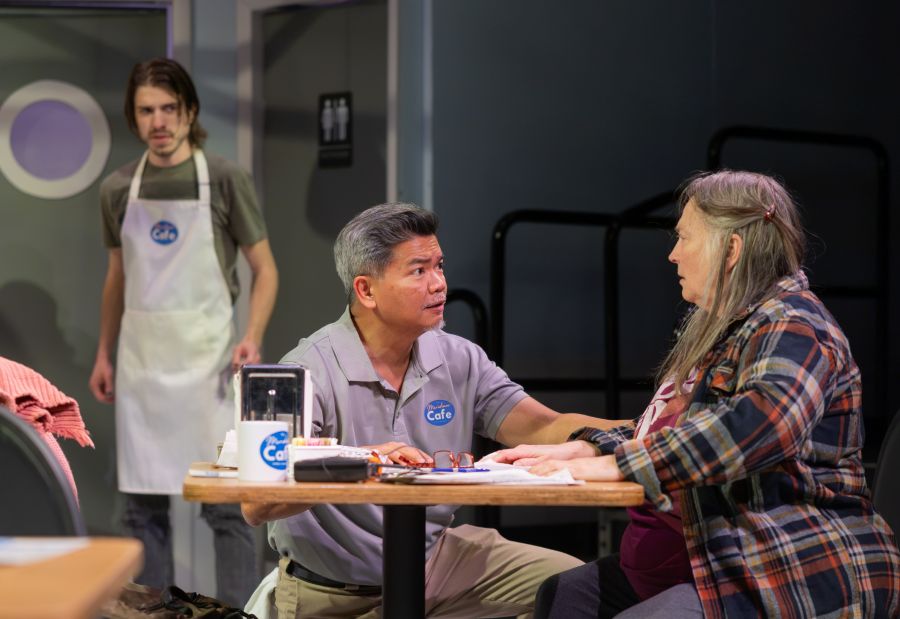
Meridian Cafe doesn’t set out to recreate these locations or the stories actors shared. Instead, Thurber said that the play came from the kernels of their lives. As they’ve marketed the show, Saunders said they’ve looked to bolster excitement around the home-grown nature of this particular production, and show local audiences that the effort goes beyond simply name-dropping locations. As reviews start coming in, it seems like the production is having the desired effect.
“It was the most moving, charming, well-acted, strongly written, beautifully designed theatre production I’ve seen in Indy in a long time,” wrote longtime Indianapolis-based arts journalist and critic Lou Harry, adding that “it’s the life and heart and ache that Thurber brings to the world that makes it special.” In another review, John Lyle Belden noted that “the setting feels like Indy’s South Meridian Street. It’s a working-class neighborhood with a small all-night diner,” and added that the play is “an excellent snapshot of Midwest life that looks kindly into its shadows.”
Saunders said that there is hope that this play could have a life outside of Indianapolis, at the very least a Midwestern tour. But that’s a future aspiration. For now, Thurber and Saunders seem to have accomplished two major goals: First, they created something that is truly grounded in the lives and artists of Indianapolis. Second, they proved that not only does a city like Indianapolis deserve good theatre, they’re actively making it.
Jerald Raymond Pierce is the managing editor of American Theatre.