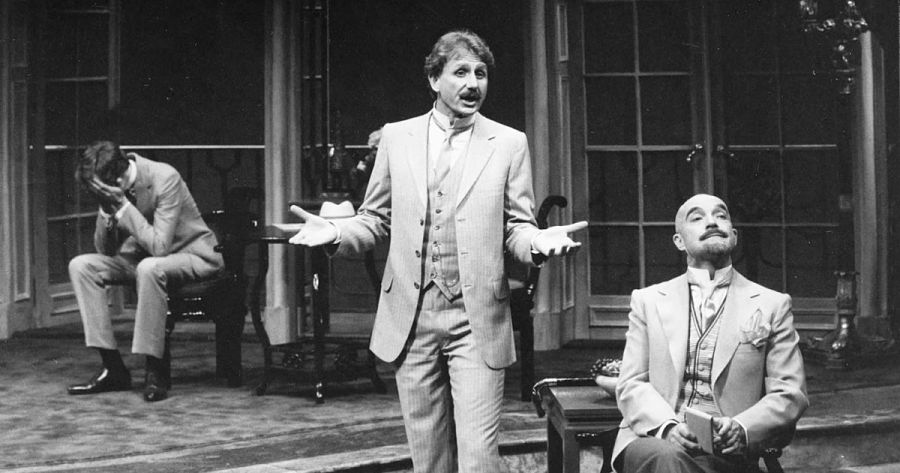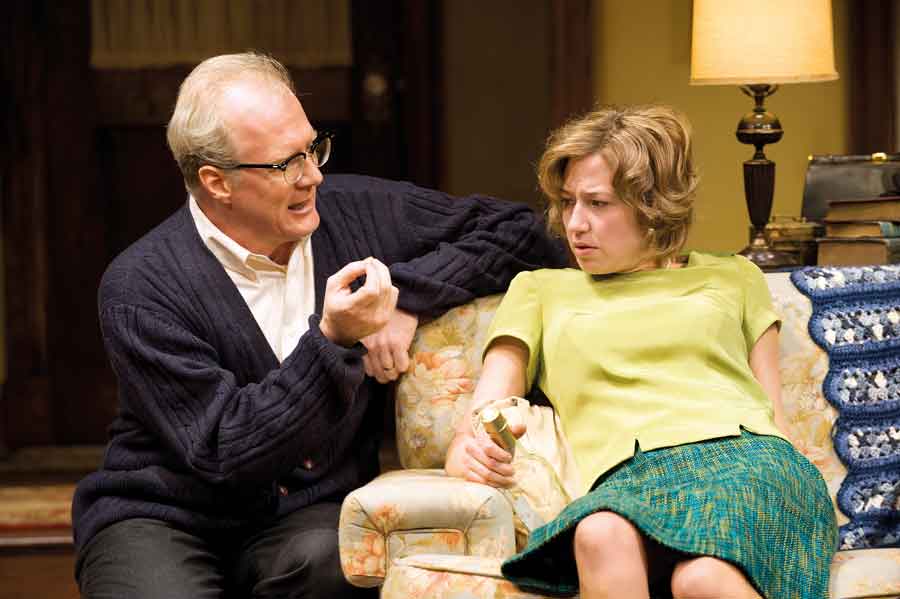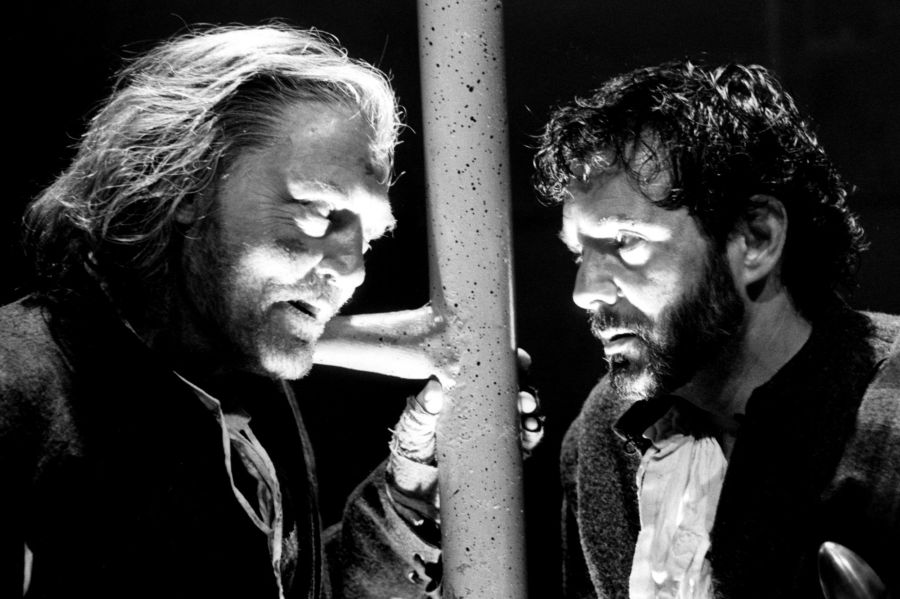
When I was a young actor in the early 1970s, there were two models of excellence. On one side stood Laurence Olivier, the greatest actor in the world, whose Richard III and Hamlet on film had brought Shakespeare back to my generation: every consonant placed, every phrase sounded, a technique you could study like a score. On the other side stood Marlon Brando and the Method: mumbling, dangerous, so physically alive that language was superfluous. We aspiring actors were torn between the two. We wanted Brando’s body and Olivier’s voice, and we were told that it was one or the other; we couldn’t have both.
Then I saw Stacy Keach.
His Hamlet at the Delacorte in 1972 led a New York Times critic to call him “the finest American classic actor since John Barrymore.” What I saw was an actor on fire. He was raw, athletic, and emotionally wide open, and he had the voice and the musicality to play Shakespeare’s verse as written. Watching him, I clearly saw what he was experiencing in his body, and when he spoke, his voice was totally aligned with his inner experience. I remember thinking, “God, I wish I could act like that!” The expression in his body and the music in his voice were one. He didn’t choose between a Brando and an Olivier approach. He had both. I was compelled to see his Hamlet five times. Yes, I wanted to be an actor, but now I wanted to be like him. It would take me years to find the phrase for what I’d seen: an actor’s actor.
In 1990, Stacy came to the Shakespeare Theatre in D.C. to play Richard III. I was cast as his brother, Clarence. I walked into the first rehearsal eager to work with my idol. What would he be like? There he was in sweats, a golf cap, and sneakers. We were dressed exactly alike. The star never came into the room. The actor’s actor did.
His mind was always working, always searching for a clearer physical gesture and musical vocal line. He brought that curiosity into the rehearsal room. He was invariably the first actor off book, often before the first rehearsal. In a Goodman Theatre documentary on the making of Robert Falls’s King Lear in 2006, in which he played the title role and I played Gloucester, he explained why: “One of the most important things, I think, about big Shakespearean roles is to know the language, know the lines, know the music, before you figure out how you’re going to play it.” Learn the notes first. Then you’re free.
And free he was. Stacy’s physical expression was bold and bigger than life. He was never embarrassed by it. He put on a crooked beak nose for Richard III (perhaps a nod to Olivier’s own), the fat suit and a bulbous nose for Falstaff, the hairpiece for Richard Nixon. Some people would now call that old school—the repertory actor changing his face for every role. Stacy loved it. He disappeared into those roles, even though the voice was unmistakably his. He could be elegant and sophisticated, and he could be crude, vulgar, and dark, sometimes in the same scene.
He was playful in rehearsals and performance. In the off moments of our Lear, he’d turn into a character we called the “Sidewinder,” who shuffled and sounded more like Gabby Hayes than a king. He made us all feel relaxed and part of the fun.
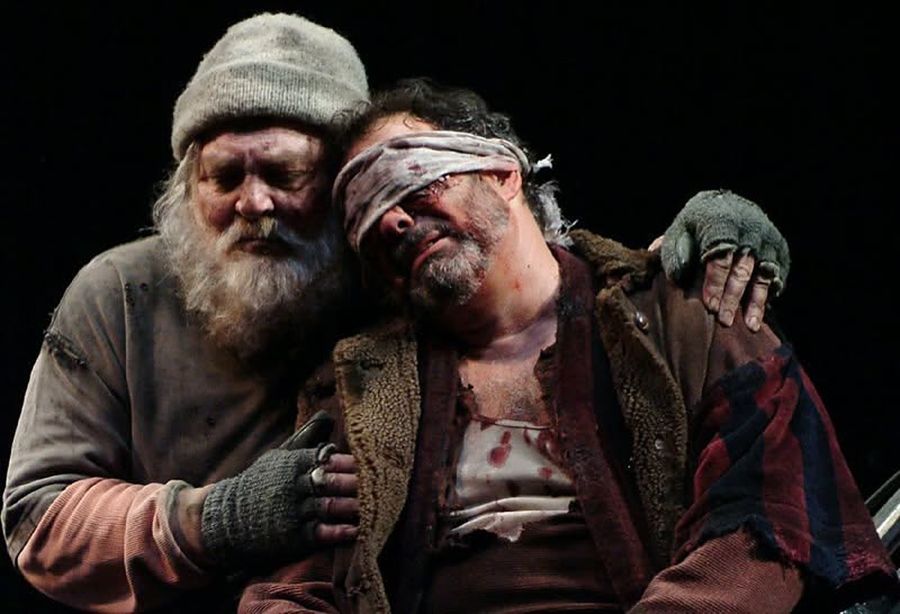
He was fearless with his body and voice. For the mad scene at Dover we shared, he took out his dental bridge and a toothless homeless man emerged. Night after night, in that bleak, wrecked landscape, I was privileged to share the stage with his physical freedom in performance. “Look, look, a mouse!” Lear cries. And silently, Stacy caught it, lifted it between two fingers as if by the tail, and lowered it into his mouth. He chewed it, swallowed it, and wiped his lips. Of course, there was nothing there. But the audience gasped. As the blinded Gloucester, I never saw that mouse—I heard the audience see it.
Later, as he held me, I heard him sing a line: “When we are born, we cry that we are come / To this great stage of fools.” If I wasn’t crying before, I certainly was then. Of that scene, Stacy said, “It’s totally liberating. It’s free…Every night I say, What am I going to do tonight?” That is the whole art: all the technique in the world in service of something that is “happening for the first time, at that moment, in that space.”
Both Hamlet and Lear were landmark productions. Seeing the first was life-altering; standing alongside him at the summit of his Shakespearean career was the greatest experience of my own.
When we first met, backstage at the Shakespeare Theatre in 1990, I told him he was largely responsible for my being in the classical theatre. He was gracious and I was a would-be protégé. Even after we became friends, a part of me remained one.
Richard Nixon changed that. I played him first, in Nixon’s Nixon, and Stacy came to see it. Afterward he said, “Hysterical, Eddie. You nailed his mannerisms and voice!” Later, when he played Nixon in Frost/Nixon, he told me he’d thought of my performance. The actor I had studied all my life had been studying me. In 2014, we were playing King Henry and Falstaff in Henry IV, Parts 1 and 2, at the Shakespeare Theatre, and were asked which of each other’s performances we most admired. We answered almost in unison: “Nixon!” After nearly 25 years of working together, he made me feel like his equal.
I was honored to join him in what became his last project: a podcast of Thomas Jefferson and John Adams in their own words. Two old friends, playing two old friends. Even as his body was betraying him, the work kept him going: reaching, exploring, creating. That was the essential Stacy Keach. He did not go gentle. Ever.
Stacy made fine films with great directors, and millions knew him as Mike Hammer. But he was a stage actor, a classical stage actor, and those roots showed in every choice he made. That is the mark of an actor’s actor: The fame is real, but it is never the measure. What other actors honor in Stacy is the work itself: his discipline, his daring, his total commitment to a role. My generation spent years seeking to bring Brando and Olivier together. We needn’t have searched at all. The answer was already onstage in Stacy Keach.
Edward Gero is a distinguished American actor with five-decade career as a cornerstone of the Washington, D.C., theatre community. A six-time Helen Hayes Award winner and recipient of the 2015 Lunt-Fontanne Fellowship, he originated the role of Justice Antonin Scalia in The Originalist, and is currently developing an international retreat for artists in southern Italy.