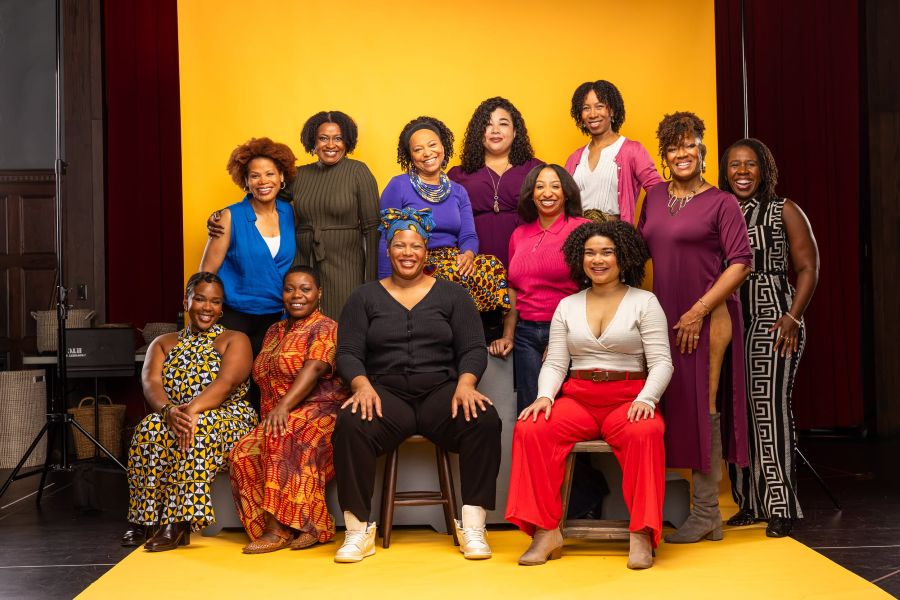
Upstairs at the Huntington Theatre in Boston on a warm October day, the Maso Studio throbbed with the din of conversation. Community members and theatremakers laughed, embraced, and conversed about the power of theatre. The gathering, where folks got a chance to hear from the cast, crew, director, and playwright of the new show Adia and Clora Snatch Joy, served as both a rehearsal and behind-the-scenes look at the show’s theatrical world-building.
It made an appropriately community-oriented cap to the two-year, city-wide Ufot Family Cycle, in which nine plays by Mfoniso Udofia have been staged by various theatre companies. Udofia’s cycle chronicles the matriarchal line of a Nigerian American family over three generations, tackling themes of identity, immigration, love, trauma, and loss. It also shows the profound evolution of the cycle’s matriarch. This event, with renderings of the set, sketches of costumes, and remarks from the creative team, feels a bit like a wistful reunion, where the crowd must bid farewell to the cycle, something they hold dearly—the impact of which is still evolving.
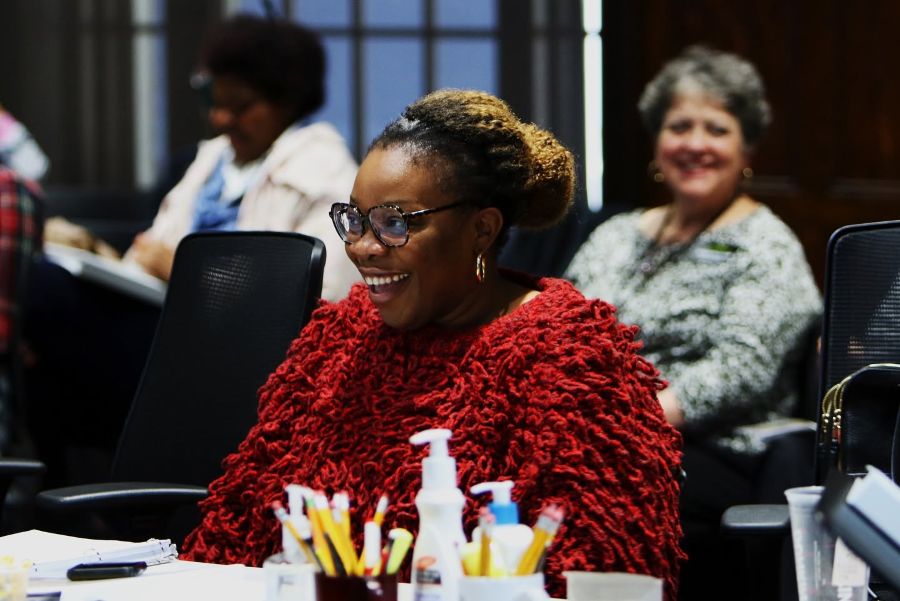
What the ending of the cycle actually feels like for Udofia, she admitted in a recent interview, is difficult to describe. “There are no words for what this is, and I don’t have any living playwright to talk to who’s been where I’ve been,” she said.
Udofia has been writing the Ufot Family Cycle for 17 years, inspired in part by a meeting she once had with the late August Wilson, who penned the American Century Cycle depicting the lives of Black Americans over 100 years. The Huntington has been leading the charge on this Boston-wide celebration over the last two years, producing Udofia’s cycle in partnership with 40 organizations. The plays in totality show the metamorphosis of the family matriarch Abasiama Ufot (previously Ekpeyong), who starts off as the “paragon of Nigerian femininity,” as Udofia put it, but who later learns to listen to herself, claims authority over parenting, lineage, her scientific achievements, and resistance to harmful ways of being.
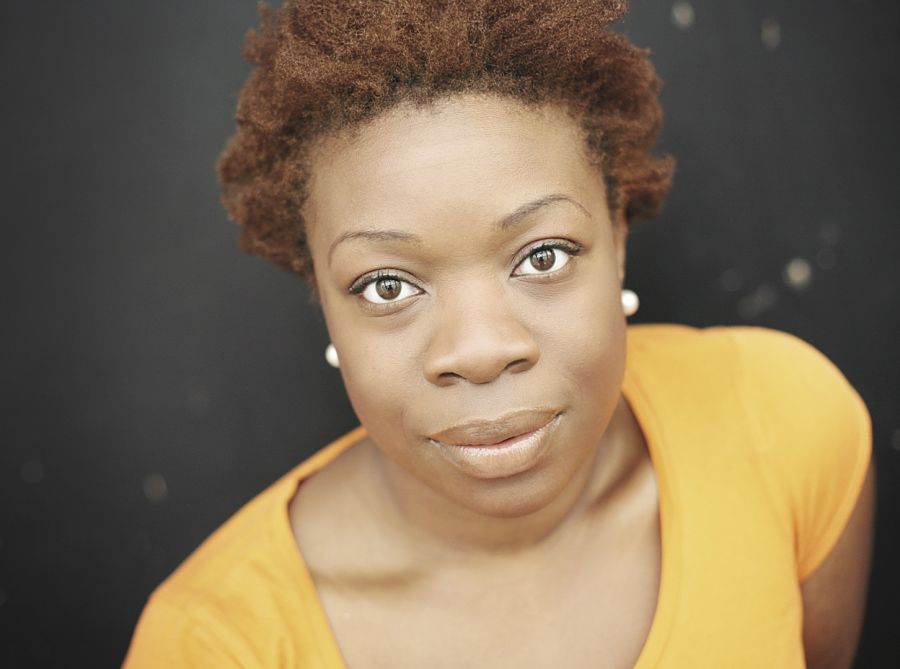
“This is a character that holds a lot,” said actor Abigail C. Onwunali, who portrayed a young and hopeful Abasiama in the first play, Sojourners, and later, Adiaha in the second play The Grove. (Onwunali recently starred in Udofia’s more autobiographical creation stories and all the important importants at Lincoln Center Theater in New York, which Udofia called the cycle’s “urtext.”)
Abasiama carries everything on her back and keeps everything together to make sure her legacy lives on, Onwunali explained. “She’s also one of the most vulnerable characters we have in the cycle. She is a person who swallows. Mfoniso uses that language all the time with Abasiama swallowing. She swallows her pain. She swallows her tears. She swallows a lot.”
The hardship Abasiama endures is something actor Patrice Jean-Baptiste took note of. Jean-Baptiste rendered the role of Abasiama in Her Portmanteau, a tough play in which Abasiama faces her first daughter’s disappointment with her.
“Abasiama was a really challenging character for me, because she carried a burden and a sadness that I’m not sure I fully enveloped as an actor,” Jean-Baptiste admitted. “I did my best with her, but her pain was so deep. I think sometimes I felt it and achieved it, but I think it was deeper than I could actually touch.”
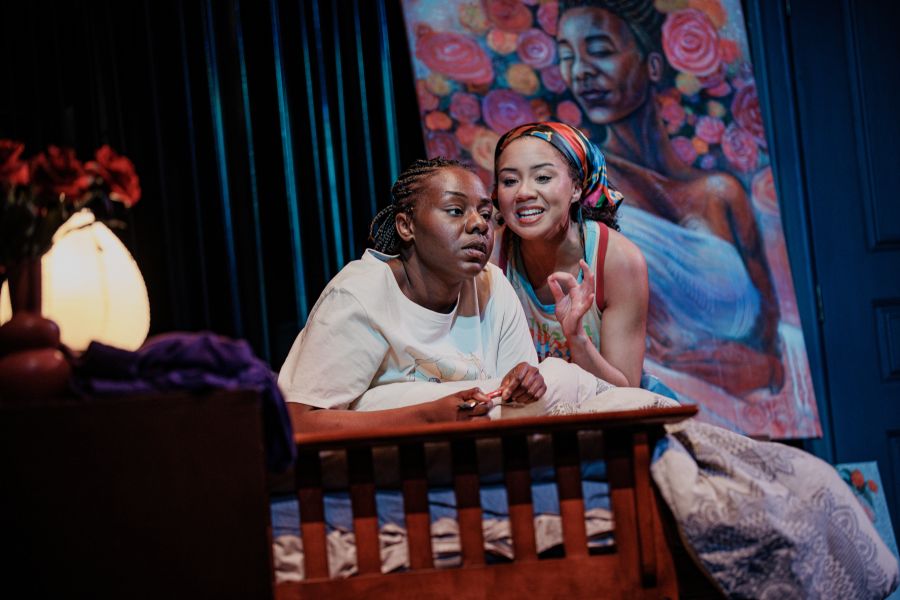
The cycle begins in the 1970s and ends in 2037. Throughout the narratives, audiences meet Abasiama, who initially dreams of returning to Nigeria after school, her first and second husbands, her children and grandchildren. Along the way, she loses a key friendship, has major career breakthroughs, and makes some choices that hurt her and her children, but ultimately she finds her way. Ancestors also play a key role in some of the plays, and the Ibibio language (also the characters’ ethnicity) is spoken throughout.
The rest of the plays—The Grove, runboyrun, Her Portmanteau, Kufre and Quay, The Ceremony, Lifted, and In Old Age—follow the lives of Abasiama and Disciple and their children Adiaha, Toyoima, and Ekong. Abasiama’s eldest child, Iniabasi (whom she had with her first husband, Ukpong Ekpeyong), shows up in the fourth play for a sort of reckoning. Throughout, Abasiama and Disciple’s relationship, and the rearing of their children, are complicated by Disciple’s trauma from the Biafran War, as outlined in runboyrun.
In Adia and Clora Snatch Joy, which is directed by Awoye Timpo (who also directed The Grove), Adiaha Ufot travels to South Carolina and knocks on the door of Clora Abernathy, the daughter of Azell Abernathy, a carpenter whom showgoers encountered in In Old Age. Adia and Clora don’t hit it off right away, but ultimately fall in love. In the play, the two women are urged by their ancestors or spirit women to come together.
The new play’s strongest link is to The Grove, which centers on Adiaha embracing her queer identity, and in which actors embody ancestors who influence their descendants while moving through wire frames behind the walls of the family home. In the new play, Mfoniso explained over Zoom before rehearsal, “When Adiaha is arriving at Clora’s house, she’s being pushed by the spirit of Abasiama.”
There is one new element in Adia and Clora: The spirit women ancestors in the play are an actual singing chorus, as the show is a kind of folk opera. As music director Brendon Shapiro put it, the score by composer Michael Ellis Ingram features “pop, jazz, gospel, classical music, folk music. Even more impressively, it’s all a cappella.”
And so the rich histories of Adiaha and Clora’s families—Ibibio wood whittlers and Gullah Geechee basket weavers, respectively—combine through music. Udofia pointed out that wood whittlers are typically male, but that a lot of her work is “taking what is male and making sure that the women’s bodies hold that, because I just have very little belief that a woman’s body never did.”
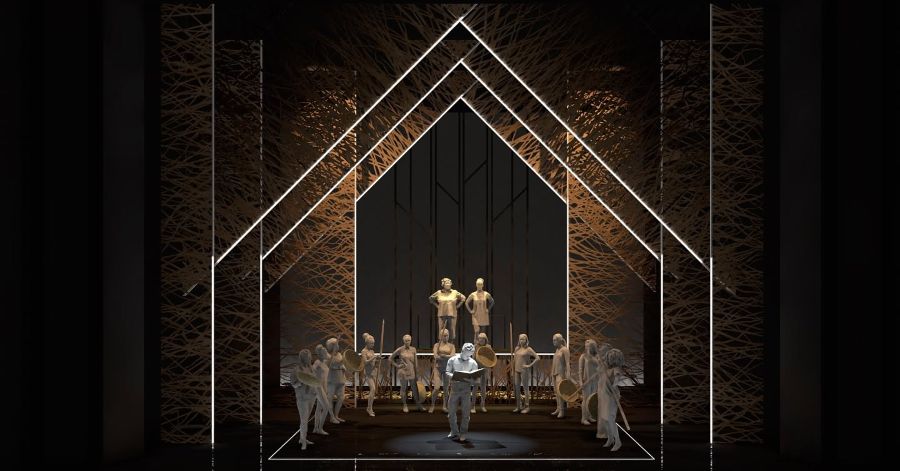
As heard in the rehearsal, the two groups of women sing operatically, communicating with their living relatives. To center the chorus, lighting designer Reza Behjat aims to illuminate them by starting with “a simple pool of light that actually acts as a catalyst that opens the book, summons the past, and expands the stage into a luminous ancestral sanctuary.”
The ancestors, having witnessed much, know the love that’s in store if Adiaha and Clora let down their guards. Udofia is excited for audiences to do the same.
“I’m incredibly proud to see this congregation of Black bodies assemble to tell a love story and an imagining of what love could be, and a reconciliation into wholeness,” Udofia said.
Love and reconciliation are key themes in the Ufot Cycle, starting with Sojourners, in which Abasiama loses one major relationship but gains another that changes the trajectory of her life. Those themes recur in the cycle’s final play in a gratifying way, said Huntington artistic director Loretta Greco.
“It feels like coming to roost with Adia and Clora, like the greatest lesson on how to love and how to be loved,” Greco said. “I don’t know about you, but loving comes very easily. Being loved is much more complicated.”
It seems that Udofia is etching her own legacy with the Ufot Cycle (she has also written for such streaming shows as Pachinko). When the Boston-wide cycle began, some of the plays weren’t finished, and Udofia worked diligently to complete them while constantly traveling back and forth from New York City to Boston. Now that the end is near, it’s bittersweet, she said. Still, she said, she’s “so honored and proud of a city that said yes to something at this scale.”
Indeed, putting a cycle like this in the world as a Black woman playwright is a real feat. Her work—which can now be compared with Wilson’s, though it stands on its own—offers a lighted pathway for playwrights to create their own cycles. There are other impacts too: The cast and crew talk of bonding over learning Ibibio, embodying otherworldly ancestors, and the joy of working on a culturally specific story. For her part, Greco talked about watching theatregoers show up repeatedly throughout the cycle.
The cycle’s legacy may also be in the new work it inspires, as Wilson’s once did. Onuwali, who is also a playwright, said that Udofia’s work “has made me so fearless as a writer. I’ve realized through her writing that I can write anything I want. So I’m going to write epics.”
Jacquinn Sinclair is a journalist, theatre critic, poet, and author whose work lives at the intersection of art and activism.