It’s been over a year since the National Guard was deployed into Washington, D.C., on Aug. 11, 2025. Directly inspired by Mixed Blood Theatre’s “ICE Monologues” (which we published selections from) last winter, Mosaic Theater Company commissioned four artists to respond to the moment with how they’ve felt living and working as artists in the nation’s capital under these conditions. Actor Ty’Ree Hope Davis, actor Raghad Makhlouf, sound designer and composer navi, and director and educator Elena Velasco took up the task.
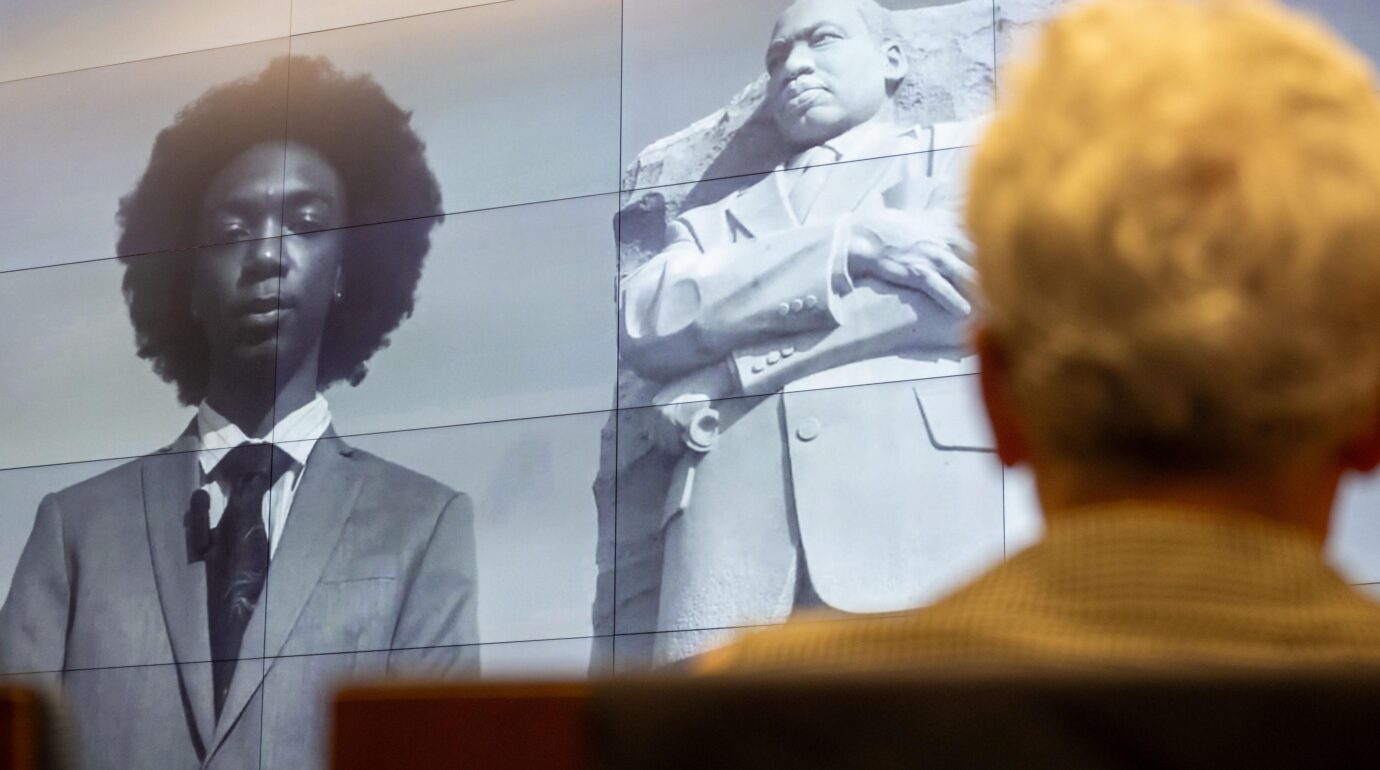
At a season preview event on Sept. 1 at Georgetown University’s McCourt School of Public Policy, a select crowd witnessed these works for the first time, followed by a panel discussion with Georgetown’s Laboratory for Global Performance and Politics director Derek Goldman as moderator. All four artists channeled their own perspectives and lived experiences in direct response to injustices, fears, hopes, and desires they’ve experienced in the past year.
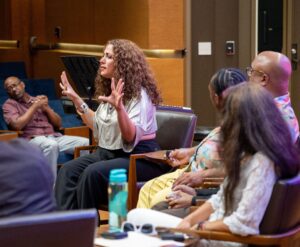
For those who want to actually say and do something about how we’re living now, projects that allow us to do so are too few and far between. Chatting with artistic director Reginald L. Douglas after the presentation, he and I agreed that no other D.C. theatre is doing this.
I couldn’t help but think of what my friend Nathan Pugh said in his recent goodbye to D.C.: “What’s frustrating to me is that many D.C. artists are clinging to neoliberal politics within this destruction…but D.C. theatre hasn’t directly confronted Trump’s second presidency. Productions are still staging history, but far fewer are tackling current politics.” This has also been my critique of the local scene. But the artists commissioned by Mosaic give me a lot of hope for true artist activism that tackles current politics. We are starting to see some of the work that can be done on this front.
Since that event, which was livestreamed by HowlRound, Mosaic has shared the videos for wide release. As a theatre artist based in D.C., I implore you to consider: If this resonates with your experience, share widely and tell your own story too. Get behind the stories that these artists have shared, then do something about it.
As we share their reflection videos, watch them bear witness to the past year of occupation, and let their words sink in and move you to action.
Daniella Ignacio, associate editor

Actor Ty’Ree Hope Davis wanted to directly tackle the impact D.C. has as the nation’s capital—and to address his personal feelings of being “stifled,” how “suffocating” it has felt to walk the streets of D.C. to get to rehearsals, support friends in their projects, and generally live under National Guard occupation. “I’ve seen less theatre because of the fear of stepping outside,” Davis said. “It doesn’t feel as welcoming or as warm anymore.”
His piece takes you through histories and visions of D.C., from its foundations built by slaves, to go-go music, to the pavement that has been invaded today.
Ty’Ree Hope Davis’s Response: I Am Human
One apple dropped from a tree,
and now everyone knows the meaning of gravity.
Yet thousands of bodies fall on our streets,
and this great nation knows not the meaning of humanity.
We mustn’t just question the rotten apple for clarity,
but the tree from which produces these tragedies—
a tree whose roots were planted on the buried tribes of the indigenous people,
watered by the years of blood and tears of enslaved Africans,
pruned by the immigrants who operate this treasured land
in exchange for calloused hands,
the people whose souls and stories are etched within the bark of that tree
are seen swinging from its branches,
cries distinguished as wind chimes,
and in time made melodic music that you hummed to.
And yet, in the core of that tree, D.C. residents have crafted a culture within it.
Chocolate City sweetens its sap into mumbo sauce and serenades the streets into go-go beats. We built a home. But home is where we raise our loved ones, not where we bury our babies. This town is not a hunting ground, an open-air prison, a war zone where the pasts are plaguey, and yet our pavement has been invaded.
For a year, we wander our now capital battlefield. Tear gas steal the life from our eyes, and we are left suffocating, holding our breath in anticipation. ICE agents patrol with hunger and temptation, itching to embrace a trigger, a bubbling anger being released with no filter. The pack of wolves smolder, stalking its prey. Their boots beat against our backs while we await the recall of these residential soldiers.
We pray, but we do not pray in idle stillness, and we do not wait in hopelessness when boots march, invading our neighborhoods, when guns draw, intimidating our voices, when masks haunt, portraying our nightmares, and when laws pass restricting freedoms and choices.
We the artists, the first generation students, the engineers of a new society, we the teachers, the librarians, the service workers. We the pallbearers, the orphans, the widows. We the survivors of encampments, the ancestors of the enslaved who constructed the White House, the 200,000 plus who marched, for there is no king who resides in our nation. We, the soil, the seed, and the thread of a variety of fabric, will weave together time and time again to remind you whose home it really is.
To speak a truth, you think it’s hard to admit. We are not cattle, or sports, or aliens. We are more alike than we are different, because we are human.
Actor Raghad Makhlouf, who also serves as the Lab’s Art of Care associate director, was born and raised in Syria, lived for some time in Lebanon, and has now resided in the U.S. for nine years. For all those years, she’s held the fear of deportation, and remembers the fear of living in a war-torn country.
“Fear is home, it’s just part of my psyche,” Makhlouf said. “I’ve never imagined feeling like this in the U.S.” When the National Guard was deployed, she recalled thinking, “Here I am feeling like home again.” She also wanted to dismantle the idea that “immigration is a choice,” because if your livelihood is being threatened, “What’s the other choice?”
Raghad Makhlouf’s Response: A Reading of ‘Home’ by Warsan Shire
No one leaves home unless home is the mouth of a shark. You only run for the border when you see the whole city running as well. Your neighbors running faster than you, breath bloody in their throats, and the boy you went to school with, who kissed you dizzy behind the old tin factory, is holding a gun bigger than his body.
You only leave home when home won’t let you stay. No one leaves home unless home chases you, fire under feet, hot blood in your belly. It’s not something you ever thought of doing until the blade burnt threats into your neck. And even then, you carried the anthem under your breath, only tearing up your passport in the, in the airport toilets, sobbing as each mouthful of paper made it clear that you wouldn’t be coming back.
You have to understand that no one puts their children in a boat unless the water is safer than the land, no one burns their palms under trains beneath carriages. No one spends days and nights in the stomach of a truck feeding on newspaper. Unless the miles traveled mean something more than the journey.
No one crawls under fences. No one wants to be beaten, pitied. No one chooses refugee camps, or strip searches where your body is left aching, or prison, because prison is safer than a city of fire, and one prison guard in the night is better than a truckload of men who look like your father.
No one could take it. No one could stomach it. No one’s skin would be tough enough.
They go home refugees, dirty immigrants, asylum seekers, sucking our country dry, messed up their country, and now they want to mess ours up. How do the words, the dirty looks, roll off your backs? Maybe, maybe because the blow is softer than a limb torn off, or the words are more tender than 14 men between your legs, or the insults are easier to swallow than rubble, than bone, than your child body in pieces.
I want to go home, but home is the mouth of a shark. Home is the barrel of a gun, and no one would leave home unless home chased you to the shore, unless home told you to quicken your legs, leave your clothes behind, crawl through the desert, wade through the oceans, drown, save the hunger, beg, forget pride. Your survival is more important. No one leaves home until home is a sweaty voice in your ear saying, “Leave, run away from me now. I don’t know what I’ve become, but I know that anywhere, anywhere, is safer than here.”
navi, a vocal advocate for change in D.C. theatre, shared the sentiment that he was “struck by how everyone’s video said, ‘This is not the first time this has happened. This is not some new phenomenon.’ But it’s what we bring to this moment that makes a difference.”
In his piece, he calls out essentially every major institution in town (including American Theatre) for not doing enough. “I’m on the offense, not the defense,” he said. “I’m here to switch you to the offense.”
During the panel, navi asked folks to raise their hands if they’ve been to a Kennedy Center protest. I raised mine. In that room, though, there were not enough people who did the same. “It’s not abstract, it’s a literal point of war,” he said. “Get on the ground with people organizing.”
navi’s Response
Puppet show, it’s a puppet show.
Look at them go!
This goes out to you, and you, and you,
and you and you and you and you and you and you,
and you and you and you and you and you, and you, and
especially you.
See the theatrical troops facing downstage.
They got scripts, they got props and they’re well paid.
That’s the contract, the main distraction.
But backstage black shirts jumping into action.
The crew move in silence, and no one noticed till it go wrong.
But the show must go on.
There are seats to fill (or flights out)
Wild crowds at nights out.
The donors all get ICE’d out
and ready for a night out.
It’s a city where things don’t change.
Watching variations on the same old plays
in an ecosystem that remains unfazed
in the face of critique, ’cause controversy pays.
All you need to push is good narrative,
selling woke, selling crime, selling good adjectives.
Put the brown face on the cover of the poster.
Politics and theatre never been closer.
They don’t really care who gets burned out or broken,
long as it flies with the folks buying tokens.
They’ll abuse every opening to market and promote the thing,
and only value how it pan out when the vote’s in.
A big win for the mannequins at home
when there’s strings on everything to keep the play going.
No one’s gonna cut ties, money must flow.
This D.C. theatre, it’s a puppet show.
Look at them go!
Puppet show, it’s a puppet show.
Look at them go!
Puppet show, it’s a…
Director Elena Velasco was interested in the ways that artists engage with this moment. As an educator at Bowie State University, she trains her students to be artist-activists. “Catharsis is dangerous,” Velasco said. “Watching theatre is not enough. You have to take the sermon out of the theatre.”
Her piece is an ode to her family, spoken in both English and Spanish, about the joyful defiance they’ve instilled in her. “No matter what, there is love, resilience, and food,” she said. “We can’t let them steal our memory of love.”
She also acknowledged: “We have to be angry. We have to turn that anger into something they don’t have.”
Elena Velasco’s Response
Skin. Piel. To peel in English is to pull away layers. I pull and peel mi piel and reveal what’s underneath.
What are you? You Black? You don’t look Black. You don’t look white. Your papi, he ain’t white. What are you?
I pull and peel mi piel and reveal palabras, sonidos, respires, avisos. No, just speak their language and they won’t ask. They don’t want to play, that’s okay. Better this way. Better to be alone. Safer to be alone. You have to know how to do this alone.
I pull and peel mi piel and reveal: un tío, una tía, primo, y prima. Papa, you weren’t alone. Oldest of eight, mami’s right hand, no childhood, just a man. Tú vez hermanos y hermanas, pero ahora, ¿donde están?
Pulling and peeling, birthing and earthing, cuerpos y juezos, capas y capas, layers of earth, tears that you shed. Say goodbye to your sister, kiss her head. Palabras sonidos, unmark our farewells and are dead.
You left that earth, those words, the sounds of a crumbling place that left you bound to no other fate but the one here now.
A brown man in a white world. Brown man better not speak. Brown man better not drive. Brown man better not strive to take his child to school and mix with the others who ain’t their kind.
What are you? You Black? Don’t look Black. Don’t look white. Your papi, he ain’t white. What are you? Soy la piel de mi tío, el alman de mi tía, abrazo de mi primo, beso de mi abuelita. Soy muchos apriles, tantos verranos, y sere las sangre de mis nietas, fuerza de mis nietos, de este mundo, de nuestra tierra.
¿Quien soy? I am my father’s skin.
Support American Theatre: a just and thriving theatre ecology begins with information for all. Please join us in this mission by joining TCG, which entitles you to copies of our quarterly print magazine and helps support a long legacy of quality nonprofit arts journalism.