During NextStop Theatre Company’s production of Once last spring, a special spirit reignited the D.C. theatre scene: the heightened energy of actor-musicians. This fall and winter, there are so many shows requiring this double skill that folks are calling it a “season of the actor-musician” (or “actor-muso,” in theatre parlance). By my count, from summer 2026 to spring 2027, there have been or will be 24 actor-musician shows, and/or shows that have required actors to play instruments onstage, at some point in D.C., Maryland, and Virginia.
I may be especially attuned to this trend, as an actor-muso myself (I’m currently performing in Glass Canon Theatre Company’s D.C. premiere of Kate Douglas and Shayfer James’s The Ninth Hour). Still, I wanted to know: Why has right now become a moment for D.C.’s actor-musos? What kinds of actor-muso experiences are most worth it? And how can this moment be sustained?
Why Now?
My working thesis: It’s special for audiences to see artists pull off something hard, embrace multiple passions, and tell a story with the energy a band brings. In an industry where Broadway pits often play to click tracks (I won’t waste space here on the Ableton-ification of Broadway), playing and witnessing this craft in both black boxes and larger houses reminds us what music feels like up close, as real as can be, communally, with space for adjustment, especially when it’s acoustic. It may also be an economic decision, admittedly—but it’s undeniably cool, and theatrical, to see where the music comes from.
Music director Paige Rammelkamp, who makes her Round House Theatre debut with Cult of Love and music-directed NextStop’s Once, said she thinks this trend is “in direct response to the rise of AI; people are really connecting with seeing music happen live. There is something magical about the kind of ensemble that you create with an actor-muso show, and that ‘one plus one equals three’ synergy.” A good actor-muso show is about more than just putting a band onstage, she added. By itself “a band onstage doesn’t make that happen.”
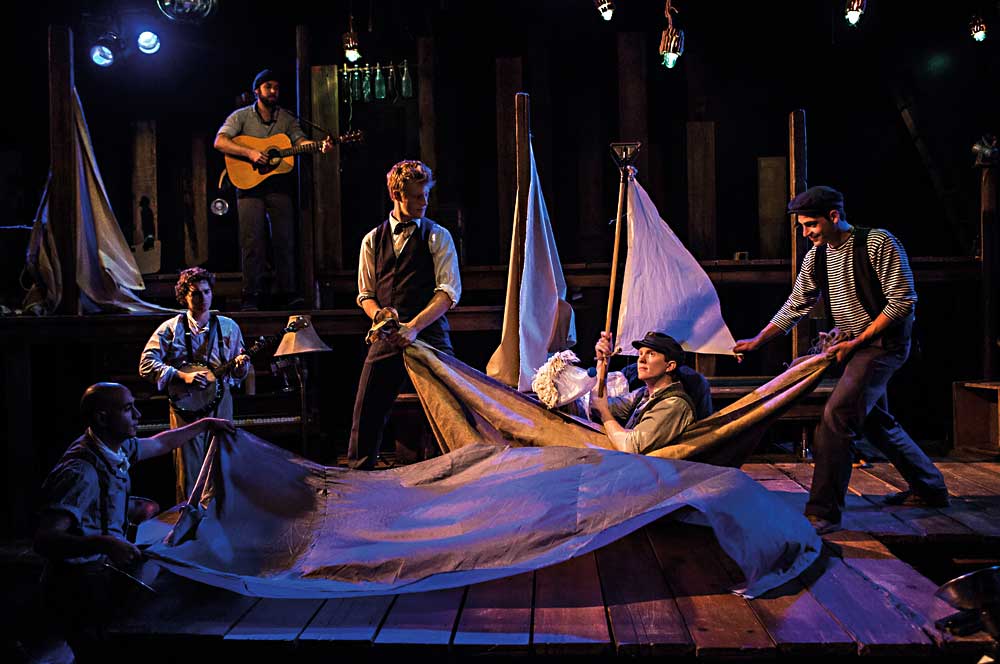
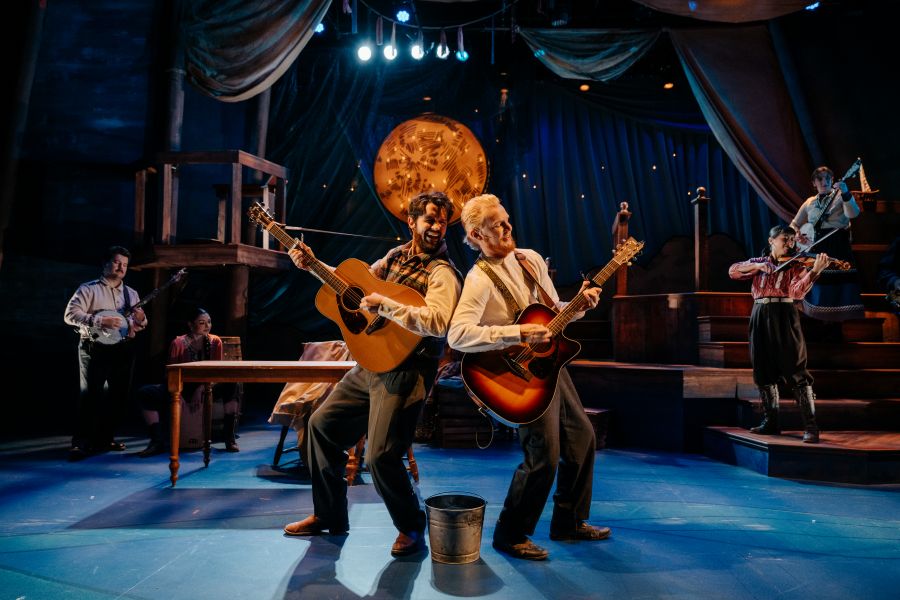
Sam C. Jones, who can count on one hand the amount of shows he has done without guitar over the years, plays the Old Man in Constellation Theatre Company’s The Old Man and the Old Moon (and will music-direct Million Dollar Quartet at Olney Theatre Center next summer, his 15th go at that show). He believes the craft “goes back to the origins of what theatre was intended to be,” Jones said. “You are watching people who are masters of their craft, jacks-of-all-trades, tell a full story while doing multidisciplinary talents.”
Sally Imbriano, who plays Mabelu and accordion in Old Man and was Reza in NextStop’s Once, loves what actor-musos can do in black boxes. “It reminds the audience: Yes, we are human; yes, we are making these sounds with our bodies,” Imbriano said. She said she’s mesmerized watching castmate Faith Wang play violin, especially “the intonation, how music speaks through her body.”
For her part, Wang has done three shows in a row as an actor-violinist—Once, Theater Alliance’s Woody Guthrie’s American Song, and Old Man—and most enjoys “when I get to do it with other people,” Wang said. “Growing up, it was one or the other: You’re learning to play solo, or you’re playing in a full orchestra. To enjoy something in between, where my playing gets to have its own moment and meaning, while blending in to create something bigger, telling a distinct story, where there are opportunities to put my own spin on something written or bring improv elements into it, has been special.”
Artistic leaders are programming actor-muso shows knowing the talent is here. Old Man and the Old Moon, originated by PigPen Theatre Company, opens Constellation’s 20th anniversary season. It’s a “perfect Constellation show,” artistic director Allison Stockman said. “It combines so many interdisciplinary art forms. Having performers who are both actors and musicians lifts the story out of the everyday into the realm of the magical and the mythical.”
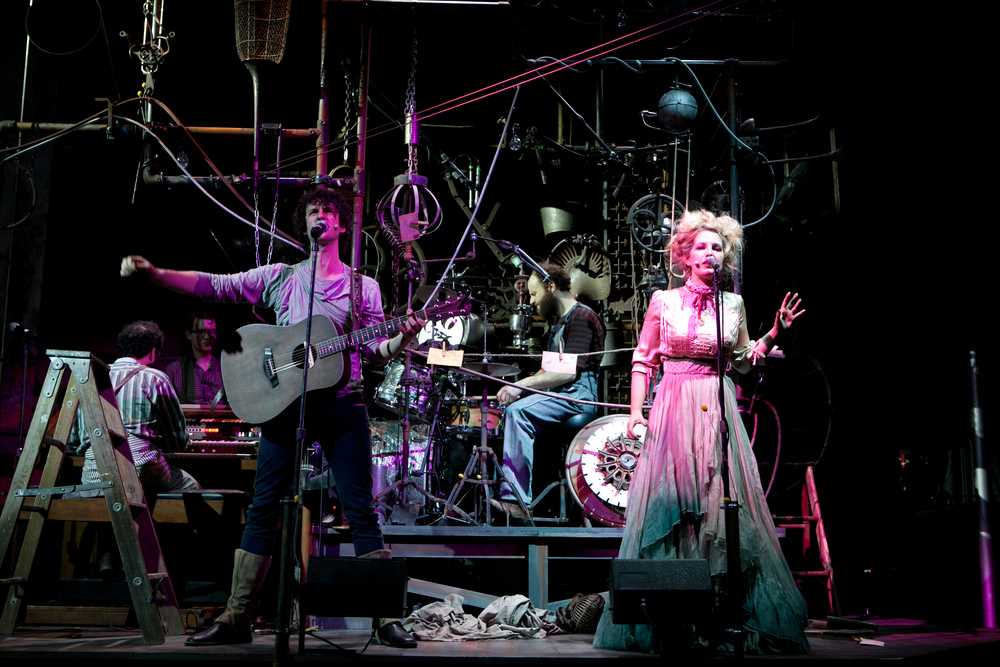
Keegan artistic director Susan Rhea discovered Hundred Days by the Bengsons and Sarah Gancher during its Off-Broadway run in 2017 and has wanted to produce it ever since. “The vulnerability of the story, and the blurred line between band and cast, makes the piece feel immediate and personal,” Rhea said.
Meanwhile, protest spirit channeled two Woody Guthrie-inspired shows (Woody Guthrie’s American Song, and Woody Sez at Voices Festival Productions), as part of #Woody-G-in-DC, a three-month celebration of the man Voices Festival Productions artistic director Ari Roth called “our greatest protest singer and anti-fascist communitarian…a cultural hero struck by personal calamity, driven to inspire humanitarianism.” (Woody Sez originally premiered at Theater J over a decade ago.)
Center Stage or Backup Band?
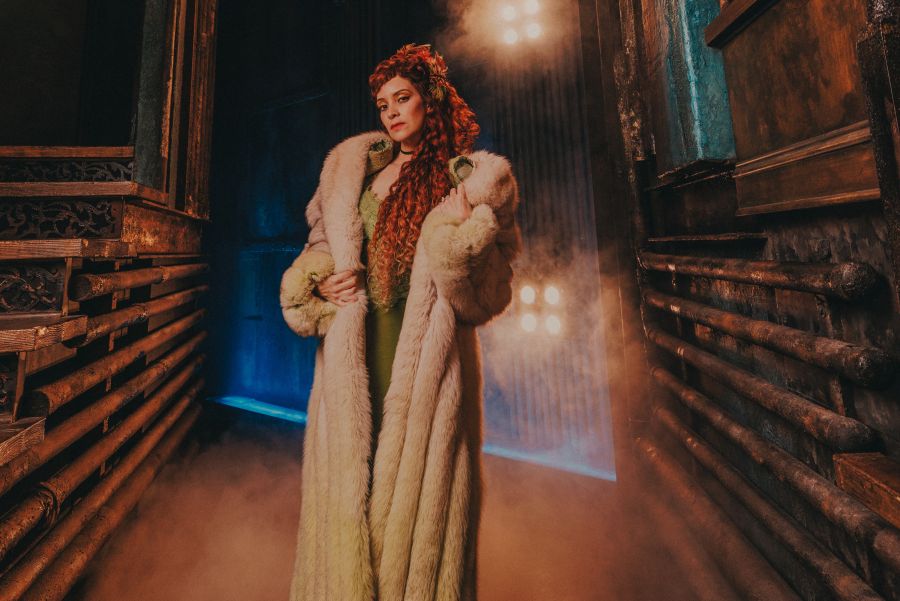
It’s important to note that not all actor-muso shows are Once or Million Dollar Quartet. In some, music is diegetic and the characters onstage are consciously experiencing the music. Others are true musicals where the songs advance the story. And a variety of straight plays have actor-muso needs, like Cult of Love. In analyzing this work (and in my own craft), I’m inclined to advocate for the equal value of music and acting to make both integral to the storytelling.
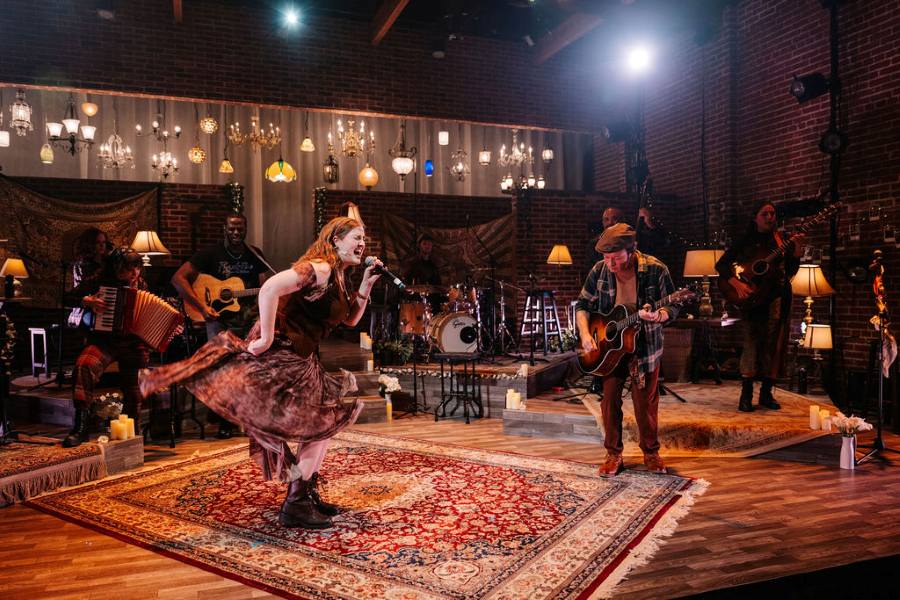
This distinction first occurred to me after Hundred Days at Keegan. This love story between Abigail and Shawn Bengson, featuring their music and a book by Sarah Gancher, is not a typical bio-musical—more of a concert with monologues and folk-punk music in the spirit of processing life, all going in and out of Abigail’s nightmare prophecy of how her relationship would end.
It was also not a traditional actor-muso show where all the musicians also play characters. Keegan employed both young actor-musicians and pro pit musicians, who were onstage the whole time but didn’t always have much to do. Moments of true actor-musicianship, like Lydia Gifford’s thrilling vocals and accordion playing, and Lucille Rieke shredding it on hard fingerpicking parts with cool ease (in fact, some of Shaun Bengson’s parts), were compelling, though both were band members whose characters didn’t get many other chances to shine.
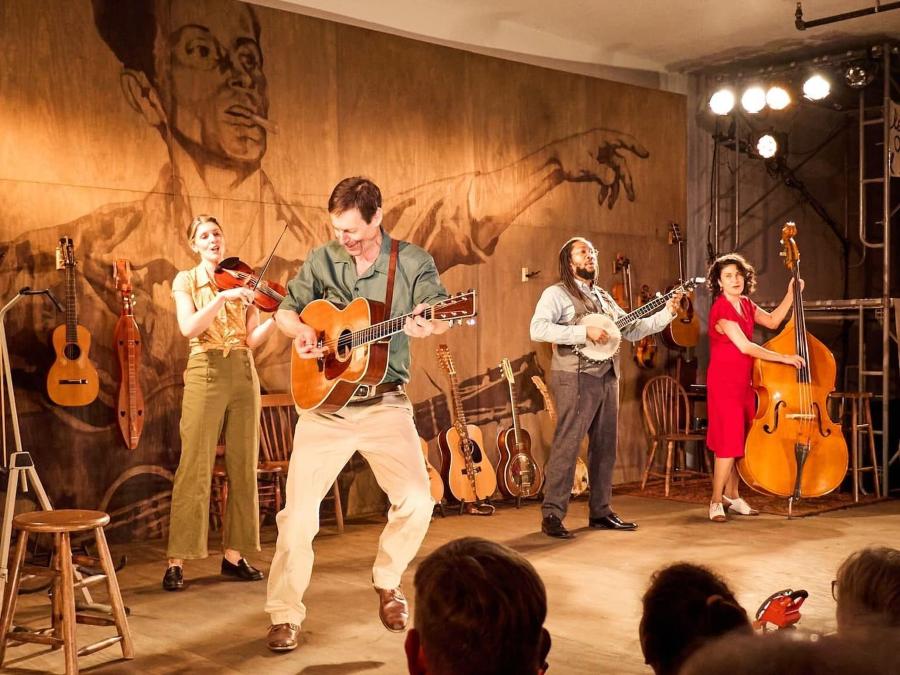
By contrast, Woody Sez at Voices Festival Productions was a clear bio-musical, with David M. Lutken as Woody Guthrie at the center. He told Guthrie’s story with seamless transitions between confessional storytelling and songs on guitar. At one point, he held down chords for Hubby Jenkins’s banjo with one hand and played guitar with the other. Lutken’s mad skill and intimately emotional acting proved how an actor-muso show can be uniquely moving.
At closing, ahead of the elections earlier this month, the company performed a rousing encore of “All You Fascists Bound to Lose.” Lutken prefaced it by explaining that he wanted the show to be an act of resistance. (He also helped lead “community resistance singing events,” singing Guthrie songs on the White House lawn for two days during performances.)
Three actor-musicians in Woody Sez had tracks that demanded they switch characters and instruments frequently: Raquel Chavez (upright bass, acoustic bass guitar, autoharp), Margaret Dudasik (mandolin, violin, dulcimer, and flute), and Hubby Jenkins (banjo, guitar, violin, dulcimer, harmonica, and percussion). It made for a dynamic experience of surprise at what they would do next, and made every one of them important to the story. And in post-show “Bring Your Own Instrument” hootenannies that filled Dupont Underground with jovial community and improvisation, the cast joined the ragtag band who showed up (including myself) for a jam session led by Lutken. As the show’s audience gathered to sing along, I thought: It takes shared trust and uninhibited release to be part of a whole. And how fun to receive the energy of a show, then immediately channel it and be part of it.
It can also be a marvel to sit and bask in the magic of true virtuosos. In Theater J’s Flying Lovers of Viterbsk—which ran in October and told the love story of Jewish abstract painter Marc Chagall and his actor-writer wife, Bella, as they escape their home during World War II—the grounded acting, awe-inspiring aerialists, and magic of the music cohered beautifully.
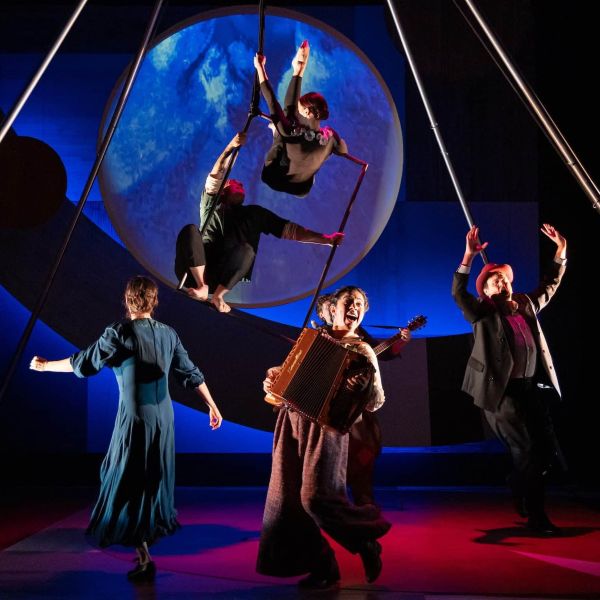
Katrina Michaels (piano, accordion, mandolin, and music director) and Jeremy Allen Crawford (cello, guitar, and percussion) were truly “leading with just music as a storytelling device,” as Michaels put it. “From the beginning, we played with instruments as Foley, finding moments of levity and comedy, and embracing that we are two musicians onstage.” Indeed, ticking clocks, dripping ceilings, letter deliveries, and more were created and accented by the musicians. A cello bow became a gun as Crawford transformed into a soldier; Michaels’s accordion helped to physicalize a crying mother, because of its sound and expanding physicality: “It felt like a Jewish mother crying.”
Crawford has done three actor-muso shows this year (also Once and Woody Guthrie’s American Song), all on cello, and won a Helen Hayes Award for an actor-muso role last year in Spooky Action Theater’s Professor Woland’s Black Magic Rock Show. (Father Lear, by the same writers, Andrea and Thomas Pemberton, plays Spooky and Avant Bard next April.) Flying Lovers felt different: The musicians were almost a reflection of the audience, shaping how to experience the show. “Usually, when I do this, I feel like a full actor-musician. In this, I almost feel more like an audience member,” Crawford said. “We start with the audience, we end with the audience, and when we’re not underscoring, I’m just kind of watching.”
Realism and Magic
For John Sygar, who appeared as Andrej in Once at Olney, there’s another way into this hybrid form: Shakespeare. This season he’s served as the lead actor-musician and music director in As You Like It and Measure for Measure at the Folger Theatre, and next up is a puppetry-focused Midsummer at Shakespeare Theatre Company that will open and close with a musical number and have interstitial 1980s pop and folk-style music. But the Bard may be a special case. “Shakespeare put songs in there, my friend—they’re in there for a reason,” Sygar said. “I think the veil between the text and music is a lot thinner than people think.”
Indeed, in stories bridging poetic magic and realism, actor-musicians can heighten these worlds. This is the case with Constellation’s Old Man and the Old Moon. Jones said he loves that it centers on a “band of misfits telling a story.” The Old Man’s journey is that he’s “forgotten where he came from, parts of his own history, and with that, he’s closed off parts of himself,” Jones said. There are moments where his memory returns, including his love of music. “That is why a guitar magically appears in his hand; when an emotion is so strong, the only thing he can do is play guitar.”
Sometimes the songs are diegetic, as when Mabelu leads the sailors in song in moments that capture “the playfulness of human nature” according to Imbriano. And sometimes the songs’ lyrics are more metaphorical. Music is also used as a soundscape. Crosby, Wang, and Leela Avilés-Dawson have collaborated on percussion, which has involved Foley work like those of Flying Lovers. Wang is trying another cool trick: using artificial harmonics and sliding them down her fingerboard, a technique usually done on a cello that makes a seagull-like sound. The effect is “fun but awful-sounding”—fitting for a storm.
Music can also become a character in an otherwise non-musical play. At Round House—which has produced proper actor-muso shows like Young Jean Lee’s We’re Gonna Die and Sarah Gancher’s I’ll Get You Back Again—Leslye Headland’s holiday family reunion play Cult of Love includes a family of music makers at all levels. When characters making music are regular folks, not capital M musicians, the craft should be “brave and simple,” Rammelkamp said. Though she’s “always talking to musicians,” for this show, she’s “talking to people playing songs. These are some of the strongest actors I’ve ever worked with, and also some of them have never sung in front of people before.”
So she arranged music for the ensemble and enlisted instrumental skills from those who qualified; she didn’t want to make anyone do anything they couldn’t. “That wouldn’t have happened in a family that was creating it for themselves,” Rammelkamp said. “They’d sing what feels good to sing.” In fact, the cast warms up by singing The Sound of Music’s “Do-Re-Mi.”
This is key to all actor-muso shows, explained Heather Lanza, who directed NextStop’s Once. “I think all good theatrical collaborations are about meeting each individual artist where they are, finding out what their strengths are, and then fostering an environment where that talent can really be featured,” Lanza said. In the case of a show like Once, she added, “The music has to be the main focus of what every other element is built around, creating an environment where your actors feel a sense of play and that they can be co-creators in the story.”
Cynics and Dreamers
As for me, playing both Grendel’s mother and the keys for Ninth Hour at Glass Canon, I go between the “band world” and the “hero story”: a clear shift of perspectives in a show about how there is both good and bad in all heroes and villains. My track is the soul, supporting melody and harmony; Gary DuBreuil as drummer is the heartbeat; Sam Slottow as the Bard and guitarist is a bridge to the audience. For a classic story originally passed on orally, we’re raconteur actor-musos. In a direction that emphasizes the toll of bearing difficult stories, doing it all is joyous and powerful.
On the flip: We know we’re doing multiple jobs, and theatres are learning what actor-musos need (in fact, some non-Equity theatres are thankfully following the Equity rule on renting instruments from actor-musos). For Jones, an Equity actor, “the cynic and the union member in me says: Pay us what we’re worth.” He pointed to Come From Away at Paper Mill last year as a show intended to have a pit that was made actor-muso (the new perennial classic was at Ford’s Theatre this fall, with an onstage band). “It’s cheaper because they don’t have to hire a pit band,” Jones said.
Understudying is another thing: Sometimes multi-instrumentalists hold it down; other times, there’s a whole roulette. In Hundred Days, Shaun’s understudy did not play guitar, so Rieke became Shaun guitar, and rhythm guitarist Daniel Ayoola was her fingerpicking cover. “There was no one movement of, somebody’s out, somebody’s in,” Rieke said. “If somebody’s out, four different people are gonna move.” For Cult of Love, Ari Post covers all the men but the father, and as many instruments as he can.
Rammelkamp noted how lucky she was to have people like Post, with many usual people already booked. In fact, the current boom of actor-muso shows may have led to something of a musician shortage. She said she’s “wished for a long time that anyone would talk to each other during season planning.”
Not every theatre has been wholly successful. “You can’t just ‘do an actor-muso show,’” Rammelkamp said. “It’s not cheaper in terms of the labor that goes into it. You might save a little money, but you will not save rehearsal time; you need double time.” She prays “for all my muso friends that there’s that kind of understanding” from theatres.
Still, as the season goes on, Sygar said he appreciates the variety of actor-muso shows. “It’s nice to see D.C. expanding the repertoire, reviving shows that were in New York, other actor-musician shows, and the blend of Shakespeare and actor-musicians,” he said. He’d like to see more unconventionally actor-muso shows, a la John Doyle revivals, in which “the community of a piece presents itself in a band/actor-musician context.”
Jones noted that the initial actor-muso boom began in the mid-2000s and 2010s, and perhaps D.C. has simply caught up to national trends. “The D.C. theatre scene would be at a loss if they didn’t think about hiring people who can do all these things and doing shows that showcase these talents as often as they can,” Jones said. “Maybe I’ll eat my words on that; maybe it’ll get oversaturated at one point. But for now, we have such a talent pool, and the D.C. theatre scene should take notice of that and use it.”
Daniella Ignacio is associate editor for American Theatre. She is an arts journalist, actor, music director, and teaching artist in the D.C. area. She reviews for DC Theater Arts and Washington City Paper.