I stand between multiple worlds. A body as a crossroads and a bridge. In diaspora. In exile. Rooting down in land that is new to me. In love with theatre, a sacred vessel to reclaim what was taken from my ancestors. My art and I embody the very possibility of a pluralistic world. I wish I could hear my blood and bones more easily. I know there are stories and traditions waiting there for me to uncover. I have shaken some of them free, but there are wisdoms waiting to be loosened from the order and control I have swallowed. I have been fortunate to begin to learn—from beings across lands and waters and organizations—how to reframe dominant Western artistic practices into more liberatory ancient future possibilities. Fugitivity and world-making are collective endeavors. I strive to create with the abundance of my ancestors.
I moved to Turtle Island (the Haudenosaunee Confederacy’s name for North America, based on their creation story about Sky Woman falling to Earth) when I was 7 years old, the child of a Jewish Ashkenazi refugee and a Black, Indigenous immigrant rights organizer, descended from labor organizers and survivors of apocalypses. Their storytelling and survival across imposed colonial borders precedes me. After a public librarian told my mom where I could go to learn theatre, I quickly fell in love with it and dedicated myself to disciplining my body, mind, and spirit to fit the form.
But the only form I was shown was a dominant Western canon, the mainstream. Sure, there were some diverse settings for my training, but we were conditioned into modalities that encouraged self-exploitation, hierarchy, and other limitations. I’ve been an actor since I was 9, carefully watching the machines that produce the entertainment industry and trying to learn how they function. I am simultaneously grateful for the ease with which my body can access its physical and emotional capacities for storytelling, and mad at the way my imagination feels weak when generating my own work. My body was tamed to “sell my labor for a wage creating performances in the entertainment industry,” to quote my friend and fellow cultural worker Chris Myers.

Those of us on this side of the world fall into one or a few of these histories: Indigenous to the Americas (Turtle Island or Abya Yala); brought over by force and enslaved; fleeing persecution in other parts of the world; or settling to seek opportunity in a new place. Our storycrafting reflects how we each engage with these lands and one another. For some, theatre is a vocation for personal expression, but for many, it is a reclamation or reconnection to culture and stories that were ripped from us. A re-membering of songs that were lashed out of our grandmothers.
How do we engage in this process of re-membering, when most well-resourced theatres built in the last 400 years are colonial? Historically, much of the theatre at “the center,” at institutions receiving significant funding in the United States, for instance, is not made for remembering, but encourages a certain cultural amnesia. Colonial practices show up everywhere in the theatre, from opaque, hierarchical leadership structures to new-work processes, to the reactions artists hope for from audiences. The systems not only leave little room for diversity in theatremaking methods, but more broadly, they limit a more active public engagement with theatre. Living room dramas and blockbuster musicals provide a level of Aristotelian catharsis that will knock you into submission. I wonder about this correlation between inaction and catharsis. Maybe an antidote or medicine for this cultural amnesia, this theatre of forgetting, can be found underground or at the margins, in counter-colonial theatre?
I experienced theatre at the margins of mainstream culture when visiting my birth home in Pindorama (the Tupí name for the lands known as Brazil), which made me think of Augusto Boal’s seminal Theatre of the Oppressed practice, particularly as framed by the Palestinian performance artist Fargo Nissim Tbakhi in his essay “Writing in the Hour of Genocide.” Tbakhi writes, “For Boal, theatre was not revolution, but it was a rehearsal for the revolution, meant to gather communities together in that rehearsal. Creative work readies us for material work, by offering a space to try out strategies, think through contradictions, remind us of our own agency.”
Beyond the content of the work I saw back home, I pay my respects to the artists I met there for the methods by which their work was crafted, the healthy administrative structures they built to hold it, and their ongoing fight to keep the public funding they had won to keep making their work.

On a quarter-acre patch of red dirt in the literal center of Brazil’s biggest city, São Paulo, 11 brightly colored shipping containers form a beautiful urban theatre with three levels. Beyond the thin wire fence is “Cracolândia,” or “Crackland,” the beating red heart of the city, where houseless folks, street kids, blue-collar workers, city dwellers, sex workers, and substance users coexist. This is Teatro de Contêiner Mungunzá*, a space cooperatively run by the theatre company the Cia. Mungunzá de Teatro, whose mission is to embrace the local population and host innovative theatremakers from all over the world. The city-owned land it sits on was in disuse when organizers occupied it, squatting on the empty plot and building up a place that serves the street children in the neighborhood by day and hosts some of the most exciting performances I’ve ever seen by night. Teatro de Contêiner welcomes the local population and works against harbingers of gentrification by providing mutual aid and educational programs. This commitment to place and community set my imagination on fire with possibility.
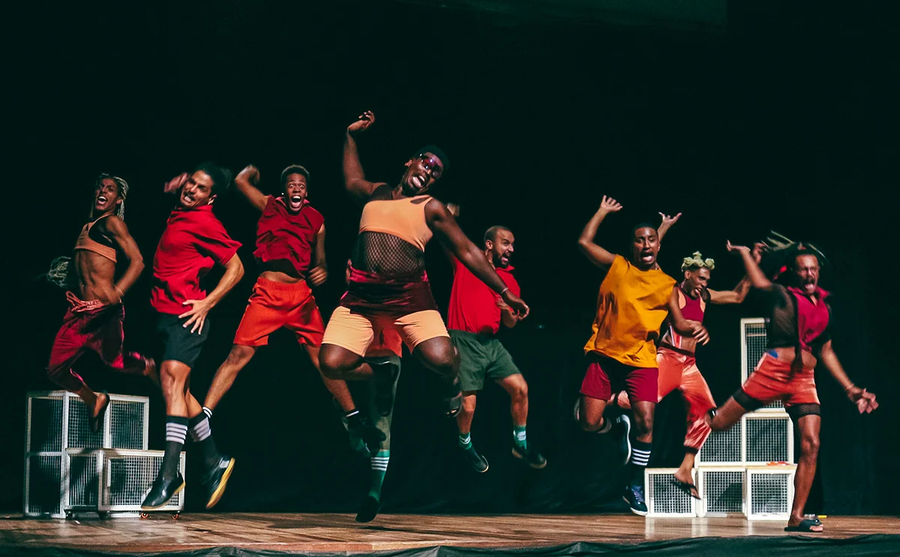
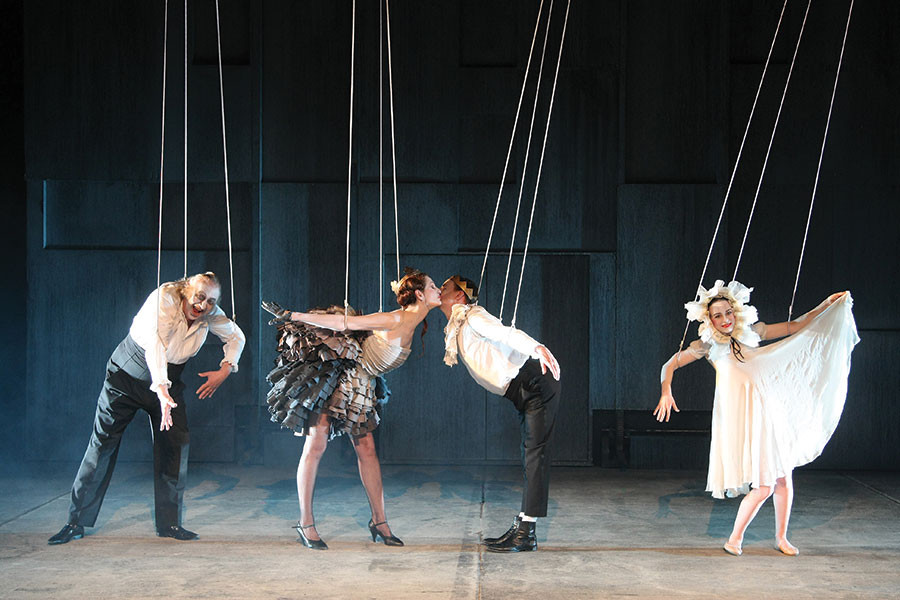
The first performance I saw there was Lobo, Carolina Bianchi’s feminist experimental physical theatre work, wherein about 20 male dancers performed naked for the entire piece, and the lead actress and writer joined them, clothed and unclothed, sometimes with different crustaceans to cover intimate parts. Another piece I experienced there was Buraquinhos ou O vento é inimigo do picumã (“Little Holes or The Wind Is the Enemy of Picumã”), created by a group of young Black physical theatremakers, Carcaça de Poéticas Negras, which includes playwright Jhonny Salaberg, about genocide and survival within a militarized police state post-dictatorship.
Both performances used all three levels of the theatre, and design was integral to their storytelling: flying kites and hoisting sails around the space, climbing up and down the scaffolding to give us a wide array of perspectives, using the windowed section of the theatre with the sprawling city as a backdrop for certain scenes. Teatro de Contêiner does not hide from the city behind tall walls; it embraces its visibility by providing social services for the unhoused. The collective walks in a long legacy of cultural centers that honor the contradictions of the urban matrix: struggle and resistance, marginalization and pluralism, pain and hope. They are unsettling dominant practices by remembering cooperative ways of making with what Fred Moten and Stefano Harney have called the Undercommons.
While lounging around after the show at the bar/café, something quite common in Brazilian art spaces, I struck up conversation with a theatre artist who told me that their impression of American theatremakers is that we are “so tame, caught up in their comfortable middle-class theatre lives.” I listened and reflected on what I could learn from this observation. I spoke with two theatre artists who have made work at Teatro de Contêiner and embody some of the paradoxes of being a theatremaker on this side of the world today. The work these artists make with their collectives is especially worth paying attention to as we face continued precarity in our U.S. theatre infrastructures. We can learn from both their counter-colonial processes and their funding mechanisms.
We are riding multiple escalators up and down the busiest subway station in São Paulo, Estação da Luz, to meet three storytelling guides holding headsets on the center platform. They hand them out and tell us to plug them in when the doors close. A Cidade dos Rios Invisíveis (“The City of Invisible Rivers”) begins with an invitation for us “travellers” to allow our imaginations to deepen our understanding of what we think we know about this city. We begin to learn about the waterways buried beneath us. We are asked to consider how different people pass the time on their commutes. We are told we can scream for help if we need it.
After a 45-minute ride with mostly napping working-class people, we arrive at one of the last stops, Jardim Romano. We are invited into this neighborhood on São Paulo’s outskirts to experience vibrant memories, songs, inventions, multimedia installations, dances, and interactions recalling the devastating 2009 flood that brought this community together, and ultimately led it to form a theatre collective. We remember together to ensure that this living archive is fed. We feel a community transmute the grief of being on the frontlines of climate disaster into theatre. We walk around their neighborhood and hear from vendors, elders, and youth about their stories of surviving the flood together. We share cups of cold beer and salgadinhos. This is the work of Coletivo Estopô Balaio de Criação, Memória e Narrativa (the [insert untranslatable Brazilian slang here] Collective of Creation, Memory and Narrative).
One of the members of this collective is Potyguara gender-nonconforming multi-artist Juão Nÿn, who comes from one of the first contact tribes in Pindorama in the northeast. They told me that “theatre was one of the first tools of propaganda in the New World. The ships came with the colonizers and their scribes, and the first thing they did was set up churches and theatres, because they knew that nation state building required capturing the imagination of the people. Those theatres taught Christianity and Portuguese.”
Which is why Nÿn and their collective engage in contrateatro, or counter-colonial theatre. Nÿn told me that for them, this means “re-Indigenizing their theatre practice to fight the continual waves of colonial invasion by building new relationships with the city and practicing collective life in the urban matrix.” Born in the aftermath of that 2009 flood, the collective embraces their existence at the margins by welcoming audiences into their world. A foundational part of their engagement practice is to treat audiences not like consumers but to invite them to be in kinship with them and their neighborhood.
Where the dominant logic of theatre infrastructure often encourages gatekeeping, obscurity, and siloing, Coletivo Estopô Balaio counters these colonial practices by rotating leadership, governance, and administrative duties so that everyone can build the skills to honor the work. Their multi-year, research-based process of creation is rooted in community, with much time dedicated to training up new generations. A circular, regenerative way of making—this is an Indigenous way of being. This praxis of making in circle nourishes pluralism, because it requires us to consider the whole process; all of the parts, not just ours. It situates us within a legacy of generational purpose by making necessary each of our roles in upholding the needs of the collective.
Nÿn affirmed that the nine-member collective has an “anti-capitalist ethic, prioritizing human resources over production elements, because what is the use of a fancy set if folks can’t eat?” They added, “We believe in a poor theatre but not a cheap theatre.” Accordingly, the budget for most of their productions is around $600,000 Brazilian reais (just over $100,000 in U.S. dollars). Most of that pays for their labor, so they can be dedicated makers, and for rent on their space, which also functions as a cultural center where they hold rehearsals, host events, and do community work.
Their most recent work, Tybyra, was performed entirely in their Native tongue, Tupí-Guaraní, as an act of language reclamation. It tells the story of Tybyra, the earliest recorded case of a hate crime against what we would now think of as an LGBTQIA+ person from the early 17th century, and brings forth questions of Indigenous sovereignty, dissolution of colonial borders, and re-Indigenizing our imaginations. In the future, Nÿn said, they hope to see what their former teacher Marcos Bulhões called “islands of disorder…that form an archipelago of folks doing this kind of community-rooted, counter-colonial work. A network of cultural workers with basic dignity in their work that breaches colonial state lines (which often dictate funding) and ushers forth cultural transformation.”
As U.S. artists know all too well, it’s never easy to carve out public funding. Theatre artists everywhere have to fight and keep fighting for it. In 1999, a grassroots network of group/ensemble theatres occupied the main building of the department of cultural affairs in São Paulo by force and created a popular assembly to voice their manifesto of demands. Calling themselves “Movimento de Arte Contra Barbárie” (The Movement of Art Against Barbarity), these were predominantly white, postmodern experimental ensemble theatres. As these troupes typically collaborate on multiple projects over many years, and often work outside of the interests of both commercial and traditional nonprofit theatre ventures, this movement wanted to protect the right to experiment with form, content, and process without the pressure of conformity to the wider commercialized theatre field. In 2002, after three years of negotiations with the state and city government, a law called Lei de Fomento ao Teatro para a Cidade de São Paulo (Law for Promoting Theatre in the City of São Paulo) was made to ensure that, in direct partnership with the cultural affairs department, a participatory process would roll out every year to grant funds to these groups.
Even with that law in place, members of the original Movimento de Arte Contra Barbárie have continued to stay vigilant, organizing sit-ins and protests in theatres and government buildings when the government tried to get rid of the law, lessen their funding, or fail to deliver promised funds. One mandate of the law is the yearly formation of a committee of theatremakers to select the winners of that year’s grants. Anyone who is a registered theatre artist gets to vote on this selection committee.
Over the years, group theatres from marginalized and underresourced areas of the city rose up to demand inclusion in this participatory selection process, raising awareness and mobilizing theatre collectives in their neighborhoods around the opportunity to have their work funded by this law. They were ultimately able to get two additional subgrants for marginalized theatre artists and first-time makers. So a grassroots, artist-led policy initiative initially centered on resisting commercialization has become a broader, participatory model for public arts funding—one shaped increasingly by demands for equity and access.

Jhonny Salaberg, a Black queer theatremaker who was part of the creation of A Cidade dos Rios Invisíveis with Nÿn’s collective, is the one who told me this history and who shared the impact this funding has had on his work with his collective O Bonde (The Tram), whose most recent work was a three-play cycle called Trilogia de Fuga (Trilogy of Fugitivity), “about the physical, psychic, and cultural liberation in the face of the ongoing dehumanization and genocide of the Black body.”
The poet and Black studies scholar Fred Moten has defined fugitivity as “a desire for and a spirit of escape and transgression of the proper and the proposed. It’s a desire for the outside, for a playing or being outside, an outlaw edge…moving outside their own adherence to the law and to propriety.” Added Salaberg, “Fugitivity is not just about survival, but also about reconstructing histories, amplifying possibilities for present existence, and collectively drawing alternative futures. Fugitivity for us also means escaping rigid expectations of what a ‘Black theatre’ is and should be, undermining stereotypes, stigmas, and social imaginaries.”
The trilogy’s three parts include the story of 50 boys enslaved in an orphanage, a children’s show about griots, and a play with music about the right to age as a Black person and an artist. “There are many hands, many tastes, many heads in ensemble creation, which requires listening, transformation, and a non-preciousness about the work,” Salaberg said. “Collaborative creation requires a lot of strength and self-confidence. You can see all the hands in our collective work. It’s a medicine of sorts.”
And it is clearly meeting a need. As Salaberg said, “When we perform in the ’hood for folks who might have never seen theatre before, it’s a different type of gratitude. In majority white spaces, people usually leave quietly and feeling guilty, but when it’s in majority poor or Black neighborhoods, folks leave feeling seen.”
I love the way Salaberg, Nÿn, and their collectives make work and move through the world together, with a foundational vision of building kinship and liberation. After reflecting on their theatrical priorities, I wonder about the extent to which theatres in the U.S. and the West continue to prioritize colonial values, perhaps without even realizing it. Are we inadvertently making nationalist theatre? Promoting fascistic American values of passivity, extraction, subservience, complacency, and authoritarianism?
Salaberg and Nÿn both describe a slow-burn collective commitment to community organizing to make sure their material needs are met. That a group of theatre artists were able to mobilize to get a law passed to ensure funding for ensemble theatre is pretty mind-blowing. What will it take for those of us who make theatre here on Turtle Island to go beyond revolutionary themes and words in our work to making revolutionary moves in our worlds? How will we mobilize in the face of federal funding cuts and endless shifts in the priorities of private foundations? Will we continue to beg at the doors of a few well-funded theatres and producers? If we in the imperial core claim to believe in a pluralistic society, if we believe that people of different beliefs, backgrounds, and lifestyles can and should coexist in the same society and participate equitably, what are we willing to risk to ensure this reality?
I believe theatre people are prolific organizers and team players. I think it is time we take our roles within the social fabric more seriously and recognize that participation requires us to “look squarely into the fucked-up face of” things, as Moten and Harney put it. Our theatres can become these islands of disorder—hubs of revolutionary struggle, in both tiny and enormous ways. We can build higher walls, or we can remember and learn how to be together. I think of the way some theatres responded to Covid-19 by opening up their spaces to become distribution centers of free food and personal protective equipment. I think of the cultural wings of resistance movements throughout history, led by theatremakers who knew that a spoonful of sugar helps the medicine go down, and would hide liberation messaging and freedom dreams in their work.
If these artists in Brazil can make these acts of refusal and great organization on the outskirts of empire, then we can surely be more creative here at the head of empire. Do we want our legacy to be that of the jester “in the court of the conqueror” (to quote my art uncle, George Emilio Sanchez)?
Liberation feels further away than ever to many people who are scared right now. But hundreds of cultures and civilizations who were here first have survived apocalypses already. What can we learn from those who have survived and are still rebuilding? What awaits us when we open our ears and minds to structures outside of mainstream colonial American theatre institutions? How do we bury, mourn, and transmute the literal and metaphorical shackles that have been used on some of us, the land and our ancestors?
I return to Moten and Harney: “It ends with love, exchange, fellowship. It ends as it begins, in motion, in between various modes of being and belonging…and on the way to new economies of giving, taking, being with and for.”
*(Note: Since the time of print publication, Teatro de Contêiner Mungunzá has been fighting to remain open and operational following a shocking eviction order.)
Rad Pereira (they/them/elu) is a queer trans (im)migrant cultural worker building consciousness between healing justice, system change, re-Indigenization, and queer futures.