You don’t have to convince a queer child to go into the theatre. And if they are fortunate enough to find it, most refuse to leave. The compelling stories of two gay Jewish boys who made a life for themselves in the theatre are chronicled in the new memoirs On the Boardwalk by Martin Sherman, author of the groundbreaking play Bent, and Theater Kid, A Broadway Memoir by Jeffrey Seller, producer of the landmark musicals Rent and Hamilton.
If one considers even the basic facts of their childhoods, neither man would appear likely to have succeeded. Yet both are responsible for pioneering shows that have shaped our theatrical landscape. Did they succeed in spite of their families or because of them? In the act of looking back on their lives, many of the setbacks, victories, tragedies, and coincidences don’t seem as random as they may have—in hindsight, the irregular path of life can oddly make perfect sense because it has led to the present moment. Already equipped with Spartan endurance, another essential factor for both Sherman and Seller was luck, naturally, and it required, as it always does, the wherewithal to recognize and seize opportunity when it showed up.
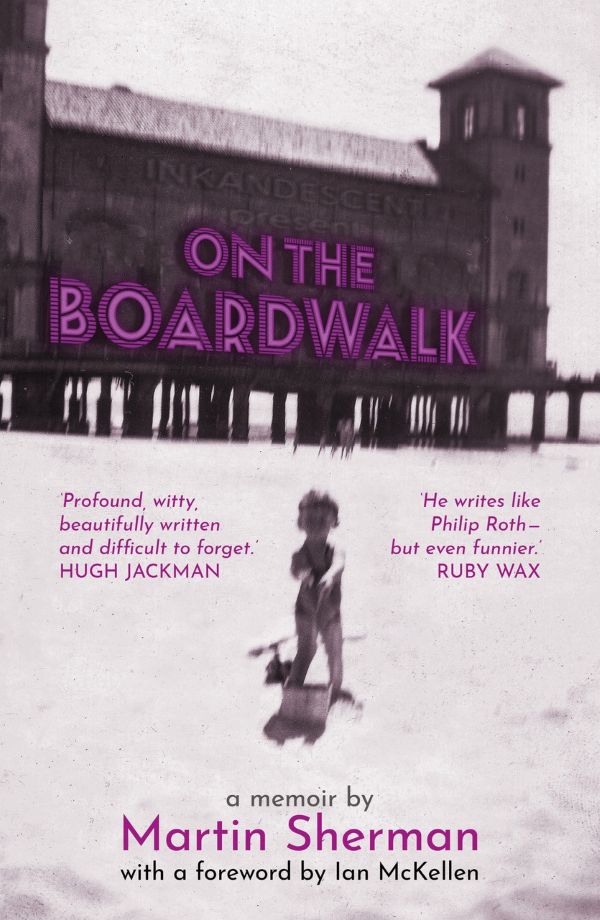
Martin Sherman identifies his guiding principal in life as “on the other hand.” His embrace of contradictions and absurdities is what makes On the Boardwalk both deeply moving and delightfully witty, a testament to the author’s compassion and well-earned gallows humor. Born in 1938, Sherman is the only child of an immigrant father, Joe (Yossil), who fled a shtetl in Ukraine for Camden, New Jersey. His mother, Julia Shapiro, the granddaughter of Armenian immigrants, suffered from Huntington’s disease, an inherited condition in which sufferers become progressively unable to control their movements, speech, or thoughts as symptoms gradually appear, though a diagnosis can typically not be confirmed until a person is nearly 40. As a result, Julia Sherman rarely spoke to her son or even looked at him; all Sherman knew was that his mother wouldn’t talk to him, and he didn’t know why. His “phantom mother” remains unknowable—indeed, Sherman is unable to recall much, if anything, she may have said to him. His grandmother once remarked of her unreachable daughter, “She was once somebody.”
It was not until Joe Sherman dropped his son off at Boston University that he unceremoniously told him about his mother’s affliction—and the likelihood that Martin would die from it as well. Joe drove away leaving his son alone, in a state of shock, a disease of Damocles hanging over his head for the next 20 years.
It turns out that Sherman’s father had an undiagnosed narcissistic personality disorder, a psychological condition that by now much of the planet is painfully familiar with. The antics of Joe Sherman—also a gambler and a yarn-spinning attorney with no patience for facts—are as dumbfounding as they are entertaining. His father was a perpetual conundrum who also happened to show up to help his son at crucial moments. Though life was not the “peaches and cream” alluded to in the song that gives the book its title, Sherman paints those early difficulties with restraint, and even takes care of his readers: “Rest assured, it gets better,” then follows with the caveat, “Although it takes a while.”
His first escape from the mad household of Camden was with Mae Desmond’s Children’s Theatre when he toured as Sneezy, the tallest dwarf in Snow White. His next fascination was the movies. Sherman fell hard for a string of screen starlets who died young, beginning with Carmen Miranda, whom he thought eerily resembled his mother. Atlantic City, where his warm and nurturing maternal grandmother worked, was a seasonal oasis.

But his favorite port in the storm was the theatre. By Sherman’s reckoning, his mother gave him two important gifts: First, she took him to the theatre in Philadelphia at a young age (and soon after allowed him to go by himself), and second, she bought him a used edition of Shakespeare’s plays. When Sherman recounts the plays and actors he saw in the 1940s and ’50s, it is a who’s who of great American performers and playwrights. Though he lacked friends with whom he could discuss what he’d seen, Sherman developed a discerning theatrical eye that provided him with a merciful sense of equilibrium—except when it didn’t. “When I sat in an audience, I had the mind of a well-balanced adult,” he recalls. “When I returned home, I was somewhere on the autistic spectrum.”
Sherman blossomed at college, where he found like-minded theatre students, decided to write plays, and began to recognize his sexuality; once he realized he was gay, it never occurred to him to hide it. Making sense of dating and the mostly secretive gay world of that period was another matter—there are stories of crushes, lovers, and friends who often pop up as stalwarts or bad pennies in later years.
After graduation from college in 1959, Sherman toiled anywhere he could for nearly two decades. Though he eventually began to make some headway with Playwrights Horizons and the O’Neill Center, and landed a few regional productions as well as L.A. freelance jobs writing for Mama Cass, Rosalind Russell, and Barry Gibb, he couldn’t get any traction from producers on, Off-, or Off-Off-Broadway. Though we know Sherman has written this memoir from the vantage point of a successful author of dozens of plays and screenplays, in reading it, we never feel entirely certain that the young playwright at its center will be able to keep leaping the hurdles life puts in his way. He was resolute and he was lost: haunted by his mother, unsure of his future, and sensitive to the way people responded to his appearance—he describes his youthful self as 6 feet tall, 107 pounds, with large teeth and severe acne.
At some point Sherman embraced two truths: that his life was composed of uncertainties, and that he loved life. “I was a Dickens opening paragraph come to puzzling life; but honestly, it was the best of times and the worst of times; it was an age of wisdom and an age of foolishness; it was the spring of hope and the winter of despair. I was a twenty-something Jewish homosexual with precious little flesh and a possibly invisible future.”
On a trip to Europe, he discovered Greece. “It was every gorgeous cliché I ever dreamed of,” he writes. “I was as unhappy as ever, perhaps even more so, but equally I had never felt as alive. The sky and the light and the sea reached deep down into my guts like a miraculous antibiotic. I liked myself a little bit more, simply for being there. If I was going to die, it wasn’t so tragic, because I was in the land that created tragedy and it was breathtaking. That evening I wrote in my journal, ‘The Ionian is trying to whisper something in my ear.’”
But it was a visit to London in 1966 that would be the real key to finding his way. A decade later, he would flourish in that theatre capital, regularly seeing and working with some of the great English stage actors of the day (“I chanced upon an actress who was clearly missing a layer of skin, because you could see straight into her soul; her name was Vanessa Redgrave”). It is also there that he met the first agent who understood him, the legendary Peggy Ramsay, and where he has lived for nearly 50 years. It was also there, as part of the pioneering Gay Sweatshop Theatre, Britain’s first gay theatre company, that Sherman learned about a story that had yet to be told, about the thousands of gay men the Nazis rounded up, forced to wear pink triangles in concentration camps, then murdered—and that he was the playwright to tell it.
Along the way, Sherman learned how to write. He cites Lorraine Hansberry and Elaine May as some of the playwrights whose work taught him about audacity and courage. May confirmed what had always been true for him: “You learn to write plays by seeing plays.” On the one hand, Sherman was as stubborn as a pilgrim slowly, methodically scaling a mountain to his holy place; on the other, he maintained an unshakable fear that at any moment he would fall to his death.
This paradox makes Sherman’s sense of humor one of the pleasures of his book. Some choice examples: “Euphoria is the Hindenburg of emotions; a few fabulous moments in the sky, and then boom!” “I had sublet an apartment on West 12th Street, which was as narrow as an evangelist’s mind.” “Being hippie-ish helped, but it only made me look like a more colorful cadaver.” “My body had been improved in part but still looked like a pencil, distinctly unsharpened,” “I knew nothing about children, even though I had recently been a child myself.” “My buttons were so pushable, they predated computers: You could swipe me with one finger and I was yours.” “I was a sissified Sisyphus carrying my sulphurous suitcase . . . It was as if my melancholy was stored in the suitcase, and melancholy is a heavy motherfucker.”
Sherman’s personal and professional interactions include a long list of fascinating characters, known and unknown, from Lee Strasberg to Simon Callow to Olympia Dukakis. Always as surprised as his readers by his unexpected timing, Sherman dubs himself a Zelig before recalling interactions with, or proximity to, the likes of Allen Ginsberg, Martin Scorsese, Joan Baez, Salvador Dali, Samuel Beckett, and John F. Kennedy, or when he finds himself on the speakers’ platform behind Martin Luther King Jr. at the 1964 Civil Rights March on Washington, or at Woodstock, or stumbling upon the Stonewall Uprising as it unfolds.
After 20 years of perpetually waiting for the other shoe to drop, then watching it drop as predicted, Sherman ran out of shoes. It gave him the temperament he needed to survive the unsparing, though hardly atypical, obstacle course that led to his first West End and Broadway openings in 1979. Bent was the 12th play he had written, and a remarkable achievement by any measure. Sherman doesn’t quite spell it out, so I will: Bent sparked use of the pink triangle as a contemporary symbol of gay identity and power, and led to the first wave of historical research into the extermination of gay men by the Nazis; prior to Bent the subject had been relegated to cursory articles and occasional footnotes.
There was another triumph that occurred without a red carpet or celebrities, when he quietly basked in the realization that he had outlived the onset of Huntington’s. It was his mother whom he thought of as he walked into the theatre at that Broadway opening.
Martin Sherman could have written a chatty book of showbiz anecdotes, a how-to manual for playwrights, or a potboiler if he had wanted to. Instead, his memoir is a brilliantly nuanced dive into the mind and heart of an American playwright. As for the next four decades, they will have to be for another memoir.

Where Martin Sherman’s unflinching tenacity took him all over the map, Jeffrey Seller’s dogged resourcefulness set him on a beeline for Broadway. Seller doesn’t outline his guiding philosophy in Theater Kid, though it might go something like, “If it needs to be done, I do it.” Most of Oak Park, Michigan, the suburb of Detroit where Seller was born in 1964, was middle-class when he was growing up, except for his neighborhood, known as Cardboard Village. It was so-called because homes there were made of the cheapest possible materials, a mere 800 square feet, no basement or garage. Seller knew his family was poor because he went to school and synagogue in a neighborhood of middle-class families. When he was 9, Seller’s Hebrew teacher asked the class if they knew of a place in America comparable to the Warsaw Ghettos, but they didn’t. The teacher allowed that Cardboard Village was “like” a ghetto, since the people there lived in chronic poverty.
The adopted son of Caroline and Mark Seller, a young couple with a daughter, Jeffrey was just 5 when his world fell apart and the family made the move to Cardboard City. His father—who, unbeknownst to his wife, daughter, and son, ran with a motorcycle gang that included an extra-marital girlfriend—was brain-damaged and otherwise disabled in a traffic accident. Unable to function emotionally or physically, Mark bankrupted the business he had inherited from his parents. He was afterward only able to find work as a process server, delivering legal papers for small fees, and also chose, inexplicably, to perform gratis as a clown for children’s charities, not earning nearly enough to support his family. This meant in turn that Caroline went from raising her children and playing Mahjongg to working full-time at a minimum-wage job to feed her family and receive health insurance.
But while his family treaded water near the poverty line, Seller got his first taste of the future: He became hooked on theatre. For the annual Purim play, his fourth-grade teacher naturally decided to combine the Old Testament story with songs from South Pacific and H.M.S. Pinafore, so that when Queen Esther was angry with the king, she sang “I’m Gonna Wash That Man Right Outa My Hair.” Thrilled with the experience, Seller sought more chances to perform.
In the meantime, he wrote fantasy stories and a play, Adventureland (which 40 years later would become the name of his producing company), all with the possibility of his parents’ divorce looming. Alongside explosive domestic scenes and a worn-down and unhappy mother, the Sellers’ father-son activities ended in embarrassment or cancellation. Even riding along with his father to serve legal papers could be a violent experience. Seller thus took on the role of an adult from an early age, caring for an infant brother and sometimes physically putting himself between his warring parents. As children will, Seller forgave his father repeatedly, hoping for improvements that never came. His best memories are the times his father faithfully drove him to auditions and took him to see musicals.
Seller’s sexuality was brought to his attention before he quite knew what it was. Participating in a game of “Truth” (minus the “Dare”) during a teenage group make-out session not long after his bar mitzvah, a girl told Seller, “I want you to know that you’re gay.” What? Seller didn’t know—had never thought about it before. “It’s okay, but I think you are . . . there’s nothing wrong with it,” she assured him. Now forced to wrestle with his unrecognized feelings, he focused on his passion, fueled when his father took him to see road companies of Shenandoah, Pippin, and A Chorus Line.

By age 15, exasperated with the poor quality of plays chosen for the local children’s theatre he belonged to, the Rag-A-Muffins, young Jeffrey went into action. He became chairman of the play-reading committee and proposed more sophisticated titles and well-known stories with larger casts that would get more adults involved. It was only in hindsight that he recognized these as the qualities of a producer. A post-graduation trip to see shows in New York only bolstered his determination: Dreamgirls, The Fantasticks, and Torch Song Trilogy proved a perfect triumvirate of influences for the kind of non-traditional yet commercial musicals he would later produce, including Rent, Avenue Q, In the Heights, and Hamilton. At the University of Michigan and during breaks, Seller took advantage of every theatre opportunity he could find or drum up. By the time of his 1986 graduation, and with inspiration from theatrical memoirs by Hal Prince and Moss Hart, he decided he would be a producer.
Seller hit the ground running, applying for jobs in New York before he left Michigan, and refusing any that did not include health insurance. Before long he was working for New York City press agents, then soon afterward interviewing to be a booking agent for Tony-winning producers Fran and Barry Weissler. During that interview, Fran asked, “Has anyone ever told you you’re too aggressive?” They hired him. When his immediate boss, the Weisslers’ booking manager, Susan Weaving, told him that being a booking agent is the “hardest job in the business,” Seller didn’t blink. He told her he would “do anything for this job,” and he did. Within three years, he had a reputation as one of the best bookers in New York. Weaving then pushed him out of the nest and back into the job market. “Your heart lies somewhere else,” she told him. “We both know you want to be a producer.”
Fortuitously, Seller had attended a reading two weeks before his departure, a “rock monologue” called Boho Days by Jonathan Larson. It spoke to him in such a deeply personal way that he wrote a letter to the struggling author, which began a relationship that lasted through a series of false starts and rebirths, culminating in the Broadway opening of Rent in 1996. It changed his life. Like Hair and A Chorus Line before it, and later Hamilton, Rent was a milestone for the American musical. While the preceding five years had been just the kind of rollercoaster of challenges and crushing setbacks one might expect, you get the sense that Seller would not be deterred in any case. The velocity and focus of his trajectory is why, in large measure, his memoir packs a wallop.
The story of the 30 years after Rent is evidence not only of the assertive business savvy Seller developed, but also his innate curiosity. It’s a potent combination: steely professional instincts and the fascination of a theatre kid. Seller provides backstories about how his other projects found their way to the stage, and he touches on the specter of AIDS, particulars of his romantic relationships, meeting with his birth siblings, and raising his children. But the twin engines that propel his memoir are the drive of a young man doing whatever he needs to do to work in the theatre and the joy he feels whenever he is part of the theatre, any theatre. Frequently asked why he produces unconventional musicals, Seller responds: “I don’t look for unconventional musicals. I look for musicals to fall in love with…At the end of the day my hope is that, if I love it, then others will love it as well.”
Separated by two generations, Sherman and Seller, have lived dramatically different lives. But they mirror one another in telling ways: in how deeply theatre informs who they are, in their Jewish upbringings, in their thorny and perplexing early family lives, in the challenges inherent in coming to terms with their sexuality. Each was an outsider who eventually found his way. There is something else meaningful they share: Both men remain in awe of their serendipity.
Thomas Keith has edited the Tennessee Williams titles for New Directions since 2002, and his writing has appeared in Gay & Lesbian Review, American Theatre, and Studies in Scottish Literature. He is a professor of theatre at Pace University.