The playwright Murray Mednick died today. A post on Norbert Weisser’s Facebook feed announced his passing; texts and emails incoming. Murray had been released from the long trial of COPD, or what used to be called emphysema, with an assortment of complications. Everyone shocked into mourning.
On social media informal tributes are being shared among a sprawling community of theatre folk on both coasts, but mostly in Los Angeles, where Murray has lived since the early 1970s.
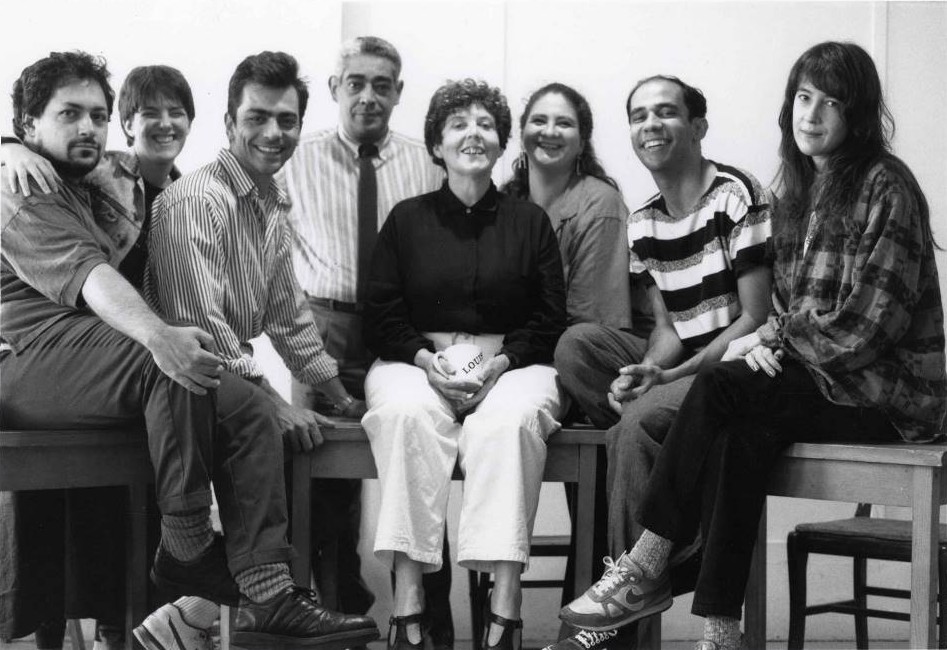
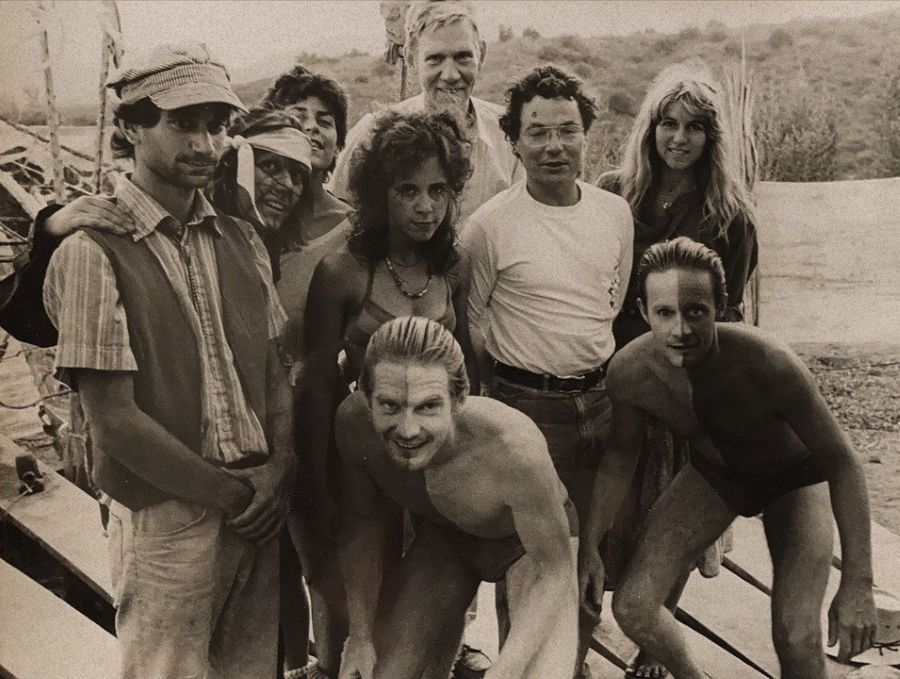
Many know this biography: his early plays at Theatre Genesis in New York, culminating in his Obie-winning The Hunter, then his groundbreaking Coyote Cycle (1978-1985) and the Padua Hills Playwrights Workshop/Festival, which ran from 1978 to 1995 in the L.A. area, and, finally, the many plays (of his and others) that I produced—along with Gabrieal Griego, Racquel Lehrman, Paul Mackley and several others—and often directed as part of the Padua Playwrights from 2000 to 2020, moving several to New York and other venues. In the past month Murray was actively planning his next production, of a new play called Not Jail, wondering if he might summon the energy to direct it himself.
Loved the stage, Murray. Couldn’t stand being away from it for long. Few people know it, but Murray was actually born out of a theatre seat on the Lower East Side, just appeared one day swaddled in blankets during rehearsals of a lost classic of the Yiddish theatre. This isn’t actually true, but the compression and manic energy of that lost theatre tradition runs through Murray’s plays like a thread of gold.
I directed his work for the first time in 1994 at the Lost Studio on La Brea. It was a short called Baby, Jesus!, a two-hander with Roxanne Rogers and Dawn Howard, as part of an evening Murray’s friend and longtime collaborator John Steppling was producing.
Murray’s text, you notice right away, is metric—iambic rhythms only—but still feels conversational. I’ve heard it said that we English speakers all observe a fundamentally iambic rhythm when we converse, and that is immediately apparent when you work with Murray’s text. You could beat a drum to it. Actors ride it like a heartbeat. Directing Murray’s work was a process of removing obstacles so something living could flow and express itself. You didn’t want to add anything, certainly, or let the actors add anything but what was most alive in them.
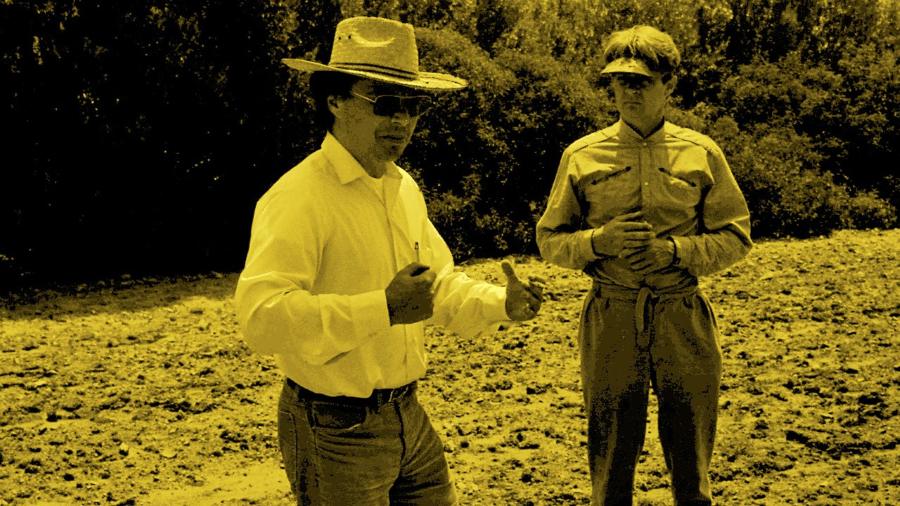
In the 1994 Padua Festival, Murray’s Switchback was staged below a steep hillside leading up to a soccer field. The play began with two women (Robin Karfo and Sharron Shayne) exchanging bursts of dialogue like machine gun bullets. Pushing a pram, they seemed to have escaped from Sergei Eisenstein’s Odessa steps sequence. Suddenly, a warplane appeared, buzzing high above the field! A human figure was ejected from the airplane! Suspended by a parachute, a soldier floated down out of view onto the field! Seconds later the soldier (played by Mark Fite) appeared over the crest of the hill! The women watched as, still dragging his chute, this soldier vaulted the little fence and dove into the pool beside where the audience, stunned, watched the action unfold.
Murray liked to say that his job as a playwright was to create a magic carpet for actors to ride, and the better the actor, the more this was true. They line up right away in my mind: Ed Harris, John Diehl, Peggy Blow, Lee Kissman, Hugh Dane, Norbert Weisser, Laura Liguori, Tina Preston, Gray Palmer, Darrell Larson, Christina Avila, Chris Allport, Lynnda Ferguson, Kevin Weissman, Maria O’Brian, Maury Sterling, Annabelle Gurwitch, Tony Abatemarco, and many more—the gifted actors who could take that thrilling ride, often signing on to work for Murray without seeing a script.
Many are commenting about Murray’s “gentle soul,” and I know what they mean. But Murray was also a fighter. Describing Murray to those who’ve never met him, I say he was a combination of Edward G. Robinson and Yoda, but with better hair. I tell people, falsely, that he was only 5’3” and slight of build but weighed 500 pounds. His mother—the formidable Betty brought to such vivid life by Annabelle Gurwitch in the play Joe and Betty —used to tell her son to make up for his size by throwing the first punch.
A rainy day in Manhattan on Sixth Avenue in 2003, watching Murray walking arm and arm to the restaurant with his old friend María Irene Fornés, windblown veterans of forgotten wars. They had met on the Off-Off scene in the early ’60s and worked closely together, first in New York to give that movement some legs, then in Los Angeles, where Irene came each year to stage Fefu and Her Friends, Mud, and many other vibrant new works at Murray’s Padua Hills Playwrights Festival. John Steppling and John O’Keefe were the other mainstays of that hotbed of vibrant new work, with younger playwrights like David Henry Hwang, Kelly Stuart, and Jon Robin Baitz passing through en route to the national stage.
A disciple of Samuel Beckett, Murray wrote a first true line and then followed that line wherever it led until the play was finished. Revisions at a minimum. For him, the act of playwriting was fundamentally about listening. For all the physical inventiveness and theatricality of The Coyote Cycle and many other early plays, his final pieces became recitations, the actors lining up to speak to the audience. In many ways, these plays embody what Peter Brook would call the Holy Theatre, “the notion that the stage is a place where the invisible can appear.”
Murray was a poet first, sustaining himself by waiting tables at the famous jazz joints in the Village and selling weed on the side. Allen Ginsberg was a client. So was William Burroughs, his mouth watering over handsome young Murray and his movie-star best friend Sam Shepard.
In the 1990s Murray ran private workshops in his home off Pico in West L.A. The basic exercise involved speaking in attention about a theatrical topic—the Greek tragedians, a play of Shakespeare or Chekhov or Beckett—and remembering what you said so you could write it down. Exhausting but also transformative. Murray and his wife Christina had just returned from China with their beloved daughter, Celie. Wes Walker, Hank Bunker, Roxanne Rogers, and many more in those long afternoons, and Murray on breaks outside, one of those damn Lucky Strikes between his slender, oddly elegant fingers…
Guy Zimmerman is a writer and director currently teaching at UCSD and writing fiction. His book of poetry, Mammal One, was published in 2024 by Slow Lightning Lit.