STEPHEN ADLY GUIRGIS: I didn’t go to grad school. I didn’t really go to undergrad. I actually learned about writing from TV. You’ve also worked in film and TV. I assume a lot of young people are going to be reading this, so can you demystify that a little bit?
CHRIS GABO: I want to caveat for younger writers that as far as the “getting into the industry part”: The industry is the ocean and we are like this tiny pebble getting tossed around. My career started in 2020. I was lucky. I entered Hollywood in an era where they were still really hype about playwrights. You know how, like, Indiana Jones slides under the door as it’s closing? I think I got in like that with the playwright shit. Because now I don’t really know—the industry is mad different now. When I was getting started, all these agents were like “Do you have a pilot? Do you have a pilot?” That really hurt my feelings, because I was like, “Why don’t you just look at my play? It took me years to write. If I have a pilot, it’s something that I wrote like five seconds ago.” The reason why I signed with my agent, David Rubin, is that he read The Surgeon and Her Daughters and was like, “Your work is done. I’m going to go get you a job.” Two weeks later, I had an overall deal at HBO for two years. So, in terms of how to get in, I think you need a strong sample and a fierce advocate.
STEPHEN: That’s a good point about the fierce advocate. I remember, at first I didn’t want an agent because I didn’t want to be a writer. Then I couldn’t get an agent. When we did In Arabia We’d All Be Kings, I sent letters out to every agent in New York, and I got, like, one response: “I’m not going to come, but thanks for inviting me.” A year later, after Jesus Hopped the ‘A’ Train, there were a lot of options. The reason I picked John Buzzetti was because out of all the people, I really believe that he thought that I was the shit. You have to choose someone who really believes in you. I remember there was someone from a bigger agency who was interested, but I was like, “I like Buzzetti because I feel like he’s ride or die.” It sounds like, if this guy David Rubin was saying, “Your work is done, I can get you work from this,” that’s the same thing.
CHRIS: A hundred percent. I think it’s actually better to have no agent than it is to have an agent that doesn’t believe in you. Because whoever is representing you out there, if they’re like, “Read, Steven, read Chris; if you don’t like them, we got other guys”—if that’s the tone, then I’d rather fucking send the cold email. It’s hard to get places with a cold email, but with my manager, Leslie Conliffe, and David Rubin, I was very aware of the fact that they were waking motherfuckers up in the middle of the night, like, “Hey, if you don’t read Chris Gabo, you’re losing money.”
STEPHEN: What did you learn from writing from TV and film?
CHRIS: I got good at writing bad guys, and I learned how to write grounded soap. When I first got to HBO, after I wrote In Treatment, Francesca Orsi was like, “I want you to come up with an idea for True Detective.” I was like, “I hate cops; I don’t wanna write a cop show,” and she was like, “Oh, you don’t like cops? We love that—write from that place.” I was kind of lost, because I didn’t know how to write characters that I didn’t like. Then my mentors, Far Shariat and Rand Ravich, they were like, “You don’t know it, but you’re actually an expert on your enemies, and if you write better bad guys, then the characters that you love will have stuff to work against.” And they were like, “What we want to teach you how to do is how to write grounded soap.” What that means is, your most important characters, they should be fucking, or they should be mother and daughter. In soap opera, you get so much mileage from clustering characters in the most elemental relationships in extremely close proximity to each other. For example, in The Americans, it’s like, two Russian spies and their next-door neighbor is an FBI agent. They were like, “You might think that’s corny, but let me tell you, if you pull that off, seven seasons down the road that’s going to pay dividends.”

STEPHEN: On the subject of bad guys, in The Surgeon and Her Daughters, what did you do to infuse Johnny Sanchez’s character, Mr. O’Halleron, with so much humanity? On the surface he could just an agitprop asshole, but he wasn’t that. What did you do to three-dimensionalize him?
CHRIS: You know, there are a lot of Latino elders in my life who I love and who also really frustrate me. They’re both things at the same time. Often in my community, what comes up is that part of buying into Americanness requires you to buy into anti-Black racism. That’s what makes a lot of immigrants feel American. So I was like, if I have that part in the character, but I also have the actual, like, “Yo, I legit crossed the border and came here with no shoes”—if I have those two things playing at once and I make the character funny, I don’t have to worry about too much. The duality of the thing is what makes it fun. It’s also real.
One of the things that I lament about my generation is I think we sort of expect perfect virtue from everybody, and if you don’t receive that perfect virtue, it’s like that person is no longer worth contending with. I just really don’t feel that way. And yo, I learned so much from the way that you write people. I’d be reading your plays and I was like, this guy loves these motherfuckers, but it’s not hagiography, you know what I’m saying? Nothing is sacred. Or rather, the sacredness is the humanity and the fact that we’re all in this together, but you’re not holding back. You’re digging deep into the people. I’m just tryna do the same thing.
STEPHEN: Bro, one of my favorite moments in the show the other night was the scene with Johnny and Eden. There was this moment where Johnny’s character was saying a bunch of vile shit, and the people in the back started groaning. I loved it. It was one of my favorite moments. It was real. I’m working on Dog Day Afternoon and I’ve got so much fucking work to do, but my goal is that. They say Jesus came to comfort the afflicted and to afflict the comfortable. That’s what I want when people come to the theatre. The people that come from Long Island with their families because they’ve seen the movie—they’ll get what they want, but they’ll get afflicted too. I also want you and me and your friends to come and get a little afflicted too.
CHRIS: Exactly. The idea is to challenge everybody.
STEPHEN: Tell me, who are three non-playwriting artists you feel influence your writing?
CHRIS: Pusha T. Biggie. Wayne. Those are individuals who are using the English language with some fucking dexterity. Because the thing is, like, when I look at Eden’s character, Isaiah, in The Surgeon and Her Daughters, the dialogue is written in a certain way, ’cause when the characters are talking, I need you to fucking care about it.
STEPHEN: Eden’s over there spitting that shit.
CHRIS: When I think about Biggie, that’s somebody who just floats on the beat. I don’t even know how he does that. I feel like his verse on “Young G’s” is a perfect example of that. And then Pusha T—I mean, obviously I think of him and his brother, Malice, as a unit as well as individuals. They’re in Big’s lineage. Push is one of the great American rappers, but if you ask him, he’ll say, “I was just imitating Big on every line, every pocket, every inflection.” What Push says about Big, that’s how I feel about you. I was making unabashed Stephen Guirgis pastiche from the jump, and then I remember the first time where I was like, “Oh, I think I found some originality here.” Sometimes when you’re copying one person for long enough, you actually become more original, because it’s just a scaffolding. I feel like a lot of people are really always hung up on originality, and I’m like, yo, no one is original. Roberto Bolaño, who’s one of my favorite novelists, he used to say that all great writing is written in the margins of other great writers. I would read a Stephen Guirgis play and be like, “I’m gonna put some Asians in this motherfucker. Make some people speak Arabic. Make it look more like my world.”
STEPHEN: It was really meaningful for me watching The Surgeon and Her Daughters. First of all, because it was good. That’s the most important thing. And I’m aware that I may have had an influence on you, but I feel it manifests in your own original voice. I started writing by writing what I wanted to see onstage. Watching your work, it’s like I’m getting to see what I want to see onstage, but with a different voice. That really moved me. I want to ask you: Was there a character that was, like, you in this play?
CHRIS: I think I gave a lot of myself to Isaiah. I think I gave a lot of myself to Yadira Guevara’s character; that is probably the character that holds a lot of my ideas. But Isaiah is like—when I’m trying to get the highest eloquence out of how I feel, I give it to whatever character Eden Marryshow is playing, ’cause it just sounds so good. And I think the character of Muhammad Ahmed is, like, the romantic in me, when I think about how I feel about love and shit and I’m like, “I wanna plant a rose bush in front of the window.”
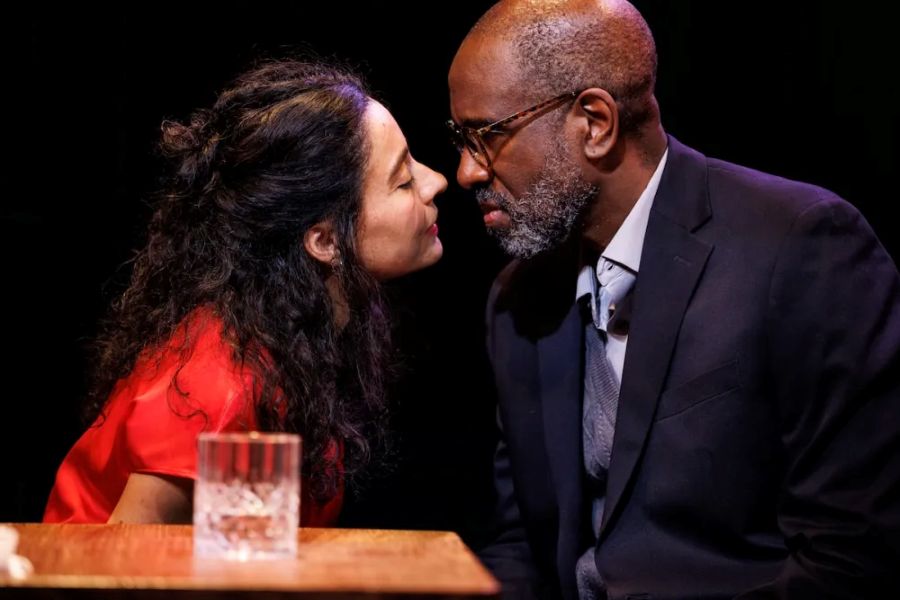
STEPHEN: That guy who played him, Brian D. Coats, was lovely. That dude’s gonna to be in Dog Day.
CHRIS: Really?
STEPHEN: Yeah, he’s understudying and he’s going to have some role.
CHRIS: Bro, how many people are in Dog Day?
STEPHEN: I don’t know. Too many, man.
CHRIS: Wait, give me a ballpark number, because I’m tryna figure out how big casts can actually be realistically—I’m tryna write some new shit and I wanna know what the marketplace can handle.
STEPHEN: I think there’s, like, 15 roles, and then there are five understudies. And they’re doing it in a way where the understudies can be onstage—so you might get cast as the third robber, but then you would understudy Bernthal or something, so you would have something to do. I’d trying to make it so everyone has something to do throughout the play.
CHRIS: It’s funny, because the thing I learned from you—or I guess now I can say, the thing we have in common—is just like: Give everyone something to do! Otherwise people don’t show up. Some playwrights don’t care about actors, ’cause actors to them are just a vessel for their thing. I’m like, not only is that an unsustainable way to go about it, it’s mad stupid. You have to give people something fun to do. They have to be able to sing and dance. They have to have a moment to fuckin’ shine!
The reason I was asking about the cast size is like, I wanna understand the economics of it, right? Because everyone’s always like, “When is someone going to write fuckin’ Angels in America again?” But who would do a play of that size from an up-and-coming writer in this economy, you know what I’m saying? The play that I’m writing now, Hollywood & Gower, it’s 10 roles, and this is me trying to take a big swing. Obviously the smartest thing for me to do would be to go write a two-hander and just try to get some celebrities in it. I will do that eventually, but…
STEPHEN: Nobody’s doing Halfway Bitches again. Nobody. It’s 18 and a goat. Everyone’s like, “I love that play,” but it’s not being done.
CHRIS: For me, I was like, okay, I could just sit here out of cowardice and not write the 10-hander that’s on my heart. But fuck that, bro: Every now and then, they do a fuckin’ 10-hander, and if you don’t have the play for someone to take a chance on, you’re fucked. You miss a hundred percent of the shots you don’t take or whatever, right? I guess what I’m asking is, I wonder if there is some magic number—obviously, you might have trouble getting Halfway Bitches up again, but because of the career that preceded, you were able to get it up once. Right now, the advice that I think people are giving is, like, four to six. The Surgeon and Her Daughters is six, but it feels big. At Theatre 54, you’re like, this is actually a lot of characters.
STEPHEN: I didn’t really follow any recipe or guideline. I just wrote what I wanted to write, and I wrote what I wanted to see on the stage and, like you, I put people that I loved on the stage to do it. I would encourage young writers to be true to their heart and write what matters to you. And to do it as artfully as you can, and don’t worry about characters, particularly in theatre, because there’s no fucking money in theatre anyway. It’s another thing if you were asking me, what would be the procedure for a television pilot? There’s art to it, obviously, but it’s also an exercise in form, right? I think for young playwrights, my message is: We need you. Desperately. Whether you’re writing a one-character play or a 20-character play, let it come out of you. And have a community. That’s the thing that both of us had. If you didn’t have a community, you wouldn’t be doing this play now.
The other thing I’d say to young writers, in terms of actors, is that there’s always going to be somebody that’s a little shinier. Like, you got Eden, but there’s some other dude that’s a series regular on a show, and he’s really good, but Eden is your boy. Stick with your boy. My recipe—maybe it’s not a commercial recipe, but it’s got to be right from your heart. Don’t worry about that other shit. Build a community, invest in your community, and then, you get their back and they get yours, right? You could cast somebody a little more famous, but you cast a friend and then two years later, they turn down a movie to do your next play. That’s how it works.