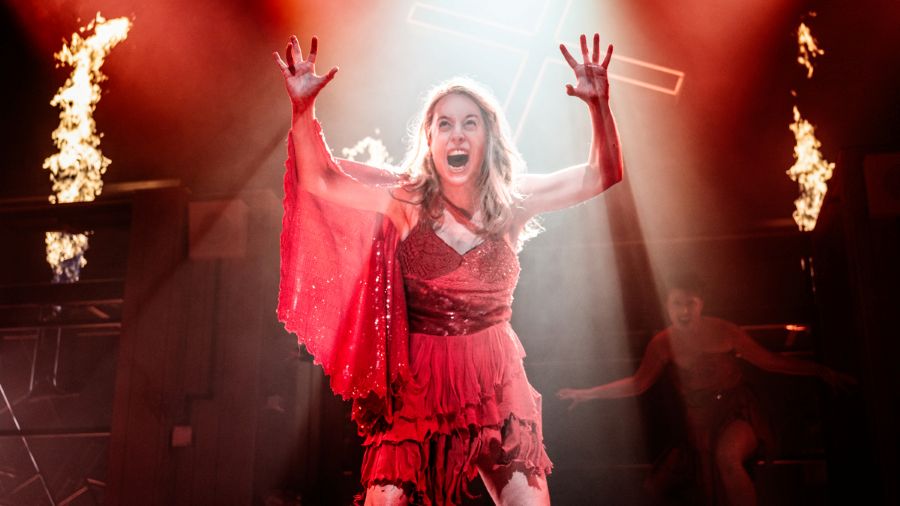
Following is the foreword to the playscript for Teeth, newly published by TCG Books and available for sale here.
About 20 years ago, when I finished my script for a movie called Teeth, I sent it to my manager to see if he could help me get it produced. After reading it, he advised me never to show the script to anyone else, that anyone who read this script would not want to work with me—ever. And then he ghosted me.
I ran up against similar resistance as I shopped the script around myself, but because I believed in its message—and in its humor—I eventually decided to produce it completely independently. And even as we began production, the unusual opposition to the subject matter continued. When we started the casting process, we found that many actors’ agencies refused to submit their clients for consideration. (Despite this, I can’t imagine a better group of actors than those who eagerly came aboard, and I will always be grateful for their work and for the trust they put in me.)
Another hurdle went up when, with some trepidation, we went to Texas to scout locations. We were relieved by the warm welcome given to us by the Film Commission’s representative, and on that first day of scouting, he showed us some very promising key locations: homes, schools, and hospitals. But the next morning, on what was to be our second day of scouting, he didn’t show up. Nor did he answer our calls. It turns out he hadn’t read the script until the previous night, and now that he had, he was busy calling all the locations he had shown us and advising them against allowing us to film there because our movie was pornography.
This is all to say that even years later, and with the movie having gained cult status, had anyone proposed adapting this story for the stage—and as a musical!—I’d have called them deranged. But then, I hadn’t yet met Anna K. Jacobs and Michael R. Jackson.
The impetus for the movie was the vagina dentata myth itself, which I learned about in a college class taught by the dynamic and inspiring Camille Paglia. It’s an ancient and pervasive myth with many variations, but it typically involves a female (sometimes a female animal) whose genitalia conceal penectomizing teeth, which the hero, a male (again, sometimes an animal), must conquer to restore societal order (i.e., male dominance). The myth is referenced time and again in popular culture, though disparately and indirectly: the Greek myth of the Medusa who turns men to stone, rigid but impotent; the beguiling but noxious yonic orchids in late nineteenth-century decadent literature; and the Alien Queen in the film Aliens, with her lubricious hidden teeth. All have been described as expressions of vagina dentata.
Why, I thought, would men ascribe this deadly attribute to women? Clearly, it’s about male fear of female sexuality/power. But why is it so persistent? I wondered if, by obscuring the original myth—and with it, the male fear behind it—we perpetuate that fear, because what we feel only subconsciously can be insidious. What I wanted to do in Teeth was expose the myth, reveal the absurdity of it, and in so doing, dilute its power. And in my telling, I turn the myth on its head: Rather than the woman being the monster who must be tamed by a hero, Dawn is the heroine, and her bodily anomaly is a superpower.
Michael and Anna were fresh out of NYU when I met with them to hear their idea about a stage musical adaptation of Teeth. I didn’t know their work—I’m not sure they had worked outside of university yet—but I got caught up in their enthusiasm and in their evident sense of humor, which signaled to me that their approach wouldn’t be conventionally didactic. And frankly, unlike a straight stage version or a movie sequel, a musical was way out of my wheelhouse, something I could never do myself.
Their talent was revealed to me in their very first workshop presentation. I loved how in-your-face their take was in every respect. It was very di!erent from the movie’s tone, which is quite demure (excepting moments of blood-pulsing gore).
In developing the screenplay into the story they wanted to tell, Anna and Michael, like all writers, had to diverge from the source material. Two instances of that divergence that really excited me were the ways in which they reinvented the characters of Brad and Ryan. In my screenplay, Brad as a little boy is smitten with toddler Dawn, but when his father marries Dawn’s mother, his love for his now-stepsister becomes taboo. As they grow into their teens, Brad’s obsession with Dawn intensifies, and his long-thwarted love/lust turns him into an angry and antisocial young man. He becomes convinced that Dawn’s devotion to sexual purity is just a defense against the lust she feels mutually for him. In contrast, Michael and Anna’s Brad has no love for his stepsister. His anger stems from the encounter he had as a young boy with Dawn’s vagina dentata, and that trauma turned him into a woman-fearing incel.
Michael and Anna’s Ryan is gay but very conflicted about it, and that figures into his betrayal of Dawn. On both stage and screen, Ryan appears to be a good guy who risks his life to be the hero in the vagina dentata myth by bravely having sex with Dawn to conquer her teeth. In the movie, Dawn finds out that the real reason Ryan is having sex with her is to win a bet he made with his friend, about which he brags mid-coitus. In the musical, Ryan’s ulterior motive is to prove to the world he is no longer gay, and he does this by live streaming their copulation to the world.
But there was another divergence from the screenplay that I wasn’t so excited about—at first. In the musical’s final moments, Dawn becomes a villain. And I wasn’t sure that I liked “my” heroine becoming a villain. It took me some time and several viewings to realize the genius of this twist.
Where the film ends with the cheer-inducing moment of Dawn fully recognizing her newfound power, Michael and Anna take her story a step or two further, to what is perhaps its logical conclusion. In the musical’s last scenes, we cheer Dawn’s victories, but in its very final moments those cheers stick in our throats. I won’t say much more, so as not to fully spoil the musical’s twist ending, but the story becomes a cautionary tale about power and to whom we give it. It’s a dark and very timely statement, and a reflection of how far we’ve come—for good and ill—since 2007.
Mitchell Lichtenstein is a filmmaker, producer, and actor. In addition to Teeth, his films include Angelica, Happy Tears, and Resurrection. He is a graduate of Bennington College (BA) and the Yale School of Drama (MFA).

Support American Theatre: a just and thriving theatre ecology begins with information for all. Please join us in this mission by joining TCG, which entitles you to copies of our quarterly print magazine and helps support a long legacy of quality nonprofit arts journalism.