
Among my community of D.C. artists, something that has always inspired me is our ability to place art and joy directly next to anger. That is life here. Our latest source of the fire: Come July 4, according to President Trump, the Kennedy Center will be closed for renovations for two years. In a gesture that coincides with America’s semiquincentennial, or 250th birthday, the president announced on Sunday, Feb. 1 via a TruthSocial post his plans to close the Center for about two years for unspecified construction (though it had an expansion and renovation as recently as 2019). This move comes after cancellations and internal discord since Trump’s takeover of the Center last year, including his rebranding of the building in his name.
If the board approves the closure, it will be a disaster not only for the National Symphony Orchestra, which offers an average of 150 concerts a year at the Center, and for a slate of theatre, dance, and music tours, but also for the Center’s day-to-day staff and programs that employ local and national artists, including Kennedy Center Theater for Young Audiences (TYA), which has developed and produced more than 120 unique productions since 1986.
Kennedy Center TYA’s staff had already downsized, with all its full-time leaders departing in October 2025, including David Kilpatrick, who’s now at Folger Theatre, Maribeth Weatherford, now at Signature Theatre, and Michelle Kozlak. The remaining staff are part-timers. The Center’s education department relies on Department of Education funding for $7 or $8 million out of its $13 million budget, as well as philanthropic and education grants. With that largesse, they managed to reach two million educators, administrators, and students across the U.S., Puerto Rico, and 12 additional countries in one year alone, according to a 2023 annual report.
If the program was already on life support even before the latest announcement, now the question is, what will happen to TYA shows that were scheduled to be developed at the Center during the planned two-year closure? One former staff member who spoke to American Theatre on background confirmed that, based on their knowledge of the contracts, artists might be able to take their shows elsewhere. But where? KCTYA was one of the only TYA companies in the U.S.—and the only one in the D.C. area—that solely produced new works, from commission to premiere to tours to national licensing, and its loss creates “a big void,” said the former staffer, who wondered what other sizable new-work incubator space could possibly take KCTYA’s place.
Of this year’s programming, a Seattle Children’s Theatre co-commission of Keiko Green’s Young Dragon already withdrew its Center run to focus on its Seattle premiere. Fishing for Stars, a theatre for the very young production by a collective that includes Megan Alrutz, Claire Derriennic, S. Elliot, Renita James, and Xinyue Zhang, comes up as a 404 on the website; another former staffer confirmed that the show, originally announced for a March run, won’t be happening at Kennedy Center. The same goes for a previously scheduled repeat tour of Sesame Street the Musical, which played the Center in summer 2025, as well as Fraggle Rock: Back to the Rock. According to an interviewee on background, no budget is currently allotted for next season in TYA, and next year’s season “doesn’t exist.” A former staffer guessed that the focus would have been on bringing in groups or pre-existing scripts, prior to the closure announcement.
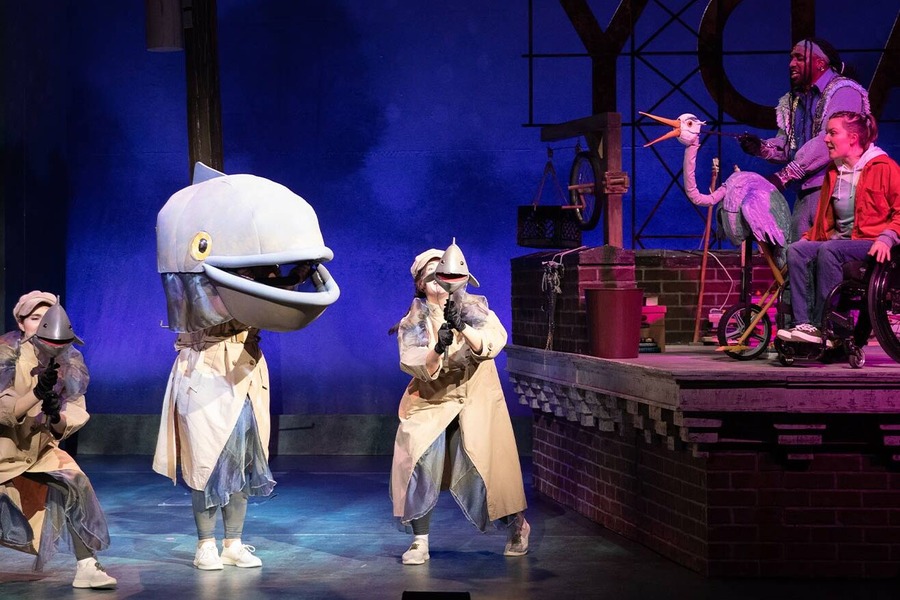
There is one more TYA show scheduled to go up before the July closure, which one former Center staffer called “one of the most creative scripts I have read in a long time”: the world premiere of The Sea Beyond the Ocean by playwright Doug Robinson, who was raised in northern Virginia and is now based between D.C. and New York. Set to run Feb. 28-March 15, it follows a boy who searches for the missing ending to his favorite unfinished book. Featuring an all-Black cast, it is a Black fantasy in a register akin to Octavia Butler that “allows for the possibility of something different” and “invites people to imagine a better world,” said dramaturg Gabrielle Hoyt.
Robinson said he wanted to write a play for his father, who read books to him over the phone when he went on business trips. It’s “a play for kids who like to read, who find that reading is the safest place for them to be,” Robinson said. “Working through imagination is a way to build the end of the story you want to have. Imagination is the key to seeing a future that has never wanted you there, right? So it’s a play that says a child’s imagination can create a whole world where the characters come out, they tell stories, they learn, and they move forward. They’re not static. They’re not like, ‘We had an adventure, and now we’re going home.’ The world is changed by the imagination. That matters.”
Robinson first pitched Ocean when former staffer Sean-Maurice Lynch introduced him to the KCTYA team. Since being commissioned in late 2023, Ocean received two Kennedy Center workshops: one with Ashleigh King, and another with KenYatta Rogers, who directs the world premiere. Over the years, what has deepened and grown the most is Robinson’s understanding of what endings mean to a child. As Hoyt put it, “It’s become a really moving discussion of how to talk to kids about endings.”
One real-life ending: the exit of Kennedy Center TYA staff. When Michelle Kozlak departed, Robinson said, she called him personally; his play was what kept her there for as long as she could stay. Conversations about who would take over her work were had. “Not gonna lie, it was scary to have that transition,” said Robinson. “But I have never felt those fears come to reality. I have never, for one second, felt a lack of intentionality or support from Kennedy Center TYA.”
For now, the company is in rehearsals, and the room has been an “intentionally and actively joyous” place, Robinson said. For the actors, staying focused on the art is important. Many were reluctant to speak for this article prior to opening out of fear that the administration would retaliate against the show. Said Robinson, “Simply put: the Kennedy Center commissioned me to write a play, and they’ve paid me all my money before the first rehearsal. I can pull the play and I’m not missing a dollar. It’s not about that. It’s about what we as a group want to do.”
He recalled a conversation with the company on the first day in which they spoke about their feelings and why they were choosing to stay. “That was heartbreaking, hearing the individual inner life that people had to contend with,” Robinson said. “But they all still came to the conclusion that telling this story in what is historically known as Chocolate City, to kids, in a time where people think representation is only in service of some DEI language…How could we not?”
The joy they’re finding, Robinson said, is also in direct relationship to a kind of resilient protest. “Do we stand up for our home? Do we stand up for a place that I went to as a child wearing ill-fitting dress shoes with my mother?” Robinson said, recalling his first visits to the Kennedy Center. “If, and I hope this is not true, if the last new work produced by Kennedy Center TYA is The Sea Beyond the Ocean, I am grateful that the last group on that stage is a group of homegrown actors, homegrown designers, and homegrown storytellers. Because, the Kennedy Center is, yes, a symbol, but it’s also a local theatre.”
On the day that it was announced that Center would be closing for two years, Hoyt said, the staff spent the day making sure that the company was getting paid in a timely fashion. “They were responding to emails of mine within 5-10 minutes, about my direct deposit details, when they didn’t know if they had jobs anymore,” Hoyt said. “What they were doing was making sure that the contractors and artists in their building were being, like, financially, taken care of and safe. It was wild. I do not know if I would have had the fortitude to do that that day, but they did.”
“It really has become an all-hands-on-deck situation,” Robinson said. “Everyone is stepping up in ways that both I appreciate and also wish that they didn’t have to. It is a both-and situation, right? It is brilliance in the face of difficulty—not that difficulty has made the place weaker, if that makes sense. The building is the people. The storm can rage around them and they’re saying, how do we keep as many people safe as possible? How do we ensure that this is not a place of more chaos, but the eye of the storm? That this place can be calm and still, and we are going to make it through?”
Hoyt agreed: “The D.C. arts community has lost a lot of funding. Institutions have closed. Institutions are going to keep closing. For me, I did not want to cause more loss, just because I would feel a certain way going into a certain building. Doug’s play is beautiful, and kids and families should get to see it if they feel that they can go there.”
Another KC program for young people had already left the building: Last Dec. 22, American College Theater Festival (ACTF) suspended its affiliation with the Kennedy Center after 58 years of partnership with the Kennedy Center. KCACTF was the oldest program at the Kennedy Center (indeed it predates the Center’s official opening, in 1971). In a Facebook post, ACTF shared that “our affiliation with the Kennedy Center is no longer viable…We want to assure you that this change does not mark an end—but a new chapter…ACTF will continue to serve as a ghostlight—a beacon of joy, a sanctuary for all, and a place where every artist feels seen, safe, welcomed, celebrated, and beloved.”
According to Kelsey Mesa, who has managed the national program with Gregg Henry for nearly a decade, ACTF held an emergency meeting the day after the “Trump Kennedy Center” name change announcement at which the national board voted overwhelmingly to separate immediately because “there was no way to move forward.” They had already cut Kennedy Center-run intensives for 2025 and 2026, after being told to cut $1 million with four months to go in the Education department’s fiscal year, and the intensives were the only budgeted item left.
One silver lining: The KCACTF National Committee and its regional conferences have operated under a separate nonprofit organization, ACTF Management, Ltd., so ACTF can continue in a different form outside of the Kennedy Center. Its regional conferences, run entirely by volunteers who work at universities and have their own artistic careers, continue to thrive, with four for 2026 already under their belt.
The national festival presents a steeper challenge. Finding a space isn’t the issue; the biggest costs are travel, accommodations, and continued learning opportunities, which were covered by the Kennedy Center. ACTF had already planned to hold the national festival in Minneapolis, with Twin Cities theatres like Children’s Theatre Company, the Guthrie, Mixed Blood, and the Playwrights Center offering space, keynote artists, hotel recommendations, and more. But their split from the Kennedy Center means that the ACTF nonprofit doesn’t have enough funds and so will not host a national festival this year. (The decision was made before the recent ICE takeover of Minneapolis.) Also at risk in the shuffle: an ACTF fellowship that allowed budding theatre journalists to attend the O’Neill Critics Institute.
In the future, said Mesa, we may see “a version of ACTF that omits the national festival but gives young people opportunities to bridge their careers.” It also may be possible to partner with other organizations to host the festival, but the price of putting it all together can run to half a million dollars, a big cost that is not always evident to potential hosts, Mesa explained.
Students are still showing up for local ACTF gatherings. In attending Region 1 and 2 this past January, Mesa said that one play that particularly touched her, during the National Playwriting Program’s 10-minute play event, was Plums by Sarah Galante, an MFA candidate at NYU. Mesa called it an “intense, grey-area, loving” conversation between two lesbian mothers whose 6-year-old daughter comes home with bruises on her arm, spurring questions about harm and protection. It was a quintessential ACTF moment: A Region 1 co-chair of the National Playwriting Program, Cassie Seinuk, had won the national 10-minute play award at KCACTF in 2015 with her play Occupy Hallmark, which was also Mesa’s first experience with KCACTF, in a reading she directed for the National Festival.
As ACTF still hopes to provide opportunities for community colleges, small arts colleges, and MFAs alike, they are actively accepting donations to stay afloat and sustain national opportunities. “This work is for students who do not come with privilege, and gives them the chance to be theatre artists,” Mesa said. “I want the field to step up for it.”
Calls to action within the D.C. theatre community have been swift. In a statement, TheatreWashington executive director Amy Austin said the Center’s closure “will have widespread ramifications for the D.C.-area performing arts community and everyone who benefits from a culturally vibrant region.” The service organization urged folks to donate to its Taking Care Fund, which supports D.C. arts workers through tough times, and encouraged displaced arts workers to use the fund.
Last Tuesday, Kennedy Center Arts Workers United, representing Actors Equity, SDC, IATSE, and more, spoke out. “A pause in Kennedy Center operations without due regard for those who work there would be harmful for the arts and creative workers in America,” the union said in a statement. “Should we receive formal notice of a temporary suspension of Kennedy Center operations that displaces our members, we will enforce our contracts and exercise all our rights under the law. We expect continued fair pay, enforceable worker protections, and accountability for our members in the event they cannot work due to an operational pause.”
Hoyt, who lived in D.C. for five years as literary manager for Round House Theatre, reiterated the respect that she has “for every artist who was supposed to come through Kennedy Center this year, who did come through Kennedy Center this year, or who did not come through Kennedy Center this year. Saying no is an act of profound bravery, and it’s really necessary. That we made a different choice, I think, does not negate theirs, and does not imply that theirs was wrong, or invalid, or created harm of any kind. The theatre community has to have solidarity right now. We have such respect for a lot of amazing artists who are faced with terrible choices. There are no good choices. This is a bad situation.”
It’s also true, she noted, that the DMV area “is a great place to be a kid who loves theatre,” citing education programs and productions at Imagination Stage, Round House Theatre, Adventure Theatre MTC, Theatre Lab, Educational Theatre Company, Shakespeare Theatre Company, Arena Stage, and many more. “It is hard for me to imagine that the Kennedy Center’s ability to serve young people is going to end this year,” Hoyt said. “I just, I don’t—that cannot be, under my personal cosmology.”
Daniella Ignacio, a writer, theatre artist, and musician based in Washington, D.C., is a contributing editor of this magazine.