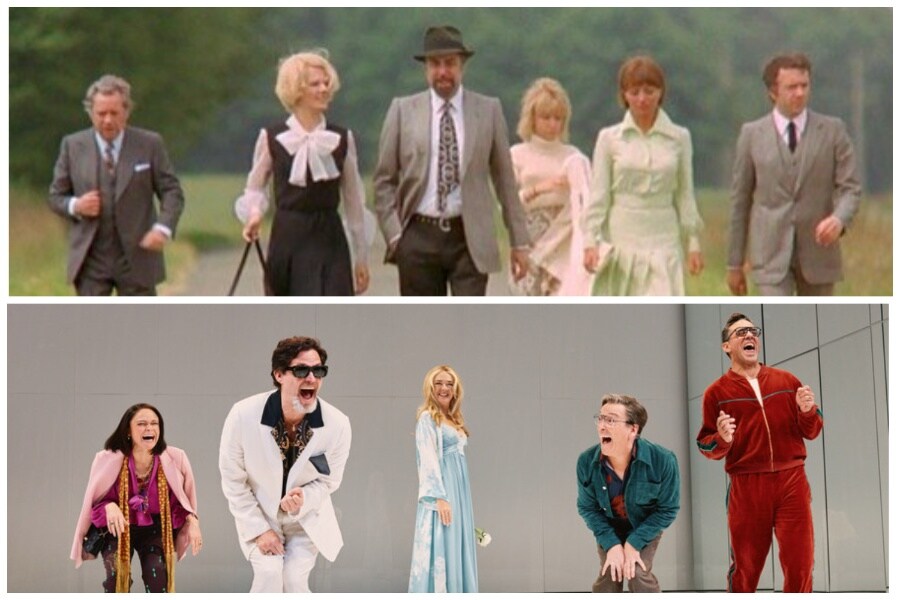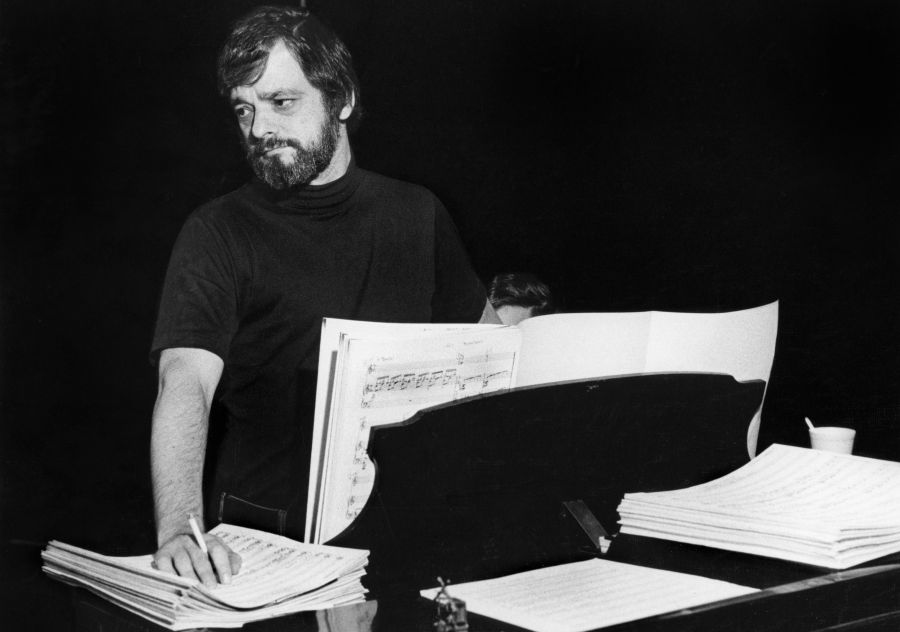
Don’t meet your heroes, goes a popular axiom. In the case of Stephen Sondheim, the composer/lyricist who redefined the possibilities if not the sound of American musical theatre, the wisdom of that advice might depend on when you caught him: in his early years, when he was learning at the feet of Oscar Hammerstein II while cannily maneuvering among peers and collaborators and chafing at the era’s, and his medium’s, restraints; in his ascendant 1970s period, when his struggle to assert his unique voice gave him a short-tempered, even manic aspect; or in his later éminence grise phase, when he mellowed into a kind of encouraging father figure for younger generations.
It was in the late bloom of that last period, in the midst of releasing his mountainous lyric collections (Finishing the Hat and Look, I Made a Hat, now sold as a unit under the name Hat Box), that he did me the considerable honor of a chat at his famous Turtle Bay townhouse; the only way our conversation could have gone better is if he’d sat down at the piano (or asked me to). But a former colleague once told me of the night in the 1970s when she was having drinks with Jamie Hammerstein, Oscar Hammerstein’s son, and another man she described as greasy, chain-smoking, and antisocial—i.e., he talked only to Jamie, in a neurotic stream, and entirely ignored her. When the mystery man excused himself to use the loo, she asked Jamie who this rude, unpleasant character was. “Oh, that’s Stevie,” he replied.
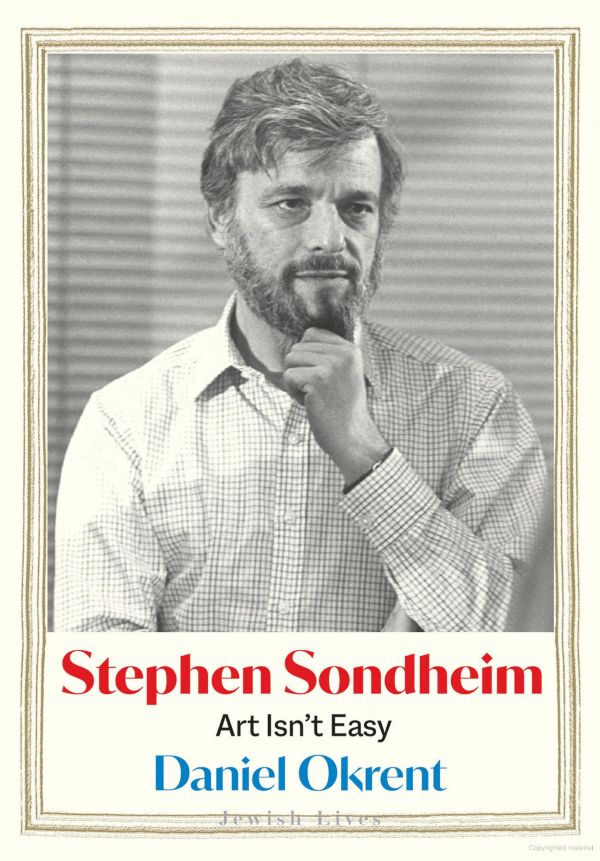
The highest compliment I can pay to Daniel Okrent’s excellent new biography, Stephen Sondheim: Art Isn’t Easy, is that it more than meets its clear ambition: to capture the full range of its subject’s mercurial personality, from bitter to sweet, ice-cold to hotly intemperate, peeved to magnanimous, and all gradations in between. Indeed, though Okrent admits that he never personally met Sondheim, his book—which relies on archives and fresh interviews, including, full disclosure, a brief citation from yours truly—comes as close as possible to giving readers a sense of what it might be like to meet the man at any point in his storied life and career. The portrait that emerges is, much like Sondheim’s musicals, complicated, ambivalent, teeming with detail, and rich with humanity. Okrent’s Sondheim is by turns a frosty, arrogant dick and a vulnerable, sensitive soul; a dear, solicitous friend and an irrational grudge holder; a savage critic, not least of himself, who nevertheless can’t abide public criticism; a shambolic slob and an exacting aesthete; a hard-working craftsman all too easily distracted from his work. No wonder the man wrote so well about mixed feelings!
Meryle Secret’s essential 1998 biography broke a lot of the news about Sondheim’s life, career, and inspirations, chiefly his troubled relationship with his mother, Etta, a.k.a. Foxy, and his homosexuality, which coexisted uneasily with a lifetime of misdirected romances with women, until he found love in his 60s with a young male composer (and later, in the early 2000s, with a young producer, Jeff Romley). The stories of his formative artistic collaborations with Harold Prince, Arthur Laurents, and James Lapine, among others, have been illuminated not only by Secrest but in Craig Zadan’s Sondheim & Company, and more recently Lapine’s own Putting It Together, about the making of Sunday in the Park With George.
What does Okrent have to add to the conversation? After all, Sondheim’s last major stage work was 1994’s Passion (with all respect to Wise Guys/Bounce/Road Show and Here We Are), and though he never stopped writing and tinkering with show ideas, the years between Secrest’s tome and Sondheim’s death in 2021 were chiefly a long, distinguished twilight his colleagues called “the God years.” There’s not a lot of new career ground to cover, in other words.
What Okrent delivers, in a packed 230 pages, is no mere rehearsal of the familiar timeline and the intervening years. He also wants to make an argument about the demons that drove Sondheim to create: namely, revenge against his mother for a lifetime of callous treatment, with a side of spite for a raft of rivals and critics. To Okrent’s credit, while he marshals plenty of evidence for his case, including articles on the topic of revenge written by Sondheim’s longtime therapist, Milton Horowitz, and blow-by-blow accounts of contretemps with a gallery of bugbears and frenemies, he also consistently complicates the picture along the way. One anecdote that has become legend, for instance, concerns the letter Sondheim’s mother wrote to her son after a near-death medical episode in the mid-’70s, in which she said “the only regret I have in life is giving you birth.” Not only does Okrent cast a flicker of doubt on whether the letter ever was actually sent or that those were its exact words, he later adds nuance to the notion of total enmity between mother and son, describing their relationship as a “cold war,” and noting that Sondheim dutifully visited Foxy over the years and paid for her elder care, though he did not attend her funeral.
One subject that was not prominent in Secrest’s biography: Sondheim’s relationship to drugs and alcohol. Of the former, those who’ve read Lapine’s Putting It Together may be ready for the news that Sunday was “created in clouds of marijuana smoke,” but I for one was not prepared for Okrent’s next revelation, via an interview with Lapine: that the writing of Into the Woods “was fueled by cocaine—‘mounds’ of it.” Magic beans indeed.
Meanwhile, reports of Sondheim’s prodigious drinking are no joke, with Lapine and others labeling him, without such qualifications as “functioning” or “part-time,” an alcoholic; many marvel at how high his tolerance must have been, given how little effect his prodigious intake seemed to have on his demeanor, at least until later in life. It had a relationship to his work, though: Sondheim said he found lyric writing “hell,” and that he drank in part to loosen his “mental censors.” By contrast, he relished writing music so much that the only score he ever wrote sober was the entirely instrumental soundtrack for the film Stavisky.
Lest these details make Okrent’s new book seem like tawdry tabloid fodder, rest assured: This characterological focus is couched in astute readings of Sondheim’s shows and their gestations, from an early Hammerstein-assigned exercise, Climb High, all the way through the posthumously staged Here We Are, and all points between, including crucial tribute concerts in 1973 and 1985. Without ever quite succumbing fully to the biographical fallacy, and giving full due to the various book writers Sondheim worked with, Okrent takes as a given that the composer’s work expresses something of its creator’s intrinsic essence, from the wishful lyrics of Climb High (“When I get famous/I’ll be free”) to shows with obvious Sondheim stand-ins, from Company’s bachelor cipher Bobby to Sunday’s perfectionist painter George.
But Okrent’s psychologizing is not simple- or single-minded. He notes that while Sondheim’s work with Lapine seemed to unlock unconscious themes that might be read biographically, not to mention fresh veins of warmth and vulnerability, Sondheim’s work with John Weidman on Pacific Overtures and Assassins “took him outside of himself.” Of course, even in looking outward, Sondheim only found more of himself, creating, in the Rashomon-like rumination “Someone in a Tree,” one of musical theatre’s towering masterpieces—a song he could barely play for Weidman when he first finished it, he was “so emotional about it.” He did manage to get through the tune, though by the end, Weidman later said, his colleague was “just completely undone by it.”
The central exhibit in this process of self-expression by other means, as well as of Okrent’s revenge thesis, is the bloody, quasi-operatic Sweeney Todd, arguably Sondheim’s greatest (I for one would argue it). The extent to which this ingenious, gruesome 1979 musical reflects its composer’s tastes and preoccupations has been duly noted and explored; aside from Passion, it was the only property he personally pursued, as opposed to having a collaborator suggest it. It was also, as Okrent reports, the score he had the breeziest time writing, later claiming, “It just wrote—as Barbra Streisand would say—‘like buttah.’” Ah, yes, Sweeney Todd, that famously simple and straightforward entertainment. (Cue “Anyone Can Whistle,” another candidate for autobiography in song: “What’s hard is simple/What’s natural comes hard.”)
Speaking of unconscious themes: As Okrent’s book is part of Yale University Press’s Jewish Lives series, he is duty-bound to report on this aspect of Sondheim’s life. There’s not a lot to say here, honestly: Raised by (divorced) parents who worked in the garment business, he had no religious training, once saying to a classmate at the Quaker school he attended, “I’m told I’m Jewish. Is that true?” There are relatively few Jewish characters in his work, and though he later claimed “very deep” identification with his Jewish identity, he meant the kind of mid-century secular Jewishness of Nichols & May, Kander & Ebb, or Leiber & Stoller. Okrent mentions a series held in 2022 at the 92nd Street Y titled “Sondheim and the Torah,” in which actor Etai Benson and Rabbi Samantha Frank explored Jewish themes in Sondheim’s work; Frank called “No One Is Alone,” from Into the Woods, “basically chapter one of the Torah.”
Sondheim may have demurred on that point, though, as Okrent tells it, that particular song was another of those hard-to-get-through, too-real moments; clearly it touched some kind of home truth for its author, scriptural or otherwise. “It was an extremely hard song for him to write and it was equally hard for him to play for us,” he records Lapine saying to Zadan. “It’s very scary when you start getting close to what you really feel and put it on paper.” Okrent finishes this thought with another self-revealing quote from Sondheim, who elsewhere insisted, in classic protest-too-much fashion, that his work was not about him: “You can be very naked in a lyric, and say what you want to say.”
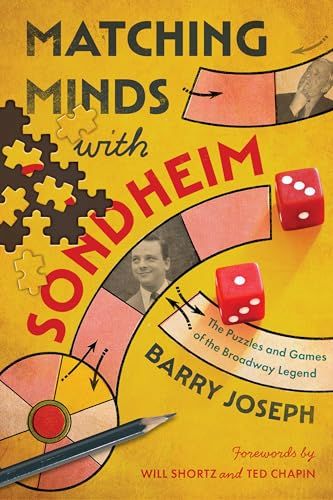
Another side of Sondheim comes through in Barry Joseph’s delightful Matching Minds With Sondheim: The Puzzles and Games of the Broadway Legend, a new compendium combining a “ludological biography” (i.e., a timeline of Sondheim’s elaborate games, treasure hunts, and puzzles) and an appendix-like guide to “how to play the Sondheim way.” While some of Joseph’s psychologizing is pat compared to Okrent’s—Sondheim’s love of games and puzzles, Joseph theorizes, springs from being “the child of a nasty divorce that left him always seeking order within the surrounding chaos”—the book functions as a diverting meta-biography, as Sondheim’s game-making career paralleled his musical-making one, and even outlasted it. (Did it occur to me, while learning about the time and effort Sondheim poured into these one-off diversions, that we could have had a few more musicals if folks hadn’t kept asking him to design a hunt for them? Reader, it did.)
The chapter on murder games and the film The Last of Sheila illuminates the influence Sondheim had on the way those games are played to this day, including in such online games as Among Us—a lineage acknowledged by his brief cameo in Glass Onion: A Knives Out Mystery. Other chapters detail the treasure hunts he designed for friends and organizations, his dabbling in computer and video games (he was an early Myst adopter), his brief stint as a 1960s-era game show contestant, and various puzzles and board games he was involved in creating.
It’s all a bit nerdy and granular, even for me. What I cherished most were the book’s insights into Sondheim’s character that Joseph gleans throughout, which make a nice complement to Okrent’s more gimlet-eyed view. The saga of how a film researcher named Jane Klain managed, after decades of archive-diving, to track down a long-lost clip of Sondheim’s 1966 appearance on Password alongside his dear friend Lee Remick is deeply touching. Sondheim’s response: “OMG, as you young people say. I am gobsmacked.”
Similarly, it seems uncharitable to begrudge Sondheim his outsized games-and-puzzles predilection when you read about the salutary effect they had on his personality. Many of his game-playing friends, who included over the years everyone from actor Anthony Perkins to playwright Jonathan Marc Sherman, note both his avid competitiveness and his youthful jocularity when he’s playing games—or, as Joseph puts it, “when swept up in the ludic moment.” One game player says that even when playing with folks a fraction of his age, Sondheim “had the youngest energy in the room. He was like a 10-year-old.”
Joseph quotes Sherman as saying, of one of Sondheim’s murder games, “He’s as proud of inventing this game as any song he’d ever written.” Of course, it’s the songs that we remember and revere Sondheim for, and that make these books worth reading in the first place. Following the instructions in Matching Minds, and reading Okrent’s biography, may get us close to a sense of Sondheim the man. But Sondheim the musical dramatist, in all his unbiddable complexity and brilliance, is always as close as the next replay or revival. He holds us too close; he ruins our sleep; he knows us too well; he varies our days; he makes us alive.
Rob Weinert-Kendt is editor-in-chief of American Theatre. He also reviews theatre and culture for America magazine.