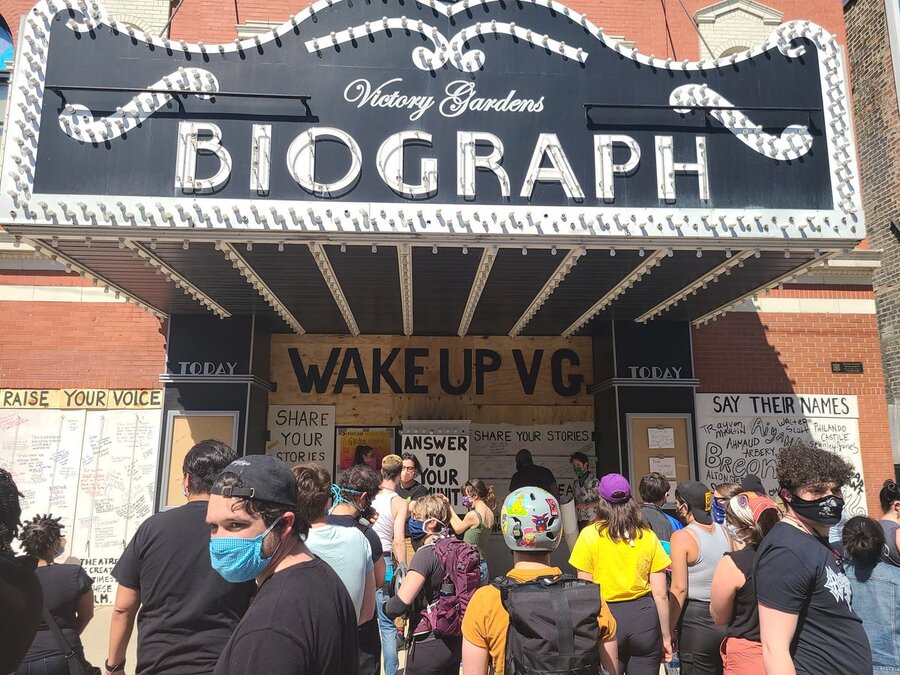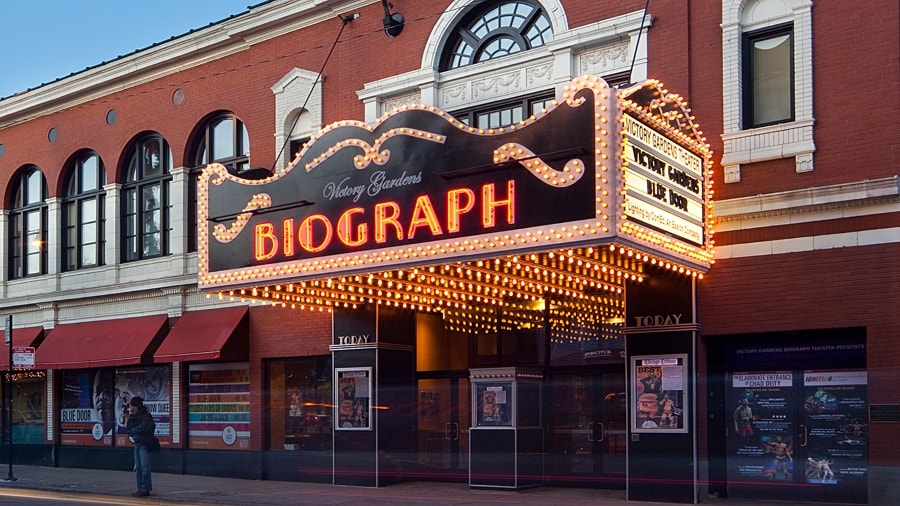
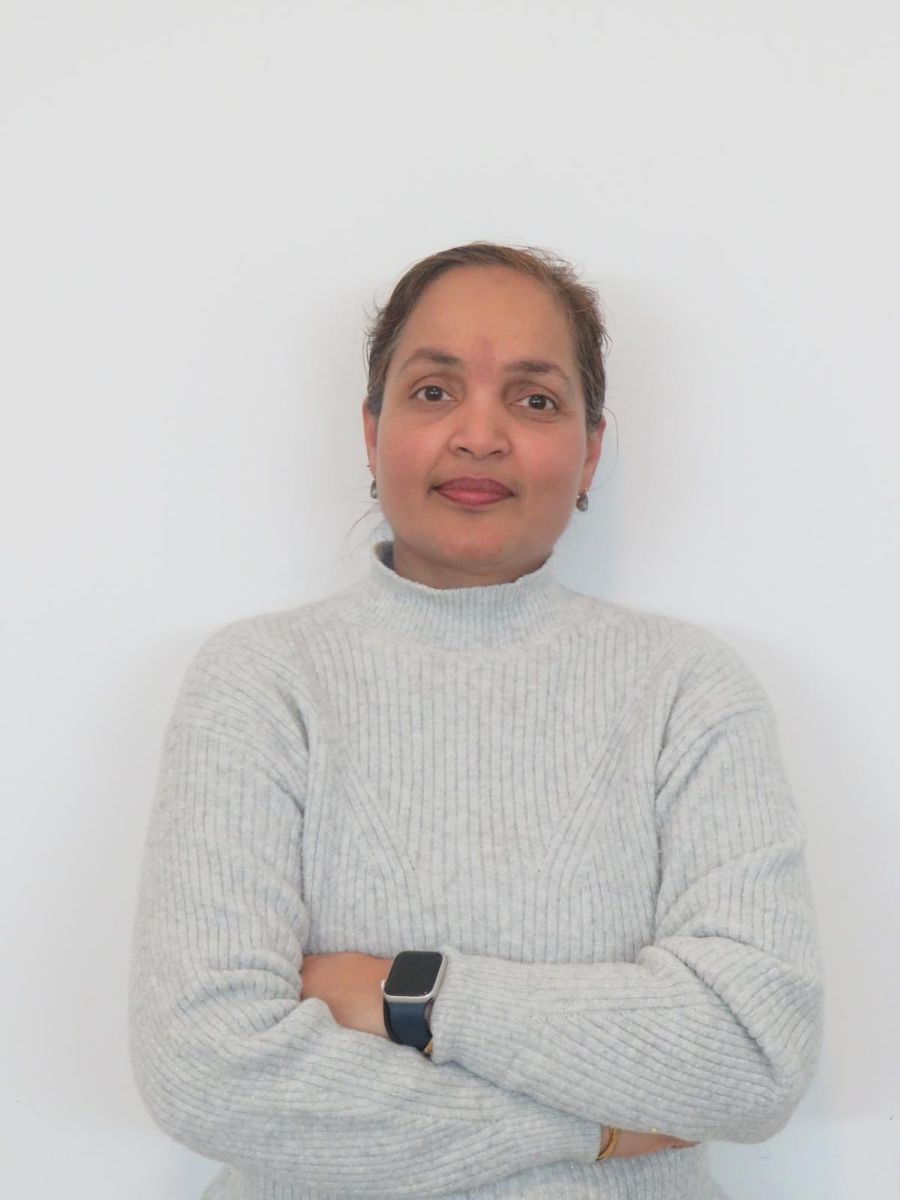
Chicago’s Biograph Theater, home of Victory Gardens Theater for the past two decades, has largely lain dormant since September 2022, when the remaining members of the company’s bare-bones staff were fired after years of high-profile disputes among the board of directors, the administration, and the ensemble. But things may be turning around at last. When American Theatre sat down with Edward Torres and Archana Vaidya—the company’s current interim artistic director and interim executive director, respectively—one weekday morning in late March, the historic Lincoln Park venue showed signs of life. Torres and Vaidya told me they aim to make Victory Gardens a fully active producing theatre once again.
Under their new leadership, Victory Gardens has hosted a writers’ workshop, a showcase of new works in collaboration with New Musical Chicago, and a staged reading of An Ocean Away, a documentary play by Belarusian playwright Andrei Kureichik about the effects of war on Ukrainians and diaspora communities. The latter event raised funds for the Protez Foundation and the Selfreliance Association, two aid organizations that support Ukrainian survivors and immigrants. It’s a start, though, as Vaidya noted, the journey back to life for now consists of “baby steps.” (Full productions, the leaders say, may come as soon as the fall.)
Vaidya joined the staff in summer 2025, and Torres was hired as interim artistic director in December 2025, bringing the staff count to two. While Vaidya is a relative newcomer to the city, Torres—a Chicago native and co-founder of Teatro Vista, one of the city’s preeminent Latino theatre companies—has a long history with Victory Gardens that goes back to the late 1970s, when the theatre toured its Equity Latino ensemble to Torres’s high school on the city’s Southeast Side. That connection led to Victory Gardens offering Torres a scholarship for acting classes; he later studied theatre at Roosevelt University and began a theatre career in Chicago. His directing breakthrough came in 2009, when he staged the world premiere of Kristoffer Diaz’s The Elaborate Entrance of Chad Deity, a Victory Gardens and Teatro Vista co-production that transferred to New York and was a finalist for the Pulitzer Prize for Drama.
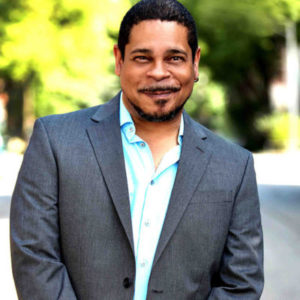
“I was born and raised here. This is my city, and this is my community,” said Torres, who also directed the Chicago premiere of David Mamet’s Henry Johnson in the spring of 2025, a co-production between Victory Gardens and Relentless Theatre Group, a new company that Torres founded with Daniil Krimer. “This theatre played an important part in my career; they gave me the opportunity. So I’d like to keep it going if I can. We’re going to try.”
For her part, Vaidya moved to Chicago from India with her family several years ago; she holds a master’s degree in management and information technology and previously won awards as an actor in India, and has directed theatre in the U.S. since relocating.
“Although I had less time as compared to Eddie connecting with this theatre, we share the same sentiments for this theatre,” Vaidya said. “We really want to welcome the people now. We want to open our hearts, open the doors of this theatre for the public to come in and to watch the art and the expressions of people. That’s what a theatre does, and that’s what we want to continue.”
Vaidya’s main priorities since she began have been practical: completing necessary repairs on the neglected building, shoring up the company’s finances, and rebuilding its donor base. There’s a lot of work to do on all these fronts.

Začek’s tenure as artistic director spanned 34 years, from 1977 to 2011. “The latter part of the time, 14 years or so, I continuously fought with the board,” he told American Theatre. “Basically, it was a question of whether or not it was a focus on art or it was a focus on things like real estate. The board was more inclined, by and large, to be concerned about real estate. Obviously, in the end, that’s where they wound up, having real estate and not much in terms of art.”
Indeed, board problems have cropped up throughout the story of the company, right up to the present; perhaps unsurprisingly, American Theatre was unable to reach any board members for comment for this story.
Many early conflicts played out around the issue of space. Since 1981, Victory Gardens had performed at 2257 N. Lincoln Avenue (now the Greenhouse Theater Center), initially sharing the space with the Body Politic Theater before later taking over the entire building when that company folded in 1995. By 2004, the board had abandoned an ambitious plan to move to the Royal George Theatre—as well as an attempt to demote Začek, who had concerns about their expansionist goals—and purchased the Biograph Theater. Victory Gardens then renovated the former cinema and designated Chicago Landmark located at 2433 N. Lincoln Avenue (best known for its connection to the death of bank robber John Dillinger) at a cost of about $12 million. The main stage, now called the Začek McVay Theater, seats 299, while the studio theatre, named for Richard Christiansen, has a capacity of 109. In 2006, Victory Gardens opened the renovated Biograph with the world premiere of Smith’s Denmark.
“I think the move to the Biograph was both a blessing and a curse,” said Post, “because what we could get away with in a 200-seat house, we couldn’t get away with it on the same level in a 300-seat house. And when you are doing new work, not every play is going to be a hit. So, the board, I think, started to get very concerned.”
Jeffrey Sweet, another member of the original Playwrights Ensemble, was blunter in his assessment. “They got a case of Steppenwolf fever,” he said. “They thought, ‘Oh, we’ve won the Tony Award; let’s move to a bigger place,’ which is a classic mistake. If you take a look at the history of regional theatres that have won Tony Awards, about a third of them fail after they win the Tony Awards, because they overreach.”
Based on the company’s publicly available 990 tax forms, its financial health indeed took a hit several years after moving to the Biograph. Victory Gardens posted a net income deficit of nearly $800,000 in fiscal year 2010 and nearly $1 million in fiscal year 2011. Net income remained negative for much of the following decade, with the exception of fiscal year 2015.
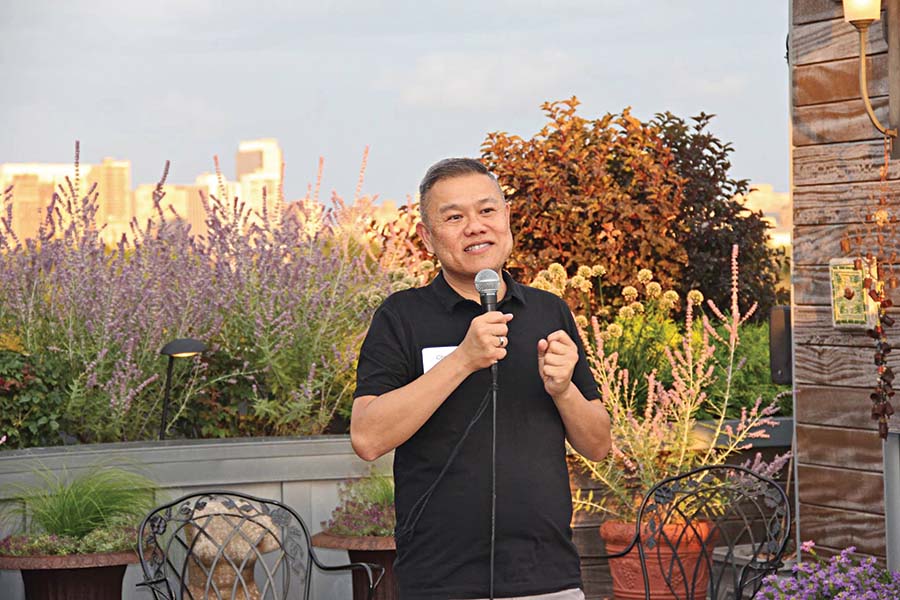
What’s more, since Začek’s departure in 2011, Victory Gardens has undergone several bumpy leadership changes. Despite Začek’s strong preference for longtime associate artistic director Sandy Shinner to succeed him as artistic director, the board conducted a national search and appointed Chay Yew, who led the company from 2011 to 2020. A Singapore-born playwright and director with extensive credits across the U.S., Yew immediately made waves by bringing in a new cohort of Playwrights Ensemble members and abruptly changing the status of the original members to “alumni” (or “emeritus,” as a printed playbill initially—and, according to Yew, mistakenly—broke the news). Some of the affected playwrights viewed this move as a betrayal of Victory Gardens’ commitment to local writers, while others acknowledged that it was natural for a new leader to start fresh with a new vision and new collaborators.
The new ensemble included writers who have since gone on to great success, including Ike Holter, Marcus Gardley, Luis Alfaro, Naomi Iizuka, Tanya Saracho, Laura Schellhardt, Philip Dawkins, and Samuel D. Hunter. During Yew’s tenure, Victory Gardens produced 18 world premieres, of which two went to Broadway, four were produced off-Broadway, and others transferred to regional and London theatres. Yew also expanded the company’s diversity, equity, and inclusion initiatives by launching new programs to support emerging directors and arts managers.
“My seven years there were extraordinary,” said Alfaro, whose premieres at Victory Gardens included Oedipus el Rey, Mojada, and St. Jude. “In Chicago, I think people really take care of themselves, so there was something really nice about feeling that the familial was a part of the language of how you engage there and you engage in the city. Those seven years were very productive; I did a lot of writing, but I also did a lot of community work.”
After Yew left the company, Alfaro was among the ensemble members who resigned via open letter in May 2020, citing a lack of communication and accountability when the board decided to appoint then-executive director Erica Daniels to the newly created role of executive artistic director. Amid the controversy, Daniels resigned before assuming the planned position. Ken-Matt Martin was then appointed as artistic director in March 2021, marking a new chapter that seemed promising to some former ensemble members. A former associate producer at the Goodman Theatre, Martin was Victory Gardens’ first Black artistic director, and he immediately embarked on an extensive listening tour, meeting with many current and past staff and artists.
But his tenure abruptly ended when the board dismissed him without clear cause in June 2022, prompting the current Playwrights Ensemble to follow in their predecessors’ footsteps and collectively resign; Ericka Dickerson-Despenza, though not a member of the ensemble, pulled the rights to her play CULLUD WATTAH in solidarity, and community members protested at the theatre that summer. The dispute seemed, again, to be at least partly over a “major real estate transaction.” When the remaining eight staff members attempted to unionize, they were fired in September 2022, and the board announced that Victory Gardens would transition into a presenting organization.