Hop on the Red Line with me; we’re headed south. Yes, we can swing by the construction for the Barack Obama Presidential Library, but we have business elsewhere on the University of Chicago campus. We’re headed to the Logan Center for the Arts for “America@250: A New Works Convening,” hosted by Court Theatre. This intimate gathering, held April 16-17, brought together Chicago-based and national theatre practitioners to “address urgent questions facing the field.”
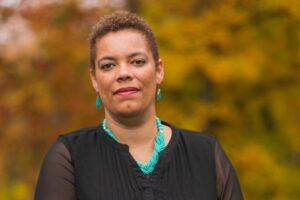
 “It has been so fruitful and rewarding to gather people in informal ways,” said Avery Willis Hoffman, Court Theatre’s Marilyn F. Vitale artistic director, who joked that they called it a convening to release some of the pressure that comes with calling something a “conference” or “symposium.”
It all came about when, as Hoffman was joining Court last year, the organization was having internal conversations about the challenges of supporting new work. Court was in the midst of bringing Out Here—a new musical from Leslie Buxbaum, David J. Levin, and Erin McKeown that has a Chay Yew-directed world premiere currently running at the theatre (through May 10)—to the stage. They also had their attention on the new opera safronia, from inaugural Chicago Poet Laureate avery r. young, which had a concert-style performance at Chicago’s Lyric Opera and is now set for a full production at Court in 2027.
So, Hoffman said, they thought, “We should gather some folks and see if we can have some conversations about what it means to incubate new work, what it means to support new work, or even present new work in these very particular times.”
Hoffman said they wound up inviting around 100 folks from around the country, including artistic directors, producing directors, and directors of new work to see if they’d be up for the conversation. Court wound up with a rather impressive list of 26 speakers for the two-day event (Hoffman notes that many more expressed excitement about the convening but couldn’t attend). Theatres represented ranged from the biggest Chicago houses (Steppenwolf, Chicago Shakespeare, Goodman) to storefronts (Remy Bumppo, The Story Theatre), from universities (Northwestern, DePaul, UCLA, Virginia Tech) to heavy hitters from around the country (La Jolla, PAC NYC).
The event was headlined by a Dean’s Salon on “The University and the Future of Theatre,” a conversation between Hoffman, University of Chicago Dean of the Arts & Humanities Deborah Nelson, and UCLA distinguished professor Peter Sellars. In addition to the salon, the other four sessions including a conversation among Chicago theatremakers about incubating and developing new work; a conversation with the creative team behind Out Here; a more national-oriented conversation on incubating and developing new work; and a discussion about developing new work specifically within higher education. While I was only able to attend the first day, I was glad, when speaking to Hoffman afterward, to hear that we both found inspiration in similar takeaways from the conversations.
“I was really heartened by ideas about new models of supporting artists, of supporting new work, of strengthening and sustaining our theatre ecosystem,” Hoffman said. “It’s important in these critical moments in our nation’s history that we in the arts say, ‘We’re here, and we’re thinking about what rises out of the ashes of our current state of affairs.’”
Indeed, I left the first session I attended—the Chicago-focused look at supporting new work—mentally turning over thoughts of efforts to pair commissioned playwrights with university theatre programs as well as DePaul’s student-centric model, in which the university can partner with a theatre that has space for a weekend and then empower students to go create their own festival. But the two thoughts that have stuck with me the longest since the convening came from Sellars and from Remy Bumppo artistic director Marti Lyons.
Said Sellars, whose storytelling ability is nigh impossible to recapture on the page, “The arts have been in beautifully funded arts centers. But actually, the arts need to be everywhere else: in hospitals, in prisons, in court. The arts need to be everywhere but an arts center.”
In a world that seems to increasingly want to forget that art has a place other than a screen or an auditorium, it was fascinating to listen to Sellars effuse about art’s place in society. And as I look around and see everyone, artists and non-artists alike, battling burnout and exhaustion, it’s a thought from Lyons that I keep coming back to.
“I just feel like we’re running so hard to stay in place,” said Lyons. “The thing I keep reminding myself, and we keep reminding each other, is that staying in place is an incredible achievement right now. We’re still here. And that is nothing to sneeze at.”
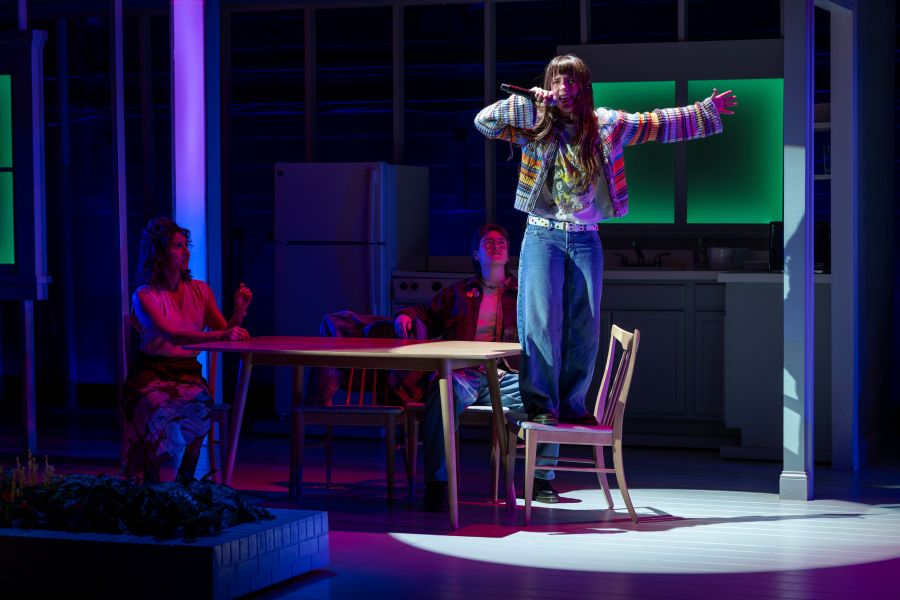
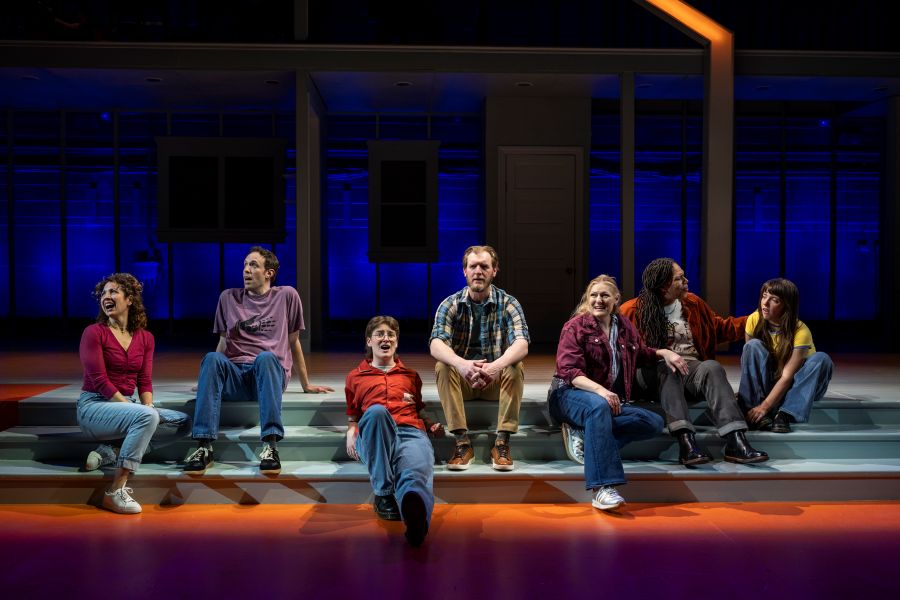
Speaking of new work, while at Court I was able to check out Out Here, a form-breaking new musical that follows Dawn, who’s torn between wanting to return to the woman she loves and not wanting to disrupt the family she’s made with her husband and daughter. Running through May 10, Out Here breaks away from what you might expect from a piece of musical theatre in fascinating (if perhaps polarizing, judging by the reviews) ways. Check out one of my favorite numbers from the show below, and head here if you’re interested in seeing a tour of Andrew Boyce and Lauren M. Nichols’s set.
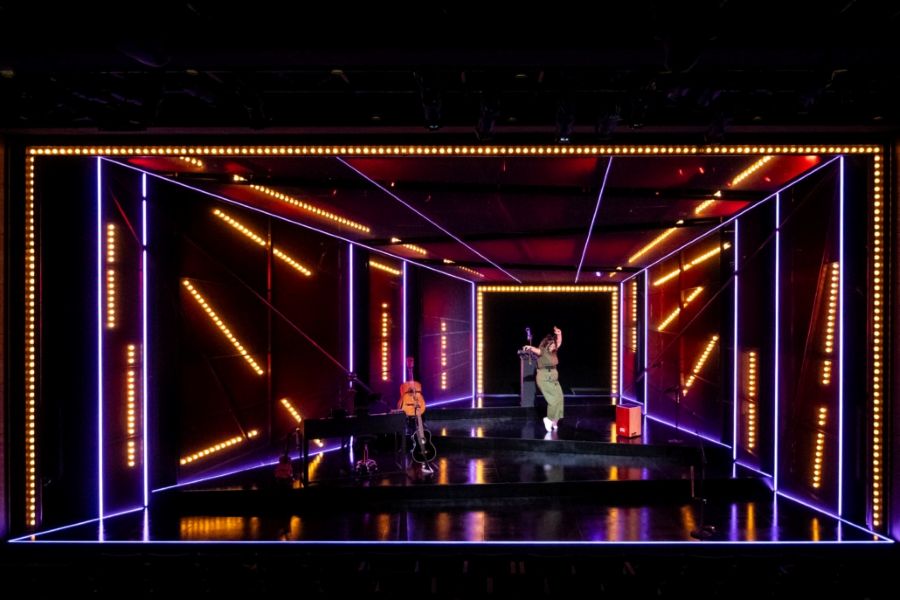
When Chicago-based singer-songwriter, sound designer, and overall theatrical storyteller Satya Chávez was asked what first got them interested in theatrical design, they pointed to Brian Quijada’s Where Did We Sit on the Bus? Written and originally performed by Quijada, the hip-hop solo piece follows a young Latine artist with immigrant parents trying to understand where they come from and how to carve out a place in the American theatre.
“Despite being Brian’s autobiographical solo show, I saw myself in it completely,” Chávez said, “down to the love story. We joke that it was clearly written for a lesbian—but I digress.”
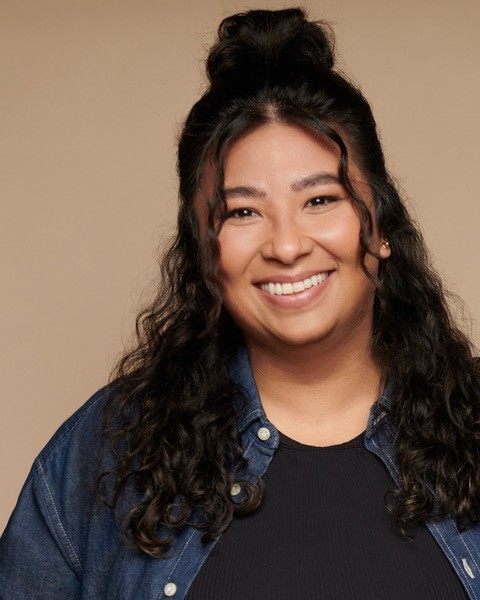
In 2020, Chávez and director Matt Dickson reimagined the piece as a virtual production for Actors Theatre of Louisville. At that point in their career, Chávez primarily identified as an actor-musician who occasionally composed. But after months of quarantine, Chávez recalled, they felt an urgency to create and, with Quijada’s blessing, dove headfirst into building a fully realized score.
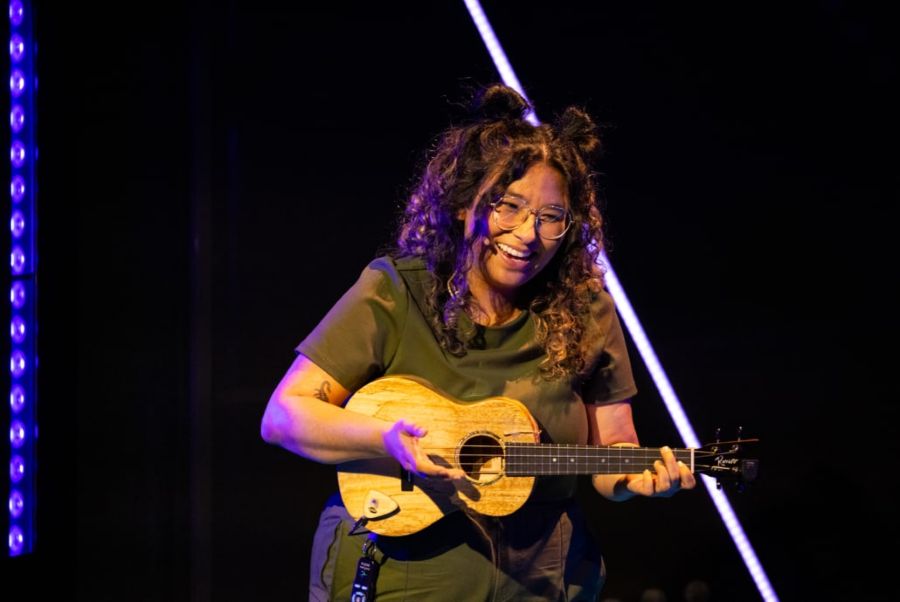
What followed, Chávez said, “was equal parts necessity and obsession.” Alone in their apartment, with Dickson’s virtual emotional support and creative vision, Chávez composed a 90-minute score, then designed, costumed, performed, and filmed it, building a studio out of a closet and teaching themselves how to mix and master in Logic Pro.
“I spent weeks shaping sound with intention, deciding which harmonies, textures, and instruments could carry the emotional weight of each moment,” Chávez said. “We transformed what had been a one-instrument looping piece into a full-scale live-looping musical, expanding it to 11 instruments and multiple loopers, turning spoken poetry into full musical arcs, power ballads on the piano, underscoring migration with layered, haunting vocal textures. It was one of the most challenging and most rewarding processes of my life.”
As theatres reopened, Chávez said they were invited to bring the show around the country, from Marin Theatre Company to the Denver Center for the Performing Arts, as well as to an ongoing residency at the Kravis Center for the Performing Arts. The continued success is one thing, but Chávez recalls this as the moment something shifted for them.
“I didn’t have the language for it at the time, but that process was my introduction to sound design,” they said. “It showed me that sound could be more than support; it could be structure, narrative, and world-building all at once. Since then, every new skill I’ve developed as a designer finds its way back into Bus. The piece continues to evolve as I do.”
The current culmination of that evolution can be seen on Chicago stages right now, with Chávez providing the sound design for Teatro Vista’s BOTH (through May 10), a world premiere production by Paloma Nozicka, directed by Georgette Verdin. Chávez is also looking forward to working on Albany Park Theater Project’s The American Project, a teen ensemble-driven work about finding light in the darkness that blends immersive storytelling, shadow puppetry, live orchestration, and studio-recorded EPs.
Earlier this month, American Theatre had a chance to check in with Chávez and learn more about them and their artistry.
JERALD RAYMOND PIERCE: What is the design/project you’re most proud of?
SATYA CHÁVEZ: This is hard to answer. So much goes into a production, from design to marketing to production management to making sure there are snacks in the green room, and I’ve been fortunate to be part of many projects I’m deeply proud of. But I keep returning to my work with Teatro Vista.
BOTH is a rare kind of experience, holistically cohesive in a way that feels almost alive, each element so thoughtfully crafted. It lives in a genre I’m drawn to: the psychological thriller, where technical elements aren’t just support, they’re momentum. Horror without sound is an entirely different organism. While Paloma Nozicka’s script is compelling enough to reverberate on its own, what we built together expanded its nervous system. The collaboration in the tech room between myself, lighting designer Max Grano De Oro and director Georgette Verdin was precise, efficient, and unexpectedly freeing. I was given a lot of liberty to create an unorthodox and discordant sonic vocabulary, rooted in breath and dissonant humming, showing up every day with some pretty unusual sounds and everyone was willing to roll with it. It felt like a process of constant distillation—layering, stripping away, rebuilding—until we arrived at something exact: eerie lakehouse, heightened unease, and a kind of mind-bending, atmospheric terror.
The whole team made the play feel like a full meal, text, design, performance, all feeding each other. From a sound perspective, it’s some of the most intricate work I’ve done. Not just in complexity, but in intention, every cue, every frequency, every wave, every loon, every silence placed with care. It’s good ol’ honest-to-god theatre magic.
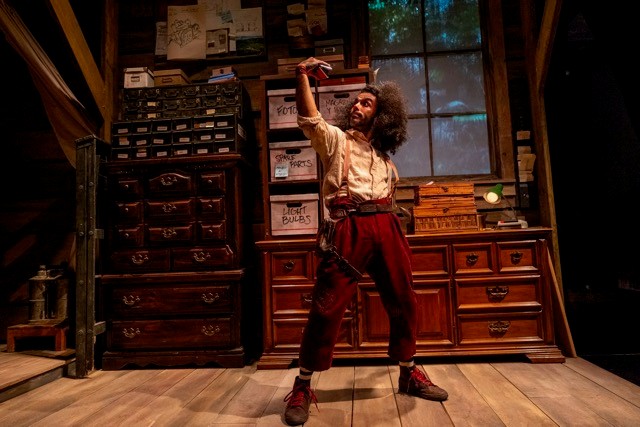
But I’m most proud of Teatro Vista’s Memorabilia. It’s a one-man circus-acrobatic play about memory—how precious it is and how fragile it can be. I was surrounded by an extraordinary team of artists, from performers to designers (Shokie Tseumah’s props were quite literally out of this world), and a stage manager tasked with calling the entire show not from a script, but from movement. I did not make that job easy.
This project was a lift not only as a composer, but as a sound designer deeply engaged in dramaturgy. Set in Puerto Rico, the piece was largely wordless, and somehow it felt both universal and profoundly culturally specific, rooted in the boleros I grew up on. I found myself calling my dad every other day, tracing the emotional and musical lineage of the work.
At its core, the play follows a man trying to remember a song, spending 90 minutes sifting through memory-triggering objects to unlock it. Along the way, he extracts memories from his body and uploads them into a kind of 1980s, Back to the Future-inspired machine, complete with textured and localized boot-up/uploading sounds, and a final, satisfying explosion. What we discover is that to remember the song, he must confront the grief of losing the person who taught it to him.
That song: “El Reloj,” a piece whose lyrics ask time itself to stop so we can remain with the people we love. It’s a song that director Raquel Torre, performer Jean Claudio, and I spent weeks choosing. Once we landed on it, everything deepened. Its resonance was immediate. We found ourselves in tears in the rehearsal room.
The design asked for everything. I recorded layered cello arrangements and a stripped-down vocal version of the theme. We built interactive moments where the memory machine “tuned in” to audience members’ imagined songs. I created a full sonic language for Mx. Bino, a pair of binoculars with an opinion, crafted from intricate mechanical textures, where every gesture carried intention, even down to a tiny, mechanical kiss.
It was one of the most satisfying creative processes I’ve experienced. From dramaturgy to composition, curation to language-building, this project asked me to bring my full self into the work. It felt like a complete offering, and it’s one I will carry with me for the rest of my career.
What’s your dream project (theatre or otherwise)?
I’ve been trying to manifest this for a minute now, but I want to do what Labrinth did with Euphoria. I’m a designer with a composer/lyricist background, and I’m especially drawn to horror and psychological storytelling, where sound doesn’t just support the narrative, it is the narrative. My dream is to build sonic worlds that operate as both score and storytelling language, where music, sound design, and atmosphere are inseparable. Also, I just think scoring a whole TV series would be such an invigorating challenge, so I’m gonna keep putting that out into the universe.
What’s a common misconception about the work you do?
That being “multi-hyphenate” means you’re doing one job with multiple skills. In reality, it often means you’re doing multiple full jobs at once. Sound design and composition are distinct disciplines. Even when they overlap, they require different mindsets, workflows, and decisions. When one person takes on both, it can create a beautifully cohesive result, but it also means doubling the labor, the time, and the creative load. There’s a tendency to celebrate the versatility of multi-hyphenate artists without fully acknowledging the cost. It’s a powerful way to work, but it requires real support and recognition to be sustainable.