What’s in a beat? A percussive pulse, a musical rhythm, yes, but also a fragment of story. Indeed, if you talk to the folks behind the sensational new musical Mexodus—writer-performers Brian Quijada and Nygel D. Robinson, director David Mendizábal, sound designer Mikhail Fiksel—they will refer frequently to “beats.” But, perhaps surprisingly for a show constructed out of live musical loops, the creators are usually talking not about the show’s propulsive score but about its narrative building blocks.
“We were digging into every beat,” Mendizábal told me, describing a writing process that took the show through multiple workshops and regional theatre productions starting in 2021, up through its acclaimed and extended run last fall at the Minetta Lane Theatre. I initially thought that Mendizábal was talking about the looping process, a painstaking aspect of the show’s development which involved Fiksel working with the writer-performers and set designer Riw Rakkulchon to craft a staging that allowed Quijada and Robinson to trigger loops and lay down rhythm tracks from all corners of the playing space.
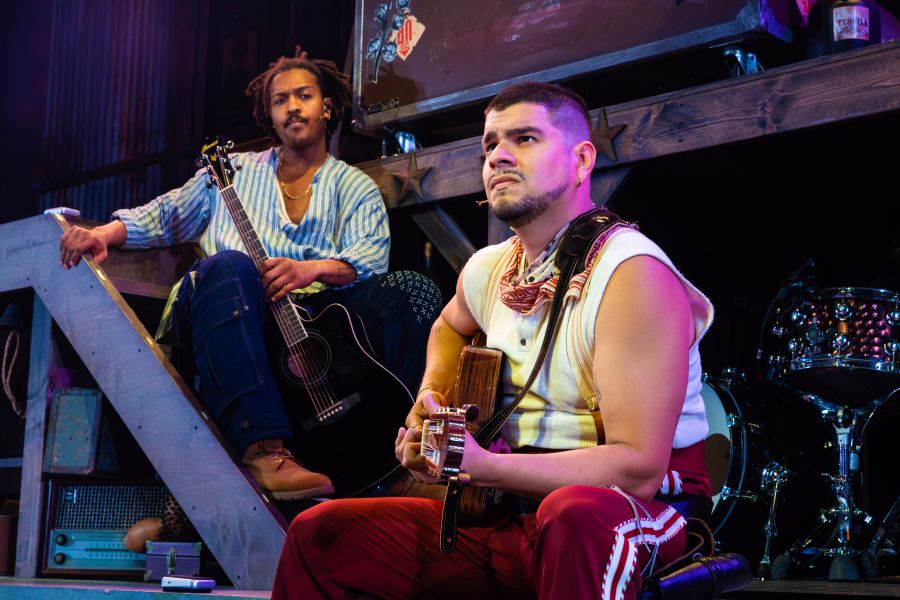
In fact the director was talking about story beats, the bricks and mortar of the show’s dramaturgy. And well he should, for the story told by Mexodus—now running at Off-Broadway’s Daryl Roth Theatre through mid-June, ahead of a national tour—is as extraordinary as the way it’s told. Inspired by a shamefully under-taught piece of American history, Mexodus dramatizes the branch of the Underground Railroad that went South, telling the fictionalized story of an enslaved Texan, Henry (Robinson), who escapes in 1851 into Mexico to hide out on a farm tended by Carlos (Quijada), a wary host who is still seething over the loss of territory to the U.S. just a few years earlier. Carlos’s crankiness aside, Mexico has one big advantage over the U.S. for Henry: It ended slavery there in 1829 and refused to sign onto a cross-border version of the Fugitive Slave Act that would have returned any formerly enslaved people found in Mexico to American slaveholders.
Quijada traces the show’s inspiration to an article posted on History.com in 2018, which cited the work of María Esther Hammack, a scholar who was then writing her dissertation on the Black diaspora in Mexico at the University of Texas at Austin. She and other scholars estimate that between 5,000 and 10,000 formerly enslaved people escaped from the U.S. into Mexico between 1829 and 1865, the year the Civil War ended. The wide range of that estimate, which is roughly one tenth of the formerly enslaved people who are reported to have fled to Northern states and Canada, indicates how little history has been written on the subject.
As Quijada and Robinson rap in the show’s opening number, “We didn’t know this shit! Why? ’Cause it wasn’t allowed…It wasn’t spoken aloud.” In an email, Hammack agreed, noting that the U.S.’s self-conception as “the land of freedom and liberty” has led many historians to highlight “stories of triumph, freedom, and liberty that shaped the U.S. and also Canada,” while failing to “shed light on the story of freedom that shaped our neighboring country to the South, Mexico. This has prevented more critical analysis and study on the many ways that the story of Black freedom in Mexico is consequential to and for U.S. history.”
Quijada was intrigued—the story was right in his wheelhouse, because, as he put it, “I write a lot about immigration, because my parents were undocumented immigrants”—but he figured, “I’m not gonna write that story alone. Half of that is not my story to tell.”
Then, in early 2020, he met Nygel D. Robinson at a New York City gathering of actor-musicians, those multi-hyphenates that have increasingly become a staple of Broadway musicals. “Nygel and I looked around, locked eyes, and realized we were the only people of color there,” Quijada recalled. Chimed in Robinson: “We were the brownest things in the room.” Quijada, who’d been invited to speak on his pet subject, looping (“The future of theatre,” he will tell anyone who listens), noted that the day’s attendees “were there to discuss doing the Once tours and Million Dollar Quartet. Well, Jerry Lee Lewis was not Latino and Johnny Cash was not Black, so I don’t know that we would ever do those.”
Happily, with Mexodus they would eventually create their own actor-musician showcase for men of color (which, they’re eager to point out, they look forward to handing off to the many talented, under-utilized artists they’ve seen at understudy auditions). But first they faced another obstacle: the Covid-19 lockdowns that foreclosed all live gatherings for an indefinite period of time in 2020 and beyond. After the duo’s single jam session, some emails, and a budding mutual “talent crush,” the world shut down and, as Quijada recalled, “We were literally Lysol-ing our bananas and apples. It was insane.”
That spring came a lifeline: Liz Carlson, then artistic producer at the new-work development hub New York Stage and Film, called Quijada and offered him some money to develop whatever he was working on. He was grateful but confused: “For what reason?” he said he told her, unable to imagine a timeline for theatre’s return. “What’s the end result?” Her proposal: Write one track a month for a year, and bring the results to NY Stage & Film’s Powerhouse summer festival in 2021, which they planned to bring back in some form after the 2020 hiatus. “She said, ‘What if we put you in a tent and you guys do it outside safely, and you present the concept album that you wrote?’ That’s exactly what happened.”
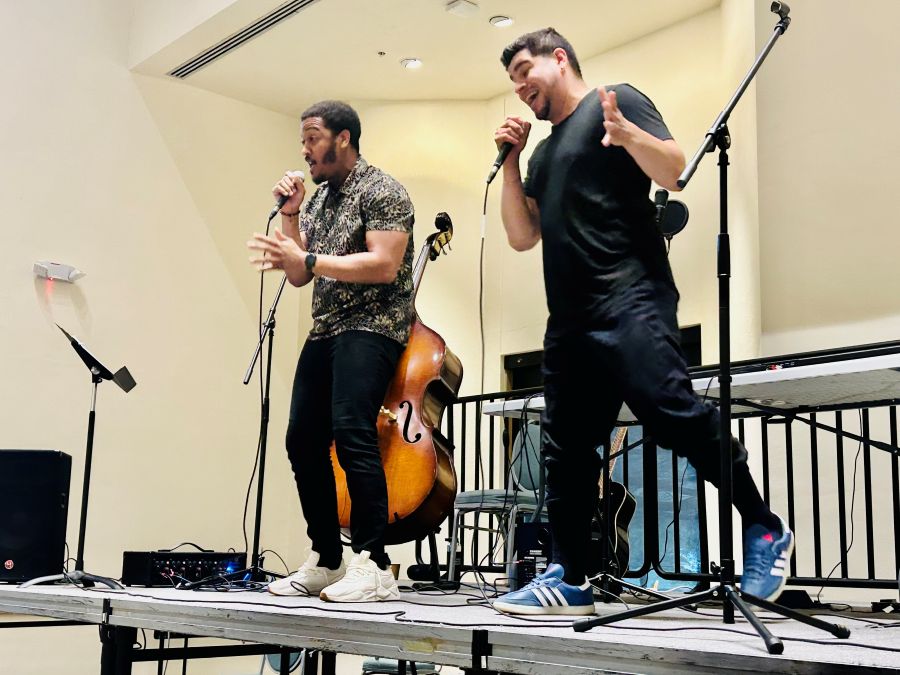
Armed with songs they’d tracked back and forth mostly remotely over the ensuing year, Quijada and Robinson connected with their director, Mendizábal, and their sound designer, Fiksel, at Powerhouse in 2021. As Robinson put it, Mexodus became “a concept album that grew legs.” Not just legs but loops: The challenge of that initial workshop, and all the subsequent productions up through the Off-Broadway run, was to turn premeditated songs into live creations, baked from scratch at each performance.
For the uninitiated: Live looping is typically done by a musician with a simple set-up, usually a microphone and foot pedal, that allows them to record short snippets of music and have these play back, often in interwoven layers, as they continue singing and/or playing over the tracks they’ve made. It’s a technique used by Ed Sheeran, Reggie Watts, Tune-Yards, and many others, and it has been the basis for much of Quijada’s theatre work, from Where Did We Sit on the Bus? to Undesirables. Its iterative unfolding can have a thrilling, even suspenseful real-time immediacy, but it typically anchors a performer to their rig. At the Powerhouse workshop, Mendizábal wanted to “untether” the performers from their tech and, as Fiksel put it, give “more physical, more dynamic performances.”
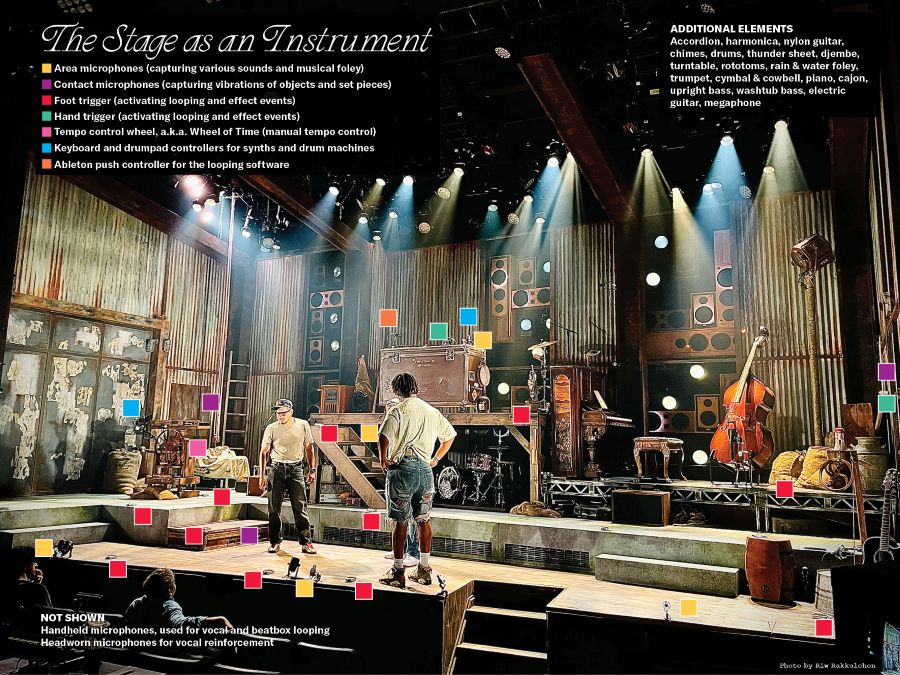
The solution proposed by Fiksel, Mendizábal recalled, was to say, “I can turn the whole stage into a looping machine.” Indeed, it was Fiksel who introduced the team to Ableton Live, a program long favored by electronic musicians, that turned over the show’s mechanics from “hardware-based looping to software-based looping.” That’s how Fiksel, programming furiously for weeks, was able to place loop triggers all over the stage, starting with one number (“Two Bodies”) and expanding to the whole score and show. The number of loop triggers now on the stage at the Daryl Roth? Fiksel estimated that they number 15 (see photo below), including everything from foot-prompted patches to a turntable-esque platform to more subtle triggers and—my favorite touch—a rusty vertical wheel the performers can turn to change the music’s tempo.
The sound elements captured in those loops include guitar, piano, standup bass, beatbox percussion, drum kit, accordion, harmonica, even at one point a trumpet, creating a score that infectiously blends hip-hop, jazz, showtunes, and rancheras. If the show has a standout moment, it is probably the panoramic, all-stops-out eight-minute number in the second act, “Henry 2 Enrique,” in which Carlos, at last embracing his role as Henry’s guide and protector, equips him for a new life in Mexico, complete with a new name. The newly christened Henry sings:
Mi nombre es Enrique
I feel it in the air
It’s a new day and a free day
I’m no longer a slave
To the name that I was given
It’s like I got a brand-new existence I can live in
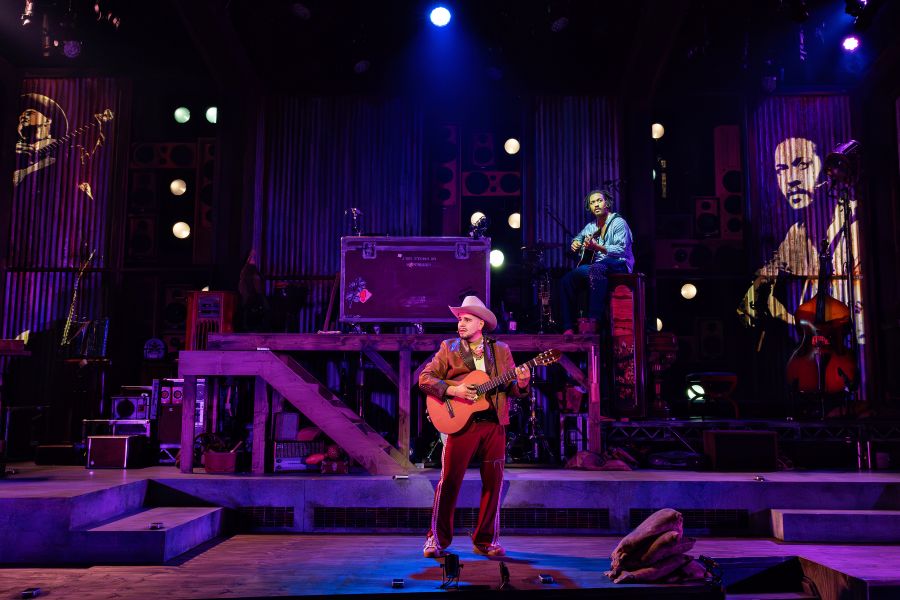
Another magical moment, also in the second act, crystallizes a key aspect of the show’s theatricality: Quijada and Robinson use acoustic guitars to mimic the motion of shovels as Carlos and Henry dig trenches after a rain. An entirely instrumental guitar duet with zero looping, it is described simply and movingly in the script’s stage direction thus: “This song is made live and should be the creation of a friendship in musical form.”
Indeed, form and content merge powerfully in Mexodus, as the lines between performer and character, dialogue and lyrics, and past and present blur and cross-fade. For one thing, loops can be read as a metaphor for patterns of history; as Quijada put it, “History repeats, so how can we break the loop?” On a deeper level, Mendizábal said, in early workshops, “It became really clear that looping was a metaphor for the labor that both characters were doing, Henry on the plantation and Carlos as a sharecropper. The act of looping and creating music together was a metaphor for these two men working together, building trust, building solidarity.”
For that metaphor to land, though, both sides of the equation had to be strong—not only the music-making but the storytelling as well. As Robinson put it, “Every single time we press a button or pick up an instrument, it has to be motivated by something that the character is thinking.”
The show’s long development history—after New York Stage & Film, Mexodus was workshopped at Rhinebeck Writers Retreat in New York, Chicago’s Victory Gardens, New York City’s Hi-ARTS, and New Harmony Project in New Harmony, Indiana, and had productions at Baltimore Center Stage and Washington, D.C.’s Mosaic Theater Company in 2024 and Berkeley Repertory Theatre in 2025—was also about “proving to people that it was a theatrical narrative,” said Quijada. “I think early on, people were like, ‘Oh, this is just music; it’s a concert.’ And we were saying, no, there’s a play here; we can live in this concert world, but there’s a play, and that play has a visual life.”
Still, even as Mexodus plans a tour (first stop: Pasadena Playhouse in July), this concept musical that grew legs is also tucking them back into the box and returning to its audio roots—what Quijada calls “reverse engineering the OG experience.” That’s because among the show’s producers, alongside P3 Productions, is Audible Theater. This offshoot of the profitable audiobooks brand has been seeding Audible’s catalogue with new plays through a variety of channels: an emerging playwrights commission program that kicked off with Madhuri Shekar’s Evil Eye in 2019, and occasional partnerships with producers or nonprofits to turn their shows into audio plays, as with Manhattan Theatre Club’s production of Amy Herzog’s Mary Jane with Rachel McAdams or Ossie Davis’s Purlie Victorious starring Leslie Odom Jr.
Audible’s biggest platform by far, though, is the Minetta Lane Theatre itself, over which the company took a long-term lease beginning with a transfer of David Cale’s Harry Clarke, starring Billy Crudup, in 2018; Audible had enhanced the production at the Vineyard Theatre, where it began, and recorded it as an audio play released before the Minetta Lane staging. Since then they’ve staged, then separately recorded and later released as Audible Originals, a wide variety of plays at the 397-seat West Village theatre, including many solo shows in the vein of Harry Clarke (Chisa Hutchinson’s Proof of Love, Eric Bogosian’s Drinking in America, Aasif Mandvi’s Sakina’s Restaurant), as well as several multi-character dramas, including Robert O’Hara’s staging of Long Day’s Journey Into Night, Rebecca Gilman’s Swing State, Lauren Gunderson’s The Half Life of Marie Curie, Hannah Moscovitch’s Sexual Misconduct of the Middle Classes (starring Hugh Jackman), and Erica Schmidt’s The Disappear.
Kate Navin, Audible’s head of creative development, started Audible Theater with the mandate from the company’s founder, Don Katz, to “create the digital analogue for theatre that exists in sports,” i.e., a kind of broadcast outlet for live events which, rather than competing for ticket buyers, only broadens their fan base. After comparing theatre and audiobook producing models, Navin said, Audible realized that “if you were to consolidate the costs for both and the revenue for both, you should come out ahead.” Though she wouldn’t divulge the company’s budget or revenue, audiobooks are big business, reporting revenue of $2.2 billion in 2024, with Audible dominating roughly 90 percent of the U.S. and U.K. markets. Navin did tell me that Audible Theater offerings represent around 15 percent of Audible Original titles. Though it’s hard to extrapolate exact figures from those data points, my back-of-the-napkin math says that’s hardly chump change in theatre dollars.
Of course, one of the few ways theatre breaks even on its own steam is with long runs, and there’s no mystery what kind of show is especially well known for long runs. “Since I landed here,” Navin admitted, “everyone’s been saying, when are you going to do musicals?”
The opportunity first struck in 2024 with Dead Outlaw, a raucous rockabilly tuner based on a grisly true story from composers David Yazbek and Erik Della Penna and playwright Itamar Moses. Said Navin, “It was in a genre that I knew would really fit with our audience—it’s a true crime story at its heart, a very strange one, but that’s a genre I could probably bring a lot of that listening audience over for.” (It won over a lot of musical theatre audiences too, though not enough to sustain its subsequent 2025 Broadway transfer for more than a few months.)
The other selling point of Dead Outlaw, Navin said, was something she looks for in all Audible Theater projects. “David Yazbek and the entire team were excited about what the audio version ultimately would be,” she said. “So throughout the entire development process, they were very thoughtful about, okay, this is for the Audible version; this is for the stage version.” Navin confirmed that “the first step when we’re reading and considering projects” is whether Audible can “make a product that works really well for the listening audience.”
Similarly, throughout Mexodus rehearsals, folks from Audible flagged moments in the show that were purely or primarily visual—not to nix them, necessarily, but to remind the creators to keep the audio version in mind. Weeks later, joining the team in the recording studio, I watched them tweak a line for audio: When Carlos holds up a “Wanted” sign to Henry and raps, “They say you killed a man,” it isn’t clear aurally how Carlos has come by this information, so they changed the line to, “This sign says you killed a man.”
For all the sparks it throws off as a live experience, Mexodus is not hard to imagine in one’s earbuds, with its sharply drawn characters and vivid incidents: a murder, a storm, a manhunt, a series of arguments in song. (Mexodus is slated for release as an Audible Original on April 16.) The live looping element must obviously be set aside—what takes the performers several minutes to build onstage sounds needlessly drawn out on record—but what the show loses in indeterminacy it is sure to gain in intimacy. That will necessarily put the focus less on how the story is told than on the remarkable story itself.
“My favorite thing is telling people what this show is about and them going, ‘I didn’t know that,’” said Navin.
But Mexodus isn’t mere edutainment, any more than it’s just a concert. While Quijada admitted that he has “moments where I felt more of an impulse to educate—I love the history, and I love being wowed,” he said he also learned ruthless self-editing from “watching all of my playwright friends do surgery on their plays, cutting things out and putting things in, and asking, ‘What is the meat of this scene here?’”
One area Mendizábal, the director, had to push the writers on was leaning into the story’s conflict. “Brian and Nygel are just lovely guys; they love each other,” Mendizábal said. “I remember one day in Baltimore, being like, ‘Have you all ever fought?’ They were like, ‘No.’” The director felt that cozy amity wouldn’t do justice either to the struggles facing these characters or to the stark contemporary resonances of their divisions in a time of anti-immigration hysteria and racial polarization. Monologues by Robinson and Quijada, speaking as themselves about their own relationships to the material, were added. And, fights or no fights, the time the team had to develop the show on its feet over so many workshops and stagings meant that they also gained some wisdom about the stakes of the drama they were trying to put onstage.
“We’ve all had a lot of growth over the past couple years,” said Robinson. “We did have this Kumbaya approach originally, but solidarity doesn’t necessarily coincide with, ‘Yay, we’re all together, we’re holding hands and singing a song.’ Solidarity can mean: I don’t have to like you, you don’t have to like me. But I don’t want you to die. I don’t want you to starve.” Carlos and Henry, Robinson noted, have little reason to trust each other, but they learn over time to see each other as allies against a greater enemy, and to recognize each other as fellow humans inherently worthy of basic decency. Or, as Robinson put it, “The bare minimum of solidarity is, just don’t be a dick.”
An earlier draft, Mendizábal recalled, had Henry convincing Carlos to become the Harriet Tubman of Mexico, but the team realized that they “didn’t want the story to say that in order to make an impact, you have to do something massive. Actually, it’s a single act of kindness. It takes Carlos a long time now until he’s 100 percent bought in, and he’s like, ‘I’m helping you because I see you.’”
Indeed, like many works of art that end up looping back to their original impulse after a long process of iteration and reconsideration, with each version Mexodus has become more itself.
“If we were to boil our existences down,” said Robinson, “Brian’s is empathy for the immigrant, and mine is venerating the people before you. When you slap both of those things together, you get a reverse border story that venerates ancestors.” Carlos and Henry, he said, weren’t based on individual real people, but “their makeup is of real people. I’d like to think that, doing this work, somebody real snuck into our dreams, snuck into a verse, you know what I mean?”
Rob Weinert-Kendt (he/him) is editor-in-chief of American Theatre.