
Victoria Lynne Barclay started to write plays when she lost her accent. “Believe it or not,” she told me one afternoon in late May, “my family don’t think I sound Scottish anymore.”
We were outside, perched on large flat rocks in Dumbo’s Main Street Park. Sitting beside Barclay was Adrienne Campbell-Holt, the artistic director of Colt Coeur, the company producing Barclay’s first New York production, which Campbell-Holt also directed. Camping, a two-hander about a friendship between two women, Ari and Brit, told over 15 years, takes place entirely within a tent in Ohio. Playing at HERE Arts Center through July 11, Barclay’s play is one of a few examples of a glistening summer trend in Off-Broadway theatre: plays featuring nuanced, at times unpredictable, female characters contending with themselves in decidedly confined spaces and contexts. These are not stories of women out in the world, per se, but portraits of individuals determining how to exist at a distance from daily life. In addition to Camping, Eisa Davis’s ||:GIRLS:||:CHANCE:||:MUSIC:|| at the Vineyard Theatre (closed), Martyna Majok’s Girl, Interrupted (at the Public Theater through July 12), and Eliya Smith’s Dad Don’t Read This (transferred from St. Luke’s Theater to Greenwich House Theater through July 18), offer up a coterie of narratives, contexts, and angles on the quest for self-determination, all at an arm’s length from the male gaze (however frustrating that in 2026 this is still a task at hand).
Camping starts when its protagonists are 15. The two women—though perhaps at this stage we should call them girls—have orchestrated a scheme to lose their virginity in the woods with the help of two random male classmates, as they, Brit laments, are the last two remaining virgins in their grade. Over time, the play’s location becomes a respite from these girl’s quotidian experiences in an attempt to alter their self-perception.
The girls are determined to enter this phase of becoming, but the boys, it turns out, are misplaced objects of the girl’s desire. While the early acknowledgement of their own amorous feelings for each other isn’t equally shared—Ari seems to find any excuse to physically intertwine with Brit, who for her part calls Ari a dyke, a comment that makes Ari recoil—the passage of time opens up the possibility of a reality in which these two women could be together, independently of the comprehension or even the label of a same-sex relationship. The play unfolds in five-year increments, with Ari and Brit continually meeting up in the tent as their lives progress: leaving town for college, marrying men, having children. The tent becomes the emblem of enduring friendship and the evidence of an unavoidable prospect.
When, at one point, feelings are acted upon, their trace is imprinted onto the tent’s walls. Perhaps these two are gay, but primarily they are simply in love with each other. Yet this lurking possibility is painful. It would not only mean eschewing domestic responsibilities, but an entire rewriting of what they have been to each other. Throughout the course of the play, the audience watches as physical space makes desire inevitable and intimacy unavoidable. A friendship, yes, but something far more charged.
For Barclay, the tent/musical festival culture of Scotland and the U.K. served as an inflection point in her coming of age. Going on camping trips with her friends denoted the onset of adolescence, she recalled. “Will you share the story about learning you had arms?” Campbell-Holt prompted Barclay during our conversation. Barclay began to explain a time in her life, around the age of 15, where she became acutely self-conscious about her body and her lack of control over it. This sudden stuckness seemed to be her new reality, which also arrived with a shift in her friend’s priorities: The boys who had been their embarrassing classmates were suddenly subjects of romantic fantasy. In this shift, Barclay saw the vastness of her female relationships narrow. Perhaps the closeness they’d previously shared was preventing engagement with other people; but now the resistance to this closeness was a rejection of what intimacy among them might mean.
On the day I went to watch rehearsal for Camping, my eyes immediately noted the intricately considered moodboards pinned to the rehearsal room wall. Among the images were two printouts of paintings, Tutti Frutti by Helen Frankenthaler and another by Cy Twombly—artists whose work exists in the multiplicity of meaning, helping to evoke the world of Barclay’s play. Campbell-Holt said she immediately saw how Camping fit into Colt Coeur’s mission. “I tend to really feel excited by plays that get at the messy underbelly, specifically of the female experience, and at relationships that allow all of the layers to exist—the contradictions of our evolving selves. I really resist labels.” In the story of Ari and Britt, Campbell-Holt also saw traces of her own experience of the pressure, as a young woman, to perform heterosexuality. Barclay echoed this notion: “One of the deepest parts of this is re-exploring the early ’90s and the late ’90s, and how rampant homophobia was in my life, without me ever realizing it. How deeply, deeply denied levels of intimacy were to me.”
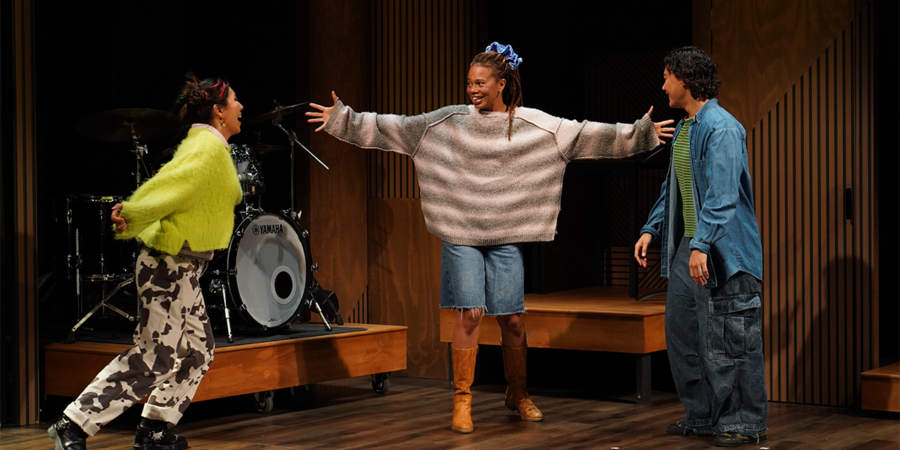
Eisa Davis’s play also has traces of her own biography. From age 10 to 17, Davis, like the four girls in ||:GIRLS:||:CHANCE:||:MUSIC:||, attended a seven-week summer music course in Berkeley. Davis did make one change: For her fictionalized homage, she made the camp all-girls.
“Studies I’ve read have said that in a girls-plus environment—like a Spelman or Smith College—people’s confidence is much higher,” Davis told me in late May over the phone. “I do wonder if the absence of the male gaze would have changed the way that I communicate and present myself.”
In ||:GIRLS:||:CHANCE:||:MUSIC:||, a co-production with American Conservatory Theater, directed by ACT’s artistic director Pam MacKinnon, each of the four girls captures something of a female high school archetype, but the play’s focus is a singer named Fax. A high achiever, Fax has endured snide comments from male classmates at home, who torment her for taking her extracurricular so seriously. The summer program, by contrast, provides Fax with a refuge where she can reject expectations of normal adolescence and engage with music pre-professionally. At camp—its oasis-like nature emphasized in the production’s superb wood-paneled sets designed by Nina Ball—dedication to technique is not only celebrated but expected. Here Fax can take comfort in her intensity and ambition.
The core of the play’s drama comes from the establishment of a friendship between Fax and Margot, who fills the role of the renegade genius, dismissing tradition in favor of exploration and improvisation, the “chance” in “chance music.” Fax becomes drawn to Margot’s fearlessness, which leads her to reexamine improvisation not as concession but as a means of expansion—a different kind of attention. This was in some ways a revisionist telling of Davis’s own story. “I knew it was possible that there were girls who could play jazz and improvise, and I felt very scared to do that,” she confessed to me. Might Davis’s experience have been different if she’d found herself in an all-female environment?
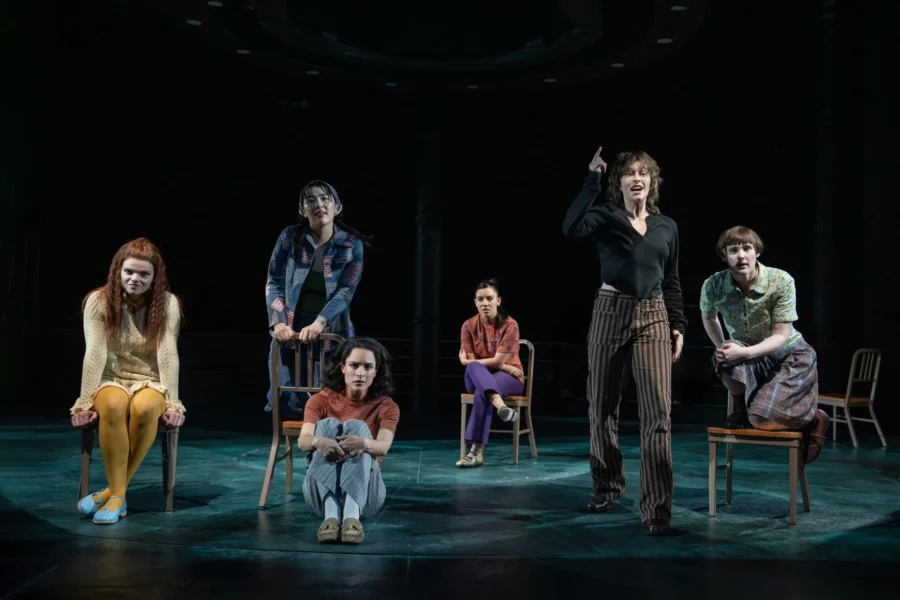
I agree with Helen Shaw’s assessment that Girl, Interrupted has a context problem. Despite its association with the ’90s, due to the book and the film’s release dates (1993 and 1999, respectively), the story takes place in 1967, amid the cultural upheaval of the Vietnam War era. Based on a memoir of the same title by Susanna Kaysen, the play was adapted to stage by Tony- and Pulitzer-winning playwright Martyna Majok, with music by Aimee Mann (a further nod to the ’90s) and directed by Jo Bonney.
The play dramatizes Kaysen’s two-year stint at McLean Hospital—a psychiatric hospital in Massachusetts where both Sylvia Plath and Robert Lowell once stayed—after she voluntarily admits herself. Kaysen, played by the elegant Juliana Canfield, serves as the window into the hospital’s daily events. She is one of a handful of girls being held at a distance from society, whose mental conditions become secondary to their particularities as people, while each gets a moment of distress or threat to illustrate their diagnosis.
Canfield, who in a feature in Vogue discussed her own Type-A tendencies as a high schooler, plays the role of Kaysen with sympathy. This humanity is further emphasized in the chemistry of the ensemble and score. Some have remarked on the music’s contrasting, or perhaps inappropriate, timbre, given the subject matter; for instance, Polly, a girl admitted for lighting herself on fire, plays a song called “Burn It Out,” in a Joni Mitchell-esque style. While perhaps lyrically and tonally at odds with Canfield’s line that “gasoline had settled in her [Polly’s] collarbones,” Mann’s evocative score provides an outlet of self-expression and examination: a way for these women to simply be. Their illnesses are weights placed upon them, but Majok, by way of Kaysen, emphasizes that these women existed prior to their diagnoses.
The time period of the play further emphasizes this point, as their personhood is at odds with the rigid social expectations of mid-century America. The women of McLean Hospital are not just individuals struggling with mental illness, but, in the eyes of their era, potential failed brides and mothers. Kaysen, despite pleas and attempts to express her literary aspirations, is only able to leave the hospital because of a marriage proposal.
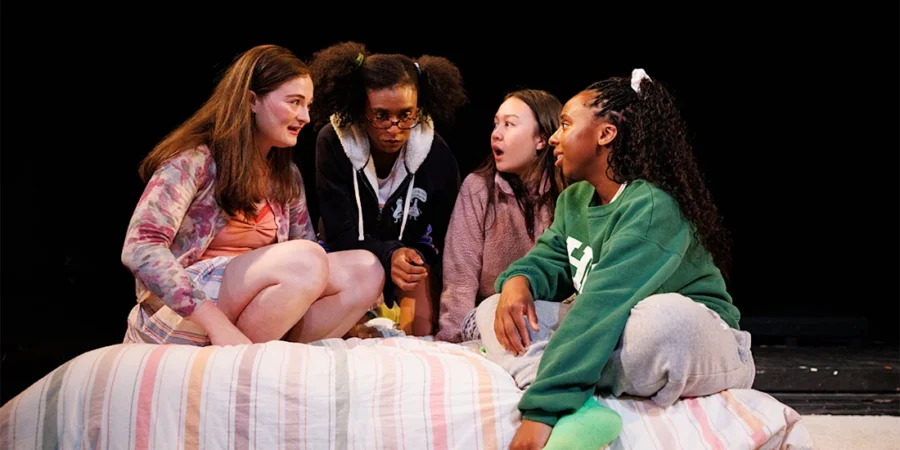
The other day I heard a psychologist argue that our digital selves, thanks to the size of their presence, constitute parts of our actual lives. In Dad Don’t Read This, Eliya Smith takes this prospect head on. Smith’s world, as realized by director Chloe Claudel (whose old-soul sensibilities have been honed in productions with her company the Goat Exchange) is ostensibly set in the bedroom of a high schooler in Ohio, but in fact it exists in the confluence of planes: in the physical space of a carpeted bedroom where her three close friends come and go for sleepovers and hangouts, and in the infinite world of the computer game Sims, played obsessively by protagonist Mal and her friends. Everything actual and material takes place in the bedroom, but the girls’ true aspirations are channeled into a technological dreamscape where they can wield the kind of agency not granted in their daily lives.
What’s compelling in this list of productions is the constellation of tactics for liberation these girls and women employ when awareness alone no longer suffices. In Camping, the women, Ari especially, wish the larger world could resemble the confines of the womb-like tent. In Chance, Fax takes great relief in the freedom that distance grants her. Girl, Interrupted explores the humanity that endures despite the brand of a medical label. Might Smith, in Dad, be arguing for technology, in its infinitude, as the next frontier of liberation?
Taking these productions together feels like an act of weaving or stitching—not the literal art form, too often labeled “women’s work,” but the meeting of impulses, ideas, preferences, suggestions that buzz when heard together, in conversation.
It was in 2018 that Barclay’s family made the comment about her having lost her Scottish accent. At a time of miscomprehension and isolation, Barclay turned to the act of writing, where she could express and record her feelings, even with all their inconsistencies and traces of hypocrisy. To put these impulses into the container of a play offered Barclay a way to share them, and to give definition to their unruliness. Perhaps this is what a play can offer: confinement not as subject, but as the condition by which a writer can become intelligible to both an audience and themselves.
Eve Bromberg (she/her) is a critic and writer from Brooklyn who is currently working as part of American Theatre’s editorial team.