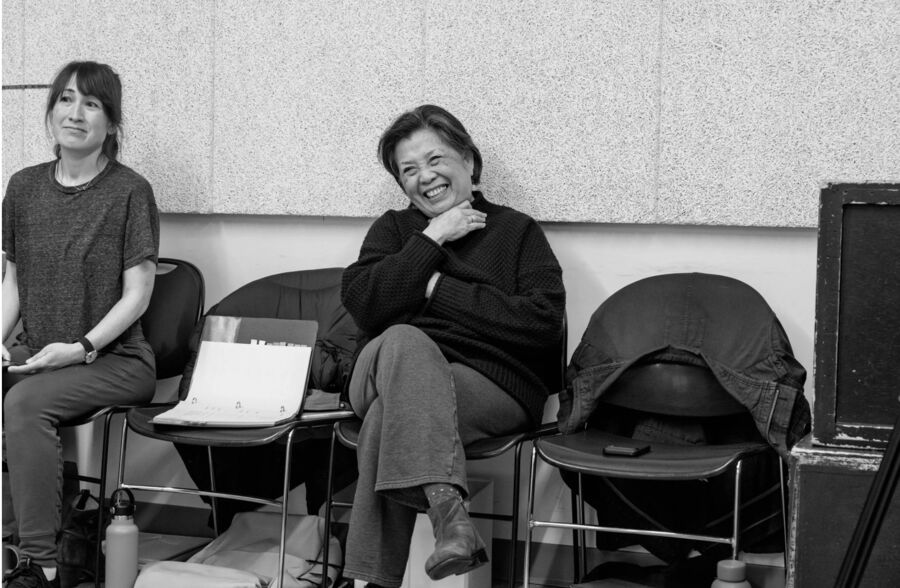
When Mia Katigbak—veteran downtown New York theatre actor and the co-founder of the National Asian Theatre Company (NAATCO)—decided to start a theatre company, her next move was to enroll in a PhD at Columbia.
“I thought I should know what I’m talking about if I’m going to be an artistic director, especially since the founding repertory of NAATCO was American and European classics,” Katigbak told me in her plummy voice in late June over Zoom. This fastidious, rigorous, and technical approach is the same Katigbak would use at the start of her professional acting career in New York City, and has used in the decades since. It is a method that has set her up to take advantage of the many opportunities that have come her way: luck by way of preparation.
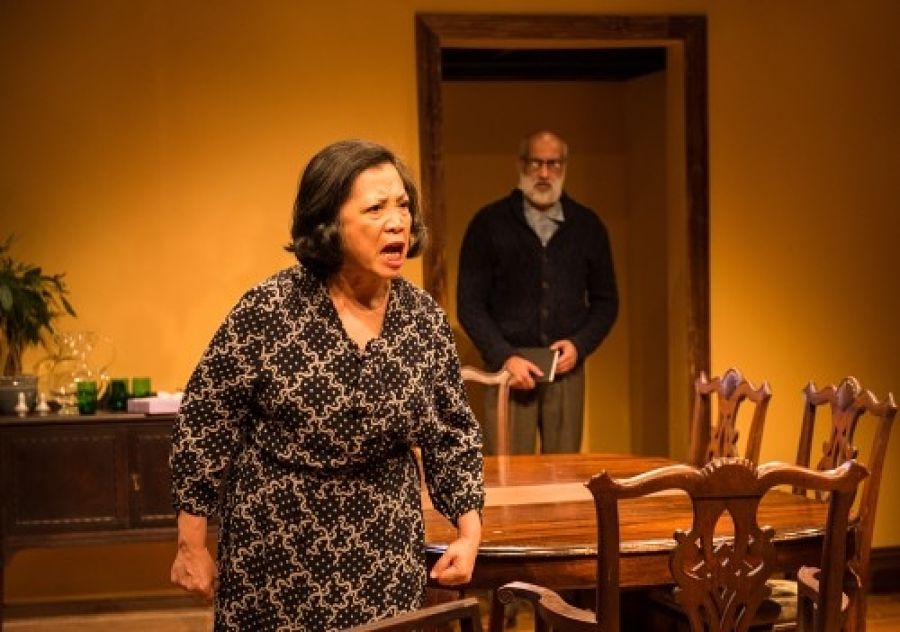
Indeed, Katigbak has become a ubiquitous presence on New York stages, with major credits including Uncle Vanya at Lincoln Center Theater, Annie Baker’s Infinite Life at the Atlantic Theater, Ivo Van Hove’s Scenes From a Marriage at New York Theatre Workshop, and the U.S. premiere of Caryl Churchill’s What If If Only (in a 2021 NAATCO production). Currently, she’s appearing (through July 19) in NAATCO’s production of Henry VI, A Trilogy In Two Parts at the Public Theater.
Katigbak’s family left the Philippines for New York City when she was 12 (interestingly, so her mother could pursue a PhD at Columbia). The family settled first on the Upper West Side, at which time Katigbak decided she wanted to go to the High School of Music and Arts (what today is LaGuardia High School of Music & Arts). But her mother forbade it, and indeed, shortly thereafter, decided the city was too dodgy to raise kids in, and moved them to New Jersey. While Katigbak continued her engagement with the arts there—as a piano accompanist for the choir, a violist in the orchestra, and a sometime performer in her school’s theatrical productions—she knew she didn’t belong in the suburbs. “I couldn’t wait to get out of there,” she said. She matriculated at Barnard, returning to the city, where she’s “been ever since.”
At Barnard, Katigbak only declared a theatre major because the music major required six terms of music theory; she only had four. She had initially wanted to be a conductor, but shifted gears when a friend suggested she study theatre.
A year after graduating, Katigbak found herself playing the narrator in a production of The Legend of Wu Chang with Pan Asian Repertory at La MaMa, where the company was in residence. “It was crazy, because we had a week-long crash course in Peking opera technique,” she recalled. Katigbak also continued training through courses at HB Studio, where her college mentor, Aaron Frankel, had started teaching. Shakespeare, she told me, was one of the key drivers of her continued study.
“I was fixated on learning how to act Shakespeare, because I thought it was so difficult,” she said. “Most Shakespeare performances I saw were completely unintelligible to me. I had a block about the language.” Meanwhile, in looking for work outside of Pan Asian Rep, which only produced two shows a year, Katigbak realized how few roles there were for Asian American actors. “Back in those days, people were very polite, because basically they were just like, ‘We can’t cast you.’”
Her studies with Frankel helped decode Shakespeare for her. Frankel dismissed the difficulty often associated with the work, telling his students to approach it like any other text. “Don’t freak out about scansion and that kind of stuff,” Katigbak said he told his students. “Just do your work as an actor and a workman.”
This built up Katigbak’s craft and bolstered her instinct to seek out continued technical courses. Frankel, she said, “used to say you need a toolbox, because you’re going to work with other people who have different techniques, and you need to know which tools to pull out when needed.” A bifurcated experience started to form for Katigbak: Though denied roles in the “real” world, in Frankel’s classroom, she could “do anything as long as you did your work.”
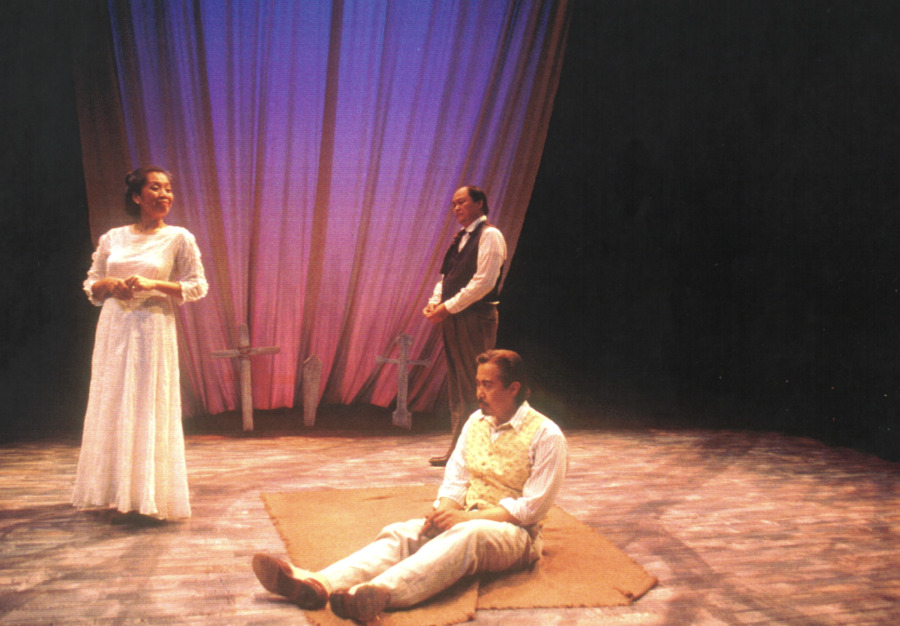
It was in one of Frankel’s Shakespeare classes that Katigbak met Richard Eng, the actor with whom she would later form NAATCO. “He’d been working with Aaron for a while and he was kind of a snob,” she recalled. In fact, she said she pegged him as “a banana: white on the inside, yellow on the outside,” due to his preference for working with white actors. But when Eng and Katigbak were paired together at a fundraiser in a scene from the Neil Simon comedy Last of the Red Hot Lovers, Eng decided she wasn’t “so bad.”
When Eng later came to her with the idea to start a theatre company, she was cool to the idea at first. As a volunteer with Pan Asian Rep, she had seen how hard it was to maintain a company. But, over the course of a dinner with Eng, Katigbak was won over—with one condition. She would start a theatre company, she told Eng, if it was all Asian American actors doing classical productions. Katigbak thought this would make the task easier, because “everyone does the classics,” as she put it. As a fan of musicals, Eng had a similar impulse.
NAATCO was born from those initial conversations, incorporated in 1989 and producing work starting in 1991. Then, after nearly a decade of staging classics with all-Asian casts, Joel de la Fuente, who played Iago in their 2000 production of Othello, suggested the company try staging new work. They dipped their toes in this idea with retellings of classical plays written by Asian American playwrights, like Michael Golamco’s Cowboy V. Samurai, a version of Cyrano de Bergerac in which, instead of a large nose, the protagonist’s perceived deficit is being Asian American. Eventually, NAATCO began working with writing-development houses like New Dramatists and The Lark, and started to receive submissions from non-Asian writers. The company mounted Jordan Harrison’s Futura in 2010. “So many non-Asian playwrights said, ‘Well, nobody’s doing my work anyway—why would I object to an all-Asian cast, even if it wasn’t written for one?’” Katigbak told me.
The shift to contemporary work put NAATCO in conversation with other small theatre NYC companies coming up in the early 2000s: New Georges, Clubbed Thumb, the Women’s Project, and Target Margin. That in turn led Katigbak to acting roles in these companies’ work, many of which she would never have been considered for, and many of which weren’t written for an Asian actor.
“It’s so much fun,” Katigbak said, to take on “wacky roles that I never, never, never would be considered for. But artists need that: to be constantly challenged to do stuff that you’d never be asked to do.”
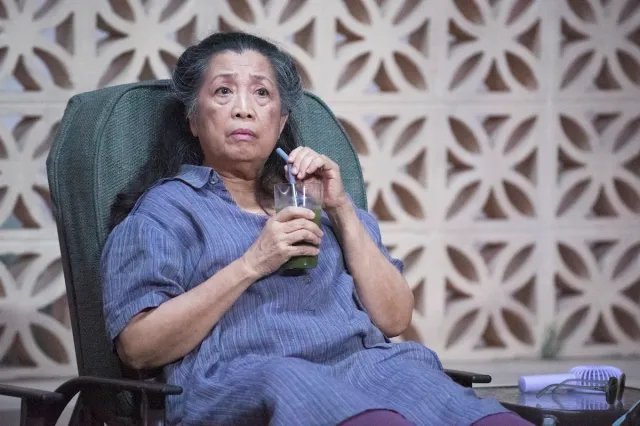
It was also around this time that Katigbak decided to change her title from artistic producing director to co-founder and actor-manager, the dual title she holds today. “I read a book about Henry Irving many years ago,” Katigbak said. “He was called actor manager, and I started to wonder. I started as artistic director, with Richard as executive director, following the conventional structures of theatre companies all over the country. But I realized, well, I didn’t know what that meant exactly. Because there were only two of us, I was also the producer. So I changed my title to artistic producing director, and then I thought: Well, I’m really an actor, and I like being an actor, because I always say that I’m in the trenches with the other actors. I understand the requirements, the difficulties, and challenges of that.” At first Katigbak fretted about this change, but soon realized she was in a lineage that included Sarah Bernhardt, Shakespeare, Chekhov, and Lady Augusta Gregory. “So I thought, okay, that’s not bad—it’s got a history.” “I revel in saying ‘actor-manager,'” said Susan Bernfield, artistic director of New Georges. “I love that Mia grabbed it off the rack, reclaimed it from history, as it’s simply the ideal description of what she does. We artist-ADs tend to keep this stuff split, but Mia’s an actor. She founded her company to act, and she’s obviously a helluva manager. I find it perfect and profound.”
Henry VI calls back to NAATCO’s 2018 production of the play at A.R.T./New York Theatres on West 53rd Street.
“People have been asking me, ‘Why the hell Henry VI?’ It’s so problematic,” Mia confessed. “The writing is young, young Shakespeare. I can’t even remember when I got obsessed by it.” It was most likely in class with Frankel. “Everyone was doing the molehill monologue. I read the play and found it fascinating.”
Still, the play is a large undertaking; Katigbak didn’t think she’d be able to find a director who would take on all three parts of the play (which for this production has been condensed into two parts). In 2013 and again in 2015, NAATCO worked with Stephen Brown-Fried on a production of Clifford Odets’s Awake and Sing! Katigbak decided to pitch Henry VI to him and he excitedly said yes.
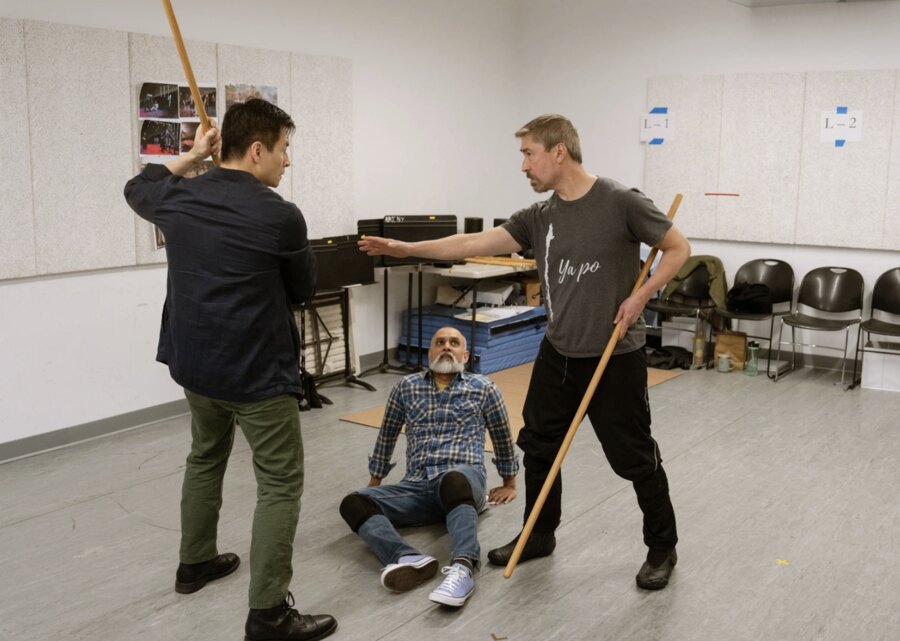
At a rehearsal of Henry VI at the Newman Theatre in early June, shortly before opening, I was struck by the warm and convivial environment. When I walked in, I immediately spotted Katigbak, who showed off the black riding boots that would be part of her costume; she’d just asked the costume team if she could keep them (they said yes). Brown-Fried raced around the theatre to examine the blocking from every possible angle. As the cast worked through their fight choreography, every actor seemed willing to try things out over and over again. Brown-Fried’s direction made complete use of the stage; the theatre’s large industrial doors were as much a part of the set as the black casket onstage (dots designed the sets).
When I returned, a few weeks later, to see the production, the actors looked sleek in white, black, and red. In addition to the multi-purpose casket, the set included stairs to act as an elevated throne, and a number of wooden posts the cast carried around: a materialization of the art of staking claims. There was an immediately striking aesthetic sense about this production—to my eyes, it strongly resembled a 1990s Prada Sport ad campaign—as well as a notable age range in its cast: a mix of returning NAATCO actors, like Orville Mendoza and David Shih, and fresh faces including Đavid Lee Huỳnh and Myka Cue, who plays Joan of Arc. As part of the ensemble (the entire play is an ensemble production), Katigbak brought her characteristic matriarchal groundedness in the role of the Duke of Gloucester and others. She emanated both a deep seriousness and touching empathy. Perhaps the categorization, for an older female actress, of “matriarchal” seems dismissive, but what I mean is that it is Katigbak’s wisdom that primarily shines through. You can sense the depths of her experience in real time.
Katigbak’s approach had seemed to rub off on others: Cue’s ease and comfort as Joan feel like the product of mentorship, an instinct she confirmed: “Working with someone as pioneering as Mia has been such a gift. She’s one of the most committed and dynamic actors I’ve had the pleasure of working with, and also one of the most nurturing, making sure we feel supported as human beings first.”
Toward the end of our Zoom conversation, I asked Katigbak point blank: What is the value of an all Asian-American cast in 2026?
“That it’s an all Asian-American cast offering a fresh take on the play and Shakespeare itself, not just stylistically,” she said. “The one comment that always makes my heart sing is when I hear people say it was ‘so clear for me,’ without having to add layers of obvious adaptation, like a Kabuki Macbeth. It’s doing the material as written, with just this interesting aesthetic. The surprise is that it’s so intelligible.”
Given the tools Katigbak has gathered and shared over a lifetime, it’s no surprise at all.
Eve Bromberg (she/her) is a critic and writer from Brooklyn. She is currently working as part of American Theatre’s editorial team and completing an MFA in Dramaturgy at Columbia.