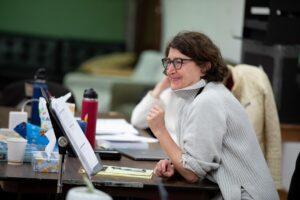
Everyone who’s ever gone through the National Critics Institute at the Eugene O’Neill Theater Center talks about how life-changing it is. And truthfully, there is nowhere else like NCI. As a person who’s succeeded in this industry by carving out my own path, I’ve still always craved one dedicated place to grow as a critic outside of work. I’ve been grateful for institutions in D.C. like Day Eight and D.C. Theater Arts that have built me into the critic I am today, especially fellow NCI alum Nicole Hertvik who’s passed on a lot of the lessons she’s learned to her writers. For the first two weeks of July, I finally learned right from the source at this theatre criticism boot camp with Chicago Tribune chief theatre critic Chris Jones and freelancer Naveen Kumar.
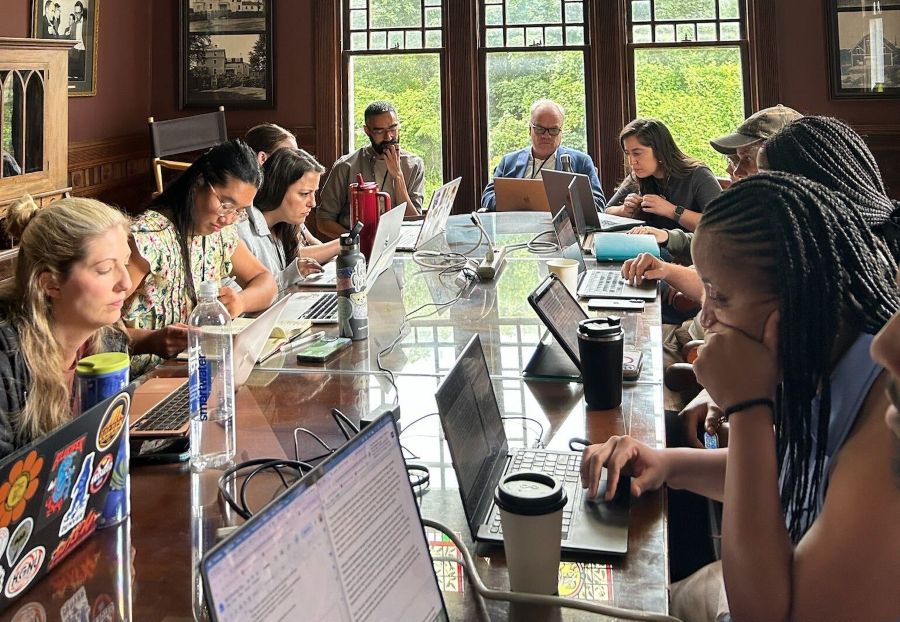
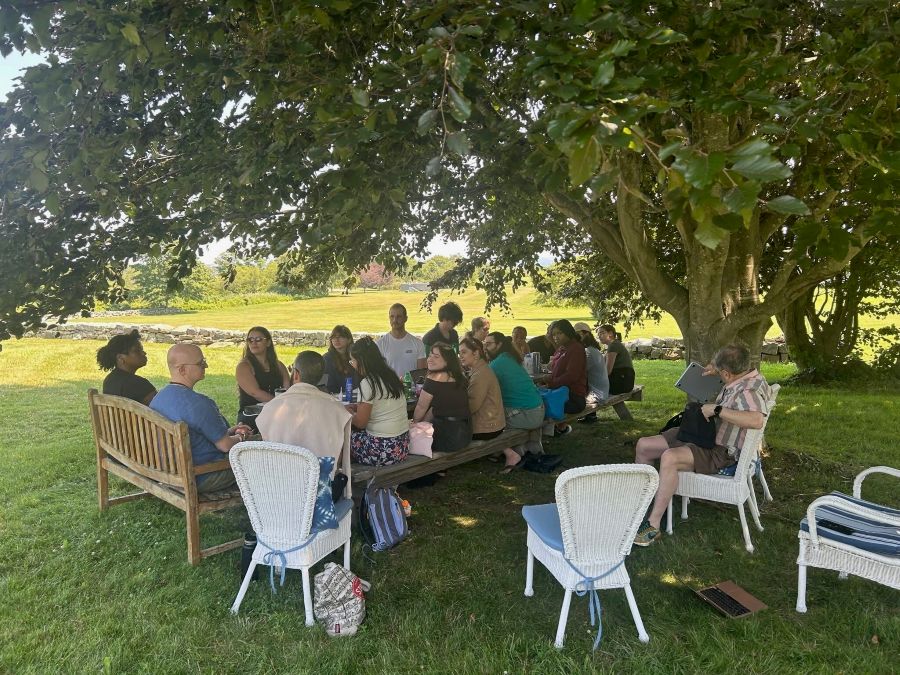
At NCI, we had a structure with built-in instruction: seeing shows together at night, spending all night writing reviews (none of which are ever shared publicly), and coming together at a picnic table under the shade of the trees by the mansion for daily morning feedback sessions, where we would dig into the importance of every word. Add on guest speakers and off-site trips to the Berkshires and Mystic, Connecticut, and it made for an intense, empowering two weeks. To be in an artist’s oasis and focus all energy on criticism felt simultaneously like the greatest escape and being scrutinized under the most terrifying microscope ever.
I came in knowing that my authentic voice is a hallmark of my writing. From NCI, I hoped to learn to think, assume, and write better. I return knowing that my vulnerability, and in particular my ability to have deep emotional responses to art, is my power. If I can get real, and say what I mean and feel, artists can feel seen, understood, and challenged—all with the purpose of service and support. I recovered trust in my process while refining skills in engaging with art, and regained hope after having grown cynical reviewing D.C. theatre recently. I unlocked a North Star: The work that I gravitate to is evocative, poetic, and grounded in a consistent, unified purpose.
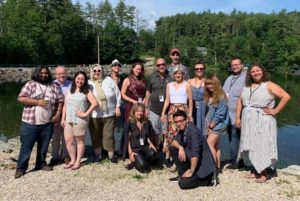
This summer’s cohort of 14 kind, insightful critics—assembled from all over the U.S. and from various levels of the business—had perspectives that were a joy to see flexed and developed. We wanted to both celebrate and challenge each other, from our ritual of clapping in front of guests every time Chris introduced Avery Beaton as NCI’s American College Theatre Festival winner, to conversations with some of my fellow D.C.-area critics about applying what we’ve learned to local coverage, and more. From this experience, I have stronger ideas of what criticism should do for a sustainable theatre ecology. Here are some of the lessons I learned.
Criticism expresses your distinct experience, and it should get to the point. At NCI, I got better at consistently imbuing opinions throughout my writing. My first NCI theatre review was of Crazy For You at Goodspeed Opera House. I love Golden Age-style musicals, so in theory this should have been my easiest review. But my structure was all over the place. After feedback from Chris, Naveen, and my peers, I realized how to strengthen my arguments, leading to a truer “so what?” kicker.
Another turning point was the chance to review Steven Spielberg’s latest movie, Disclosure Day. Many fellow critics did not like it, but I found it moving, relaxing into the experience after a period of feeling stressed. It doesn’t serve anyone to stress about criticism! I discussed the film’s universe and themes, then got into details, while trying to not wax poetic too much. Upon getting positive constructive feedback from L.A. film critic Katie Walsh, I teared up, to the point that Naveen wanted to check on me. Those were happy tears, I told him: I had shown up as a writer.
That was also around the time I realized my process needed to consist of starting to write at night, then taking one more hour in the morning before filing, to let thoughts marinate overnight. Pro tip: When reviewing on deadline, don’t stay up too late!
Criticism can be a form of advocacy. It tells you who belongs, what art matters, and impacts livelihoods. Meeting National Playwrights Conference writers Sebastian Alberdi, R. Forrest Malley, and Gloria Majule was fascinating. One big takeaway from these emerging playwrights was how long it takes for playwrights to get produced, and how much they don’t control the answer to the common question, Why this play now? And Dallas Theater Center artistic director Jaime Castañeda talked about how he has appreciated his relationships with journalists as a director, and about his inaugural season of all new work. He’s “going all new, because we have nothing to lose and we’ll do it now.” He’s “betting new work will attract people.”
When Alberdi asked us, “What is the role of the critic at this stage?”—i.e., in a play development conference, as distinct from a public festival—I considered where I was coming from. I’ve been a music assistant and a script reader at the O’Neill, and have music-directed, composed, and acted in new musicals. Voicing my public opinion as a critic, which I would not be able to do when I’m participating in making new work and serving the objectives of the artists creating it, is a power I don’t take lightly. Adventurous artists deserve adventurous critics.
There’s a difference between being a dramaturg and being a critic; sometimes it’s helpful to do a little of both. Assessing a play based on what it is “on the page,” as I did as a script reader, is different from reviewing a live reading (let alone a full production). But leaning into the text is often helpful as a foundation for analyzing voice and dramaturgical context. My long-standing practice—of creating form/content charts to assess what I’ve seen before I even try to write my lede, from my play analysis training—served me well for readings on campus. I merged that with new tools NCI gave me to assess writers’ voices with my own voice.
I played with this while reviewing Episodes by Kallan Dana, a 1970s/’80s coming-of-age story inspired by Dana’s own grandmother that plays with the concept of time. Focusing on form for a play with a pseudo-Brechtian structure seemed the best way to approach it. I didn’t focus much on acting intent, because I wanted to consider the work as a whole, making for a review that felt dramaturgically sound but perhaps could have been more emotionally driven.
Mat Smart’s The Last Nun at Lake Leaf Monastery, directed by Castañeda, had a more physicalized reading. As AJ and Bachal try to fix their marriage and row out to a secluded lake retreat with nun Sister Sally, they take on a month-long challenge: Don’t speak to each other except for one word a day at 7 a.m. Then two words. Then a haiku. Occasionally, 90-second free-form. In response, I first wrote a poem, because I wanted to be intentional about a play that centers looking inward. Then I wrote my actual review, giving limits to my own consideration of a play that was itself a ritualistic experiment in setting limits. I was able to control myself in my sharing of vulnerable reactions to that piece.
Criticism sometimes comes with conflicts of interest, but if you have lived experience, embrace it. I was faced with reviewing a show I had worked on for its first reading, The American Five by Chess Jakobs. Commissioned by Ford’s Theatre, where I once worked in communications, it had its first production outside D.C. at Berkshire Theatre Group’s Unicorn Theatre. I know what this play, about the five giants of American history who organized the March on Washington, can do.
In reviewing this production, I considered what doing a new play means for the canon. I felt that this production, at a summer theatre for a largely white audience, didn’t have the wacky spirit it required, and I worried that if it is done this way when it reaches the wider world, it will seem like a “basic history play.” I know from working on it that it is so much more than that, so in my review (again, just for my NCI colleagues, not for the public eye) I went a little feral. It was cathartic to blow past my own conflict of interest in this case (though in real life I would probably navigate it differently).
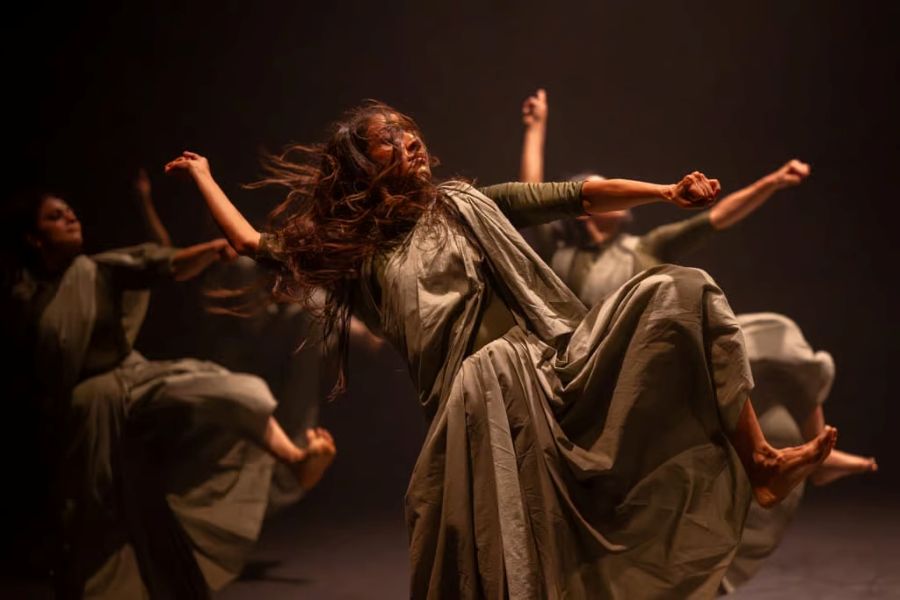
When answers to questions aren’t clear, trust your feelings. This helped me while reviewing dance. In the case of Akram Khan Company’s Thikra: Night of Remembrance at Jacob’s Pillow, I could not rely on the unreadable notes I took during the performance; I could only remember how I felt: astonished and inspired by this long-standing dance company’s last production. The piece included some serious hair-ography and represented control within chaos beautifully.
When trying to distill this into the simplest words, I thought: There’s a power in seeing an all-women ensemble, many of them Asian, making simple movement choices involving their dark hair. This one idea grounded my whole review, reflecting on what it meant to see free-flowing yet assertive movement. With a personal anecdotal lede about what my own Asian hair has meant to me, I got vulnerable again.
It’s especially vulnerable to write about food. It’s a human necessity, and often a shared experience, but writing about it is a whole other thing. NCI this year included a crash course in food writing from New York Times head food critic Ligaya Mishan (co-author of the Filipinx cookbook I live by). Naveen came along as Teniola Ayoola, Stefanie Fernandez, and I were assigned to review Cucina Al Pantheon, a new restaurant in Mystic.
I tried to enjoy everything, and gave each dish I wasn’t sure about multiple bites and sips. Reviewing food at a place that advertised itself as wanting to exude “togetherness” was a learning experience in how to assess a meal that doesn’t satisfyingly come together, even if we humans found ways to connect beyond the food. Focusing on the task at hand, doing what you need for your process, and trusting your own experience of taste is a skill to continually develop in all mediums.
Criticism is expansive and can bridge divides. At its best, criticism doesn’t just consider the art at hand; it should speak about the way we live now. It should imagine better art, experiences, and futures, with the critic’s experience and perspective given full authority. For me, it comes back to vulnerability and willingness to truly experience the world, and not to shrink back from either really loving or not loving the art. I reminded myself of this as we finished with the last two musical readings: Live fully and make every word count.
Considering how to live and write with abandon also involves new ways of thinking about what criticism can look like, particularly in the wake of real-life attacks on theatre criticism. It was fascinating to hear Peter Marks talk about his pivot into life “on the other side” as an actor, dramaturg, and consultant on productions since leaving his longtime post as The Washington Post’s lead theatre critic in 2023. Candidly, he shared, “I’ve seen the devaluation of honest opinion and analysis. The walls we’ve created haven’t done us any favors. The old model is broken. There is room for the new.” We explored such new models in a conversation with Brittani Samuel and Matthew Wexler on their critical sites 3Views On Theater and 1-Minute Critic, respectively, covering multiplicity of views, concision, and tenacity in freelancing.
Criticism meets the work where it is and takes a stand. Goblins and Gates: A Pen and Paper Musical Adventure, by Gonzalo Valencia-Peña and Michael Campbell, is a Dungeons and Dragons-inspired musical that presented its first 53 pages and finale at the O’Neill reading. In my review, I considered what this show could be, analyzed its scene-into-song moments, used the show’s own lyrics in pointing out growth points, and paid tribute to the songs that worked.
The last reading we saw was Mirror Image, a new musical by Laura Winters and JJ Warshaw. Sans evaluative opinion, here’s a fact: This one made me sob. In this new musical, high school senior Jade dreams of getting into Northwestern’s Medill Journalism School but is challenged by a new girl. Jade spirals into an eating disorder, which appears to her in human form as a “mirror image” of herself. Throughout, her family, friends, and boyfriend lighten the mood.
Come time for our final reviews on Mirror Image, which we drafted as radio segments and read out loud to each other, it was so clear that many of us had learned what we wanted to say and how to get out of our own way. It’s a lesson for all writing: Take a stand and back yourself up with craft, and you’ve got nothing to lose. As for me, I’m beginning to own a style I call simply: sweet but sure.
Daniella Ignacio is associate editor for American Theatre. She is an arts journalist, actor, music director, and teaching artist in the D.C. area. She also reviews for DC Theater Arts and Washington City Paper.