In January 2026, playwright Katie Ka Vang was working on her new play, HMong Futures, when thousands of Immigration and Customs Enforcement and Border Patrol agents descended upon her home state of Minnesota. In the ensuing months of occupation, federal agents killed two U.S. citizens, raided homes, businesses, hospitals, and schools, and conducted violent detentions and arrests, including dozens of HMong.
Vang described feeling “floored” by the occupation. “I was like, ‘What the fuck is going to happen afterwards?’” she recalled. “I became really interested in what is going to happen after this administration. Maybe there’s a chance for some kind of repair?”
The experience made Vang realize anew how important it was not only to honor her community’s legacy but also to dream its future. Accordingly, her play—which ran April 9-May 3 at the Gremlin Theatre in St. Paul, Minnesota, in a world premiere production by Theater Mu—imagines what might grow after the world falls apart, using an urban farm as an apt metaphor for the resilience of the HMong community in Minnesota.
Thought to have originally migrated from China to the mountains of Southeast Asia, particularly Laos, the HMong who arrived in Minnesota in the mid-1970s had allied with the U.S. during the so-called Secret War, the name for the C.I.A.-led proxy conflict that ran concurrent with the war in Vietnam. In the years after the war, many HMong fled to refugee camps and eventually to the United States. Vang’s contemporary spelling of HMong in her play’s title, with the first two letters capitalized, honors both the White Hmong dialect, which pronounces the “H,” and the Green Hmong dialect, which doesn’t. Both dialect groups have a presence in Minnesota, where around 95,000 to 105,000 HMong people live, constituting the second-largest population of HMong in the U.S.
HMong Futures, commissioned to honor the 50th anniversary of the HMong presence in Minnesota, was initially slated for a workshop presentation at Theater Mu’s “New Eyes Festival” in January. The longest-running program of the Asian American-focused theatre company, “New Eyes” showcases new plays in development.
Operation Metro Surge disrupted those plans. The influx of ICE and Border Patrol agents into Minnesota, which began in December and reached a peak of 3,000 federal agents in mid-January, unleashed massive chaos in Minnesota. More than 3,700 people were arrested during the surge, only a fraction of whom had a criminal record. According to Minnesota Public Radio, 106 people from Laos were arrested, including HMong people, including 56-year-old U.S. citizen ChongLy “Scott” Thao, dragged from his home wearing only his underwear, shoes, and a blanket in freezing weather. He was released after being wrongly identified.
When Renée Nicole Good, a volunteer legal observer of ICE activities, was shot by an ICE agent on Jan. 7, community members responded by protesting, creating mutual aid networks, and participating in grassroots monitoring of ICE activities. For their part, Mu decided to carry on with the “New Eyes Festival,” even when activists called for a general strike on Jan. 23, the day of the festival’s opening, in protest of ICE.
In a hearing before the Minnesota House Legacy Finance Committee on March 11, Mu’s artistic director, Fran de Leon, explained her decision not to participate in the strike and shutdown. “After consulting with other artistic directors, with our funders, and program officers,” she said, “we came to the realization that Theater Mu was not a part of the problem, but part of the solution.”
Going ahead with New Eyes “was a wonderful respite from the intense amounts of cortisol that had been infiltrating our veins,” de Leon told the committee of the festival’s first night on Jan. 23. “It was exactly what we needed. But those feelings didn’t last very long.”
Indeed, as de Leon next relayed to the committee, the following morning, she received a text that another ICE observer was shot. The observer had been filming a raid at Glam Doll Donuts, a donut shop in Minneapolis’s Eat Street corridor, home to a diverse array of businesses and restaurants. He was shot in front of Peninsula Malaysian Cuisine, a once upscale Asian restaurant across the street from Glam Doll, which had been takeout-only since the start of the Covid-19 pandemic.
After the news of Alex Pretti’s shooting, de Leon said, “The light and joy and the relief that we all received the night before was unceremoniously snuffed out and replaced with grief and fear and frantically checking our contact sheets to see who of our staff lived in the area and were they safe.”
So there wouldn’t be a reading of HMong Futures that month after all. Audiences would need to wait until the full production three months later.
Looking back on that moment, de Leon said it wasn’t an easy decision. “It was so difficult to say, ‘Let’s not do this,’ because this is when we’re needed. This is when our voices need to be stronger and louder,” she said. “But it’s one thing to put myself on the line and talk to press and do the interviews and do testimonies, and it’s another thing to ask our artists to do that, and our audiences as well.”
Vang initially envisioned HMong Futures as a project that would emerge from a community engagement process. To write the play, she drew from the extensive research she conducted as part of a grant from the Joyce Foundation, as well as her own life experience.
Initially, she said, she was inspired by the work of Larissa FastHorse, whose playwriting often draws from a process of community engagement. In 2023, FastHorse, along with Ty Defoe, premiered For the People at the Guthrie Theater, Minnesota’s largest regional theatre. The work came out of a six-year process of research and partnership with the Twin Cities’ urban Native community, guided by the Guthrie’s Native Advisory Council.
“I knew some folks who were a part of the community engagement process for years before it was even onstage,” Vang said. “I wondered how it would look for me if I got the opportunity to do it, because so much of my plays are just about me, my life, and my identity.”
At the time, she was scared to even apply for the $100,000 grant from the Joyce Foundation. “It was so massive,” Vang said. “I was like, ‘Should I even try?’” Lily Tung Crystal, Mu’s then-artistic director, added encouragement. “She was like, ‘Let’s do it.’”
Vang had experience being immersed in community. Early in her career, she had roles with community-based nonprofits like the Center for Hmong Arts and Talent and the Asian Economic Development Association. “This grant gave me a chance to codify that work for myself,” she said.
Vang has noted that institutions often talk about community engagement, which for her is “just me being with my people,” she said. “When you’re not in the community, you call it community engagement.”
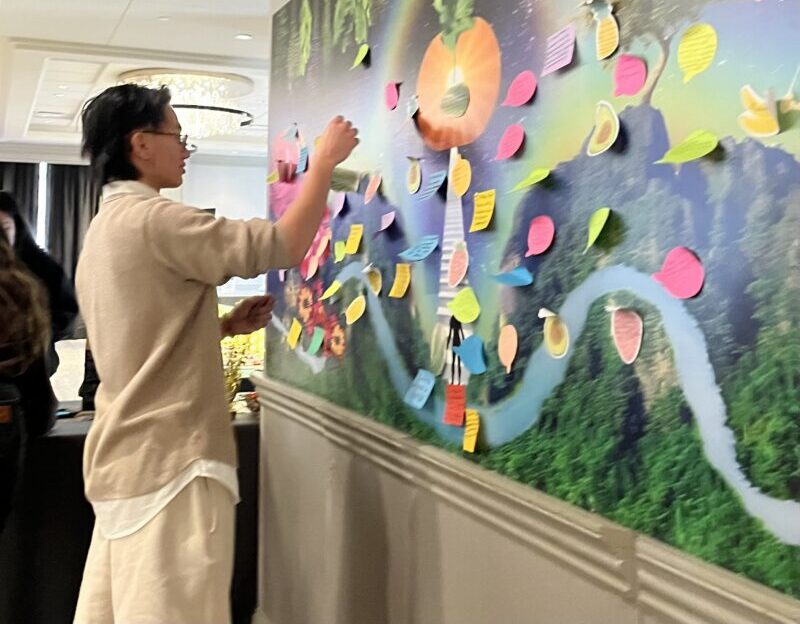
To start the process, Vang put together an advisory committee of people from the community, paying them to help organize and co-host community dinners of 10-15 people. The dinners centered around asking guests what they hoped for the future of their community and what changes they’d like to see. Mu also tabled at the Hmong National Development Conference, which happens every two years. In 2025, the conference took place in Minneapolis to mark the 50th anniversary of the Southeast Asian diaspora in the city and across the country. Vang’s team talked to at least 50 people there, creating a digital collage based on a Post-It note activity they conducted at the conference. “I think we collected 300 or 400 Post-It notes,” Vang said. “People deeply wanted to have conversations.”
Once she’d collected the data, Vang was careful not to be extractive. Rather than directly using stories people told her, she let her research inform the tone of the piece, adding bits of knowledge about HMong culture into the text.
For example, the huge role of farming in the play reflects its importance to HMong communities. When the HMong arrived in the U.S., they brought with them their deep knowledge of cyclical agriculture. They were particularly adept at making food grow amid a migratory lifestyle in the mountains of Southeast Asia, and they employed those skills as they settled in America. Even today, farmers markets in Minnesota are filled with food grown by HMong farmers; many HMong grow food in their own yards or in neighborhood urban farm plots.
Melody Her, an actor in HMong Futures, remembers visiting community garden plots with her grandparents, aunts, and uncles. One of two HMong actors in the show, she was able to draw on those experiences as part of the process.
“I’d follow my grandpa and my grandma to the farm and walk through the garden with them,” she recalled. “I’d help pick and harvest vegetables and herbs, and then we’d bring it back and wash it all together, put it in bags, and put it away for cooking or freeze it. It was a great bonding moment.”
Today her mom still farms cucumbers, bitter melon, Thai chili peppers, sesame leaves, and mint in her yard, but like many in her generation, Her hasn’t kept up the tradition herself. “I don’t really have a green thumb,” she confessed.
Even so, Her instinctively understands her community’s connection to food. One day in rehearsal, another actor in the play asked if it was common or realistic for a HMong mom to give food to her daughter after not seeing her for five years, despite tension between them. Yes it was, Her replied. “In my culture, I understand it—it’s very normal,” Her said. “Cooking and offering food is a form of love, especially when we don’t have the words and we don’t know how to express those emotions. The least that we can do is, ‘Hey, have you eaten?’”
Kathy Mouacheupao, a member of the HMong Futures advisory committee, remembers her mom once telling a houseguest to “go kill a chicken.” This reflected a tradition in which HMong typically send visitors—in this case, a guest was staying at their home while Mouacheupao and her mom were traveling—off with boiled chicken and rice. “You pack them a lunch, because it’s usually like a day or two walk to the next village,” she said. When she explained to her mom that she couldn’t expect visitors to kill their own chicken for their meal, Mouacheupao recalled her mom responding, “I keep forgetting, you American kids. Growing up, it was so normal that every girl knew how to kill chickens and how to garden.”
As part of the rehearsal process for the show, actors took a field trip to an urban farm, where they learned about different growing practices like grafting, a process that joins two plants. Slaughtering poultry, a plot point in the play, was not on the agenda for their visit, though the farm does have chicken coops, and the cast and crew did learn about the herbs to make chicken herbal soup, a traditional recipe that plays a key role in Vang’s script. They also worked with cultural advisor Pang Foua Xiong, who helped the cast with elements like washing vegetables and the intricacies of the dialect. She also worked with the cast and director Reena Dutt on HMong healing processes. “We have our own bone acupressure practice,” Xiong said, “and so we were making sure that that shows up in an authentic way.”
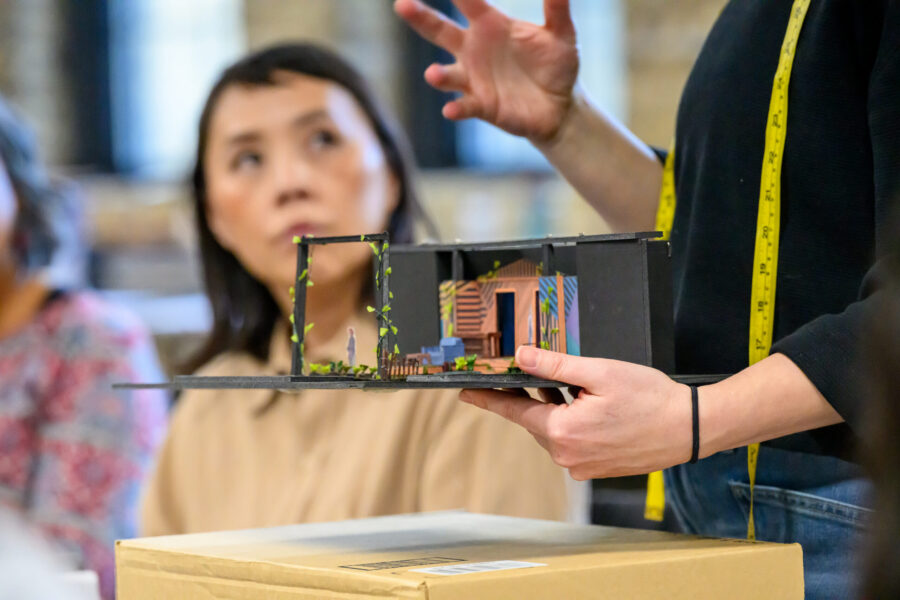
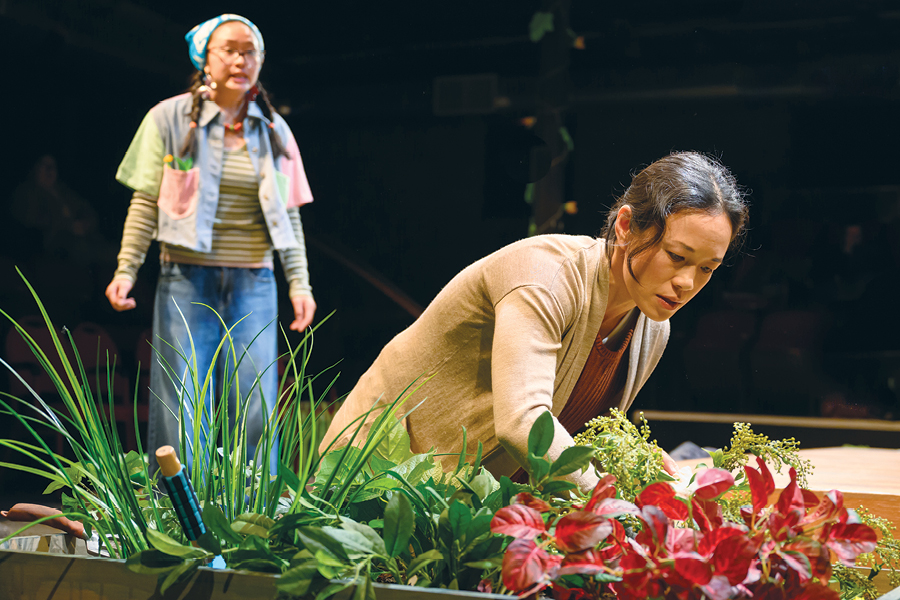
The play’s set, designed by Sarah Bahr, created garden plots all around the perimeter of the thrust stage, with artificial plants the actors cared for and harvested over the course of the play.
Kaohly Vang Her, St. Paul’s first HMong mayor, who took office in January, was flooded with recognition when she entered the Gremlin Theater on opening night. “It was interesting to walk into this space and see this set,” she told the crowd in a pre-show speech. “It looks like all the HMong houses that I saw when I was growing up in the ’80s.”
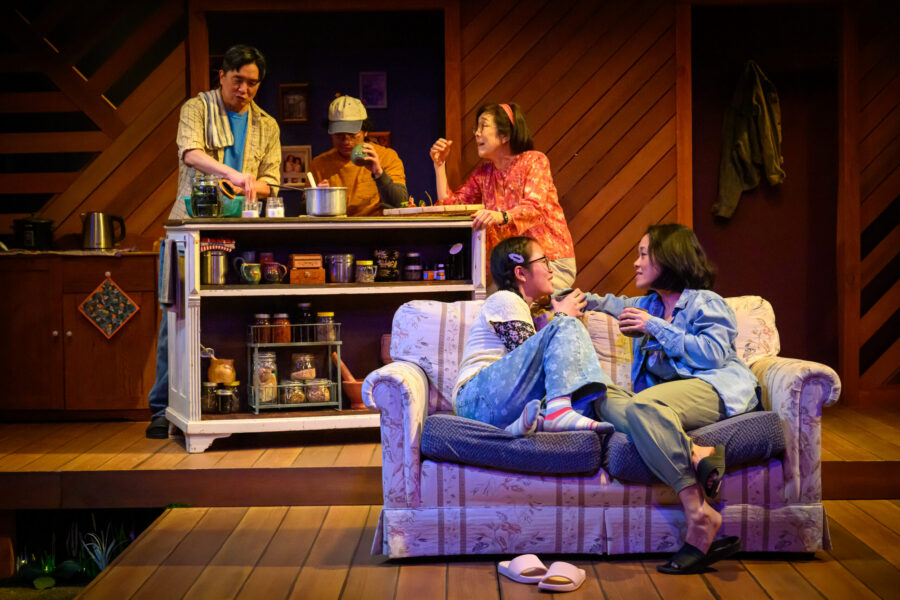
The play is set in the home of Zong, an elder HMong woman played by Sharon Omi, a character based in part on Vang’s own mother, who has been farming her whole life. Zong takes a cooperative approach to the garden, sharing duties with her neighbor, Unclefriend (played boisterously by Greg Watanabe). The two are friends who also shower together to save on water costs and are possibly romantically linked, though they never admit as much. Also in their circle is a teen boy named Aben (Mason Yang), who sleeps in Zong’s daughter’s old room and helps out with the farm. He and Unclefriend have a sweet relationship, as the show explores what it looks like to build love and trust outside immediate family.
That is, until Zong’s daughter, Fhoua (Nancy Ma), shows up, disrupting the utopian order. Soon she’s joined by her own daughter, Maly (Melody Her), a youngster versed in nonviolent communication lingo. Fhoua is full of fury, stress, and anxiety, all of which are making her ill. We learn that several years before the events of the play, she was arrested during a federal immigration crackdown as a result of protesting the ICE presence.
The play’s flashbacks to the ICE occupation diverged starkly from the realism of the rest of the production. The memory section unraveled like a nightmare, complete with eerie lighting designed by Ellie Simonett and sound design by Pan-Pan Gou. The trauma from the ICE occupation erupted like a storm onstage.
In a way, Vang sets up the cultural components as pathways toward Fhoua’s healing. Farming, cooking, and traditional medicine—it is only when Fhoua allows herself to be open to these cultural touchstones that she is able to begin rebuilding herself. Her daughter’s new knowledge, learned from a progressive summer camp, aids in her healing too.
Director Reena Dutt said she was interested in exploring generational trauma, which she knew from her own family history: Her father came from a farming family in Bangladesh who were forced to migrate after the 1947 Partition of India and Pakistan. “Working on the play has really made me think about my roots, about my own family and what my father went through, and how he made change happen back in the ’60s,” she said.
Dutt was especially interested in how rebuilding happens after trauma. “If you look at the HMong community here, they have built such a strong and beautiful, tight-knit community in Minnesota,” she said. “The strength that comes from loss and the strength that comes from forced migration out of necessity—I think that’s such a huge part of American culture. So many people came to this country because they couldn’t stay at home or they needed to find something better for their communities.”
For Zack Nguyen, a Vietnamese American dancer who attended the opening night performance, the play connected deeply with themes of intergenerational relationships. Watching the play, he said, he realized how time has changed, and is changing, the culture. “It’s kind of hard to really see what it’s going to look like for the new generation,” he said. “I feel like it’s going to be breaking a lot of generational curses, or just a lot of trauma that comes with them.”
Nguyen’s parents fled Vietnam due to the war when they were just 16 years old. “They didn’t know a lot, so they had to build their own culture here,” he said. “Coming together with the new generation and just having those conversations, I think, would be healing for both.”
When Xiong brought her 13-year-old daughter with her to the show, it was meaningful on multiple levels. Said Xiong, who has known Vang since they were both in the modeling and acting worlds as young people in the 1990s, “It was really emotional just to see how far we’ve come.”
Xiong also knows ChongLy “Scott” Thao, the elder HMong man whose arrest is being investigated as a kidnapping by Ramsey County Attorney John Choi and Sheriff Bob Fletcher. Indeed, she lived with him for 10 years before he moved into the house where he was apprehended. Thao’s arrest made Xiong think about her grandfather, who, when she was a kid, would say things like, “The Americans betrayed us,” Xiong recalled. “That was all that I heard from my grandpa growing up, just the feeling of betrayal. They lost wives, sisters, brothers, and an entire village fighting for something they didn’t know.” The rough, chilling treatment of Thao, Xiong said, made those memories come flooding back. “That feeling of betrayal is coming up again,” Xiong said. “It’s still a really emotional time.”
As a millennial, Xiong said she’s from a generation that still had the chance to be immersed in authentic HMong culture. She grew up speaking HMong, and was able to both “see what the American experience was like” and to “experience what was being left behind, and also how we’re evolving in our language and our culture.” Younger generations don’t have the same fluency or connection, she said: “It’s such an eye-opening experience to see how much in just one generation has changed with our culture and our language.”
Vang said above all that she hopes her play shows the world just how resilient HMong people are.
“We’re trying to fight the good fight like everybody else,” she said. “While caring for our people and loving others.”
Sheila Regan is a Minneapolis-based journalist and critic. She contributes to MinnPost’s Artscape column, writes classical music reviews for Pioneer Press, and has written for Hyperallergic, Bomb, The Art Newspaper, and The Minnesota Star Tribune.