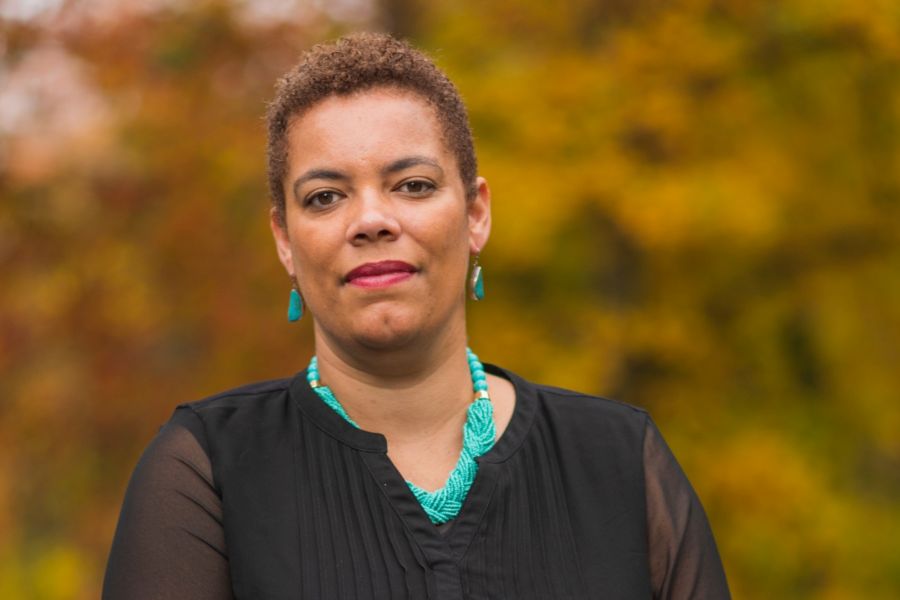
Avery Willis Hoffman’s theatre career took a turn at the age of 12. Raised in Princeton, New Jersey, where her mother was an artist and father taught at Princeton University, Hoffman grew up participating in theatre. Her first professional role was on the stage at the McCarter Theatre Center where, at 12, she played Bob Cratchit’s eldest daughter Martha in A Christmas Carol. During a performance halfway through the run, Hoffman recalled in a late October interview, her period dress got caught and ripped in the show’s revolving set. As Hoffman now takes the reins as Court Theatre’s newest Marilyn F. Vitale artistic director, succeeding Charles Newell who had led the theatre for three decades, she’s looked back on that moment as “a real turning point.”
“I was like, you know, I don’t really need to be on this stage,” Hoffman said. “Let’s make sure that doesn’t happen to anyone else, and that will be it. I was very lucky because I had wonderful drama teachers in high school, so that somewhat traumatic experience on the professional stage of the McCarter did not end my career entirely. It just sort of diverted me to other things, which I very much enjoy.”
Indeed, Hoffman’s career took her away from the stage, but never too far from the theatre. Hoffman holds a BA in classics and English from Stanford University and a masters and doctorate in classical languages and literature from the University of Oxford, where she was a Marshall Scholar. She has worked around the world with director Peter Sellars on theatre, opera, and dance productions, including Othello, Mozart’s Zaide, Toni Morrison’s Desdemona, and the New Crowned Hope Festival in Vienna. She has produced international tours and performances through Avery Productions, the company she founded in 2006, and she has served as program director at New York City’s Park Avenue Armory and as content developer at Ralph Appelbaum Associates, where she worked on the development of the permanent exhibitions of the Smithsonian Institution’s National Museum of African American History and Culture. Most recently, Hoffman served as the inaugural artistic director of the Brown Arts Institute at Brown University, where she oversaw the opening of the Lindemann Performing Arts Center.
“Avery is a visionary leader whose knowledge of the classics, depth of experience, artistic rigor, and commitment to inclusive storytelling make her an exceptional choice to guide Court’s artistic future,” said co-leader and Court executive director Angel Ysaguirre in a statement. “Her collaborative approach and thoughtful leadership will be invaluable as we continue to grow our national profile and deepen our engagement with audiences. I look forward to working closely with her to advance the theatre’s mission and build on its legacy of bold, thoughtful storytelling.”
I had the chance last month, ahead of Hoffman’s official start this month, to chat with Hoffman about her vision for Court’s future, working at an organization housed within the University of Chicago, and what we can learn from the classics.
JERALD RAYMOND PIERCE: What made Court Theatre feel like the right next step for you, and what interests you the most about this particular opportunity?
AVERY WILLIS HOFFMAN: For me, it’s a coming home of sorts, coming sort of back to the theatre. I think one of the things I’ve really enjoyed across my career is the multidisciplinary nature of it. Often, I am the theatre person who’s bringing theatrical ways of thinking and that kind of collaborative spirit to a project, even if it’s not in the theatre. So for me—because all of my degrees are in the classics and the through-thread has always been theatre, even in my classics training—the opportunity to be associated with an incredible university like University of Chicago, to be in a great theatre city like Chicago, and then to be thinking about the future of a theatre that’s really focused on the classics and what does it mean to interpret the classics, what is a classic, was super exciting for me. It actually was a really beautiful culmination of all of these threads across my career and all the things that I’ve been deeply committed to and interested in.
As you talk about Court’s legacy, are there certain places that excite you the most about helping this organization continue to grow?
You know, Court just turned the bend on 70, and one of the things I’m excited to do with the staff and the artistic team is to look back on those 70-plus years as we think about our 75th coming up. In a moment where we’re celebrating 250 for the country, what does it mean that, for 70 of those years, the Court has had an incredible contribution to the theatre and to Chicago and the University of Chicago? What does that look like?
I think part of that is kind of nerdy and academic: What are the most common plays that were done over these 70 years? Who are the directors that worked multiple times at Court? And what are the gaps? Who hasn’t been produced? I think this ongoing question about what is a classic allows us to be really creative about the future. So I’ve been thinking about looking back to look forward. How do we build on this incredible legacy?
It was really kind of eye-opening to be the third artistic director in 70 years. That’s kind of amazing. To look at the legacy that Charlie Newell built, that Nick Rudall built, and to think about how we build on that legacy and what can we do going forward, given the state of the world and the state of theatre and what I believe to be theatre’s really central role in the civic life of a place, of a country, of a city. So I think, at least for the first couple of years, just thinking about where Court has been and what are its strengths and getting to know what are audiences really responding to. Those productions can really offer us a lens that we wouldn’t get otherwise.
And then also really thinking about pipelines and workforce development and how we strengthen not only Court, but the Chicago theatre scene, the national scene. How can Court play a role in identifying young writers and young directors and young designers and shepherding people along and not just being a kind of pinch point where folks can’t emerge and evolve?
Sometimes, when we talk about classics, it can feel like there’s a strong segment of folks who look at some of what we call classics and just see a bunch of dead white guys. As we talk programming, thinking specifically about season planning, how are you looking at balancing these classics, which of course became classics for a reason, with that impulse and desire to make room onstage for other voices?
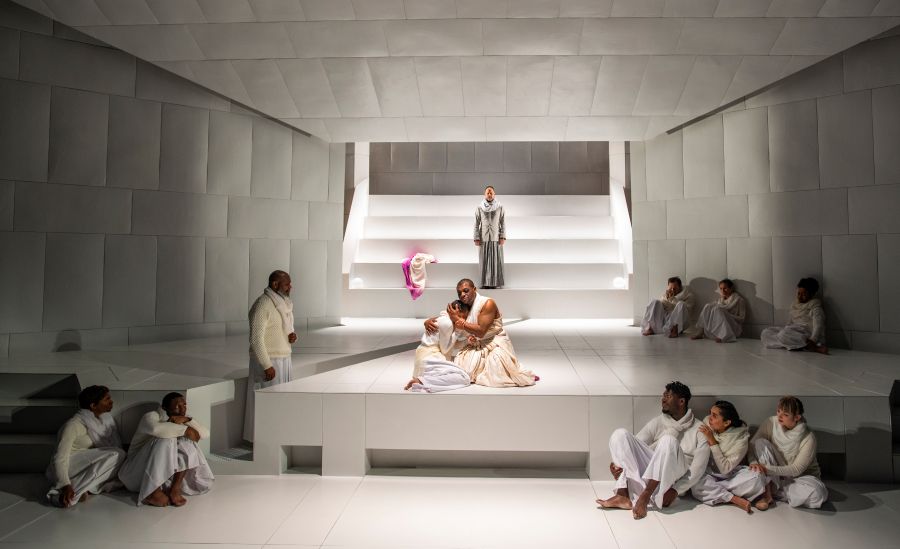
We just had our artistic retreat a couple of weekends ago, which I was very lucky to attend, and one of the things that we debated and talked about was how we define the classics. I think it’s an ongoing debate, and I’m happy it’s ongoing, because that’s part of the work, that it’s fluid and not a static, “This is a classic. We only do this and this.” So I think that there’s a Western canon that’s very specific. It’s your Greek tragedy. It’s your Shakespeare. It’s Molière. It’s other folks who, let’s say, have been canonized as “classic.” I think there are a multitude of ways to be very, let’s say, multi-generational about those works. So for example, thinking about an ancient tragedy. What would happen if you had a young Latine director and Latine designers thinking about Medea? That’s a different lens than what we might expect from a “classic.” So I think that there are those old texts, and then there’s adaptations and thinking about how we use these texts which are in the public domain and we can manipulate them and transform them.
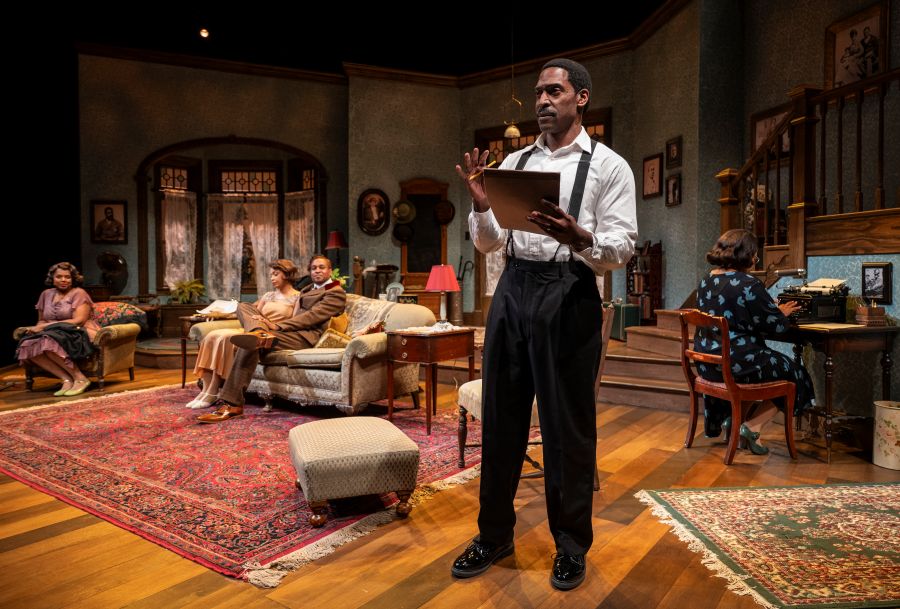
Then, Court has recently been dipping into, what are our new classics? What is it that makes a classic? What are those enduring themes? And who are the playwrights out there who are thinking about those? I think there’s this sort of sub-subcategory of American classics. Thinking about August Wilson—we’re about to finish the Century Cycle, which is a huge accomplishment—I think many would say that August Wilson has entered the canon of classic American playwright because of theatres that have produced the entire Century Cycle and have produced content around that Cycle, you know, additional programming to help people understand August Wilson and his work.
So when we’re approaching season planning, we’re thinking through those different categories and what might it look like to have some of each of those things. I’m also personally very interested in going beyond the Western canon. What does it look like to look at Indigenous storytelling and stories? What does it look like for African-based storytelling? The world is enormous, and there are these traditional stories in every culture. What is the difference between a traditional story and a classic? All of that’s a debate, which I think is super fun and really evergreen in a way. We ask our audiences to participate in that debate, to say, “Hey, no, this isn’t, you got it wrong,” or, “How about this one?” So making it an open dialogue with the audience and not so much like, this is what we have deemed a classic and therefore it has a stamp on it and we should proceed accordingly.
Given your background, and thinking about the eras of theatremaking that came way before us, are there things that we as present-day theatremakers could learn from earlier eras, either about the way art was done or produced or the way folks engaged with art?
I think for me, in my admiring of the Greeks, what I particularly found compelling was that they really put theatre right in the center of civic life. When they did these huge festivals, the generals, the politicians were in the first and second rows. Everybody was called to the theatre. That, to me, was super interesting, that every aspect of civic life was present in the physical folks who were there. And the folks who weren’t there—like women, slaves, and other folks who were not, essentially, Greek males—were represented onstage. I’m a particular scholar of Euripides. He put women on the stage in almost every show that he put together. That was really telling. They were not in the audience, or if they were, they were in the way, way, way, way, way, way back.
So this idea that theatre would bring forth the really important, compelling issues of the time and would represent folks who weren’t otherwise represented in this very particular kind of democracy, I think that’s a really enduring thing that we should continue to think about. Who is not represented on our stages? Who is not represented in our audiences? Can we use the theatre to bring new understanding? Theatre can be a place where representation can happen, if we support that effort. The opposite can also happen, so I think it has to be a deliberate act. It has to say, “This is a space where we are going to tackle these really hard topics. This is a space where we’re going to respond to what we’re doing right now in this country or in this world.” Often, I’ve discovered, theatre is the only place you can do that.
Speaking of audience, Court is uniquely positioned in Chicago, both because it’s within a university, but also because it’s the most prominent theatre on the South Side of Chicago. How are you looking at Court’s place within the Chicago community?
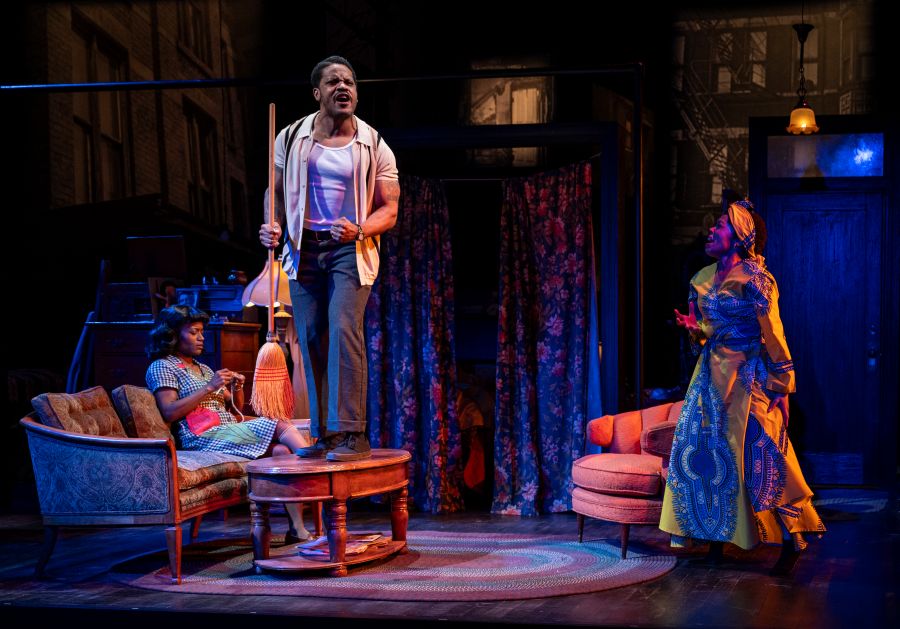
Power of place, to me, is really, really crucial in the kind of civic responsibility that the theatre has. The South Side has such an extraordinary history and an extraordinary history for artists: literary artists, theatrical artists, folks who, across the last century in particular, really contributed to American culture in these really beautiful ways. I know, for example, the production of Lorraine Hansberry’s Raisin in the Sun was the best-selling theatrical production in Court’s history, and that was last year, honoring Lorraine Hansberry’s South Side ties. It’s something that I think has really alerted us to the fact that we need to honor and celebrate folks who have come through the South Side, who have then gone on to other places.
But I’m really interested in—this will be my learning curve—who are the folks now who are making work on the South Side? I have a long-standing collaboration with Theaster Gates, and thinking about the ways in which he’s doing these really beautiful collaborations with folks, making space for those collaborations to really thrive. There’s something about honoring the history, but also thinking about who’s there now. Who are the young people there who are making work and thriving in this artistic way across disciplines, not just in the theatre?
I also think—and this is something, again, that I’m learning about—there’s something to be said for the Court’s position in Chicago more broadly and what it looks like to represent the South Side and to show the really complicated, intricate, and wonderful contributions the South Side has made to Chicago more broadly. I think Court can be a really beautiful emissary for that. The university is also thinking about the South Side, what it means to be there, and their responsibilities on the South Side. I think Court is kind of beautifully positioned to think within the South Side, within Chicago, and then beyond. How do you take the spirit of Chicago elsewhere? That’s definitely a priority for us. It’s going to take time to evolve, but I think it’s on its way.
Touching more on the university aspect, it feels like an interesting time for academia in general—thinking about the current administration and funding questions around universities as well as theatre itself. What are the opportunities of this unique partnership? What are the challenges?
That’s a great question, one I’m going to be exploring quite a bit. What is a gem is that the university is absolutely committed to Court, and that is something, during these really challenging times, that is gold, right? Not only does the university financially support Court, but it’s constantly inviting folks to go in both directions. What does it mean to bring what Court does into the university space? Whether it’s into the classroom or into partnerships with other UChicago arts entities, thinking about what those partnerships look like. But then also the other direction, bringing students into the theatre.
I went to [Court’s production of] Big White Fog and I sat with some business school students. Part of their orientation was to come to the theatre, and I thought, Wow, this is great—to just sit with them and overhear how engaged they were. These are business school students, and they were talking about the play and the things that they were really interested in. So I think there’s a two-way relationship with the university that I would love to explore more.
I think that Court can be a great ambassador for the university on the South Side. We have an incredible engagement team and education team that’s out there in the community. We’re representing the University of Chicago during this moment. I think that goodwill and that good work does a lot for the university. I also think that there’s a potential for students to learn so much with a professional theatre on campus. That’s pretty rare, you know, to actually have that. It’s not an academic space, it’s a professional space.
So I’m excited. There’s lots of opportunity to strengthen that sort of two-way exchange, so I think some of our work will be to figure out what are those opportunities. Some of the challenges have to do with the university’s history on the South Side and the inevitable expansions that happen and the kind of view that the residents have of the university. Navigating that is something that needs to be done thoughtfully, and I think Court can go a long way to help with those sorts of relations and relationships.
If you were to jump ahead however many years into the future, when Avery Willis Hoffman’s tenure at Court has come to an end, what would you hope that the community is saying about your time leading the organization?
I would hope that they would say that during my time, Court really strengthened its relationships with the community, that it really brought forward a variety of playwrights and directors who have then gone on to prominence in Chicago and the world—that I opened the doors for folks to come through Court to really share their work and help them on this journey towards becoming a classic or interpreter of the classics.
I also really hope that my time is seen as a cementing of the legacy of my predecessors, that the extremely high quality of theatre continued, that the choice of plays continued in a trajectory that was really set up by Charlie and Nick and those who came before me, and that Court continued to surprise and thrill and challenge its audiences. I think more about the quality and the content than the sort of, as we say jokingly in the theatre, “butts in seats.”
And I hope that some of the initiatives that I start have legs that maybe end up having Chicago-wide or nationwide impact. I hope those initiatives are related to workforce development and pipeline and that Court really established itself as a leader of innovative thinking in the theatre.
Is there anything else you’d like to let readers know?
The only other thing I would mention, and I think this is kind of an ongoing discussion: I’m really curious and excited to think about a new definition of artistic director. I think we’re on the cusp of it. There’s been an era of the artistic director who’s kind of the flyby, who’s out in the world, sort of scouting and is kind of itinerant and comes back and sets the season and then goes off. There’s also, in many ways, the Charlie Newell kind of model, which is to direct a lot, where directing is your thing and that’s what you do. That’s been something that’s come up as I’ve been taking on this role, that I’m much more of a creative doula, someone who’s there to help make space for the next generation in whatever direction: writing, directing, designing, et cetera.
So I’m excited to think about what the new era of artistic director looks like. I’ve said very clearly and transparently that I’m not going to be directing two or three of the plays each year. So what does that mean? What are those opportunities? What does that look like? Because I come from a producing space, from a different kind of leadership role, I think it’ll be really interesting to see how that role evolves at Court and elsewhere. So it’s a little bit of a challenge to readers to think openly about what an artistic director’s role really is and what it could be for this next era.
Jerald Raymond Pierce (he/him) is the managing editor of American Theatre.