In the spring of 2025, Erik Schark, managing director of Theatre Now New York, received a note from the National Endowment for the Arts informing him that his company’s grant had been terminated. The independent federal agency, established in 1965 to support and expand access to the arts across the United States, was, the email said, updating its grantmaking policy. The agency wanted to focus on projects that reflected “the nation’s rich artistic heritage and creativity as prioritized by the President.” Theatre Now’s $15,000 grant, awarded to support the development of new musicals through their Musical Writers Lab, seemed to no longer align with this direction. Schark and his team were particularly crushed by the news, as it was the organization’s first NEA grant.
“We were really honored,” he said. “It was the first time our organization got funding on the city level, the state level, and the federal level.” To have that support suddenly yanked was, Schark says, upsetting.
Schark and Theatre Now were not alone. Across the country that May, hundreds of arts organizations received a similar email from the federal agency and found themselves scrambling to close unexpected budget gaps. An informal tally done by PBS in June 2025 found that almost 560 grants, totaling more than $27 million, were cancelled. Brian Weaver, producing artistic director and co-founder of Portland Playhouse in Oregon, received the termination email before opening night of the company’s spring production, August Wilson’s Joe Turner’s Come and Gone. “We had definitely already spent the money,” he said of the $25,000 the playhouse received from the agency. “We were waiting for the check to come in. It was devastating.”
The news of the NEA’s grant terminations sent shock waves through the arts, including the theatre industry. Despite having one of the smallest budgets of any government agency, the NEA has long been one of the largest arts funders in the U.S. In the email to grantees, the agency listed some new, vague, and thematically incompatible areas of focus, which included elevating historically Black colleges and universities, celebrating the 250th anniversary of American independence, making America healthy again, supporting Native tribal communities, and fostering AI competency. How could one both support historically marginalized folks while also cheerleading artificial intelligence, an environmental disaster for many of the same communities? And what exactly did it mean to make America healthy again in this context?
Still more confusing, these priorities were announced just months after the NEA asked grantees to attest that they would not promote “diversity, equity, and inclusion” or “gender ideology.” The latter policy was removed in March after the American Civil Liberties Union filed a suit on behalf of a number of arts organizations, including the National Queer Theater, The Theater Offensive, and Theatre Communications Group, this magazine’s publisher. At presstime, the anti-DEI guideline remained intact.
Following the grant bloodbath in May 2025, Weaver said that Portland Playhouse conducted internal conversations with their staff and board about whether or not to seek further grants from the agency, even though “we explicitly did not agree with the language in the agreement.” Their ultimate decision to apply came from a belief that the NEA “doesn’t belong to the federal government,” Weaver said. “It belongs to the people.”
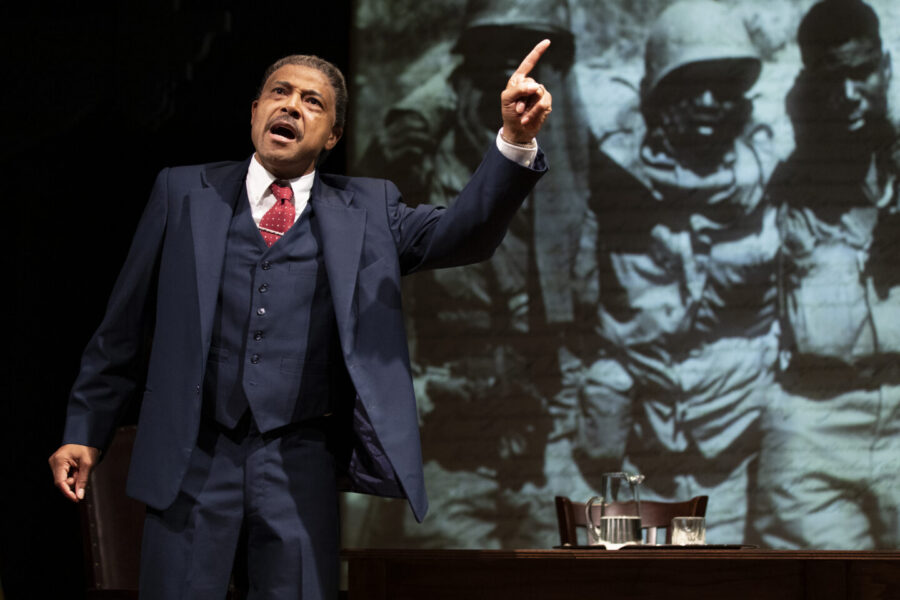
Later that summer, Portland Playhouse applied for an America250 grant, to be allocated to projects celebrating one of the more than 200 “national heroes” included in a 2020 executive order issued during President Trump’s first term. Weaver saw Thurgood Marshall, the Supreme Court’s first African American justice, on the list. In 2022, the company had staged Thurgood, a one-man show about the trailblazing Civil Rights figure, whose winning cases included Brown v. Board of Education. Weaver thought America’s semiquincentennial would be the perfect occasion to produce the show again.
Still, it surprised Weaver when Portland Playhouse was among the 50 recipients of an America250 NEA grant. The announcement came in December 2025, just seven months after the termination emails had been sent. Since then the agency has continued to fund projects on a rolling basis, with each recipient expected to receive up to $25,000 for a project highlighting an American hero, chosen from a list that barely hides its perfunctory inclusion of non-white people. (Civil Rights leader Martin Luther King Jr. is honored alongside Barry Goldwater, the father of modern conservatism, who voted against the Civil Rights Act of 1964.) “It’s such a weird time,” said Weaver. “It wouldn’t have surprised me if we hadn’t gotten any response.”
Indeed, it is a strange time for the federal agency, which is navigating capricious executive orders, vague declarations, and dramatic budget proposals while still claiming to champion arts equity in the U.S. It’s now been over a year since the Trump administration began its crusade against many federal agencies, including those supporting the arts and humanities, with the callous rescission of active grants. While the NEA, unlike USAID, has survived the DOGE purges, the president’s most recent plans send an ominous message: The administration’s proposed 2027 budget, released in April, allocates just $29 million for the NEA, a drastic reduction from $207 million in 2026, with the intention of sunsetting the agency.
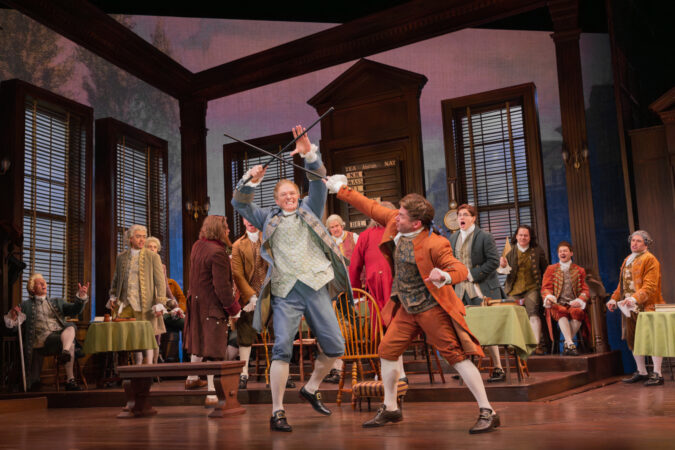
In the face of those harrowing numbers, the organization is continuing to sponsor meaningful if politically anodyne work. The initial theatre grantees of the America250 grants include not only Portland Playhouse’s Thurgood but a play about Rosa Parks and the Montgomery bus boycott at Theatre Now New York, about Jackie Robinson’s integration of Major League Baseball at Karamu House in Cleveland, the Wright Brothers at Rude Mechanicals in Austin, and not one but two stagings of the Declaration of Independence-themed musical 1776.
The generally inoffensive nature of these selections seems to reveal an agency that has trimmed its sails (not only financially) and ceded ground to conservative demands in order to survive.
“It is not the same agency,” said cultural historian and critic Isaac Butler, whose new book The Perfect Moment: God, Sex, Art, and the Birth of America’s Culture Wars came out in June. According to Butler, previous generations of NEA administrators understandably made concessions to ensure bipartisan support and guarantee the endowment’s survival. But this “hunker down and wait strategy,” as Butler called it—an approach that assumed the worst policies would be overturned once the arts secured a more certain future—has not worked.
“What happened instead is that Trump and his ideologues won a second presidential term,” said Butler. “And they’ve decided to turn every arm of the federal government, including the NEA, into an instrument for furthering their ideology and power.” This reality, coupled with the confusion and opacity around the NEA’s decision-making processes, makes it difficult to put much faith in its future.
When Theatre Now’s Schark applied for NEA grants for the 2026 fiscal year, he, like Weaver, had no expectations. He knew that it would be challenging to portray Theatre Now in a way that aligned with the current administration’s anti-DEI agenda. In January 2025, on the day of his inauguration, President Trump signed an executive order which required all federal agencies to end the Biden administration’s “illegal and immoral” diversity, equity, and inclusion programing. Schark says he’d been advised to remove mentions to DEI for federal awards, but he refused. “It’s so baked into who we are as a company,” he said. “I cannot take those words out.” He wasn’t surprised, then, when the NEA proposal he wrote for general operating costs was turned down.
What did come as a pleasant shock was when the NEA went on to approve a grant for Theatre Now’s Rosa Parks musical. Parks is one of the people on the National Garden of American Heroes list, which Schark was excited but a little puzzled to see, considering this administration’s approach to American history. “It felt like a validation of our work,” Schark said of the grant. “It’s been such a roller coaster.”
A roller coaster would be one way to describe the history of the NEA. When signing the legislation that established both the NEA and its sibling organization the National Endowment for Humanities in 1965, President Lyndon B. Johnson referred to the arts as the United States’ “most precious heritage. For it is in our works of art that we reveal ourselves and to others, the inner vision which guides us as a nation.” Unlike past federal projects, such as the Federal Art Project or Federal Writers’ Project under the Works Progress Administration (WPA), the NEA was not designed with an urgent material need in mind.
While the earlier programs were specifically designed to employ artists during the Great Depression, the NEA was created in a time of relative plenty to support America’s understanding of itself through the arts.
It’s also worth noting that the agency was founded in the midst of the Cold War, when both the U.S. and Russia were using culture as a tool in their international political psychodrama. A few years before the agency was officially formed, the historian Arthur Schlesinger Jr. wrote in a memo to President John F. Kennedy that the arts would be critical in “transforming the world’s impression of the United States as a nation of money-grubbing materialists.”
If art supported by the NEA would indeed alter the world’s idea of the U.S., this vision has been contested in the decades since. Despite initially receiving bipartisan support and positioning itself as a nonpolitical entity, the NEA became a battleground for the culture wars. Early hints of unrest emerged during the 1980s with the election of President Ronald Reagan. His administration questioned the necessity of the agency and launched a task force to investigate the purpose of an arts endowment. Luckily for the NEA, the conclusion of the committee’s hearings recommended keeping the Endowments alive and well-funded. President Reagan eventually went on to increase the agency’s budget to about $169 million, and his presidency did mark the establishment of such programs as the Jazz Masters fellowship and the National Medal of Arts.
“You have an American renaissance of creativity in all art forms that would not have existed without the state sponsorship,” Greg Reiner, the former director of theatre and musical theatre at the NEA, said of the organization’s history. The creation and expansion of the NEA helped all artists, but it especially allowed playwrights to thrive apart from the mandates of commercial Broadway. It also played a crucial role in the creation and sustenance of the national nonprofit regional theatre network as we know it, including several theatres of color.
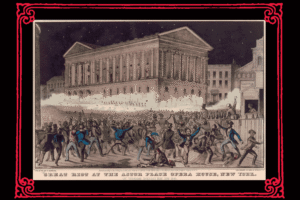
The biggest flare-up around the NEA came in the late ’80s, when a retrospective of Robert Mapplethorpe’s photography, some of sexually explicit, in Cincinnati and Washington, D.C., and an image by Andres Serrano depicting a small plastic crucifix submerged in urine, became flashpoints for the agency’s Congressional enemies, as both artists had been partly and/or indirectly funded by NEA grants. An independent commission was established to investigate whether taxpayer dollars should be put toward material considered obscene or indecent, and the NEA found its existence questioned again. The agency emerged intact but not unscathed: Language was added to NEA grants that invoked standards of decency.
In 1993, performance artists who would be dubbed “the NEA Four”—Karen Finley, John Fleck, Tim Miller, and Holly Hughes—successfully challenged the rescission of their grants on these grounds, but a later Supreme Court decision upheld the NEA’s policy. That 1998 decision not only codified the decency standard for grants; it also spelled the end of direct NEA funding for individual artists. “All the money had to flow through institutions,” said Butler. “Institutions are more conservative than individual artists, and the amount of control the NEA exerted over who got grants was informally increased.”
The Trump administration’s stringency around DEI and how American history is told certainly echoes prior schisms. But as in other areas of public life—the media, academia—the second Trump term has ushered in a trend of capitulation that is more frightening.
The administration officially appointed Mary Anne Carter as NEA chairman in December 2025; Carter had previously served in the same role during President Trump’s first term, which was embroiled in similar controversies. (In both terms, his administration’s annual budgets have consistently proposed shutting down the NEA.)
Despite repeated requests from American Theatre, Carter was not made available for an interview. But she did speak about her priorities in a recorded conversation with Nina Ozlu Tunceli, the chief counsel of Government and Public Affairs and the executive director of the Americans for the Arts Action Fund. In that conversation, Carter said she had asked to be placed at the agency because she understood “the value of the arts.” Citing her experience as the mother of a child with learning differences, Carter said she was aware of how arts had helped her daughter. “It became a very powerful tool,” she said.
Carter also reiterated a desire to uphold the “spirit” and “efficiency” of the agency. Asked about recent changes in grant guidelines, she cited a desire among the staff for a clearer rubric around “the core product” of the NEA, which is “giving grants…The reason that we changed the guidelines,” she concluded, “is that we have a new president.” (It’s worth noting that many NEA staffers, from senior officials to grant managers, resigned after the Trump administration announced its divestment plans.)
The tenor of the interview shifted when Tunceli pressed the chairman for clarity around the NEA’s new guidelines, particularly the expectation that organizations comply with Trump’s anti-diversity executive order, which called for the termination of “illegal DEI and ‘diversity, equity, inclusion, and accessibility’ (DEIA) mandates, policies, programs, preferences and activities.” Tunceli honed in on the inherent contradiction of the NEA’s guidelines. “Grants for underserved communities is a valid request for a proposal,” she said, “but how is it also not preferential for DEIA?”
To that, Carter simply said: “We are seeking clarification.” She recommended that all organizations ask themselves if, in an effort to be inclusive, they are being exclusive. To illustrate the point, Carter could only offer a hypothetical example of a Hispanic music organization turning away a young Black musician or a young white kid from their free music programming because their target audience is Hispanic kids. “The answer is obvious,” she said. “Of course, they’re going to be included.”
Perhaps what’s most odd—and ironic—is when Carter offered the Alvin Ailey American Dance Theater as an example when asked if organizations that “might be considered one race” can still apply for funding. Ailey founded the studio in 1958 originally as an all-Black dance company, and later died from AIDS-related complications; as such, the intersection of his race and sexuality make him an antithesis to the current administration’s vision of America. “The answer is yes, of course they can,” Carter says, “because they don’t exclude anyone. I know this as a fact because my daughter takes Ailey workshops.” The “of course” haunts her replies, because if all of this is so obvious — and in Carter’s words, common sense—then why is the current administration requiring arts organizations to spell it out?
Nearly all the grantees American Theatre spoke to for this story shared similar recent experiences with the NEA. They found themselves in the lurch when grants were unexpectedly canceled last spring, and seemed surprised and grateful to be awarded months later for a semiquincentennial project. A few of the organizations, including Theatre Now, Portland Playhouse, and Rude Mechs, had internal conversations about whether applying for a federal grant would amount to complicity.
“We don’t want to seem like we’re in support of the government,” said Kirk Lynn, an artistic director and co-founder of Rude Mechs. “On the opposite side we were like, getting money from the government is great and giving it to artists is a great idea.”
Butler, who dives deep into the history of the NEA in his new book, disagrees. “The fact that any arts organization was applying for funding at all after all the DOGE shit a couple of years ago is inexcusable,” he said. “By taking the grant, you are signing on to things like being against DEI, being against trans rights—you are saying you agree with that.” Butler said he doesn’t view the forms organizations have to sign to receive the money as empty gestures.
But none of the organizations we spoke to felt they had to compromise their vision or their mission to win the grants. Tony F. Sias, the artistic director of Karamu House, one of the oldest Black theatres in the U.S., said that “honoring and celebrating the Black experience” is central to the company’s mission. He had felt “optimistic” about their chances of getting an America250 grant after he saw Jackie Robinson on the list of heroes; their federal funding goes to a production of Edward Schmidt’s Mr. Rickey Calls a Meeting, about the integration of Major League Baseball by Robinson in 1947. “It’s quite timely right now as we look at the climate of the country,” Sias added.
Meaghan Simpson, artistic director of the Texas Shakespeare Festival, expressed a similar sentiment about the rural East Texas company’s summer production of 1776. Not only is it the musical most requested by local audiences, but Simpson said it’s “shockingly relevant to this moment.” Indeed, though its title and subject matter would appear to feed a simple patriotism, the show’s arguable high point is “Molasses to Rum,” a scouring song about the slave trade that underpins the nation’s founding. Simpson said she plans to approach their summer production as Hamilton did in recreating a similar period: as a vision of America then, told by America now. Accordingly, the production’s cast is multiracial.
Paper Mill Playhouse also received an NEA grant for their production of 1776, which ran in April to approving reviews (though its cast was predominantly white). Mark S. Hoebee, the theatre’s producing artistic director, hadn’t expected to receive any money for it. “There was so much uncertainty,” he said. “The edict came quickly and at the last minute.” Paper Mill Playhouse’s terminated NEA grant had been for their autism-friendly productions and outreach initiatives, which technically violated the anti-DEI executive order. Hoebee and his team pivoted quickly to seeking funding for their mainstage production, which was a challenge. “There was so much cloudiness and a lack of clarity,” he said. “It was such a shot in the dark.”
Still, for them it was worth the effort. For a nonprofit organization, support from the NEA, even an imperfect one, is still an important marker. It makes it easier for theatres to receive funding from other sources, which in turn helps sustain a meaningful American theatre culture. The idea that the federal government no longer sees the value of this kind of support, especially as the country descends into more obvious modes of fascism, is, Hoebee put simply, “really tough.”
But some arts advocates, like Butler, think it would be better to let the organization go.
“I just think there’s no reason for the arts world to be putting any energy whatsoever into protecting the NEA right now,” he said. Instead, Butler wants artists and arts advocates to build something that restores the agency’s original vision. This is not a moment to put our heads down and hope the storm will pass, but to do the work of “strengthening state arts agencies,” he said, “and frankly building private alternatives.”
A return to state, local, and private power—what could be more American?
Lovia Gyarkye (she/her) is a writer and editor based in New York.