There are countless ways to say “I love you.” Then there’s “elephant shoes,” perhaps the sweetest way of not saying it at all. It’s a homophene, or a “visual homophone”: a set of words that, when silently mouthed, form a near-identical shape on a person’s lips as another phrase, making them difficult to distinguish by lipreading alone, and, in this case, bear a striking resemblance to those three little words. (Just try mouthing them, or better yet, mouthing them to someone you love.)
No surprise, then, that Elephant Shoes is the adorable title of an original musical about a Deaf person and a hearing person falling in love. With a score and lyrics by Caroline Kay and a book by Ivan Menchell, Elephant Shoes had its world premiere at New Jersey’s Two River Theater in June, in a co-production with L.A.’s Deaf West Theatre. Though Deaf West has reshaped the musical mold many times with American Sign Language-inclusive productions, most notably Spring Awakening and Big River, this new show marks an elephantine step forward: It’s one of the first sung-and-signed musicals written about a Deaf main character, starring a profoundly Deaf actor. (Marshall Pailet’s Private Jones, from 2024, seems to have been the first musical to feature a hard-of-hearing actor in a Deaf leading role, while Bruce Hlibok is credited as the first Deaf actor to play a Deaf character on Broadway, originating the role of Hubbell in 1978’s Runaways; Sleeping Beauty Wakes, a 2007 Deaf West/Center Theatre Group co-commission, also included characters written as Deaf, played by Deaf performers.)
This past May, I ventured to Red Bank, New Jersey, to observe rehearsals and get to know the artists behind Elephant Shoes. I couldn’t help but fall in love a little myself with the warm, open-hearted environment that has become Deaf West’s calling card. It’s an energy that ebbs over the mezzanine, flows beyond the box office, and breaches the real-world barrier, reaching out and drawing you in like a catchy pop earworm.
“I don’t mean to brag,” said DJ Kurs, Deaf West’s artistic director, through an interpreter over Zoom the week before previews, “but I feel like every time we work with people, they always say that was the most magical experience they’ve had working in theatre. I do think that’s not because they learned sign language, but because of the depth of these connections that are forged.”
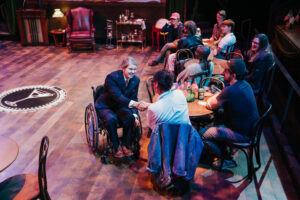
Inside the Two River rehearsal room, I watched as more than 20 people, all somehow calmly concentrating without a communal bowl of Adderall, gathered around music stands, tables, chairs, an upright piano, and furnishings meant to represent a bachelor pad. Multiple conversations were happening at once, most of them silently. Interpreters flitted in and out of view like Cheshire cats, or Barbara Eden in I Dream of Jeannie. There was certainly some order to the chaos, some magic to the madness. And one man stood in the center of it all.
Audiences may recognize Daniel Durant from Deaf West’s productions of American Idiot, presented with L.A.’s Center Theatre Group in 2024, or from Fidelio, in collaboration with the L.A. Philharmonic in 2022, or from the critically acclaimed revival of Spring Awakening, which transferred from the Wallis Annenberg Center for the Performing Arts in Beverly Hills to Broadway in 2015, or, most likely, for his starring role in the Best Picture-winning film CODA. (In a case of life imitating art, Durant was a semifinalist on the reality competition show Dancing With the Stars in 2022, where he was partnered with professional dancer-choreographer Britt Stewart. Reader, they’re married now!)
In Elephant Shoes, Durant originated the role of Cy, a Deaf tech developer whose plucky startup is engineering glasses that translate ASL into spoken English and vice versa, enabling wearers to communicate in real time and appear as if they’re speaking each other’s primary languages. Alas, even the most well-intended technology cannot account for the interference of human emotions. Enter firecracker Taylor Iman Jones as Roxy, the brainy and beautiful data architect who is more proficient in Excel than ASL. No one needs any special glasses to see that Cy is smitten—except his oblivious childhood best friend and roommate, Chris, played by the charming James Olivas, who happens to swoop in at the wrong time, saying mostly the right things in a language Roxy can understand.
Except, spoiler alert: They aren’t actually his words, they’re Cy’s. If this setup sounds familiar, that’s because it’s loosely based on Edmond Rostand’s classic Cyrano de Bergerac.
Menchell began writing the script five years ago, and was initially enamoured of the code-cracking plot line. Over time, he said, the love story came into the foreground, right where it always belonged. Durant, who had been involved with the show’s development for years, said he was excited about finally bringing Cy’s story to the stage. “I have to pinch myself every day knowing that this is actually happening,” he said through one of the company’s three on-site interpreters. Coincidentally, Durant’s first show with Deaf West was a production of Cyrano starring Troy Kotsur (later an Oscar winner for CODA) back in 2012.
That day in rehearsal, the company happened to be tackling the show’s most complicated sequence: a heated confrontation centered around the song “Self-Serving Lie.” On a nearby iPad, captions scrolled, sing-along style. Spoken dialogue and ASL were displayed in sentence case, lyrics in all-caps. Each line was carefully cued and timed to the music. A workflow-integrated software from Panthea kept everyone, whether singing, speaking, or signing, on the same page. There was an ongoing discussion, amid lighthearted joking and snack sharing, about who should be facing Cy and which lines were meant to be delivered to whom.
Multiple people apologized, as if I’d been invited into their messy house before they’d had the chance to clean. Please, I assured them like a musical theatre Marie Kondo: I love the mess.
Love Letters
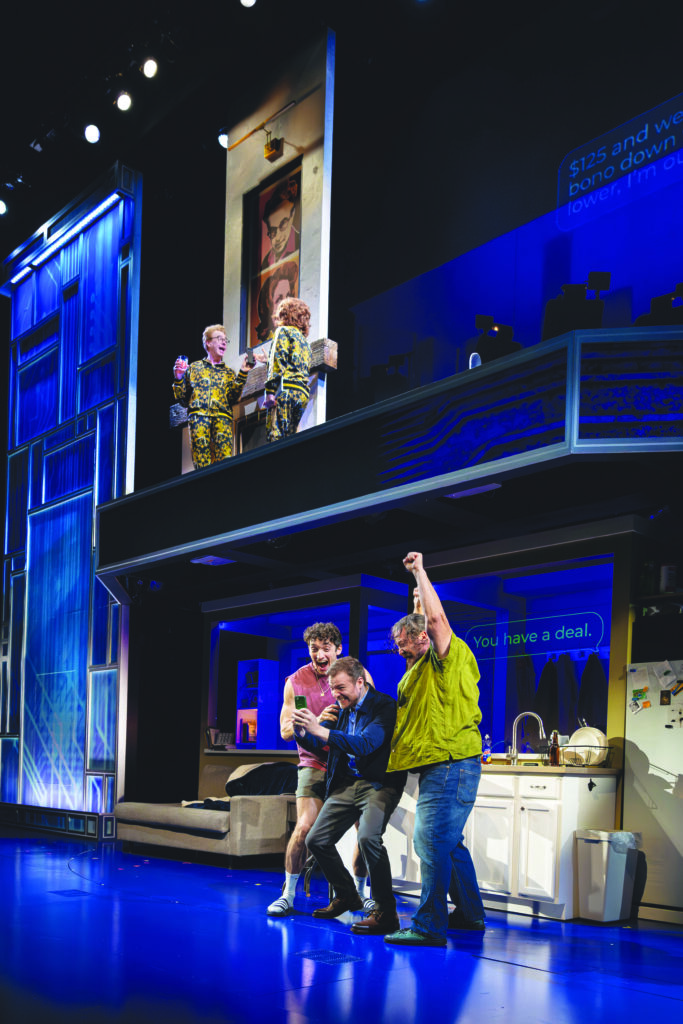
Olivas, who recently played Juan Perón in Evita in the West End, barely knew ASL before being cast in Deaf West’s production of American Idiot. (Unless you count picking up the sign for “I’m sorry” from watching FX’s The Bear.) Olivas said the experience changed him, making stepping into Elephant Shoes a no-brainer.
“When you’re adapting hearing work,” Olivas said, “I think you can find really beautiful things in the text—you can mine it and infuse new meaning into what already exists. But starting from the ground up with the first-ever musical for and about Deaf people and Deaf culture, is incredible. There’s never been a story like this before.”
Though Menchell has seen productions of his work find audiences in South Korea and Japan with the help of translators and interpreters, having both English and ASL at the same time “takes it to another level of insanity,” he said. “That has been a fascinating process and unlike anything I’ve ever experienced.”
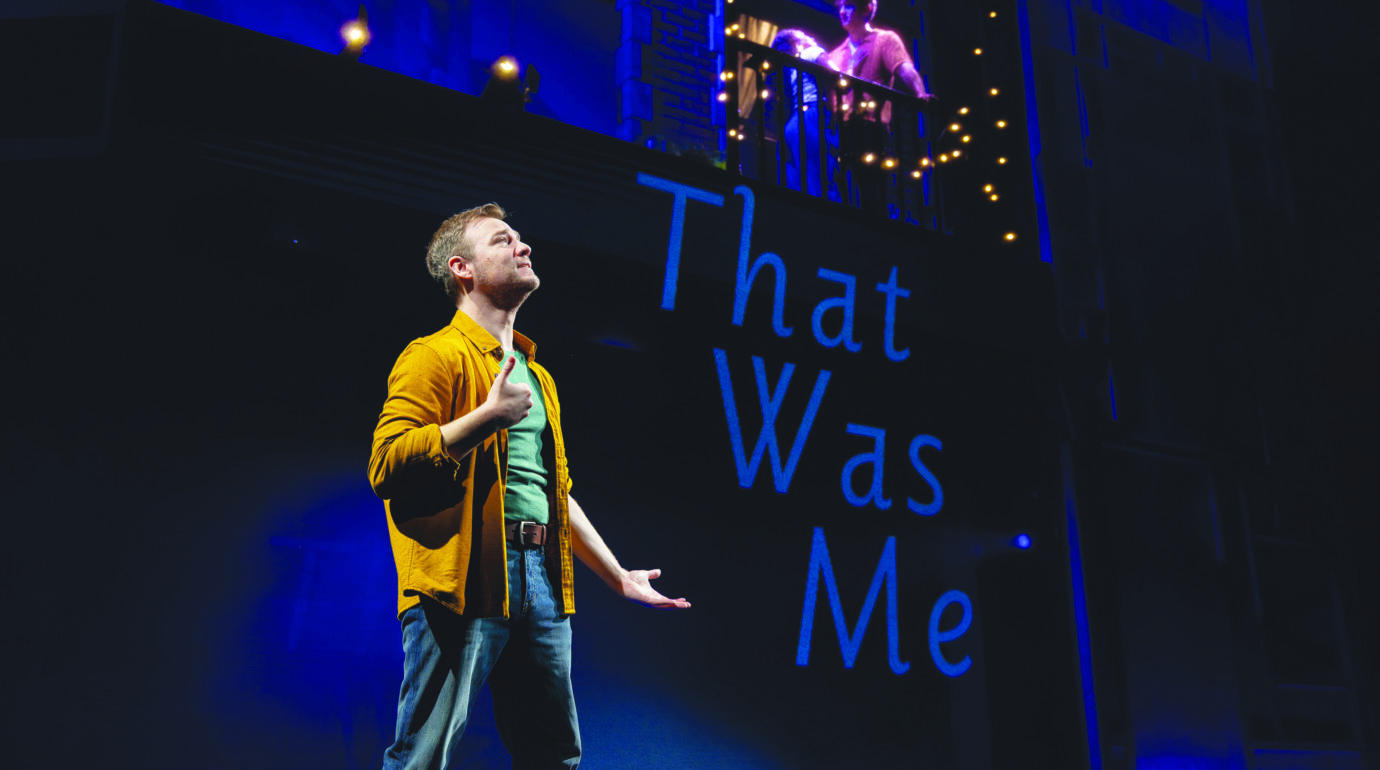
It’s not quite Sim-Com—the practice of speaking English aloud while simultaneously signing in ASL. That is generally discouraged, because it divides attention and compromises the grammatical structures of both languages to the detriment of clear, effective communication. In Elephant Shoes, by contrast, the emphasis was on clarity. When two signing characters interacted, or two hearing characters spoke/sang without signing, their dialogue appeared in supertitles projected onto the set. At other times, a character onstage functioned as an ASL interpreter for both the characters and the audience.
It’s a credit to projection designer Caite Hevner, scenic designer Tobin Ost, and the entire design team that the projections fit so neatly, splayed across different quadrants of the set. Words appeared over someone’s shoulder or floated overhead the way an aesthetically pleasing tattoo suits its frame.
And lest you forget: It’s a musical. The show’s buoyant contemporary score sounds a bit like Dear Evan Hansen grew up and went to college. Lyrics come to life in social media posts and flirty text messages. It’s a pop culture potpourri with nods to movies, manga, and modern art. There’s even a Shrek-coded song comparing men to onions and a not-at-all creepy Love Actually moment that, in performance, produced a collective “aww” heard round the proscenium. There hasn’t been a theatre audience so unanimously besotted since Paddington graced the stage.
Fittingly, Menchell connected with composer-lyricist Caroline Kay after hearing her songs on social media. She said that Deaf West’s reputation preceded them even all the way to London, her home base. She jumped at the chance to work with them and make Elephant Shoes her first staged production. She said she learned very quickly “the irony that Deaf people listen so much better than hearing people.”
“As hearing people, we’re used to turning our backs on each other,” Menchell agreed, “talking to somebody and they’re checking their phone—all of that multitasking, which is so disrespectful, but we’re used to it. And then when you’re with the Deaf, it’s like, no, we have to have eye contact. There’s a respect, there’s a focus, there’s a way of being present. There is so much that is wrapped up in that that is so satisfying for anybody who’s trying to communicate.”
The musical continued to evolve through feedback from Deaf members of the company. With Kurs as dramaturg, associate director Joshua Castille, ASL choreographer Colin Analco, and associate ASL choreographer Bridget Berrigan worked as invaluable collaborators throughout the development process. Deaf cast members Durant, Antoinette Lori Abbamonte, Hector Reynoso, and Raven Sutton each contributed to the layered backstories of their characters, showcasing that Deafness is a spectrum, not a monolith. The creative team’s research also included meetings with Deaf tech developers and entrepreneurs, conversations with Children of Deaf Adults (CODAs), even a road trip to the Rochester Institute of Technology to see a Deaf tech development lab in action.
As ASL choreographer, Analco’s role involved working alongside the creative team to translate and interpret the musical’s cadence in ASL. It’s not just about getting the signs right, he explained, but also “giving the stage the respect that it is due.” ASL is a full-bodied, visual-spatial language with its own velocity and vocabulary that has no English equivalent. To borrow an analogy from one of my favorite numbers in the show, “Hard to Put Into Words”: “If words are notes, then signs are chords.”
Kurs is grateful for what he called “bi-directional collaboration,” which has allowed the company to interrogate the thematic tension between universality and specificity. “From the start, we knew that this universal story of connection would apply to many but have the specificity that would ring true in the world of Deaf people and CODAs, and in deaf-hearing exchanges. That tension has been a governing principle for the show and for our process.”
Rhythm & Cues
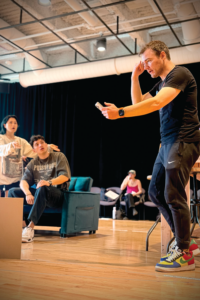
It’s no easy feat performing a musical when you cannot hear the score. Along with monitors and video recordings of rehearsals, Deaf West utilizes a system of color-coded cue lights programmed to deliver hundreds of character-specific cues, providing a visual signal when one line finishes and another begins so that the Deaf cast members can internalize the show’s timing.
Director and choreographer Jeff Calhoun has been a longtime collaborator with Deaf West since first staging Oliver! with the company back in 2000. He’s since gone on to work on Deaf West productions of Pippin, Sleeping Beauty Wakes, and a staging of Big River that was revived on Broadway in 2003 after success in L.A., all incorporating ASL and featuring Deaf performers throughout the cast. Still, Elephant Shoes was a different animal—a challenge Calhoun called “harder than teaching Twiggy to tap dance.” Indeed, adding a layer of ASL to an existing musical about hearing characters is different from devising a theatrical world around multiple Deaf characters that is accessible to both Deaf and hearing audiences.
“I started to feel guilty that my four Deaf West shows, as much as they were showing representation for Deaf actors, were still asking them to revise a show that was originally created by hearing actors about a hearing story,” Calhoun said. With Elephant Shoes, “I was determined to not do that. I wanted to have Deaf representation, not just in acting, but in the story.”
The blocking was particularly important. “There are times when it will look messy, intentionally,” Calhoun noted. The reason, he explained: “We’ve never had a show, to my knowledge, that has had an interpreter as a character. It changes all the blocking. No theatre classroom in America teaches you how to do that. Now I have to be sure not only can the audience know who is speaking at the right time, but the Deaf actors onstage have to have sightlines to the interpreter as well as the audience.”
This realization led the creators to write the character of Simone, an ASL interpreter at Cy’s startup, skillfully portrayed by Siena Rafter. “Interpretation is built into the storyline rather than something that’s imposed upon the show,” Menchell said of this choice.
Simone takes on a Puck-like quality of being simultaneously involved in, privy to, and spared from the dynamics of the central love triangle. Then there’s newcomer Remy Laifer, who came into the production with no prior sign-language training. His character, Bob, ends up interpreting in a pinch, a necessity the show happily plays for laughs. (As part of the production process, Two River staff took three months of ASL and deaf culture classes, and the cast and crew received ongoing instruction throughout rehearsals, including one-on-one lessons.) Make no mistake: Laifer is no slouch, despite playing Bob, a loveable stoner software engineer. During rehearsal, he showed me his shorthand glossary of signs. He was fueled by cautious enthusiasm, while still warning me not to take any ASL lessons from his playbook. Onstage and backstage, interpreters provided the centripetal force that made the turntable go round.
Take Chris, played by Olivas, a CODA repeatedly burned by his father’s struggles with alcoholism. He’s got walls up and wears the term “womanizer” like it’s a badge of honor. No wonder he’s gotten a little too comfortable being in the middle, acting as an intermediary between his Deaf best friend and the hearing people in his life. So Chris interprets for Cy, even when he’s angry, even when he doesn’t feel like it, and there’s something to their bromance that tugs at the heartstrings as much as the love triangle.
But in the world of Elephant Shoes, miscommunication is also part of the comedy. The conflict between what is signed (and captioned for the audience) versus what is being translated for the characters who do not know ASL, serves up dramatic irony at its most delectable.
Take, for instance, when Cy pointedly asks Chris in ASL whether his latest situationship, sitting mere feet away on their couch, is aware that he has Tinder open on his phone. Chris intentionally mistranslates so the poor gal is none the wiser. It’s brilliant, funny, and emphatically Deaf.
‘Elephant’ Never Forgets
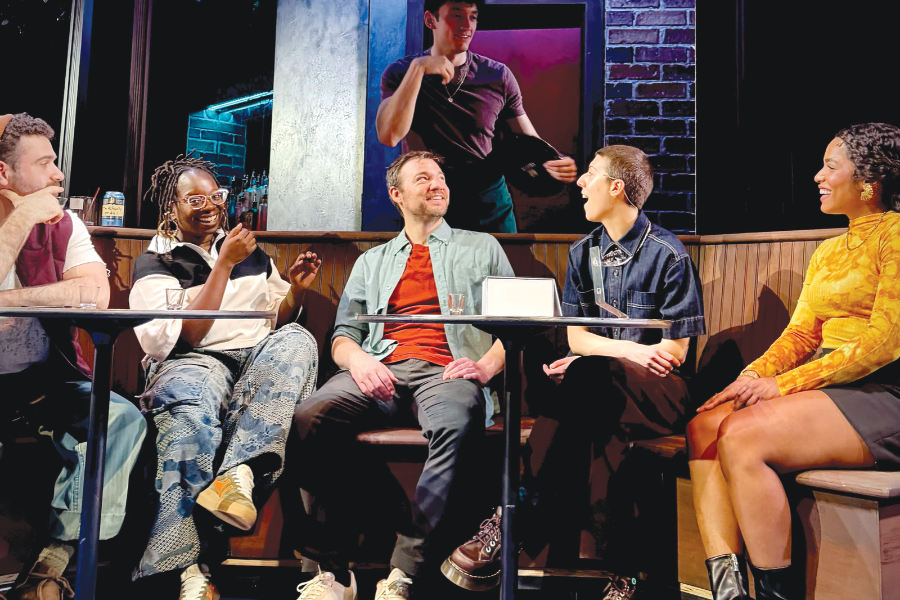
The June run of Elephant Shoes, credited as the best-selling show in Two River’s history, charmed audiences and critics alike. (Including my parents, both retired New Jersey educators, who agreed that the show would be a delight on high school stages, particularly those with well-funded ASL programs.) There’s certainly an audience for it. Perhaps just as importantly, Two River audiences left thinking deeply about technology’s real-life role in bridging communication gaps—and eager to learn ASL.
Durant said he uses plenty of cool gadgets in his day-to-day life and hopes that a breakthrough for ASL transcription isn’t far off, though he suspects there will always be a human component to communication. Captions are a helpful tool, but they can’t tell you everything you need to know. Facial expressions and body language are a key part of ASL. Durant observed that hearing performers who’ve learned to sign typically become more physical actors. His solo in Elephant Shoes, “That Was Me,” performed entirely in ASL with instrumental accompaniment, was a master class evocative of the vow, from Brian Hooker’s translation of Cyrano, “Never to make a line I have not heard in my own heart.”
“I am humble, sure, but I am also very, very proud of my language,” Durant said of his signature signing style. “I am proud that I am not the same as everybody else. ASL led me to come here. When you work with producers and writers, they don’t always notice that. Like, ‘OK, you’re a great actor, whatever.’ But they’re missing the fact that it’s my ASL, right? My language.”
Case in point: A quintessential Durant moment in rehearsal came when the cast had been running a number under tempo to learn the blocking.
“Is it okay if we try it on tempo?” Calhoun asked.
Durant signed back, “Yes!”
But this wasn’t just an affirmative: It was sassy, delivered with a smirk, as if to say, “Hell if I care, why are you asking me? Just try and keep up!”
Through laughter, someone in the room called out, “You put some stank on that!”
Indeed, though I’ve done my best to capture the spirit of these conversations, interpreted quotes will always be loose translations at best. Like exchanging currencies of different values, there will always be something precious that gets lost. My Latin professor used to call these inexplicable discrepancies “vividness.” Let this be an acknowledgment of everything vivid that can neither fit on the page, nor be put into words—but can live onstage.
Alexandra Pierson is a former associate editor of American Theatre. She also writes for Broadway.com. Pierson was a 2024 National Critics Institute fellow. Follow her @allipierson on Bluesky.