How did they do it? How did women in the past come together across ideological differences to create a social movement? And in the 21st century, where do American women find public justice and real community? These questions seem to be weighing heavily on the minds of contemporary women playwrights.
 The social and ideological movement known as feminism can be measured in waves. First wave feminism is defined by white women’s suffrage; second wave feminism is defined by bodily autonomy and economic independence; third wave feminism is defined by intersectionality, uplifting the concerns of women who weren’t white; and fourth wave feminism encapsulates the Time’s Up and #MeToo movements, calling for accountability for systems and individuals. Now there is the search for the fifth wave, which, if our stages tell us anything, will be a feminism defined by solidarity and cooperation.
For example, in Suffs, Shaina Taub travels back to a critical turn in the women’s suffrage movement when a younger generation rejects the moderate “let Mother vote” tactic and chooses more disruptive public displays of discontent to secure enfranchisement. In the stirring number “The Young Are at the Gates,” Taub tries to capture the fervor that got white women the vote in 1920 to see how it can inspire another generation today.
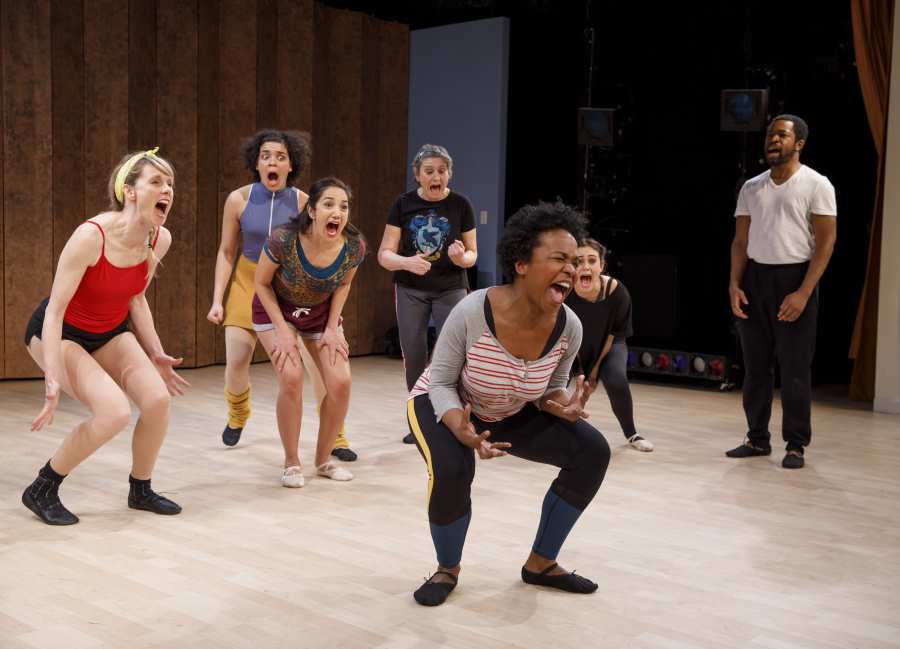
In Heidi Schreck’s What the Constitution Means to Me, the playwright/performer reflects on her years as a teenager competing in constitutional debate competitions. Over the course of this (mostly) one-person show, Schreck’s character comes to the realization that women’s place as citizens at the time of the ratifying of the U.S. Constitution was precarious at best. And it leads her to ask, in the 21st century, what is women’s future in the constitution as a living document? She doesn’t arrive at any easy conclusion.
Kimberly Belflower’s Arthur Miller riff John Proctor Is the Villain takes the audience inside of a suburban Georgia classroom at the height of the #MeToo movement, where a group of high school girls who are reading The Crucible decide to start a feminist club, and in so doing discover that their beloved literature teacher and one of their classmates may have a dynamic closer to that of John Proctor and Abigail Williams than they think.
The protagonists in these plays are embodying and/or looking to the past for guidance while barely clinging to a hopeful future in a present where it seems that women’s public identities and private rights are shrinking. The sense of urgency is understandable. While these plays had their time in the limelight, Roe v. Wade was overturned; SNAP benefits have been reduced for millions of Americans, namely women and children; trans women and girls have been barred from girls’ sports; and nursing, public health, and social work—all professions dominated by women—have been de-professionalized. In the 2026 tug-of-war between trad wife versus girl boss, there seems to be a deep search among these playwrights for another option, and a desire to put other ways of being onstage for theatre’s predominantly female audience.
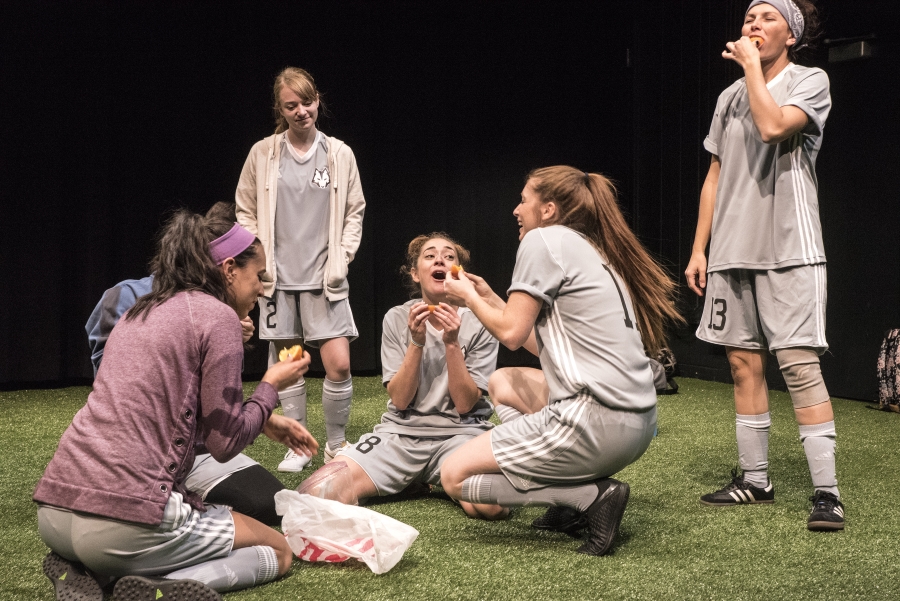
The aforementioned shows are just a few examples. Over the past decade, plays such as The Wolves by Sarah DeLappe, The Revolutionists by Lauren Gunderson, Dry Land by Ruby Rae Spiegel, POTUS: Or, Behind Every Great Dumbass Are Seven Women Trying to Keep Him Alive by Selina Fillinger, and Are the Bennett Girls OK? by Emily Breeze have taken different approaches to examining how women and girls rebel against systems that threaten their intellectual and bodily autonomy. In this year’s Pulitzer Prize and Tony Award winner, Liberation by Bess Wohl, a woman goes back to her mother’s 1970s feminist group to essentially ask how her mother’s generation let a century of progress slip through their fingers.
It must be mentioned that all of these plays are by white women who are philosophizing, noodling, and mulling on a specific brand of white girlhood and white womanhood. In stark contrast, as an example, shows by Black women highlight interpersonal relationships as a bridge to justice. Much like the collisions at the intersection between Blackness and womanhood, these plays don’t fit neatly into genre either.
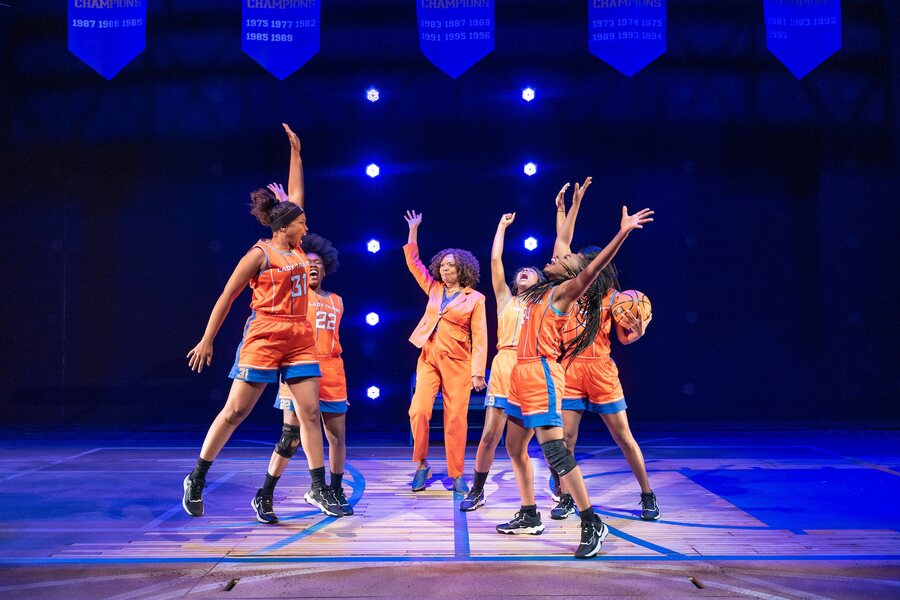
Flex by Candrice Jones shows how a pregnant teen basketball star depends on her team to rally behind her choice to terminate a pregnancy. In Aleshea Harris’s play-now-movie Is God Is, twins Racine and Anaia depend on each other to get vengeance against their father for abusing them and their mother. In playwright nicHi douglas’s spiritual dance choreopoem Pray, she drops the audience into a gathering of women who help guide a youngin’ along her journey to self amid the politics of the Black church. In Lisa B. Thompson’s plays Single Black Female and The Black Feminist Guide to the Human Body, she unpacks the ways stereotypes around beauty, pleasure, and desirability are imposed on Black women. And in two different time periods, in the plays Cadillac Crew and If Pretty Hurts Ugly Must Be a Muhfucka, Tori Sampson searches for Black women’s place in broader social movements.
I recently caught the world premiere of CrazySexyCool: The TLC Musical, now at Washington, D.C.’s Arena Stage through Aug. 9, and I was struck by how boundary-pushing this condom-toting girl group was for their time. As a child growing up in Atlanta, I listened to “Ain’t 2 Proud 2 Beg,” “Unpretty,” and “Waterfalls” and watched the music videos on MTV. But we rarely understand we’re witnessing something revolutionary in the midst of the revolution. Sitting on the shoulders of such womanists as Audre Lorde, Alice Walker, and Sonia Sanchez, the sex-positive and, dare I say, woke lyricism of TLC’s music called for self-love and sisters before misters long before it was popular.
The primary difference between these plays by Black women writers (though the TLC musical was penned by a man, Kwame Kwei-Armah) and plays by white women writers is that in the former there is very little reference to, or expectation of, the state or other institutions to be the holders, enforcers, or securers of any rights. There is no just past for Black women playwrights to long for because it has been, and continues to be, a constant struggle. And underneath the trad-wife-vs.-girl-boss dichotomy, this may be the real challenge: the need for mutual understanding around difference of experience and a willingness to find common ground to attain the freedom everyone actually wants.
As different as the shows by these various writers may be, the common thread is, in the words of 19th-century poet Phyllis Wheatley, a “love of freedom; it is impatient of oppression, and pants for deliverance.” Yet as I reflect on the heavy presence of these plays, many of them on American Theatre’s most-produced plays lists (or likely to be), I can’t help but wonder: What is the place of arrival? What is the actual plan to secure a positive and hopeful future? How long do we wait for the audience to activate before we have to become the ones to activate them? Is that what theatre is for?
Like these writers, I am left with more questions than answers. But what I do know is that we best start searching together rather than apart. I personally desire an allyship (or maybe accompliceship?) among the characters in these plays and in the lived experiences of the women artists who’ve created them in navigating the theatre industry. How do we erode the stigma around sharing contract terms, contact information, grant application due dates, and other opportunities that can help sustain an artistic career? Could that be a place to start and be its own form of resistance?
If these playwrights have shown us anything, it is that if feminism is to usher in a fifth wave, it will not be in tidy agendas and single-issue votes. It will be shoulder-to-shoulder, in much the same way we sit in the theatre.
Kelundra Smith is TCG’s director of publishing. Her play The Wash received a 2024 National New Play Network Rolling World Premiere. Her articles have also been published in The New York Times, ESPN’s Andscape, Garden & Gun, Atlanta magazine, and elsewhere. More at kelundra.com.