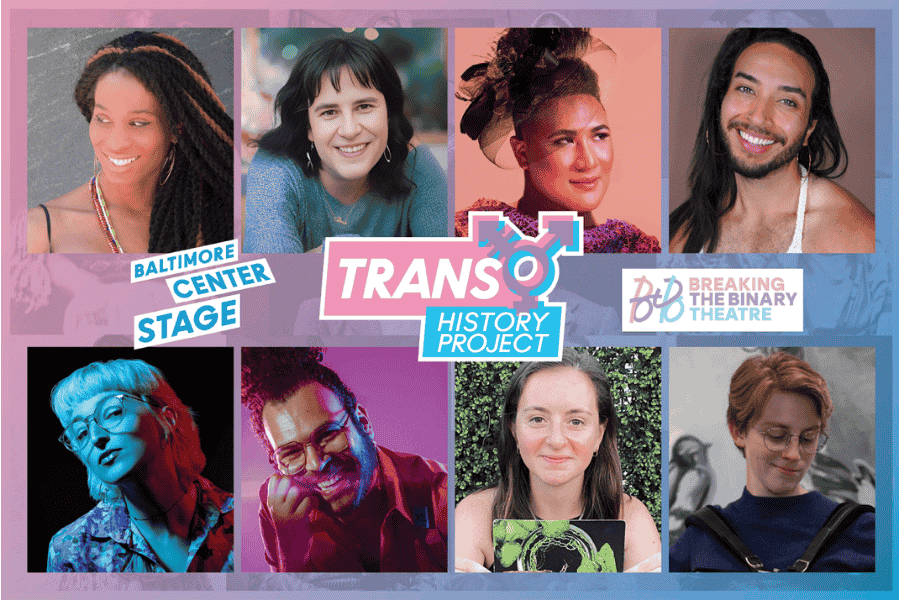
History has included transgender and gender nonconforming (TGNC) people since the beginning of time, even if they’ve been left out of most history books—and theatres. The Trans History Project, a commissioning project between Baltimore Center Stage (BCS) and New York’s Breaking the Binary Theatre, aims to correct that. Launched in spring 2025, the project will pair 10 TGNC playwrights with participating theatres to develop their work over the next two seasons.
The first five artists and their partnering institutions have been announced: Roger Q. Mason and San Diego’s Diversionary Theatre; Mirage Auto Depot (a troupe led by Raychel Ceciro, Logan Gabrielle Schulman, with devising by Alexandra Neuman and Murphy Severtson) and NYC’s Rattlestick Theater; Bree Lowdermilk and Bethesda, Maryland’s Round House Theatre; Lady Dane Figueroa Edidi and New Haven, Connecticut’s Long Wharf Theatre; and Yona Moises Olivares, who’s paired with Baltimore Center Stage.
“I was really excited to amplify artists that were new to me, more emerging, and had not been produced,” said Bo Frazier, a trans femme, nonbinary, queer, and neurodivergent artist who leads the Trans History Project. “The selected playwrights come from different backgrounds and experiences, ranging from well-known playwrights and musical theatre composers to brand new playwrights who had a brilliant idea, and an emerging TGNC theatre ensemble. The plays will tell stories of untold American history and world history. I cannot wait to share these stories with the world.”
“All of us at Breaking the Binary Theatre are thrilled to be partnering with Baltimore Center Stage to help bring Bo’s ambitious and revelatory idea to life,” said George Strus, Breaking the Binary Theatre founding artistic director. “Breaking the Binary Theatre has a rich history with inaugural cohort members Roger Q. Mason and Dane Edidi Figueroa, both of whom participated in our first festival in October 2022. We are overjoyed to deepen our relationships with them, as well as welcome Yona Moises Olivares, Bree Lowdermilk, and Mirage Auto Depot to the BTB community.”
For the inaugural year, the team reviewed more than 170 applications, which Frazier said were well beyond their wildest dreams for the project. In the submissions, they noticed strong diversity in ethnicity, race, age, geography, and style, plus a lot jumping among time periods and genres. At least a third told histories that were new to Frazier themself, they said. One subject Frazier saw treated a lot was the Public Universal Friend, a famously genderless Quaker evangelist from the 1700s (though none of the selected projects ended up being about them).
“I was completely blown away by the response from our open submissions,” Frazier said. “TGNC folks make up 1 percent of the population, and not every TGNC writer is interested in history, so to have this response was overwhelming and rejuvenating.”
The project had its roots at the beginning of the year, when people kept asking Frazier how they were doing, given the increasingly anti-trans political climate. They came to realize the need to focus on their “micro” community, rather than on the “macro” level of government and the larger society. Launching this program is their “form of protest,” they said. “This is what I can do within my community, and the difference that I can make, within not only the theatre industry but also within the TGNC community.”
The Trans History Project was one of five regional theatre projects to receive the competitive National Theatre Company Grant from the American Theatre Wing. The project is seeking funding to support Cohort 2, as well as regional theatre partners in the American South, Pacific Northwest, and Midwest, and culturally specific organizations. Those interested in learning more should contact Frazier at TransHistoryProject@centerstage.org.
“We are honored to commission these artists to expand the representation of trans and gender nonconforming stories in the American theatre as part of the vision of the Trans History Project,” said Ken-Matt Martin, producing director of Baltimore Center Stage, in a statement. “The five new plays from the inaugural cohort are innovative, visionary, and artistically groundbreaking.” The project, Martin added, is an integral part of BCS artistic director Stevie Walker-Webb’s “commitment to develop new work by marginalized voices…We hope to serve as a model for others to reshape how new work is developed in this country.”
The Artists and the Plays
Yona Moises Olivares (they/she/he) is a genderqueer Latine artist from Chicago. The premise of their play, miss EMERICA, to be developed at Baltimore Center Stage: “She is beauty, she is grace, she is undocumented? Congratulations and welcome to America, where you get the amazing opportunity to compete and earn your spot as a Real American Woman™!”
Roger Q. Mason (they/them) is an award-winning writer, performer, and thought leader from Santa Monica, California, who will develop The Gladys Bentley Project in residence at Diversionary Theatre in San Diego, California. Set in 1952, it centers on Gladys Bentley, Harlem’s most (in)famous drag king, who has hung up her gender-bending/queer affirming act, married a short order cook in Los Angeles, and decided to write her life story.
Bree Lowdermilk (she/her), a nonbinary trans woman and award-winning theatre writer, composer, lyricist and orchestrator from Philadelphia, will be developing Days of Awe in residence at Round House Theatre in Bethesda, Maryland. This musical takes place during a Yom Kippur dinner that erupts into absurdity and chaos when a daughter comes out as trans to her Jewish family.
Lady Dane Edidi Figueroa (she/her) is a Black Nigerian, Cuban, Indigenous American performance artist, author, poet, educator, advocate, producer, a Helen Hayes-recognized playwright and choreographer, filmmaker, dramaturg, and a Princess Grace Honoria Award winner from Washington, D.C. The play she will be developing in residence at Long Wharf Theatre, A Continent of Forget, is about a widow who doesn’t know if she’s ready to open herself to love as a new man walks into her life; it’s loosely based on and an homage to the incredible life of Lucy Hicks Anderson (1886-1954), an American socialite, chef, and philanthropist.
Led by Raychel Ceciro, Logan Gabrielle Schulman, with devising by Alexandra Neuman and Murphy Severtson, Mirage Auto Depot is a trans-experimental incubator and performance [art] collective obsessed with the processes of queer creative community, making and unmaking, the normalization of failure, hybridity, and the feverish development of hyper contemporary live arts: theatre, dance, music, puppetry, and video. In residence at Rattlestick Theater in New York City, they will develop LES BI(T)CHES, a trans-historical experiment adapted from the ballet Les Biches, about the gender-nonconforming lesbian artists Claude Cahun and Romaine Brooks who worked amid rising fascism in early 20th-century Europe.
Finalists included playwrights Nova Cypress Black, Ty Defoe, Tyler Rocio Ecoña, Reese Fernandez, Mackenzie Foy, Kaela Mei-Shing Garvin, Caden Healander, Dena Igusti, Justice Jamal Jones, Youri Kim, Gaby Labotka, C. Meaker, D.A. Mindell, Cheeyang Ng, Nwachukwu Oputa, Nico Pang, KT Peterson, Utkarsh Rajawat, Alex Lee Reed, Omer Abbas Salem, Sharifa Yazmeen, as well as duos Che’Li and Sean-Joseph Choo, and B Kleymeyer and DJ Hills.