Thornton Wilder’s Pulitzer-winning 1942 play The Skin of Our Teeth concerns nothing less than the survival of the human race. The stakes could not be higher. They’re also high for Ethan Lipton’s musical adaptation, The Seat of Our Pants, currently at the Public Theater through Nov. 30. In addition to the usual pressures of making any new musical, this is the third high-profile attempt to adapt Wilder’s play, with previous musical theatre giants Leonard Bernstein and Kander & Ebb trying in vain to musicalize it.
Indeed, The Skin of Our Teeth is difficult to crack in any form. Its three acts swing wildly in tone, from vaudeville and burlesque to dark, often brutal views of humanity. It features an ice age, a great flood, and a war, each poised to wipe out the human race, which manages to survive each ordeal by, as the title has it, the skin of their teeth. There are also a pet dinosaur and mammoth, a convention of mammals, and the frequent breaking of the fourth wall. It is hard enough, in short, to get the play right without throwing songs into the mix. (Its last Broadway revival, at Lincoln Center Theater in 2022, got mostly respectful but not ecstatic reviews).
A musical theatre sensibility might be just what the play calls for, and Lipton is up to the task. A playwright and a songwriter—his band Ethan Lipton & His Orchestra has been performing for 20 years—Lipton has been involved with the Public since 2009 when he was part of the first Emerging Writers Group. It was during this time that he first connected with director Leigh Silverman, who came to one of his band’s shows and approached him afterward as a fan; she asked him to send her his playwriting work. She ended up directing his 10-minute excerpt in the EWG spotlight series, and five full-length shows since, including Lipton’s No Place to Go at Joe’s Pub in 2012 and his 2024 musical We Are Your Robots at Theatre for a New Audience.
When Lipton first mentioned The Seat of Our Pants to Silverman about seven years ago, her reply was, “Good luck!” When she first read The Skin of Our Teeth in high school, Silverman said on a break from rehearsals, she found it strange, hard to understand, and unfeeling—the antithesis of what she wanted from theatre. When she first heard Lipton’s music for his adaptation, though, she changed her mind. “It was like the pilot light turned on in my heart,” she recalled.
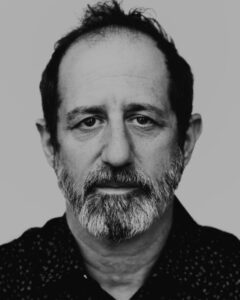
The musical’s development began even further back, in 2013, when Jeremy McCarter, now the literary executor of the Thornton Wilder estate but at that time on the artistic staff at the Public, thought Lipton might be the perfect person for the material. He approached Tappan Wilder, Thornton Wilder’s nephew and then literary executor, and after an initial meeting Tappan went to Chicago to see Lipton’s play Red-Handed Otter. He was blown away.
“I knew we had found our adaptor,” Tappan Wilder said over Zoom. “Like St. Paul on the road to Damascus, I had a conversion experience on the spot and I couldn’t wait to seal the deal.”
The Wilder estate then had to approve Lipton’s take on the material. Tappan acknowledged that he does not make these decisions lightly and consulted various family members and lawyers before granting permission, especially given the show’s history. Bernstein’s adaptation with Betty Comden and Adolph Green fell apart before the planned production could materialize in the fall of 1965, though Bernstein did reuse some musical material for his Chichester Psalms.
Meanwhile, the Kander & Ebb version, with book writer Joseph Stein, titled Over and Over, had a poorly received 1999 production at the Signature Theatre in Virginia, directed by Eric Schaeffer, then another try under the title All About Us the Westport Country Playhouse in 2007, with Eartha Kitt in one of her final performances as the Fortune Teller. The show still wasn’t working, and Tappan had to pull the plug. “It was a very difficult decision for me to make because they’re very great figures,” he recalled. “I felt that it was time to move on. Sometimes things just don’t fit, it doesn’t matter how great.”
Oddly enough, Lipton found the previous attempts freeing.
“The fact that some of our most legendary theatremakers had previously worked on Skin adaptations struck me as an invitation,” he said during rehearsals. “It made me feel the play didn’t have to be treated as a sacred tome, that it could be viewed as a playground. I was ready for my turn on the slide.”
It helped that the play’s sensibilities aligned with his, especially its mix of sincerity and irony. As Lipton put it, “One of the reasons that I love the play is that I have always thought those elements belong together.”
When Tappan gave Lipton his blessing, he told him, “Don’t ever hesitate to put yourself into this work. The musical is a collaboration between two gifted artists.”
That in turn has allowed Lipton to have a relationship with an imaginary Thornton Wilder as he wrote. “Imaginary Thornton has been very supportive the whole time,” he explained. “We’re in touch periodically but not all the time. In my mind, he’s the Thornton that wants the show to be alive in this moment, and that’s what I’ve been trying to do.”
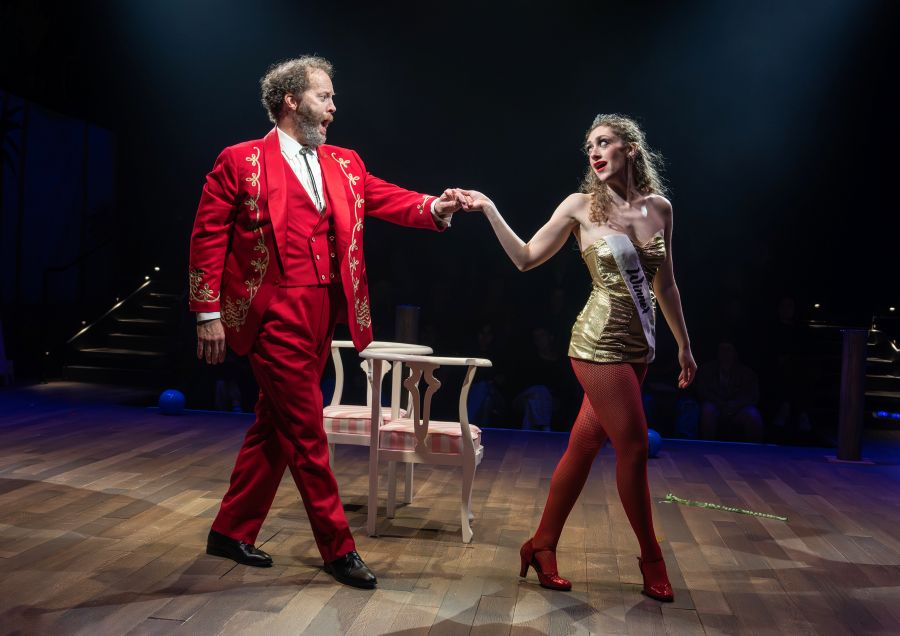
With Thornton by his side, Lipton had to make some authorial decisions. Would The Seat of Our Pants lean more heavily into the play’s absurdity, or would it veer in the opposite direction and use the songs to bring audiences closer to the characters? Lipton took the latter course.
“I didn’t want the characters to be those crazy people over there,” he said. “I wanted them to be the crazy people in this room, the ones that I know. It was really helpful to be clear on that.”
That focus on a more intimate connection with the characters helped the actors access the piece. Still, Lipton’s songwriting style—classic jazz and folk elements mixed with playful, offbeat lyrics—is not without its challenges.
“Songs are little clues—they’re markers on a map for a character,” said Micaela Diamond, who plays Sabina, the family’s maid as well as temptress, unreliable narrator, and the audience’s confidant. “Sometimes the melody or the arrangement will align with what a character is feeling or the struggle a character is having. Sometimes it’s subtext and you have to push against the music, and that can create an incredible tension for the audience or your scene partner.”
Ruthie Ann Miles, who plays Mrs. Antrobus, said that she “had to become comfortable with discomfort” in Lipton’s music. She found a song from the first act, “Stuff It Down Inside,” particularly tricky. “I don’t get to sing the song at face value,” Miles explained. “I have to filter it down a few times before getting down to the essence of what needs to be said. The gorgeous music is like a trap; it serves a very different purpose than the lyric. It’s my job to sing the words without feeling the feeling in the music. So much of it is unspoken.”
For Lipton, “Stuff It Down Inside” was a moment of insight into Mrs. Antrobus’s character that didn’t come from Wilder’s text. He realized that denial gave her character agency and was a way she could get what she wanted—that denial is her way of dealing with the pain of the world.
Shuler Hensley, who plays Mr. Antrobus, actually played the same role in the Kander & Ebb version at the Westport County Playhouse. “It was a while ago, so I feel like I know Mr. Antrobus but I also don’t,” Hensley said over Zoom. “It’s sort of like, ‘Oh, I heard about you.’”
For him, Lipton’s songs are extensions of the dialogue. “They fit so beautifully within the element of the scenes,” he said. “The style of Ethan’s songs are very storytelling, very folksy. A lot of it reminds me of Kurt Weill as well.”
Andy Grotelueschen’s Announcer character kicks off each act with news of the world and is tasked with opening the show with the song “The World Is Ending,” a phrase that might feel familiar for many audience members. He too praised the interplay between scene and song. Lipton, he said, “has distilled the essence of a lot of the scenes to the point that they have to move into song,” Grotelueschen said over Zoom. “The songs answer some of the questions that are asked by the book beforehand in a very satisfying way.”
Lipton wrote the songs mostly in the order they appear in the show and in a style similar to the music he plays with his band: an assortment of Americana, folk, country, jazz, and rock. He does not play any instruments himself or notate music; his process involves singing until melodies and song forms emerge, then working with orchestrator, arranger, and co-music supervisor Daniel Kluger to flesh out the score. Orchestrations are usually written closer to production, but in this case, Kluger started about a year earlier so that Lipton’s score could take shape.
The result is Wilder’s The Skin of Our Teeth through a new lens, and a deepening in the way only musical theatre can do: exploring characters through song, giving more emotion to particular moments, and bringing characters together who didn’t otherwise interact in the forms of duets and ensemble numbers. Not only can a musical of The Skin of Our Teeth finally enter the musical theatre canon; it may bode well for more musicalizations of Wilder’s works to come.
And the human race will be there to see them, sitting eagerly on the seat of their pants.
Shoshana Greenberg (she/her) is a lyricist, librettist, screenwriter, journalist, and singer based in New York City. She hosts the musical theatre podcast Scene to Song.