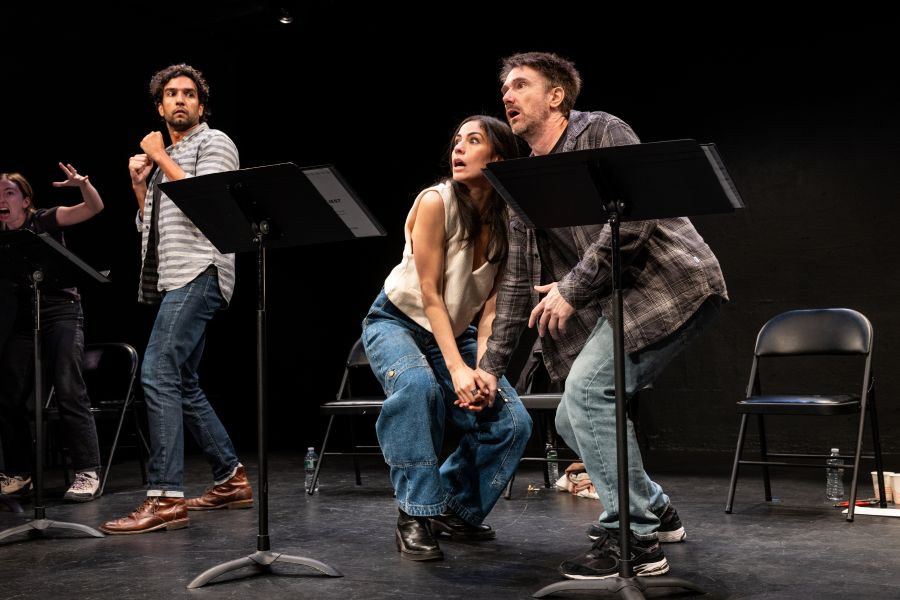
Bougie Ted, the managing director of a leading New York nonprofit theatre company, is choking Karl Marx to death.
“Stop wiggling!” yells the pernicious administrator (played by Shawn K. Jain) as life drains from the revolutionary socialist philosopher before our eyes. “Resistance is futile! What can one person do, anyway?”
But good ol’ Karl (here played by Kate Eastman) gets the last word.
“The seeds…of your destruction…” gasps a dying Marx, “have been planted…in ze system you uphold…!”
Marx is dead. But the revolution is just getting started. Or at least so says the new theatre collective Necessary Labor, who presented this profoundly silly, proudly socialist bit of theatrical tomfoolery last July in a two-day gathering at New York City’s ART/NY. Set at a talkback that becomes an uprising, the hour-long agitprop piece—playfully entitled A Statement Concerning the Dialogue Surrounding the Open Letter to the Theatre Community Regarding the Current Situation—grew out of an intensive study group in which 11 theatremakers read volume one of Marx’s Das Kapital over 10 weeks.
In a post-show talkback, founding member Chris Myers, an activist and current cast member of Buena Vista Social Club on Broadway, discussed Necessary Labor’s mission with an audience composed entirely of fellow theatre professionals.
“Our goal,” Myers said, “is to raise the working-class spirit of the theatrical workforce.”
Building class consciousness within a splintered, unstable theatrical working class has historically been a tall order.
Yet in a moment when politically potent crises of affordability and wealth inequality have taken powerful hold—most notably driving the insurgent candidacy of New York City mayor-elect Zohran Mamdani, a self-proclaimed democratic socialist—theatre artists are working both onstage and backstage to challenge, or entirely rethink, the capitalistic structures that harm or constrain theatre workers. Some have stepped up their union organizing efforts within the existing nonprofit theatre scene, while others—among them Small Boat Productions, Working Theater, and Necessary Labor—are seizing their own means of production.
Actor Ben Natan said he was inspired by the Group Theatre of the 1930s to found Small Boat Productions, an artist-led company seeking to “return powers to the workers who make art possible.” Small Boat debuted last year with a production of Waiting For Lefty, Clifford Odets’s seminal 1935 one-act based around the 1934 New York taxi driver strike, which famously concludes with a call to “Strike!” that implicitly includes the audience.
“For us, doing Lefty was about the self-determination of the artist,” said Natan. “Trying to celebrate the fact that, if we all band together, we could create more opportunities for ourselves and each other.”
Natan, discouraged by what he felt was the absence of a collective spirit among independent theatremakers in New York, hopes that Small Boat can unite disparate artists around a shared mission, rather than a shared graduate program. This year, the company followed up Lefty with the New York debut of Naomi Wallace’s Slaughter City, a brutal picture of working-class life set in a meat-packing facility in Kentucky. A kaleidoscopic work, Wallace’s play also journeys through decades of American labor struggles, its characters haunted in particular by the specter of the Triangle Shirtwaist Factory fire.
“My loose definition of ‘liberal’ theatre in New York is theatre that takes a step back, looks at everything and goes, ‘Doesn’t this suck?,’ and then that’s the end of the show,” said Natan. “I think it’s more effective, especially given the urgency of the moment right now, to do theatre that says: Actually we all have to do something.”
The legacy of the Group Theatre was also the inspiration for Working Theater, an NYC-based company focused on creating work “for, about, and with working people” since its founding in 1985.
“People are really hungry for mission-driven organizations speaking to the national political climate,” said Working Theater artistic director Colm Summers.
Summers is seeking to unite the complementary visions of his two predecessors at Working Theater. The company’s first solo leader, Bill Mitchellson, focused on experimental work about working-class life, while his successor, Mark Plesent, worked to tie Working Theater more closely to the city’s labor movement on an operational level. Summers joined the company in 2023 as it transitioned to a co-leadership organization, joining managing director Kylee Brinkman, following a transition period after Plesent’s death in 2021.
“I see our work as a conglomeration of the two companies that came before us: Bill’s artistically integrous company, who made boundary-pushing work, and Mark’s company, who insisted we get out in communities and serve this theatre to working-class audiences,” said Summers. “A third string is tackling the pipeline issues in the industry head on, and expanding definitions of who gets to take part.”
Summers has continued landmark programs founded by Plesent such as TheaterWorks!, which provides free 16-week theatre training programs to local union workers. The Mark Plesent Commission Fund supports the development of new plays written by working people. And the company’s upcoming durational performance, 12 Last Songs, will feature real workers performing paid shifts onstage, staggered over 12 hours and entirely unscripted. Created by a U.K. company called Quarantine, this co-production among Working Theater, La MaMa, and next January’s Under the Radar Festival will offer tickets on a sliding scale, like all Working Theater productions.
After entering the company in 2023, Summers has pushed Working Theater into financial stability from a structural deficit by partnering with think tanks and educational institutions. Stressing a focus on equitable pay, Summers dedicated a new budget line for rehearsals outside of regular hours to accommodate, and compensate, working artists with regular 10 a.m.-6 p.m. jobs.
“We all, in the theatre, work inside of that contingency,” said Summers. “For all of us, it’s affecting what we produce creatively.” The financial reality of slotting artistic work in or around a schedule dominated by work, childcare, or eldercare, is one he says Working Theater is seeking to build into the foundation of its artistic practice.
For playwright Alex Lin, that same contingency required opening a conversation that many working artists may fear to broach. When Primary Stages offered to stage Lin’s new play Laowang, a contemporary spin on Shakespeare’s King Lear set in a Chinatown restaurant, the playwright knew that she wanted past collaborator Joshua Kahan Brody to direct. She also knew that Brody, like herself, has a full-time day job.
“We knew that if we wanted to make it a reality, the rehearsal schedule had to be something more unconventional,” said Lin.
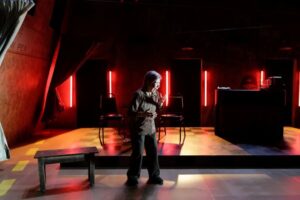
So Lin requested that rehearsals for Laowang be scheduled primarily on evenings and weekends, an adjusted schedule that was included upfront in all audition notices. This kind of ask obviously opens up larger conversations about working conditions and compensation—conversations that theatres often wish to keep private. The reality that few Off-Broadway contracts offer a living wage is not one institutions are looking to advertise. By talking openly about these economic realities, Lin said she hopes to encourage other theatre workers to open up similar conversations.
“I know that I’m preparing all of my meals because it’s so expensive to eat out during rehearsals, I see all the actors doing it, I see the stage manager—we’re all doing it!” said Lin. “In an industry where so much of what we do is concerned around telling the truth around art, why aren’t we also telling the truth around this issue?”
Erin Daley, artistic director of Primary Stages, said she hopes that transparency can also help artists appreciate the financial realities facing theatre companies striving to keep their doors open.
“Institutions should be questioned and held to high standards,” said Daley. “But working on the inside, and seeing what our ticket sales are, and seeing how hard it is to get people to the theatre for a world premiere play—the reality you recognize is, we are using every inch of our budget.”
“It often can feel like an artist-vs.-institution environment, and I don’t think it has to be,” echoed Lin. “At the end of the day, we’re all facing the same issue.”
These issues have led some institutions to rethink budget priorities from the ground up. A few years ago, new-writing incubator the Playwrights Realm chose to shift away from productions entirely, instead prioritizing direct support of artists.
“We aren’t officially not a company that produces,” said producing artistic director Katherine Kovner, noting that Realm staged Emma Horwitz’s Mary Gets Hers in 2023 and still hosts year-round readings and workshops. “But the resources that we have go so much further, and make such a bigger difference in artist’s lives, when we’re putting them toward playwright support.”
The Realm, which gave playwrights like Sarah DeLappe, Mfonsio Udofia, and Lauren Yee their New York debuts, has also rethought the financial model in other areas. On top of their upfront fee, playwrights are also compensated for rehearsal time. Every writer who has gone through a Realm program gets an opportunity to request financial support each year. And the Realm’s Radical Parent-Inclusion Project offers caregiving services to artists and audiences, providing both on-site support and reimbursement to parent-artists.
“We’re always asking how, as a small institution, we can do things differently,” said Kovner. “What is the way we think the industry should be working? What is the way we want to be living?”
Within the fictional talkback of Necessary Labor’s A Statement Concerning…, all of the questions facing Realm, Working Theater, and so many other New York City theatre arose in turn. Exhausted stage manager Lindy spoke of Grub Hub-ing on the side due to low wages. Scenic painter Steve criticized the theatre’s silence on Israel/Palestine. Playwright-in-residence Andre cited the “gratitude trap”—i.e., feeling unable to speak his mind openly for fear of being labeled difficult while a white-run theatre “feeds upon” his perspective as a Black playwright. Garrett, an actor, recalled pushing his body past the point of exhaustion, performing eight shows a week on a show he did not believe in while receiving a tiny piece of the overall financial pie.
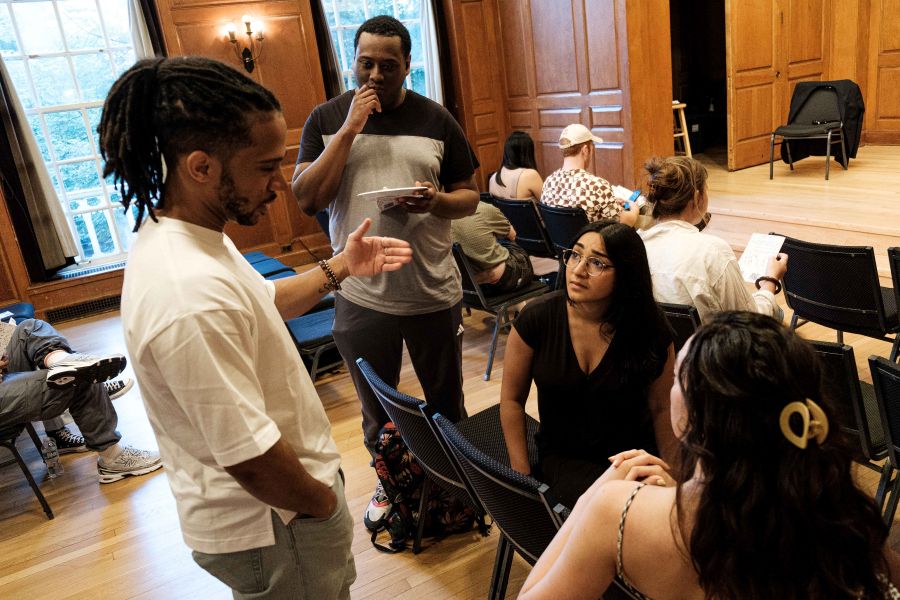
“There are those out there pushing for better wages and better contracts, which is important work,” said Garrett (played by Garrett Turner, a co-writer on the show). “Still, it seems like instead of negotiating for our freedom, we’re negotiating to be slightly less taken advantage of.”
Even if their show did not hesitate to put complicit administrators on blast, Necessary Labor ultimately puts its focus on the systems and structures underpinning these inequities. In keeping with the group’s strict focus on a Marxist lens, the answer can never be incremental change, however well-intentioned. (David Bruin, Alex Hare, Deadria Harrington, Kimber Lee, Julian Elijah Martinez Rivka Rivera and Lianah Sta. Ana round out the collective’s membership; A Statement Concerning… was written by Lee, Jain, and Turner, and directed by Hare and Myers.)
“If it’s truly class war, then those of us who dare say art has a role to play in it need to be just as disciplined, just as militant, and just as strategic about advancing proletarian liberation,” said Myers. “It’s not art as representation, but art as a weapon in a cultural struggle. Something that your average nonprofit is not even considering, respectfully.”
After Karl Max’s brutal murder, the theatermakers of A Statement Concerning… rose up and cast out Bougie Ted. Full of adrenaline, the newly formed collective ask: What now?
For now, they decide to meet weekly. Necessary Labor plans to do the same. Paradigm shifts can’t be rushed.
“Changing the world sounds like a tall order,” admits Lindy. “I got an early call tomorrow, too, so…”
Joey Sims has written for The Brooklyn Rail, Vulture, Into, Queerty, TheaterMania, New York Theatre Guide, and TDF Stages. He is an alumnus of the Eugene O’Neill Theater Center’s National Critics Institute and runs a theatre Substack called Transitions.