Maybe the title should have been a warning. In attempting to adapt one of her short stories into a major theatrical work with the poet Langston Hughes, Zora Neale Hurston might have looked twice at the name “The Bone of Contention.” That’s precisely what the writing project between this pair of Harlem Renaissance icons turned into, when their efforts to turn Hurston’s story into an ambitious folk epic of Black life, which they gave the new title Mule Bone, imploded over copyright claims and recriminations, with disastrous ripple effects on an entire artistic ecosystem.
 Mule Bone never saw the stage in their time (Lincoln Center did mount a version in 1991, and you can find a version of the script here). But the Hurston-Hughes relationship that was its crucible is now onstage through Feb. 15 at Passage Theatre in Trenton, New Jersey, in David Robson’s Muleheaded.
“Many writers who have written about the Harlem Renaissance, as well as Langston Hughes himself, said their friendship both began and ended the Harlem Renaissance,” said Brishen Miller, artistic director of Trenton, N.J.’s Passage Theatre, who directed Muleheaded.
The timing tracks: While scholars date the stirrings of the cultural movement that would be called the Harlem Renaissance to the early 1920s, there’s a strong case for 1925—the year that Opportunity magazine gave out literary prizes to a brace of promising Black writers and Alain Locke’s influential anthology The New Negro was published—as, in David Levering Lewis’s words, “Year I of the Harlem Renaissance.”
Hughes and Hurston met at that Opportunity awards dinner and were soon plotting collaborations. They co-founded the magazine Fire!! with Wallace Thurman and shared a memorable, bonding road trip from Alabama back to NYC in 1927 (now that’s a play I’d like to see). Hughes then introduced Hurston to his patron, a white dowager named Charlotte van der Veer Quick Mason, a.k.a. “Godmother,” whose largesse played an outsized role in bankrolling the Harlem Renaissance, even as her attitudes privileged primitivism and her fickle favors complicated relationships among her beneficiaries, including Hurston and Hughes.
It was Mason’s checkbook that underwrote Mule Bone, paying not only for Hurston and Hughes but for a typist, Louise Thompson, to take down their words. This uneven trio is the dramatis personae of Robson’s play, which follows Mule Bone’s conception, composition, and collapse at Hughes’s Westfield, New Jersey, home, from 1930 to early 1931.
Robson, who teaches writing at Delaware County Community College, has compressed the timeline somewhat and artfully sidestepped the non-theatrical spectacle of lawyers dispatching strongly worded letters. His focus, he told me, was on the close relationship among Zora, Langston, and Louise. “What comes from intimacy,” he added, “is tension and secrets, telling one person one thing but maybe telling someone else another—that creates an engine for drama.”
Drama indeed: When the Hurston-Hughes partnership foundered on claims and counter-claims of authorship and credit, fused with powerful feelings of envy and resentment, it effectively tore not just their friendship but their entire creative community apart, putting a bookend on the Harlem Renassiance project. (The Great Depression certainly played a big role in its end too.)
“What’s interesting to me,” said Miller, “is that the networks were so tight. Langston followed Bessie Smith on tour and would join her backstage, and Aaron Douglas did several of his paintings for Langston Hughes poems. The circles were very tight, so this one rift kind of rippled out.”
The loss of Mule Bone was arguably a great blow in itself. As Henry Louis Gates Jr. later wrote, the play had been conceived as a kind of anti-minstrel show, aimed at reclaiming Southern archetypes from decades of racist caricature. “It is clear that Hurston and Hughes believed the time had come to lift the veil that separates Black culture from white,” Gates wrote, “allowing Black art to speak in its own voice, without prior restraint. Had they not fallen out, one can only wonder at the effect that a successful Broadway production of Mule Bone in the early 1930s might have had on the development of Black theatre.”
That cause would be taken up decades later by the likes of Lorraine Hansberry, the Black Arts Movement, and a more recent bumper crop of Black dramatists. And there has been no shortage of Hurston and Hughes on U.S. stages since they passed, in 1960 and 1967, respectively: George C. Wolfe adapted three of Hurston’s stories into a play called Spunk at the Public Theater in 1990, while more recently Tamilla Woodard staged Hurston’s “lost” play Spunk at Yale Rep. Pulitzer-winning James Ijames is under commission from Orlando Shakes to adapt Hurston’s classic novel Their Eyes Were Watching God into a play. And Hughes’s Black Nativity still turns up regularly around Christmastime.
In place of their beloved Mule Bone, though, we have Robson’s solidly constructed Muleheaded—a kind of crime-scene tape around the show that got away. It has smooth direction by Miller, expert design by Jaelyn Alston-Frye, and some knockout performances, particularly by Constance Thompson as Zora and Anthony Vaughn Merchant as Langston.
Trenton is only about an hour’s drive from Westfield, and the Harlem Renaissance is a century in the past. Theatre can close these distances of time and place, and even heal deep personal rifts: Though, as Robson noted to me, Hurston and Hughes never spoke again after their Mule Bone contention, one thing you can say for Muleheaded is that it’s got these two great storytellers talking again, however briefly.
Emergency Powers
“I think I probably have a more complicated relationship with Tony than anybody in my entire life,” said Larry Kramer at one point in a C-SPAN interview in November 1993, referring to his interlocutor, National Institute of Health director Anthony Fauci, with whom he’d tangled over the agonizingly slow pace of government research into HIV and AIDS at a time when it was killing hundreds of thousands, but with whom Kramer, the activist and playwright of The Normal Heart and The Destiny of Me, eventually formed a kind of tetchy alliance—a kind of rapprochement between the outsider activist and the insider bureaucrat.
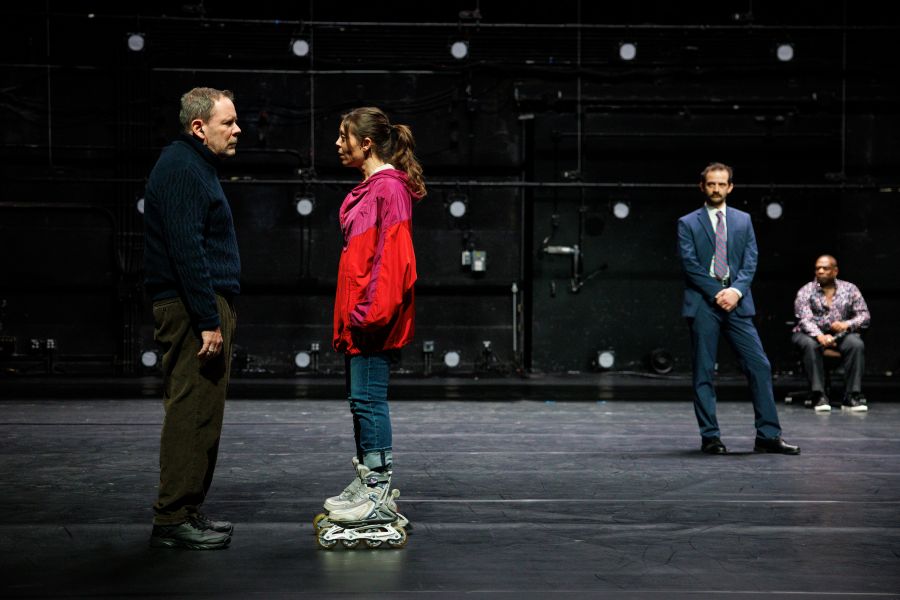
“The complicatedness of the relationship drew me—the extent to which they’re aware of the roles they are playing,” said director Daniel Fish, whose new show at NYU Skirball Center through Feb. 21, Kramer/Fauci, recreates that television colloquy, with Will Brill as a buttoned-up Fauci and Thomas Jay Ryan as a passionate Kramer.
The performative element is part of what made it seem naturally theatrical to Fish, who cut his teeth with avant-garde takes on classics and originals like House for Sale and Eternal before creating the bracing Oklahoma! revival of 2018. As the director put it, “That TV interview is an act of performance from those guys. Not that it’s false, not that they’re lying or pretending or saying things they don’t believe, but in the sense that, these are the roles, the points of view they adopt, and they both know what the other is going to do. Fauci knows Kramer is going to get very angry about Fauci’s diplomacy, and Kramer knows that Fauci is going to be diplomatic, yet it still pisses him off.”
The other reason to make a play of it is more straightforward, Fish said: “I just always found it very compelling and moving.”
Fish’s recreation of the TV interview is in some ways just as straightforward. On a bare set designed by Jim Findlay, Josh Higgason, and Amy Rubin, with 54 house-aimed lights arranged on a grid behind it (lighting design is by Scott Zielinski), the actors speak all the words in tempo with the original with the help of in-ear technology, in which the audio plays in the actor’s ears. Greig Sargent plays the C-SPAN interviewer and Jennifer Seastone voices all the callers, who include a few outright homophobes but are generally sympathetic to the argument that AIDS is, as Kramer shouts insistently, “A plague!” Fish includes a handful of meta-theatrical flourishes and an evocatively surreal stunt I shouldn’t spoil. But what chiefly comes through Kramer/Fauci is both a heady debate about declining trust in institutions and public health—an argument in which Dr. Fauci has more recently figured as a major player—and a portrait of a complicated public friendship.
Their intimacy comes through in a way it couldn’t on TV, since Kramer was on a video feed and the callers on audio. Kramer/Fauci dissolves those barriers, and constructs a few of its own. “I was interested in what happens when they’re all in the same room together,” said Fish.
The show lands at a moment of peril for U.S. public health: Funding for the NIH has been narrowly preserved by Congress and the courts despite the Trump administration’s efforts to slash it, and the Department of Health and Human Services is now run by an anti-vaccine demagogue and the Environmental Protection Agency just ended all efforts to combat climate change pollution. On the night I saw it, there were titters of recognition when Fauci, shutting down a caller who suggests quarantining AIDS patients, makes the crucial distinction between blood and airborne transmission (cough, cough—literally). But for me the real through-the-looking-glass moment comes when Kramer repeatedly demands that President Clinton invoke “emergency powers” to combat AIDS in a way analogous to Desert Storm, given that our current administration has repeatedly claimed exactly those powers to run roughshod over constitutional guardrails in the name of myriad phantom “emergencies.” AIDS was a true emergency; “harmful trade practices,” not so much.
Though President Clinton never did invoke those powers to fight AIDS—the 1993 interview takes place in the context of Clinton’s new Office of National AIDS Policy, which Kramer sees as another bureaucratic feint, while Fauci touts its potential for meaningful progress—just three years later, Highly Active Antiretroviral Therapy (HAART) was approved by the FDA, significantly decreasing mortality and effectively ending that era of the crisis in the West (though it ended neither the scourge of HIV/AIDS, which remains a global pandemic, nor the pace of research, which has continued to look for new treatments and a cure).
The activist and bureaucrat each had their role to play in that outcome, but there’s no question where Fish’s sympathies lie. Kramer/Fauci, he said, is about “the power of an individual to not shut up and just say what has to be said, and to say it again and again and again and to be willing to offend people.” He sees another, more conciliatory lesson for our divided time: “The way these two men are able to disagree with each other, and be able to do that in a meaningful way—that is something we seem to have lost.”
Seen Around Town
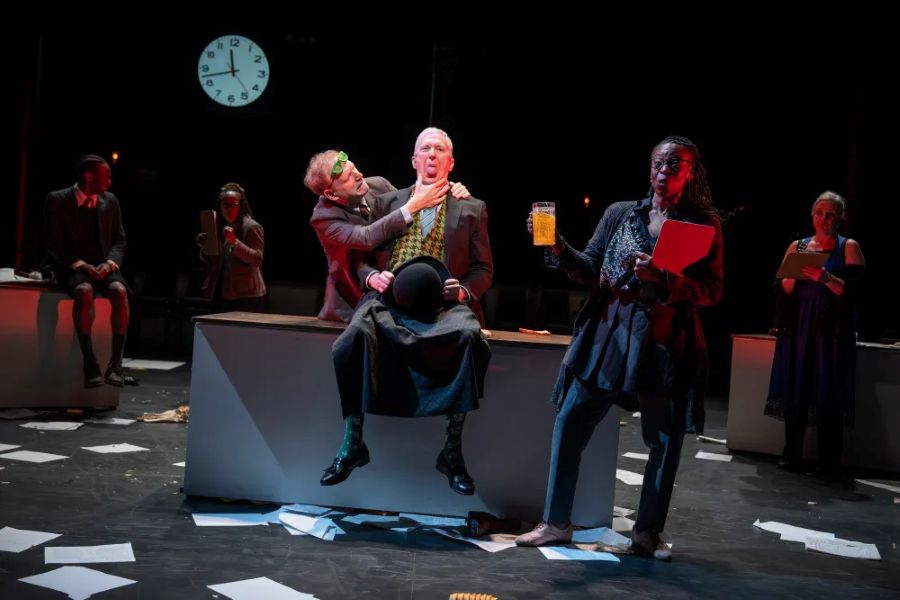
On my first day of college, while stocking up on required textbooks at the USC bookstore, I also made an impulse buy: Ulysses by James Joyce. I’d read and loved A Portrait of the Artist as a Young Man in high school, and my older friend Cinco Paul had raved (bragged) about how he’d been assigned to read Ulysses in four separate classes at Yale. I knew it was going to be a step up from Portrait in literary difficulty, but I thought I was up for it. I was not: I could barely get through the first chapter. So I walked into the Elevator Repair Service’s new stage adaptation of the Joyce novel, now at the Public Theater, with some trepidation. I had very belatedly (and somewhat dutifully, if I’m honest) caught their seminal durational GATZ in its grand finale there in the fall of 2024. And though I knew Ulysses promised to do the opposite of GATZ, essentially—take a long, dense text and compress it to a relatively economical evening of theatre—I was wondering: What did I get myself into here? I need not have feared. Though I didn’t vibe with or follow every moment of the two hours and 45 minutes that followed Scott Shepherd’s humble, avuncular intro, ERS’s aesthetic daring, conviction, and commitment to the bit ultimately paid off. By the second act, the show’s assured mix of hallucination, inquest, and logorrheic monologue hit an impressive groove. The experience even sent me back to the book with renewed curiosity, if not crystal clarity…Matthew Libby’s Data, now at the Lucille Lortel, is well acted and slickly directed by Tyne Rafaeli, but it ultimately offers little beyond eerie topicality. It follows a young Indian American programmer who’s tempted to sell a breakthrough algorithm to a sinister Silicon Valley firm that wants to use it to aggressively screen, and possibly surveil, immigrants to the U.S. Once we grasp the Palantir-esque premise, and Maneesh’s dilemma, there’s honestly not much play there…In my last column, I spoke to Harbor Stage Company’s Jonathan Fielding and Brenda Withers about their new stage version of the iconic film My Dinner With André, which they brought to New York City for a painfully short run, Jan. 16-Feb. 1, with Fielding in the Wallace Shawn role and Robert Kropf as André Gregory. Mounted in a tiny basement venue on 9th Street in the East Village, it was blessedly simple, straightforward, and utterly riveting—a tiny gem. Here’s hoping they can find a way to bring the show back (and that Shawn grants the stage rights to others, as it works surprisingly well as a sort-of-two-hander)…Speaking of excellent two-handers, Phanésia Pharel’s The Waterfall (previewed here by Brittani Samuel) opens at the WP Theater on Sunday, Feb. 15. Since the review embargo doesn’t lift till then, I should only say here that it’s an auspicious Off-Broadway debut for Pharel, with two meaty parts sensationally acted by Patrice Johnson Chevannes and Natalie Paul…A final note of conditional praise for George Abud’s wild, pointedly topical remix of The Threepenny Opera, styled as 3Penny Opera, which I caught in a short workshop run, Jan. 15-25, with Off-Brand Opera. Broadway stars Katrina Lenk, Mary Testa, Barbara Walsh, and Abud himself headlined a very eager cast through a properly irreverent raid of Brecht’s script and (not enough of) Weill’s score. The thing isn’t fully baked, but there’s something to the recipe: Abud’s Groucho affect as Macheath was infectiously acrid, and while his lyrical translations were hit-and-miss, his general attitude of equal-opportunity effrontery was honestly closer to the bumptious spirit of the original than any Threepenny I’ve ever seen.
What Else Is New
A roundup of February world premieres all across the U.S. (If you’re producing one in the coming months, let us know at rwkendt@tcg.org and at@tcg.org.)
Northeast
The Dinosaurs is Jacob Perkins’s play about six women who gather for a recovery group. With a powerhouse cast including Elizabeth Marvel, April Matthis, and Kathleen Chalfant and direction by Les Waters, it runs at New York City’s Playwrights Horizons Feb. 4-March 1.
Brooklyn’s Bushwick Starr joins with ¡Oye! Group to present Gooey’s Toxic Aquatic Adventure, a new puppet musical about a mermaid in nearby Newtown Creek. Written and performed by La Daniella, with music and lyrics by Ben Langhorst and direction by Sammy Zeisel, it runs Feb. 4-21.
Relentless, Rae Binstock’s new play about a woman who runs a boxing gym and receives an offer that’s too good to be true, plays at New York’s Syracuse Stage Feb. 4-22, under Melissa Crespo’s direction.
Harley Walker’s MFA thesis project, Darling: Or, a Guided Adventure in Dismantling the Patriarchy, is getting a mainstage production at Connecticut Repertory Theatre in Storrs Feb. 5-15. Using puppets and other media to reexamine J.M. Barrie’s Peter Pan stories, it’s directed by Kate Brehm.
In Kirk Lynn’s The First Line of Dante’s Inferno, at New York City’s La MaMa Feb. 5-22, a woman searches for her missing sister in a state forest. Christian Parker directs.
I can’t vouch for the play but the title certainly grabs attention: Hans Litten: The Jew Who Cross-Examined Hitler is Douglas Lackey’s new drama, based on the true story of a German litigator who questioned the future dictator in a legal proceeding years before he rose to power. It runs Feb. 5-22 at Theatre Row in New York City, with direction by Alexander Harrington.
Ken Urban’s The Moderate, a play about the struggles of an online content moderator, is at Cambridge, Massachusetts’s Central Square Theater Feb. 5-March 1, in a Catalyst Collaborative@MIT Production directed by Jared Mezzocchi.
I’ll count Caesar, Tyler Dobrowksy’s new 95-minute, four-actor adaptation of Shakespeare’s play, as a world premiere (a new title is usually a good marker of freshness; see Chez Joey below). It runs Feb. 6-22 at the Philadelphia Theatre Company, of which Dobrowsky is co-artistic director.
Plantation Black, Phaedra Michelle Scott’s new play about present-day white and Black descendants of a land-owning family arguing over their rightful inheritance, is being offered by Philadelphia’s InterAct Theatre Company at the Drake with a fascinating twist: Each night of its run, Feb. 6-March 1, the play begins at a different point in its historical timeline after a cast member spins a drum bearing the names of all the scenes in the play.
Ai Yah Goy Vey! The Adventures of a Dim Sun in Search of His Wanton Father is the mouthful-of-a-title solo show by Richard Chang, premiering in a Pan Asian Repertory Theatre production at A.R.T./New York Theatre Feb. 8-Mar. 1.
11 to Midnight, a theatrical dance experience from Cost n’ Mayor (Austin & Marideth Telenko) and Hideaway Circus (Josh & Lyndsay Aviner), runs at the Orpheum Theatre New York City’s East Village Feb. 11-March 1. It’s directed by Lyndsay Magid Aviner.
In Kramer/Fauci, director Daniel Fish revisits the televised 1993 clash between playwright-activist Larry Kramer and AIDS researcher Dr. Anthony Fauci over research and care for HIV/AIDS, with Will Brill and Thomas Jay Ryan in the lead roles. It runs at NYU Skirball Center Feb. 11-21.
XOXO: Montco’s Variety Show is a company-created Valentine’s Day offering from Norristown, Pennsylvania’s Theatre Horizon. Directed by Ontaria Kim Wilson, it runs Feb. 11-22.
Playwright Theresa Rebeck takes the director’s chair for Samantha Inside Out, a play by Marisa Smith about an English teacher of a certain age who radically rethinks her life, at Long Branch’s New Jersey Repertory Company, Feb. 19-March 15.
Ethan Slater co-wrote (with director Marshall Pailet) and stars in Marcel on the Train, about the formative WWII-era years of the famous clown Marcel Marceau. It runs at New York City’s Classic Stage Company Feb. 22-March 22.
Vichet Chum’s new play Kween is set in Lowell, Massachusetts, where Merrimack Repertory Theatre is based. The theatre commissioned this play about a queer Cambodian American teenager “finding her voice and stepping into her legacy.” Directed by Pirronne Yousefzadeh, it runs Feb. 25-March 15.
Writer/director Aya Ogawa’s MEAT SUIT, or the shitshow of motherhood, is described as “a genre-defying theatrical carnival that plunges audiences into the chaos of being a mother.” A production of Off-Broadway’s Second Stage, it runs at Signature Theatre Feb. 25-March 15.
Milkweed, Wendy Dann’s new play about “the charged space between students and teachers,” plays at Ithaca, New York’s Kitchen Theatre Feb. 25-March 15, under the direction of Emily Jackson.
Chay Yew directs Alex Lin’s Chinese Republicans, a new comedy about a group of high-powered businesswomen, which runs Feb. 26-April 5 at Roundabout Theatre Company’s Off-Broadway Laura Pels Theatre.
West
Sunny in the Dark is Elaine Jarvik’s new play about a 15-year-old who gets surprising results from a DNA test. Directed by Marion Markham, it runs at Utah’s Salt Lake Acting Company Feb. 4-March 1.
Sylvia Sylvia Sylvia, Beth Hyland’s dark comedy about a young writer haunted by the ghost of Sylvia Plath, plays at Los Angeles’s Geffen Playhouse Feb. 4-March 8. Jo Bonney directs.
Playwright Claudia Shear has adapted Bob Spitz’s book Dearie: The Remarkable Life of Julia Child into a new play called Recipe, which runs at California’s La Jolla Playhouse Feb. 10-March 8 under Lisa Peterson’s direction.
DACA recipient and San Jose poet laureate Yosimar Reyes has written No Llegamos Aquí Solos (We Did Not Arrive Here Alone) to tell the story of East San Jose’s Latine population. It runs Feb. 12-22 at California’s Teatro Visión under the direction of the company’s artistic director, Rodrigo García.
Matthew Scott Montgomery’s Foursome, which runs Feb. 13-March 23 at IAMA Theatre Company in Los Angeles, is a queer rom-com that unfolds at a fraught friend reunion. Tom Detrinis directs.
Straddle is Harrison David Rivers’s new romantic comedy about two women trying to spice up their relationship as they mark yet another anniversary, and it runs at San Diego’s Diversionary Theatre Feb. 19-March 15 under Sherri Eden Barber’s direction.
Fiasco Theatre Company unveils a stage version of Herman Melville’s short story Bartleby at San Diego’s Old Globe Theatre, Feb. 20-March 15. Adapted by Noah Brody and Paul L. Coffey, it’s directed by Emily Young.
Teal Sherer is the author and performer of The World Looks Different Sitting Down, her tale of “confronting the world at crotch level” and busting misconceptions about life as a wheelchair user. Directed and choreographed by Jessica Wallenfels, it runs at Seattle Public Theater Feb. 20-March 1.
In Ballybunion Backs Bill, inspired by the true story of President Bill Clinton’s 1998 visit to Ireland, the residents of a small town feud and scheme with hilarious results. Seanie Sugrue is the author, Locked in the Attic Productions is the producer, and L.A.’s Broadwater Main Stage is the venue, Feb. 26-March 15.
In Paul Calandrino’s The Fifth Hypothesis, at Oregon Contemporary Theatre in Eugene Feb. 25-March 15, an ecologist and “Sasquatch researcher” squares off with her skeptical brother. Direction is by Kirk Boyd.
South
↓ D←R←O←W←N←E←R [Renword] is the typographically adventurous title of Nia Akilah Robinson’s new horror comedy about two Black students and a nightmare summer job with an older white professor. Directed by Heather Lanza, it runs through Feb. 22 at NextStop Theatre Company in Herndon, Virginia.
Margot Bordelon directs English Only, Nicholas Griffin’s new historical drama about the historic Mariel Boatlift of the early 1980s, running through Feb. 22 at Miami New Drama.
Dawn, Tuyết Thị Phạm’s new play about a mother and daughter confronting a legacy of love and loss, set against the backdrop of Khmer Rouge’s atrocities in Cambodia, runs at Baltimore’s Everyman Theatre Feb. 1-March 1. The director is Seonjae Kim.
In The World to Come, a new epic by Ali Viterbi, directed by Howard Shalwitz, residents in a retirement home use friendship as a form of resistance as the world outside edges toward apocalypse. Co-produced by two Washington, D.C., companies, Theater J and Woolly Mammoth Theatre Company, it runs at Woolly Feb. 3–March 1.
Joriah Kwamé’s Little Miss Perfect, Feb. 8-March 8 at Maryland’s Olney Theatre Center in Maryland, is a new musical based on a viral TikTok song. Direction is by Zhailon Levingston, with choreography by Chloe O. Davis.
Director/writer Aaron Posner and the illusionist Dendy have created Nothing Up My Sleeve for a Feb. 11-March 15 run at Bethesda, Maryland’s Round House Theatre.
Lena Waithe’s Trinity, at Baltimore Center Stage Feb. 12-March 8, is described as “blending the sharp wit of a romantic comedy with the searching depth of an existential drama.” It’s directed by BCS artistic director Stevie Walker-Webb.
I’m going to count this “revis-ical” of Pal Joey as a world premiere because it has a new title, Chez Joey, and a new book by Richard LaGravenese. Co-directed by Tony Goldwyn and Savion Glover, this new take on the iconic Rodgers & Hart tuner plays at Arena Stage in Washington, D.C., Feb. 13-March 15.
Tamarie Cooper directs Joe Folladori’s colorfully titled Katy Perry Candy Darling Mary Magdalene, Feb. 13-March 7 at Houston’s Catastrophic Theatre in Houston. I can’t improve on the show’s description as a “madcap musical romp through the modern entertainment industry, a psychedelic meditation on the intertwining dualities of religious faith and gender identity, a harrowing discopunk psychodrama, and a hot wet heavy metal nightmare.”
Peter Rabbit and the Secret Garden Gate is a newly devised offering for very young audiences at Maryland Ensemble Theatre in Frederick. Shea-Mikal Green is the director, and it runs Feb. 22-March 15.
Inspired by Uncle Vanya, Beth Hyland’s Fires, Ohio puts tired intellectuals in contention in a small Ohio college town as wildfires rage nearby. It runs at Atlanta’s Alliance Theatre, with direction by Marissa Wolf, Feb. 25-March 22.
Midwest
Borrowed Babies is the arresting title of Jennifer Blackmer’s new drama, in which an aging home economics professor has occasion to look back about the discredited tradition of using “practice babies” to teach young housewives. Directed by Bridget Haight, it runs at Indianapolis’s American Lives Theatre Feb. 5-22.
Alex Lubischer’s new dark comedy, Pivot, is about a Nebraska farm woman whose wedding plans blow up in her face. Directed by Hallie Gordon, it runs at Chicago’s Rivendell Theatre Feb. 11-March 21.
If the name Pot Girls sounds familiar, that’s because this new play by Paul Michael Thomson, about a young English writer named Caryl premiering a major feminist play in 1982, is “a smoky riff” on Caryl Churchill’s Top Girls, and it’s running as a Story Theatre production “in creative conversation” with director Lucky Stiff’s revival of the Churchill play at Chicago’s Raven Theatre. Directed by Ayanna Bria Bakari, Pot Girls runs Feb. 12-March 1.
Chicago’s Lifeline Theatre premieres Kitty and the Beanstalk, a new TYA musical which resets the popular fairy tale in the big city among stray cats, Feb. 14-March 22. It’s written by ensemble members Jess Wright Buha, Miles Buha, and Molly Buha, with music by John Szymanski and direction by Calvin Adams.