The royal “we” reportedly dates to the 12th-century reign of Henry II, the English king best known to me as the one who had his former bestie Becket knifed over a church-state dispute (yes, I learned much of my history from the theatre), and who had, possibly in light of that very killing, a strong motivation to double down on the purported divine right of kings: By “we” he meant “God and I.” Talk about pulling rank.
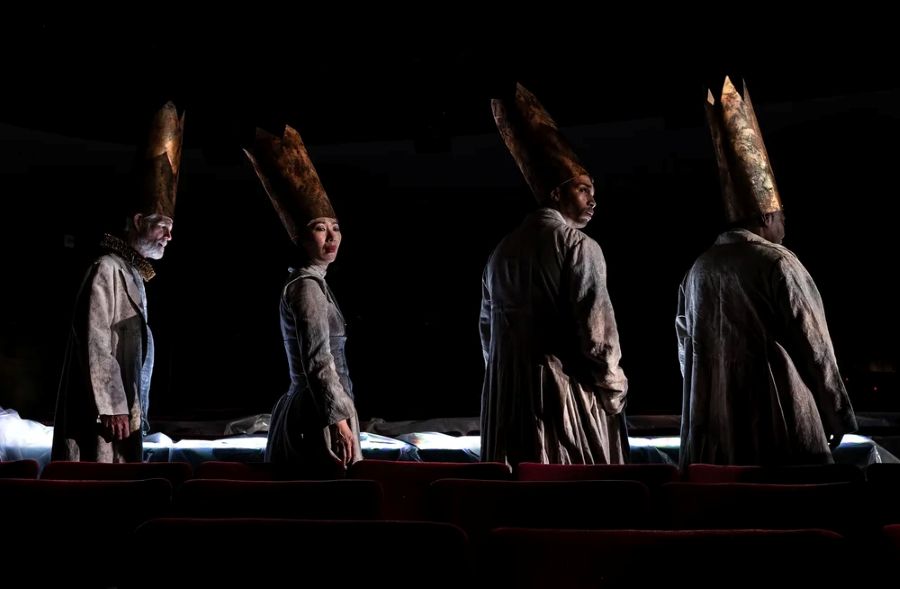
 For Karin Coonrod, a director who’s made her name with bracing new stagings of classics and literary adaptations, the royal “we” conveys multiplicity and complication, as well as a bit of playfulness: Her new rendition of King Lear, which runs at La MaMa Jan. 23-Feb. 8, begins with the 10-member company, all draped in Oana Botez’s greige costumes and wearing gilded paper crowns roughly a foot and half tall, circling the audience with amused detachment. They then start the text with Lear’s “know that we have divided” speech, delivered in tag-team form—all are Lear, and no one is Lear—until Abigail Killeen knocks her crown off to give Goneril’s response; later Jo Mei as Regan does the same, and so on.
“This play starts off like a child’s game, then moves into an existential journey into nothing and beyond,” Coonrod told me in an interview last month at Sullaluna, a West Village restaurant that also has an outpost in Venice, Italy (more on that connection below). Citing Lear’s origins in a fairy tale about a king whose most loyal daughter says she loves him like salt, Coonrod said she saw this opening contest as quick-thinking one-upwomanship in the face of patriarchy.
“I was thinking of that wall of power, and the fact that they all turn on her,” she said of the moment when nine other Lears turn their expectant gaze to Goneril. What is she supposed to say to them? “Sir, I love you more than words can wield the matter,” is how she starts, and, as Coonrod put it, “She goes on and on until it gets so over the top—‘dearer than eyesight, space, or liberty’—that we see it as a game. It’s transactional. Regan sees that as well, and then competes with her sister because she’s younger; that’s the psychology of the second daughter.”
When it’s the turn of Cordelia (Celeste Sena), she’s simply unwilling to join the game, but her resistance has a more dangerous edge than in many stagings of Lear, as do Regan and Goneril’s later squabbles with the aging king. That’s because Lear is embodied collectively by several circling actors, literally outnumbering his daughters, even as they haggle over the size of his retinue. Far from dispersing the force of this aging monarch, then, this multiplayer mode only enhances his power.
“I’m so not interested in making it about this old, old feeble leader,” said Coonrod. “I think he’s vital. He can still kill somebody.” This many-faced corporate Lear can be read another way too: “He’s a part of a system, he’s a patriarch. And in facing that wall of power, when you’re told, ‘No questions asked,’ a child can always feel that.”
Of course, by play’s end, Lear is reduced to a kind of second childhood himself. It’s not a spoiler, I don’t think, to note that Coonrod’s many-headed Lear conceit is essentially blasted away by the storm, leaving the majestically cuddly Tom Nelis to assume the role. When I mentioned to Coonrod that most folks think of King Lear as one of the bleakest plays in the canon, she countered, “It’s apocalyptic, but I don’t think it’s bleak.” Nervously registering the current end-times feeling coursing through our contemporary politics, she continued, “This play is a stunning play for this moment, because there is this amazing forgiveness between the father and the daughter. That is astonishing. That scene is real. We all face death, right? But to face death having had that exchange of love, one is ready for it.”
Coonrod, who began staging Shakespeare as a high school drama teacher at Christian Brothers Academy in New Jersey five decades ago, has since directed all over the world, including in her mother’s native Italy, to which she maintains strong ties. (The company she founded in 2004, La Compagnia de’ Colombari, is explicitly conceived as a binational effort.) One of her most auspicious efforts, which she documented for American Theatre in 2006, was Laude in Urbis, a roving reimagining of a medieval mystery play staged all over the Italian city of Orvieto. Another was her searching 2016 take on The Merchant of Venice in the former Jewish ghetto in Venice (which she also wrote about for our magazine). She has also adapted literary works for the stage (Flannery O’Connor, Isak Dinesen, Queen Elizabeth I’s letters). But Shakespeare remains a wellspring.
“That guy, he’s just a good writer,” she said with a laugh, then got more specific. “He uses the word ‘shake’ all the time.” (An online concordance confirms that the word appears in his plays, in various forms, 183 times.) “And I think shake is what he’s doing. He’s shaking the system, politically and metaphysically. That’s what I feel very, very strongly. If you just stop at the political, which a lot of people do, it’s limited—I think, what if we expand it to the mystery? You can never get to the end of what he was writing. You keep finding more and more.”
Wally (and André) World
What is it about the 1981 film My Dinner With André that made it, and continues to make it, so enthralling? I watched it again recently and can confirm that the unique spell of this 100-minute filmed conversation between playwright-actor Wallace Shawn and director-raconteur André Gregory has not abated.
If I had to guess, I’d say its persistent glow has something to do with the urgency and pungency with which the two communicate their diverging ideas on life, art, and contemporary society; each really wants to get through to the other, if not to persuade their friend, then at least to be truly heard by him. This tracks with the backstory of how and why the film was made: Shawn was looking for a pivot from his wild early plays, which had received more acclaim than popularity, to work that would reflect more of his own lived experience—he was looking for a way to put himself in his plays, essentially, and from My Dinner onward he did just that: literally put himself in them. For his part, Gregory had spent time in the spiritual wilderness, after a similarly acclaimed career as an avant-garde theatre director, and had come to some realizations about the world that he had a kind of missionary zeal to share. So the two men spent hours recording their conversations and honing them into a kind of play, which director Louis Malle filmed with circumspect brilliance (in an abandoned hotel in Richmond, Virginia, hilariously).
The result is a timelessly great film that helped launch Shawn’s film acting career. But apart from the Malle-directed Vanya on 42nd Street, My Dinner had no real cinematic follow-up (though films like Before Sunrise and Coffee and Cigarettes certainly owe it a debt). Instead its influence was felt most strongly in the theatre, as Shawn’s playwriting palette, in plays like The Fever, The Designated Mourner, and Grasses of a Thousand Colors, expanded to include a version of his own dyspeptic personality. (The new What We Did Before Our Moth Days, being billed as Shawn’s final play, will start soon at the Greenwich House Theater under Gregory’s direction; Shawn is not in the cast.)
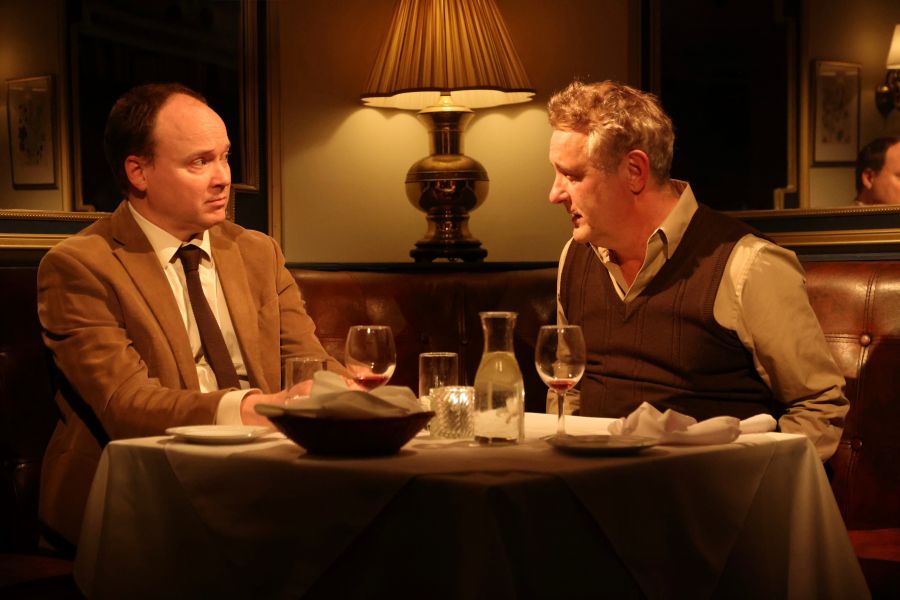
Theatre is in the film’s DNA, in short. Its first line is, “The life of a playwright is tough,” and one of its central subjects is the state of the theatre, which Shawn’s character argues “is in terrible shape today” but at its best “can bring people into contact with reality.” And in fact the script was performed for a few weeks as a kind of backers’ audition at the Royal Court Theatre. So what if My Dinner With André could in fact be reclaimed by the theatre—if it were staged as a play? It’s happening now, thanks to a production that starts performances tonight at New York City’s East Village Basement, after runs at the Harbor Stage Company in Wellfleet, Massachusetts, and at the Boston Center for the Arts last year. In the roles of Wally and André are two of Harbor Stage’s co-founders, Jonathan Fielding and Robert Kropf, who first floated the idea as a kind of running joke for years until they decided to ask for the stage rights from Shawn, and got his blessing.
Fielding, who has the receding hairline if not quite the hobbit-like physicality of Shawn, said their version is based on Shawn’s “full three-hour text,” though the running time of the new stage version is still 90 minutes. The question must be asked, though: How are he and Kropf approaching these iconic characters in performance?
“We are not camping it up,” Fielding said. “We looked back at the text and said, what are the character traits that are inherent in this text? Wally’s a playwright, but he’s dipping his toes in acting. He is a hard worker. He’s afraid to ask questions, he’s nervous about meeting. So all these character traits come together and you get something a little bit like Wally Shawn. While people might watch it and go, ‘Yeah, he’s like Wally Shawn,’ I’m absolutely not doing an impression of him.” Still, when André Gregory himself came to see the show on Cape Cod, Fielding said that Gregory’s wife told the actors, “I just felt like I was looking at Wally and André onstage.”
The content of their conversation also hits different after 45 years. Essentially Gregory, with his tales of near-death experiences and forest-bound excursions with Grotowksi and his Polish theatre troupe, represents a spiritual approach to life’s mysteries, while Shawn expresses a pragmatic skepticism toward grand theories, clinging instead to small comforts and material realities. This dichotomy was as alive in what would become the Reagan era as it is now. Though the play is framed by Shawn’s voiceover (and he is the “my” of the title), neither voice gets the last word.
Brenda Withers, another Harbor Stage co-founder, said she’s watched the play several times and still finds that tension electric. “Depending on the night, it’s an amazing litmus test in that room to see which way the audience is going to tilt—how many Wallys are there and how many Andrés are there,” she said. “This play can turn you; I’ll be there and think, ‘Oh, tonight, I’m a Wally,’ because there’s just that vibe in the room, or depending on what’s happened in the world.”
Indeed, if only all of us could sit and talk out our differences over dinner.
Seen Around Town
My theatregoing has gotten off to a slow start in 2026. First on my dance card: the hotly anticipated new Broadway production of Bug. I shared in that anticipation, not only due to the buzz around its Steppenwolf premiere(s) in 2020/21, but based on my own love for the Off-Broadway production in 2004, which was my happy introduction to playwright Tracy Letts and the powerhouse actors Michael Shannon and Shannon Cochran. I don’t naturally gravitate toward the old ultraviolence onstage, but Dexter Bullard’s production rang all my bells, not least because, as I later wrote, the show’s indeterminacy was as ironclad that of as Shanley’s Doubt, just more viscerally conveyed: Were Peter and Agnes, the conspiracy-addled loners at the play’s heart, merely deluded, or were there somehow really government-planted bugs crawling all over them? That staging really stuck with me. (I should probably add that having John Waters sitting in the next row, giggling at all the most horrifying stuff onstage, might have enhanced my experience.) David Cromer’s relatively measured new staging has great performers and a killer design, but I never felt implicated in its madness. Jason Zinoman’s rave in the Times almost convinced me that I had missed the boat, but I felt more closely aligned with reviews by Sara Holdren and Jonathan Kalb. This Bug just didn’t bug me out…
What is it about cats in Irish plays? A supposedly dead one figures heavily into McDonagh’s The Lieutenant of Inishmore, and at least two appear incidentally in Leo McGann’s The Honey Trap, which had a hit run at Irish Rep last year and has reopened there through Feb. 16. A few tonal quibbles aside, I was riveted by this twisty tale of a former British soldier on a mission of revenge for an IRA killing of his young mate in Belfast in 1979. With sharp direction by Matt Torney and a stellar cast headed by Michael Hayden and Samantha Mathis, the play brings fresh, pungent angles and human complication to a conflict we may think we know all too well. The result plays a bit like the series Say Nothing crossed with a romantic thriller. That may not sound like a winning formula but it seemed craic to me.
What Else Is New
A roundup of January world premieres all across the U.S. (If you’re producing one in the coming months, let us know at rwkendt@tcg.org and atm@tcg.org.)
West
Joanna McClelland Glass debuts her new play Louisa Gillis at North Coast Rep in Solana Beach, California, Jan. 14-Feb. 8. It’s described as a psychological thriller about the cost of revenge, and it’s directed by North Coast Rep artistic director David Ellenstein.
Intiman Theatre is presenting SHe Said, a new rock musical in an immersive nightclub staging, by and starring Seattle musician Jen Ayers, Jan. 14-Feb. 1 at the Erickson Theatre in Seattle. Allison Narver directs.
Cowboys and East Indians is Nina McConigley’s adaptation, with Matthew Spangler, of her short stories about the cultural collisions faced by an Indian immigrant family in Wyoming. It runs Jan. 15-March 1 at Denver Center Theatre Company under the direction of DCTC artistic director Chris Coleman.
Village Green Productions is presenting Kid Gloves, a new musical comedy by Matthew Leavitt and Nathan Wang that parodies reality TV, at Skylight Theatre in Los Angeles, Jan. 15-Feb. 15. Richard Israel directs.
Li, Wei He’s new comedy about a thief in Mongolia who’s reconsidering her life choices, plays at Seattle Public Theater Jan. 16-Feb. 8. A co-production with Sis Productions, it’s directed by Christie Zhao.
After decades of making shows in which he has portrayed famous composers at the piano, writer/performer Hershey Felder is telling his own unique story in The Piano and Me, running at TheatreWorks Silicon Valley Jan. 17-Feb. 8.
Running After Shadows had its origins during the Covid lockdown, when San Jose’s City Lights Theatre Company commissioned writers of color. Now Vincent Terrell Durham’s play, about a culinary journey that unlocks complicated childhood memories, is having a full staging at City Lights Jan. 22-Feb. 8, under Aldo Billingslea’s direction.
Two Nails, One Love is Lee A. Tonouchi’s adaptation of Alden M. Hayashi’s novel about a gay man in New York City whose estranged mother from Hawai‘i shows up unexpectedly. It plays at Honolulu’s Kumu Kahua Theatre Jan. 22-Feb. 22.
Jacob Ming-Trent’s solo show How Shakespeare Saved My Life, in which the writer/actor makes links between Biggie and the Bard, plays at Berkeley Repertory Theatre Jan. 23-March 1 under Tony Taccone’s direction.
Robert Axelrod’s Lifeline will have its world premiere at North Hollywood’s Road Theatre Company Jan. 23-March 1. Directed by Ken Saywer, it tells the story of a woman who takes a job at a suicide hotline.
In his new solo show My Son, the Playwright, writer Justin Tanner plays first his father, then himself in two separate acts, portraying two souls who try but can’t connect. Directed by Lisa James, it runs Jan. 24-March 1 at Los Angeles’s Rogue Machine Theatre.
Godspeed, Terence Anthony’s new Western about a formerly enslaved woman on a mission in post-Civil War Texas, runs at Denver Center Theatre Company Jan. 30-Feb. 22, under Delicia Turner Sonnenberg’s direction.
Will Van Dyke and Jeff Talbott’s new musical, Ten Brave Seconds, tells the story of a teen’s coming out on a fateful day. Directed by Ellie Heyman, it runs Jan. 30-Feb. 14 at Salt Lake City’s Pioneer Theatre Company.
Northeast
Concrete Temple Theatre will premiere Packrat: The Quest por la Abundancia, a “puppet-forward play” about home, belonging, and responsibility at a time of global displacement and climate crisis. Written and directed by Renee Philippi and featuring puppetry and set design by Carlo Adinolfi, it runs Jan. 7–23 at Dixon Place in New York City.
The Disappear, a new comedy by British playwright Erica Schmidt, runs Jan. 8-Feb. 15 at Audible’s Minetta Lane Theatre in NYC, and will be released as an audio offering in coming months. Schmidt also directs the play, about a Hollywood power couple whose relationship goes wildly offscript.
Shelter in Place, a new comedy by Henry Feldman, about five people stuck inside during a Gulf Coast hurricane, runs Jan. 8-25 at the Sgouros Theater in New York City. It’s directed by Joan Kane.
Dream Feed is billed as an electro-acoustic live concept album by The HawtPlates (the power trio of Jade Hicks, Justin Hicks, and Kenita Miller-Hicks). Running Jan. 9-25 at HERE Arts Center in New York City, the show is a 2023 HERE Artist Residency Program (HARP) commission, with additional co-commissioning support by the citywide Under the Radar Festival.
Playwright/director Bill Van Horn goes back to the Conan Doyle well for a new anthology show titled Sherlock Holmes: The Great Detective, running at Philadelphia’s Walnut Street Theatre Jan. 13-Feb. 15.
South
Karen Li’s From East, Like the Sun follows two generations in two families (and one 19th-century ghost) searching for treasures both material and otherwise. Directed by Jalice Ortiz-Corral, this Rapid Lemon production runs Jan. 8-25 at the Strand Theatre in Baltimore.
Austin’s VORTEX presents the wolf you feed, a new play by Darcy Parker Bruce billed as a punk-influenced fable inspired by Where the Wild Things Are. Directed by Chris Fontanes, it runs Jan. 15-Feb. 7.
S. Schulze’s 10 Billion Sapiens, a Theatrical Mining Company production running at the Baltimore Theatre Project Jan. 16-25, pits a hospitalized neo-fascist against the only rehab nurse who will still work with him. Barry Feinstein directs.
In Bleeding Hearts, Steve Yockey’s new farce at Atlanta’s Theatrical Outfit Jan. 28-Feb. 22, a middle-class couple reckons with both a knife-wielding drifter and a wealthy kleptomaniac neighbor. Directed by Sean Daniels.
Circle Forward is a new comedy about grief, hope, and the unexpected by Deb Hiett, and it’s getting its debut at Naples, Florida’s Gulfshore Playhouse Jan. 29-March 1, under the direction of Neel Keller.
Pop! is a new immersive show for very young audiences (0-5), created by Julie Herber and Shea-Mikal Green, that runs at Maryland Ensemble Theatre in Frederick, Maryland, Jan. 29-Feb. 8.
Atlanta’s Alliance Theatre is not messing around: To inaugurate their new Goizueta Stage for Youth & Families at the Woodruff Center, they’re rolling out three new family musicals in repertory under the banner The Underground Rep: First is Into the Burrow: A Peter Rabbit Tale, written and directed by Mark Valdez, with tunes by a cohort of songwriters (Jan. 31-June 27). In February comes Mo Willems and Deborah Wicks La Puma’s Naked Mole Rat Gets Dressed: The Rock Experience and in May The Great Ant Sleepover by Madhuri Shekar, Christian Magby, and Christian Albright.
Angelle Whavers’ John Doe, the story of an introvert who talks to a dead man, plays at Washington, D.C.’s Keegan Theatre Jan. 31-Feb. 22. Direction is by Josh Sticklin.
Midwest
At Theater Wit Jan. 9-Feb. 8 is Prospera, a new sci-fi retelling of of Shakespeare’s The Tempest, directed and adapted by Tiffany Keane Schaefer and co-produced by Theater Three and Otherworld Theatre Company.
Maybe call it 100 Proof: In Fair State, writer/performer Megan Gogerty reckons with the death of her alcoholic father and uncovers ancestral ties to Iowa’s founding. It’s at Iowa City’s Riverside Theatre Jan. 22-Feb. 1.