He would perform in one final serious theatre work, a Beckett play, That Time, at La MaMa, directed by Gerald Thomas, who was making his mark in the downtown theatre world and created a significant event by bringing together three well-known actors of the avant-garde—Julian Beck, George Bartenieff, and Fred Neumann—in three short American premieres by Beckett.
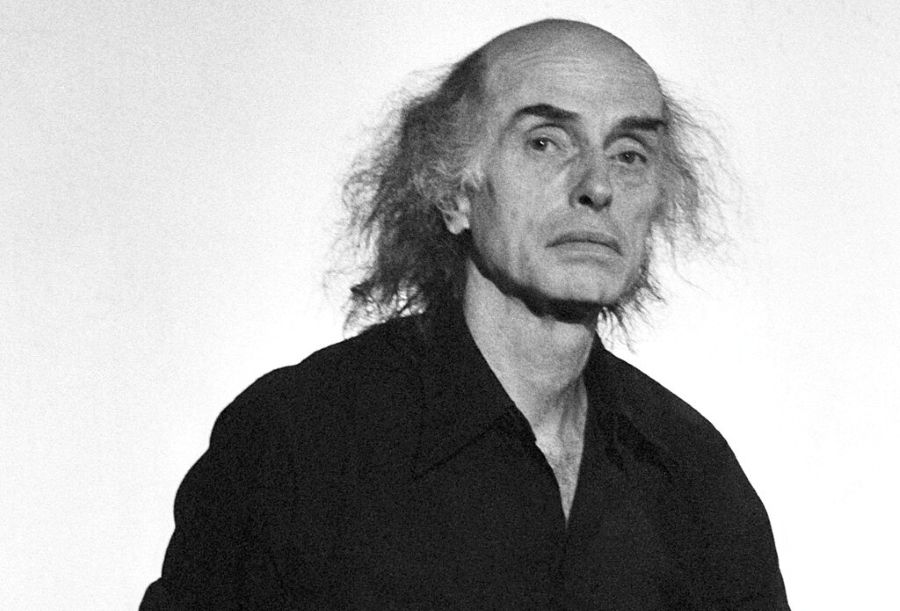
“Old white face, long flaring white hair, as if seen from above, outspread. Voice A, B, C are his own coming to him from both sides and above,” Beckett describes the actor in That Time. Julian was perfect for this part. A spectral image, speaking in three different voices, each one himself, coming from where? From beyond the grave? Beckett does not say. Julian leaned against a slanted black platform that supported his weakened frame, his feet on a ledge; he was hoisted high. Only his face was lit. He appeared to be floating in space. As Beckett asks.
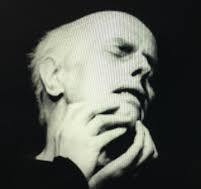
He pre-taped Beckett’s words as the text demands, his hiccups edited out: “that time you went back, that first time to look was the ruin still there where you hid as a child.” He acted the emotions with his beautiful, ravished face while the tape of his three different voices played. A glorious performance. George Bartenieff, whom I did not yet know, Fred Neumann, and Thomas Walker, in a non-speaking role,were in the two short companion Beckett plays on the bill, Theater I, Theater II. Julian’s play: haunting. George and Fred, eerie and comic.
For each of his acting roles in the final year of his life, whether on film, on television, or in the theatre, Julian received high praise. No longer doing his own radical plays, he was recognized, at the end of life, as a consummate performer in other people’s works. His face and form ever more chiseled as he approached his death, he occupied a liminal space. As cancer eats the flesh, the frame appears, the shape of the self; there is no longer anywhere to hide. The eyes pop from the face. The bones protrude. Nothing extraneous remains. The skeletal form looks both as if it might break at any moment and pure, indomitable, as if made of metal, like a Giacometti sculpture.
Julian went on, through the great disappointment over the critical reception of his final creation, The Archeology of Sleep, which brought the end of his Living Theater. He used his failing body and voice to create memorable villains on film and television, since the market would pay. He was trying to leave behind as much money as he could for Judith Malina and Hanon Reznikov so they could restart the Living Theater in New York after his death. He was the maniacal villain in the film Poltergeist II; Sol Weinstein, the gangster in The Cotton Club; and a villainous banker in the television cop show Miami Vice.
On the stage, one last time, he created Beckett’s questioning everyman. Samuel Beckett seems to me now, as the playwright emerging from his role in the Resistance in the Second World War, as the playwright of the buried trauma of that war generation, inarticulate, trauma acted out as riddle, vaudeville turn, game, rambling tale. “That time, that time” is the repeated refrain in this play, but what happened “that time” is never voiced or understood; only its impact, not the event itself, is seared into consciousness. War trauma. No one spoke of war trauma then, when so much of the world had been fought over. PTSD was not a concept until soldiers returned potheads and worse from Vietnam and the rap sessions began. After World War II, people were silent about what they had suffered, what they had done. Characters unaware of what has happened to them once, in that time, dominate Beckett plays. As if he, consummate poet, could not write a description of what happened to so many incinerated, tortured, bombed, displaced, hunted. Only the impact of a terror inarticulate, often reacted to with gallows humor, remained (as it did for decades among the survivors). So many people who never spoke of what happened to them then—soldiers, refugees, resisters, collaborators—were haunted by feelings of fear and terror. Inexplicable explosion of rage or of grief, a stony, implacable silence. “That time” of collective destruction. How insignificant any single person seemed amid global suffering. Stuff it down and forget.
How contrary to Julian Beckett was. Julian himself thought so. (Julian, a pacifist, had avoided the draft by coming out as homosexual.) He lacked patience for Beckett’s inability to explain or exhort. Yet they remain complementary artists. Both gravitated to the extreme, the unknown, the leap, or, in Beckett’s case, fall, or pratfall, the confusion that masks the forgotten essential event. Julian said to me that he did not share Beckett’s worldview, and yet there is something in the poetic extremity of each, their purity and the position of the characters they create who are always on the edge, so it seems, of finally arriving at some great understanding, ever eluding them again. In their theatres, both manifested Artaud.
That Time is a man recollecting from the grave, or from just before, on the turning points of his life. He remembers each consecutive moment well, that time, that time, that time, again, but he has no idea what happened to him then, though each time he changed unutterably. But why? Perhaps he is trying to recount the moment of his dying. We write from what we know and what we don’t know yet, and the unknown speaks through the known words that we choose. Beckett was one of the first writers to be able to touch and record the unspoken horrors of World War II, nightmare annihilation for which we have no words. He broke theatrical form, as did other postwar artists, like Judith and Julian, to reveal history’s nightmare and the poetry that might yet be found in the extreme—in other ways of perceiving, of being. That time when that happened to me is the call of the one who cannot recall the event too terrible to know.
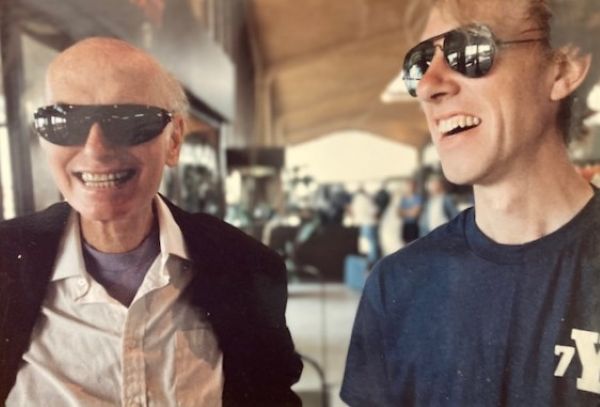
Julian went, emaciated, to Europe to perform one last time in Beckett’s That Time; with George, Judith, Tom Walker, Fred, and Ellen Stewart, to Munich. George took photos of Julian at the airport, beaming his smile beneath large dark glasses. No one could guess from the happy face in the photo how close he was to death, though the tour was cut short. They returned home from Munich, the performances in Venice abandoned. He would die the next month. Yet he went on, unable to stop, and finished his last book, Theandric, in Mt. Sinai hospital. The life force burning into death, stronger as the flesh vanished, a continuous transformation.
Julian lived in his final months what he was searching to convey in his last play about dreams. He seemed always exalted in those final days. Always on the verge of wish fulfillment. The insult and cruel dismissal of his Sleep play had been left in the past. Julian was a man looking forward—peering into the unknown as he always had been. He was acting and writing. Around him in his last year, a community of the self-elect stood, determined to live with him as he died. We understood our privileged place. We have no choice but to continue to transform, until we are lifted from this world.
Karen Malpede is an ecofeminist pacifist playwright and theatre director. With George Bartenieff, she co-founded the social justice Theater Three Collaborative.