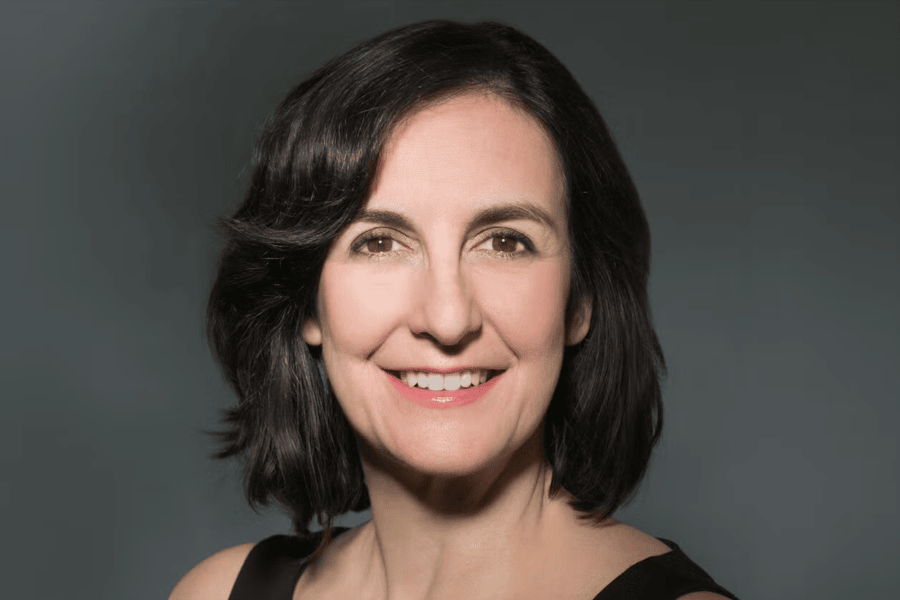
Evan Yionoulis has always been a woman of the theatre, growing up from the kind of child who wrote and directed the school play, to an undergraduate who could turn a dining hall into a theatrical experience, to a mentor who fiercely fights for the future of theatre. Today she’s known for her formidable track record of directing and developing form-breaking new plays, sharpening acting pedagogies, and leading during tough times (she oversaw major transitions at Juilliard from 2018 through the present moment).
As Juilliard School’s outgoing Richard Rodgers Dean and Director of the Drama Division, her New York office will soon be empty, but when we sat down for a conversation, I caught glimpses of the art-filled walls that inspire her each day—pieces that capture “theatricality and transformation,” as she put it. The pieces come from the Peter Norton Art Collection, which lent pieces to Signature founder and former Juilliard drama director Jim Houghton when he inhabited the office. This thoughtful sense of legacy fuels her dramaturgically keen work.
Soon different artwork will surround her in New Haven, as Yionoulis prepares to helm both Yale Repertory Theatre as artistic director and the David Geffen School of Drama as dean, succeeding James Bundy’s nearly 25-year-run. The charge will come in a familiar environment: Yionoulis studied literature and theatre studies as an undergraduate at Yale, completed the School of Drama’s esteemed MFA in directing, led as chair of the acting program, and served as resident director at Yale Rep. In spite of a profound connection to the environment, she said her immediate priority in the new role is deep listening.
When asked what she’d like for current Yale faculty and students to know about her, Yionoulis laughed, recalling how the last time she was asked about hobbies, she didn’t quite know how to answer. Instead, she has devoted countless hours through both practice and teaching to furthering the art form, understanding its power, refining collaborative process, digging into the distinct mysteries of each play, and instilling in the next generation a sense of theatre’s sacred necessity.
Our conversation at this moment of transition spanned highlights from her time at Juilliard, the kinds of art and processes that appeal to her, and what she’s most looking forward to in her multifaceted new job. The transcript has been edited for length and clarity.
GABRIELA FURTADO COUTINHO: Congratulations! This dual role helming Yale Rep and the School of Drama feels like such a fitting venture for you. How are you feeling about this homecoming?
EVAN YIONOULIS: I’m very excited and of course very honored. It’s an opportunity to really make an impact on the next generation through the school, to make an impact on those in the next generation with the theatre, to reach out to the New Haven community, and to forge some global partnerships. I’m excited about all of the possibilities with these dual positions.
How are you preparing for the transition, and what are some of your first priorities entering the role?
I’m right at the beginning, but what I think was important for me as I started at Juilliard and will be important here is just to do a lot of listening. I was there eight years ago, but there’s been a lot that’s happened in the eight years with Covid. All of us in higher education are dealing with impacts on our students. And there is the perennially current need to speak to the current moment for any theatre. First, I’ll just be finding out the lay of the land and what’s changed since I’ve been away. Then, looking at what our resources are and how best to deploy those.
At Yale Rep, there’s the Binger Center for New Theatre, which has a very robust commissioning program. I think we have an opportunity at Yale Rep, through commissioning and what we program, to give opportunities to work on canvases that artists don’t get to work on elsewhere. And the theatre is a role model for the students who are studying that can help them expand their sense of what theatre can be and also give them an opportunity to participate in that. So there are a lot of those things to balance.
That balance of artistic excellence with instruction feels exciting. I’m curious about how you anticipate the day-to-day will look in this role, and the particular ways Yale Rep and the school are linked.
The day for the school and the Rep is constructed in a pretty amazing way, in that there are classes from 9 or 9:30 until 2:30, and then the rest of the day is devoted to rehearsals and performances of various kinds. Many of the people who work at the Rep are also on the faculty of the school. So there’s that natural bifurcation of the day that exists already. Then, in the latter part of the day, students and faculty are practicing what they’re learning or teaching in the classroom. As you know, I taught there for 20 years in the acting program and in a directing course as well. I hope to be able to continue that in this position. Of course, I’ll be engaging with people from the larger school, the Council of Deans, and all those administrative layers as well.
But there’s something I remember about sitting at budget meetings for shows at the Rep: The room was not configured quite in this way, but almost so that behind each designer there was a faculty advisor. And behind the student technical director, there was the technical director of the Rep, etc., so it’s a beautiful community of concentric circles. There’s that sense of legacy. I think about carrying on the work that James Bundy’s done, and how that built on what Stan Wojewodski did and Lloyd Richards did, who was there when I was a student, and of course Robert Brustein, who started the Rep, and the legacy of all my teachers from that time and all my colleagues…It’s really a beautiful thing.
How would you compare the environment at Juilliard versus Yale?
The structure of Juilliard and of the David Geffen School are different, but there’s a real shared base of values and artistic ethos. Juilliard has an acting program and a playwriting fellowship program, a two-year program for playwrights. It offers a four-year program where BFA and MFA students study together. The David Geffen School is an MFA program with a DFA for dramaturgy students, but it’s only masters students. The school is one of the few in the world that trains every discipline of the dramatic arts. The main construct is built on collaboration: student directors directing student playwrights’ work, designed by student designers, stage-managed by student stage managers, managed by administrators, with sets built by the technical design and production folks. At Juilliard, productions are created for those actors with professional directors and faculty directors, etc.
I think one of the most important things about theatre, especially in our time, is the sense of community. There’s a community and collaboration in how theatre is made and also in how theatre is shared—the fact of getting an audience in a room to experience something live. Breathing the same air is so crucial. The peer collaboration is one thing that’s so exciting about the Yale program. And there are obviously challenges with that. But there’s growth and lifelong artistic collaborations built, as they were with me.
I’m interested in your process as an artist: directing new work, working with playwrights, and writing/developing your own work. You have a book centered on process, Listening and Talking: A Pathway to Acting. What are you excited to investigate as an artist at Yale Rep?
Looking at the plays I’ve been attracted to, there is this strand of legacy that runs through. In Richard Greenberg’s Three Days of Rain, there’s the question of what we can build on from past generations. Adrienne Kennedy’s He Brought Her Heart Back in a Box is about how we break free from the oppression of past generations. How do we make sense of the good and the bad of our histories? And Redhand Guitar is about four generations of American musicians and questions of legacy and art-making. I tend to be attracted to pieces with a theatrical element that are form-breaking. The last play that I directed at Yale before I left for Juilliard was Guillermo Calderón’s Kiss, which was formally adventurous. That same season, I got to do Adrienne’s play at Theatre for a New Audience. And I just remember thinking these are two plays where I don’t know what they are. The beauty of being able to discover with actors and designers is so exciting. I find myself attracted more and more to pieces that scare me as I get further into my career. At Juilliard, I got to do a Howard Barker piece, The Power of the Dog, which I had been wanting to do for at least three decades.
You oversaw some major transitions at Juilliard, from challenges like the pandemic, to milestones like We See You White American Theater, and triumphs like the tuition-free MFA. I would love to know a little bit more about how the program shifted while you were there.
I’ve really enjoyed my time at Juilliard and really admire my colleagues here, both in the greater school and certainly on the faculty and staff of the drama division. The students’ dedication, generosity, and supportiveness of each other is truly extraordinary. I think we’ve done a lot to keep the rigor in an environment which centers belonging and which looks at each student for their unique gifts and journey. And I think we’ve been able to really uphold the high artistic standards of Juilliard.
I’ve of course made some nuts-and-bolts changes in curriculum sequencing and in performance opportunities. I’m very happy to have been able to bring our teaching fellowships. We have a one-year teaching fellowship where we bring in people, allow them to be part of the community, have them sit in and observe classes and provide a primary mentor to them to whom they can ask things like, “Why did you say this? Why didn’t you say that?” We’ve also instituted a film program to give students not only acting-on-camera experience in the classroom, but to let them do short films that are written by our writers from the Lila Acheson Wallace American Playwrights Program.
It’s such a smart initiative, to support and prepare artists for the nature of the current industry.
It’s been really gratifying, and a learning curve for us theatre folks. We’ve worked with some amazing producers, professional directors, cinematographers, and crews. I think it’s important that the films help actors be able to afford to work in the theatre. The tuition-free MFA is life-changing, and the gifts that made that possible are so important. There are many people at Yale who also contribute to the education of those students and, of course, there’s Mr. Geffen’s incredible gift. That made it possible not just for one cohort, but for the entire cohort in perpetuity to be in school without crippling debt. I had relatively small debt but paid it for 10 years after graduating, and the worry while one is in school is real. And the worry when one gets out: If you’re taking theatre jobs, you are planting seeds for five years, sometimes 10 years, before you’re able to get enough work just in the theatre to sustain you as an artist. We don’t want to lose those people to film and television or to other pursuits. We want them to be able to use their gifts and training for a lifelong practice.
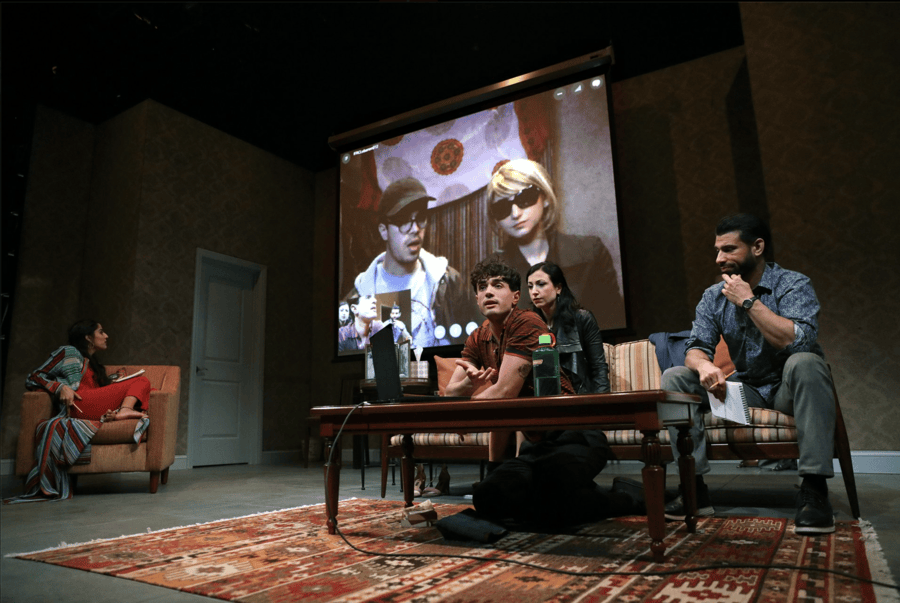
And that training is not just a three-year prospect or a four-year prospect. What we’re doing is training artists to continue to learn throughout their lives. I know that’s been so exciting for me as a director through all the chapters of my work, to continue to learn and grow. For example, with the Dread Pirate Project, which I’ve been working on, I learned about the dark web, tying it to the tragic rise and fall of a young man, and how to put together a piece by going to sit in on his trial, and how to deliver internet chats in a theatrical way. We’re all constantly learning.
What advice would you give to your successor at Juilliard?
I would say enjoy this fabulous community, and the students who have such passion and gifts and to really make it their own. I do think that schools, from Northwestern to Juilliard—there is sort of a character of a school that’s important to the alumni. There are important throughlines, and I tried to preserve what was Juilliard about Juilliard, while moving it in certain directions that I thought were right for the moment. I don’t think you want to make one school into another school, while knowing that nothing stays exactly the same; the purpose of an educational institution is to always be moving forward. The purpose of the theatre is to speak to the times as they are now, not what they were five years ago or 25 years or 50 years ago. You can’t be afraid of change, as long as the core abides and you are true to that and guard that. All those things can speak to the moment—what a production of The Piano Lesson may have said 10 years ago versus what it says today. Or a production of King John.
I love King John! Such an underrated, urgent play for our time.
I love King John! I got to do it with the third years at Juilliard last year. Nathan Winkelstein from Red Bull Theater has a podcast wherein you talk about a play, and he asked which I wanted to talk about, and I said, “King John!” And he goes, “King John?” It is the perfect play. It is just people in political life behaving badly, from lights up to down—and maybe at the end there’s a little redemption, for the bastard anyway, if not for King John himself.
What an incredible learning opportunity in this setting. I appreciate what you are saying about preserving the core and forging ahead with that as a compass.
One of the core things I think is important to communicate to students, especially in this time, is that theatre matters. Art matters. It makes a difference. It’s a noble endeavor. Whether that’s helping people understand other people’s points of view, whether that’s asking hard questions, whether that’s, as Brecht says, making something familiar look strange to see what has to change. All of that provoking thought. That can come in very different theatrical forms. But the fact that what they’re studying is important is important to convey, and that there’s a sacredness to the task and that we all have a responsibility to preserve and further the form.
Gabriela Furtado Coutinho (she/ela/ella) is the digital editor of American Theatre, and a Chicago-based actor, playwright, and poet.