The writer-director relationship in the theatre is a complicated one. The received wisdom that film is a director’s medium, while theatre is a writer’s medium, is based on some truth—much of it related to economic and union power, some of it to the intrinsic nature of the mediums themselves. It seems to clear enough to me that, much as a film director can be said to be a kind of co-screenwriter, telling the story with the images they shoot and select in editing, albeit within an architecture built by a writer, the director of a play is charged with inscribing the writer’s work on actors’ bodies, in space and in time, in concert with designers, in a way that’s mapped out by the playwright, no doubt, but which only takes on three-dimensional life in tandem with a director’s organizing (or co-organizing) vision.
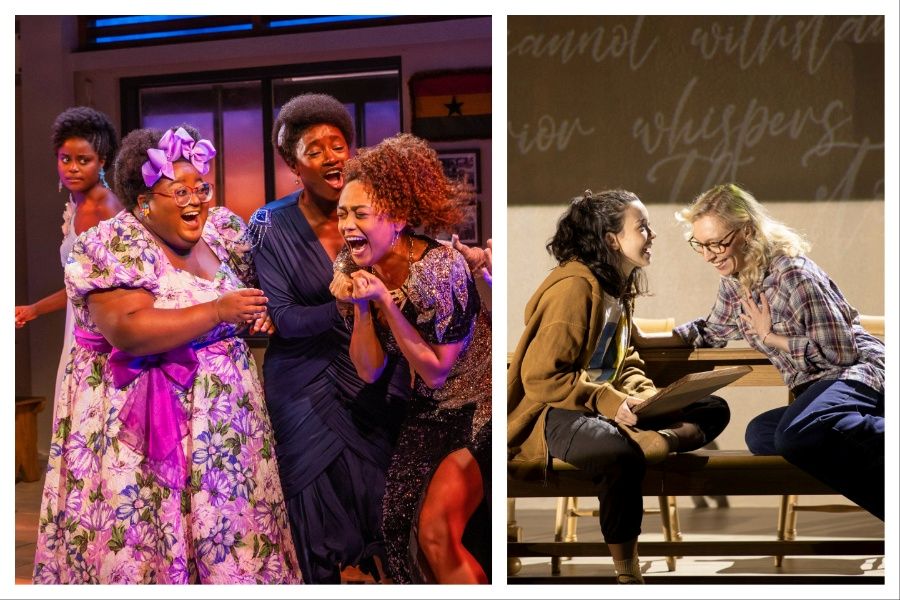
 I didn’t see Jocelyn Bioh’s School Girls; Or, the African Mean Girls Play when it premiered at MCC Theater in 2017, or in any of its subsequent runs around the country as one of the nation’s most-produced plays for a time (I did read it, though, and quite enjoyed it). That premiere was directed by Rebecca Taichman and was well reviewed (including for its “delicious ensemble work”), while its current Broadway revival at Manhattan Theatre Club reunites Bioh with Whitney White, the director who made Bioh’s 2023 comedy Jaja’s African Hair Braiding play soar, also at MTC.
It is no shade on Taichman (who has nothing to prove in terms of Broadway-scale directing, having masterfully helmed the original Indecent) to note what a great fit White is for Bioh’s material, particularly on this boulevard-comedy scale. White’s gift for both the fine-grained simpatico of ensembles (evidenced in Liberation) and broad-stroke gestures (evident not only in Jaja’s but in her own self-penned Macbeth in Stride, or her recent staging of The Whoopi Monologues) seems to me to make her an ideal match for Bioh’s unique blend of ebullient, knockabout comedy and quiet, often thorny subtext.

“In my opinion, there is no one delivering pathos and comedy like her,” White said of Bioh via email last week. I’d second that. Indeed, I was curious about how Bioh, in both Jaja’s and School Girls, was able to create comedies so vibrant that their poignant, pointed endings don’t feel crushing or preachy, or even tonally off. It’s a delicate balancing act that, in both plays, as directed by White, came off beautifully.
Bioh, also answering by email, took the compliment and explained further: “I’ve said many times before that I discovered a quote when I was an MFA playwriting student that said, ‘Comedy is just a funny way of being serious.’ That has been my thesis statement as a writer. I want my work to be funny, fun, engaging, but also speak to a truth—sometimes a sad truth—about the world.”
In the case of School Girls, that hard truth is the colorism among a group of Ghanaian teens, who have their own internal social rivalries but who grow especially envious of a new mixed-race, light-skinned arrival, Ericka (Jasmine Amy Rogers), who upends the beauty-pageant ambitions of the beautiful, dark-skinned Paulina (performed with a diamond-hard edge by Denée Benton). Indeed, when I asked White and Bioh about the toughest challenge they faced in staging the play, White said frankly, “What was toughest for me, the cast, and Jocelyn at times was contending with our own very real experiences with colorism as Black women in the world, as Black artists and performers. This story is real for us. We have lived it and work to overcome it every day.”
I wondered if White could share any of the rehearsal-room tricks she uses to create such winning ensembles, as she also did in Liberation. “I don’t want to give away all of my tricks,” she replied. Fair enough, but she added, “I believe my training in classical theatre helps this. It motivates me to lift all of the language, and to leave no word left behind. If you fight for every beat of the story, then you have to fight for every character, and every actor too.”
For her part, Bioh said she didn’t want to compare the original production to this one, except in terms of where she stands in relation to the material.
“10 years ago, I was still rewriting School Girls as we were rehearsing it,” she said. “This time around, I really was firm in knowing what the play was.” Revisiting the work of nearly a decade ago, she concluded, “I’m a different woman than I was then, and I have deeper empathy for all of the characters in this play. Even the mean ones!”
For playwright Anne Washburn and director Anne Kauffman (whom, incidentally, Whitney White assisted on the 2017 Broadway production of Marvin’s Room), their reunion as collaborators, for new play ANON at MCC Theater, is long overdue. Though they’ve moved in the same Off-Broadway circles for decades, including as co-conspirators with the docu-theatre troupe The Civilians, their last theatrical collaboration was 2008’s The Communist Dracula Project, a piece about Ceausescu’s Romanian regime, at American Repertory Theater.
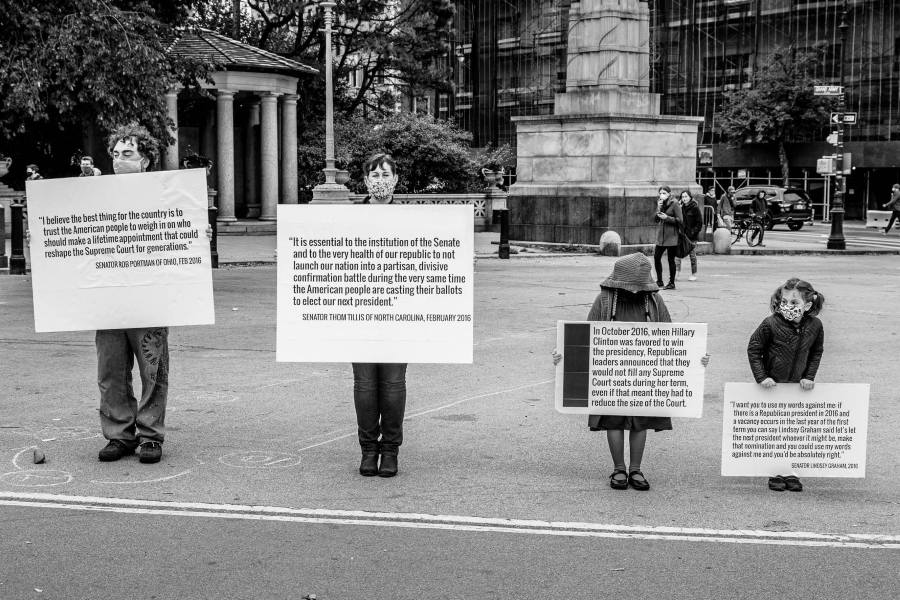
Perhaps significantly, their last collaboration was not in the theatre at all: In 2020, when Republicans in Congress were fast-tracking Amy Coney Barrett into a Supreme Court seat right before the presidential election, despite having blocked Obama’s nomination of Merrick Garland during the election year 2016, Washburn and Kauffman participated in a project they now refer to as “eerie silent signs,” which Washburn described recently as being “as much conspiracy as theatre, and a lot of fun.” For 25-minute stints, they and others would stand in public spaces—the steps of the Grand Army Plaza library in Brooklyn, Washington Square Park in Manhattan, the Capitol building in Washington, D.C.—holding large signs with “a lot of language on them, mainly quotes from GOP senators in 2016 saying that of course they were acting strictly on principle and would of course uphold that principle even if the situation were reversed in the future.” Though most passersby quietly read and even photographed the signs, once in a while someone would “freak out,” as Washburn put it, but, she added, “I don’t mind being yelled at. The silence of the thing gave it a lot of gravity. Also we were all masked, of course.”
What did the author of Mr. Burns, a Post-Electric Play and the director of such plays as The Sign in Sidney Brustein’s Window and Mary Jane hope to accomplish with this installation-like protest? “We did not expect to change anything,” Washburn said. “We were really just relieving our feelings.”
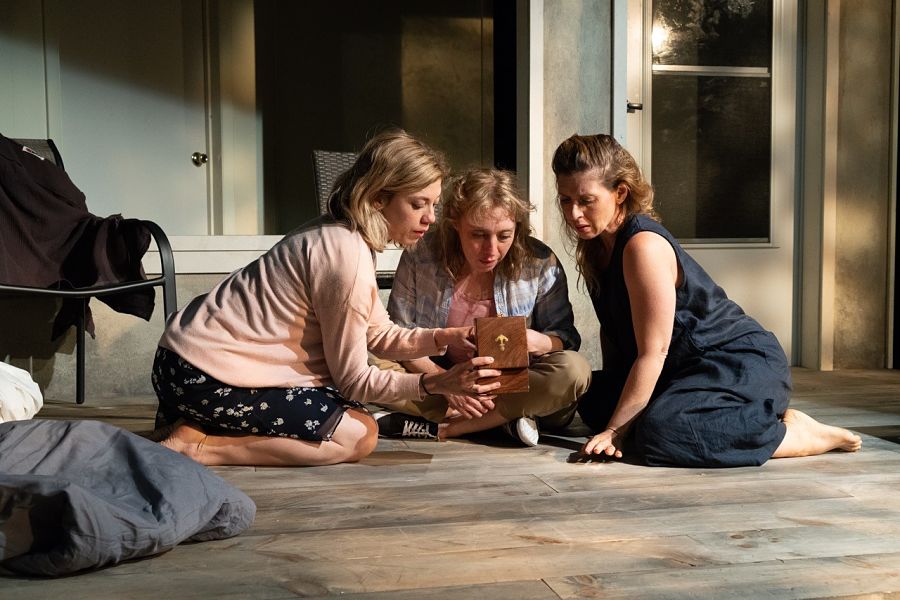
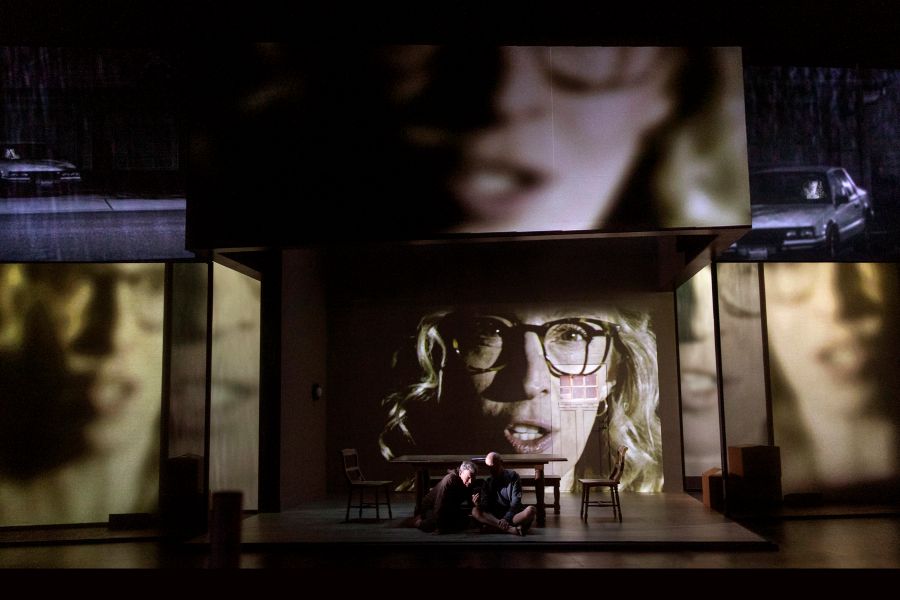
That’s all relevant to their current project, ANON, which is more overtly topical than anything either artist has worked on in a while. The title is a reference to the QAnon affiliation of the lead character, Jeannie (played with translucent intensity by Crystal Finn), a Texas woman who goes ballistic on her new gay neighbors when she sees a Pride flag in their window. If that premise sounds like a recipe for shrill liberal sanctimony, I must report that that’s not how this strange, disarming play landed with me. Though more naturalistic and linear in some ways than many of Washburn’s works (definitely including last year’s The Burning Cauldron of Fiery Fire), it’s still weirdly funny and often hypnotic, in classic Washburn mode.
Still, the danger that it might be too on-the-nose—a play-length staging of one of those silent signs—was also definitely on the mind of the Annes as they made it. As with White and Bioh, the central conflict these creative folks faced in the rehearsal room was rooted in the material itself.
“What I was worried about was that it was going to be like shooting fish in a barrel, poking fun at her,” said Kauffman, referring to Jeannie. “Not that Anne disagreed, necessarily, but I think my focus went a lot to making it a little bit more of an even playing field.” Said Washburn, “I wanted it to be as complex as it could possibly be.”
The play’s political ledger does include a lot of unfiltered right-wing conspiracism, as well as some harder-to-parse politics. The gay neighbors, for instance, have some contrarian views, and Jeannie’s daughter and husband, though clearly steeped in a reflexively anti-liberal worldview, stand at various sharp angles to Jeannie’s full-blown wingnuttery. What struck me more than the show’s of-the-moment politics, actually, was the play’s portrait of isolation and atomization—the way our self-curated social media feeds and earbud-delivered podcasts cocoon us apart from each other most of the time.
“I do think we didn’t get to this place that the play is about without that,” said Kauffman of the apocalyptic, borderline violent politics that fuel the show’s conflict. “The isolation is what’s breeding this particular brand of cult.”
Of their collaboration, which began with Civilians projects The Refreshment of the Spirit and The Ladies, Kauffman said, “It’s nice being back in an Anne Washburn world, because I really can take big theatrical swings. I mean, it’s the place that I love the most.”
Returning the compliment, Washburn said to Kauffman, “That’s been the gorgeous thing about working with you on it: You work in a way which is very finely calibrated, like you’re always searching out the moment of emotional truth that is also able to be comic. But then, yes, there are these big theatrical swings, some of which I was quite surprised and delighted by. It’s very robust.”
Theatre Futures
On my calendar, Tuesday, Sept. 29 was a day of talk, some of it quite illuminating (and some of it less so, inevitably). I began the day at Hunter College, where Gregory Mosher, in his role as executive director of the Office of the Arts, has been hosting a series of “breakfast brainstorming sessions” to flesh out some of the ideas and concerns that arose in a January convening called “We the People: A Working Class Artists Forum.” I missed last month’s session on “Arts Access for Working People,” which asked the straightforward but provocative question: Shouldn’t tax-supported nonprofits be accessible to the average taxpayer? And just this week Mosher and co. got folks together to discuss a Hunter proposal for an artists’ pipeline directly from CUNY to the professional fields, and on Oct. 27, they’ll be doing a “Mission Fidelity” discussion to look at how arts institutions are really spending their money.
The topic that late September morning was “Cheap and Cheerful Spaces for Artists,” and despite the somewhat breezy title, this was a brass-tacks conversation about how New York theatre artists and companies are strategizing to find and create affordable space for them to make work. Mosher kicked off the conversation with a slide showing the legendary Off-Off-Broadway space Caffe Cino, which helped launch so many artistic careers in the 1960s and ’70s, then let the dozen-plus attendees take the conversation where it needed to go: to debates over the merit of temporary and pop-up spaces, to promising models that could be built on (mixed-use rezoning à la the Western Queens Community Land Trust, Brooklyn’s Greenpoint Manufacturing and Design Center, the Queer Nightlife Community Center in Brownsville, San Francisco’s Community Arts Stabilization Trust), to the advocacy still to be pursued with both city and private supporters. As one speaker put it, “We need to reframe the conversation. The arts and artists are not separate from the industrial and retail sectors of the city, but integrated into the city life. We can’t be precious about it.” Mosher—an award-winning director and storied artistic director in his own right—spoke hopefully of “the Mamdani window” to persuade the city to act on affordability.
Incidentally, Anne Washburn was there to join in the discussion, as was playwright Ife Olujobi. The voice I was most intrigued to hear from was that of Randi Berry, executive director of IndieSpace, a nonprofit dedicated to addressing this problem, which is about to open a new multi-use arts space on the ground floor of a mixed-income rental building in Hell’s Kitchen. If that’s possible…
Then, zooming out from NYC to the national scene, that afternoon on Zoom was the DeVos Institute-sponsored colloquy, “Is the American Nonprofit Theater Movement ‘Over’?”, spurred, of course, by Oskar Eustis’s somewhat intemperate statement that it is. As Eustis himself clarified in the conversation—actually a series of speeches—and others reiterated in countless ways, what he meant to eulogize was the end of a “business model,” which co-host Ariel Fristoe, of Atlanta’s Out of Hand Theatre, described succinctly as “theatres make plays, audiences buy tickets, donors subsidize the difference.” That model, and the purported consensus that sustained it, has noticeably frayed, though, as was made clear by Gary Anderson, artistic director of Detroit’s Plowshares Theatre, the consensus was never as universal as assumed, let alone evenly distributed.
Anderson put forward a formulation which rang with terrible clarity: Describing a “four-sector architecture” that has underpinned much of the nonprofit movement but “was never extended to most of the field,” including Black-identified theatres like Plowshares. The four pillars: private foundations, individual giving, corporate underwriting, and government support. These four escorts operated in rough tandem for much of the nonprofit movement but, Anderson pointed out, they “don’t move together. When foundations pulled back, individuals often stepped forward. TCG’s own data shows foundation support for theaters fell 12 percent between 2019 and 2023, while individual giving rose. When trustees and corporations retreated during the pandemic, it was the government’s relief that kept the doors open for many of those theatres. But that Stage Act only supported institutions with facilities. It didn’t support the rest of us.” Anderson’s bracing bottom line: “The theatre with four legs under it can lose one and stay standing. A theatre with one or two cannot.”
There were also more sanguine takes, as well as some more fired-up ones, and I recommend a full read of the transcript—but pace yourself. It’s a lot to take in at once (and your mileage will definitely vary). If Eustis was right about one thing, it is that the consensus among leaders in the theatre field, fragile or selective as it once may have been, has indeed evaporated. In its place: many voices, many models, and a lively debate among them. To rephrase T.S. Eliot: There can be no permanent defeat, because there is no permanent victory. And who knows more about impermanence—and hence about the precious precarity of here and now—than theatre people?
Seen Around Town
I’ve been a busy theatregoer in the past month. In addition to the two shows praised and recommended above, I had a blast at Paranormal Activity, and almost entirely because of the audience (and, of course, the way the show’s creators so deftly played the audience). It was a borderline sacral experience, even—not that it wasn’t also basically a theme park ride. I elaborated on these points for my review in America magazine…
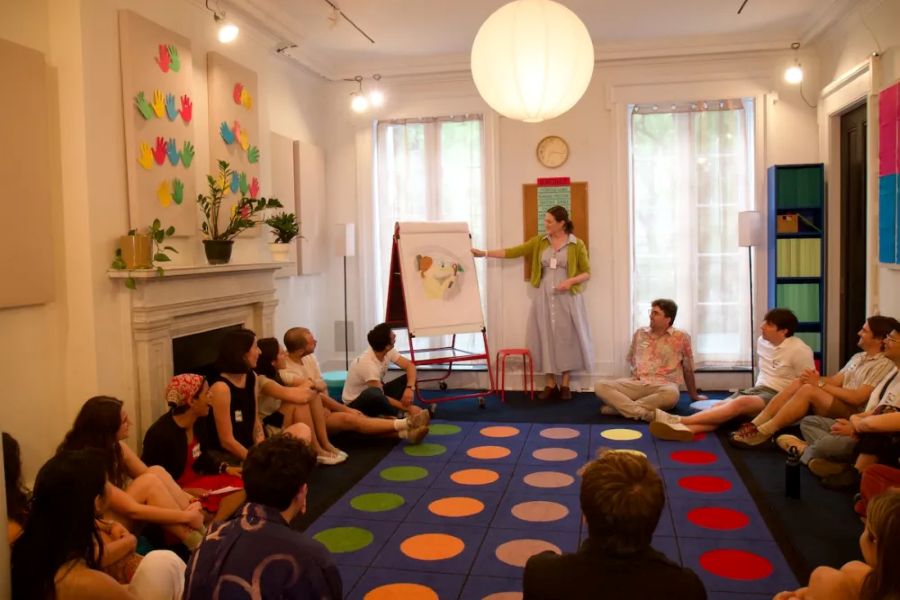
I went to Big Feelings at the cell in large part because I’ve been a Julia Greer fan ever since I saw her piercing lead performance in Kallan Dana’s Racecar Racecar Racecar a few years back. Ryan Drake’s immersive grade-school classroom experience is a kind of parlor trick, in which we’re thoroughly disarmed by the gentle-touch participatory experience, all the better for Greer, as a nervy, needy teacher named Ms. Joy, to cut straight to our hearts with a tale that grows more harrowing by the minute. I should also praise Sammy Ziesel’s direction for the show’s overall effectiveness. I overheard some fellow theatregoers who sounded like they were expecting a more interactive, Accomplice-like puzzle show—though they didn’t seem mad about the bait-and-switch…
Saw a reading of Cinco Paul and Bekah Brunstetter’s new musical Sweet Jesus, a rebranding/rewrite of the well-reviewed A.D. 16, about teenage Mary Magdalene crushing on teenage Jesus. As Cinco is an old friend and it was an invite-only workshop, I shouldn’t say much more than that it shows promise (and the theatre machers in the room seemed to agree)…
I liked Else Went’s Degenerates a lot more than I did last year’s sprawling Initiative, and there is an undeniable, even bracing vigor in the way she and director Emma Rosa Went, and their fearless cast, attack this material—basically, an internet-fueled hate-romance between a closeted gay incel and an agoraphobic camboy (possibly turned camgirl). But I found the proportions of shock and sentimentality out of balance in this recipe. The show seems eager to dive deep into trauma porn, then make nice with hopeful, healing gestures; to me, both of these extremes feel like youthful missteps, in a way I found both endearing and limiting. As ever, I find Sara Holdren the best, most sympathetic guide to what the Wents are up to. And the good news is that, despite my misgivings, I look forward to more from this team…
I wish that my first Mfoniso Udofia show—I’ve read and admired a number of the plays in her Ufot Cycle, but never seen any—had not been creation stories and all the important importants, an autobiographical fantasia that feels like the kind of show she very much needed to write. I’m sorry to say that I did not connect with it, though…
As for Slam Frank: I confess I was dreading this show, which has been praised for its scathing anti-woke satire by friends I trust but whose tastes, let’s say, run hotter than mine. I am probably going to write more about this show soon, so for now I can just say a few nice things about it: I had a much better time in the theatre with it than I imagined I would; the cast is off-the-charts talented and committed; and I’ve been thinking a lot about the show ever since—not all positive thoughts, to be clear, but I guess it’s one measure of success that it’s sticking with me (and/or sticking in my craw)…
On the non-theatrical performance tip, I caught David Byrne’s show at Forest Hills Stadium, a transcendent spectacle I won’t soon forget (though nothing will probably ever top the intimacy and clarity of American Utopia at Broadway’s Hudson Theatre), and Willow’s lively set at Sony Hall, in which the nepo-baby polymath somehow got her fans to sing along with her beguiling but intricate math pop (at one point, before debuting a new song, she said, “I hope you brought your calculators”).