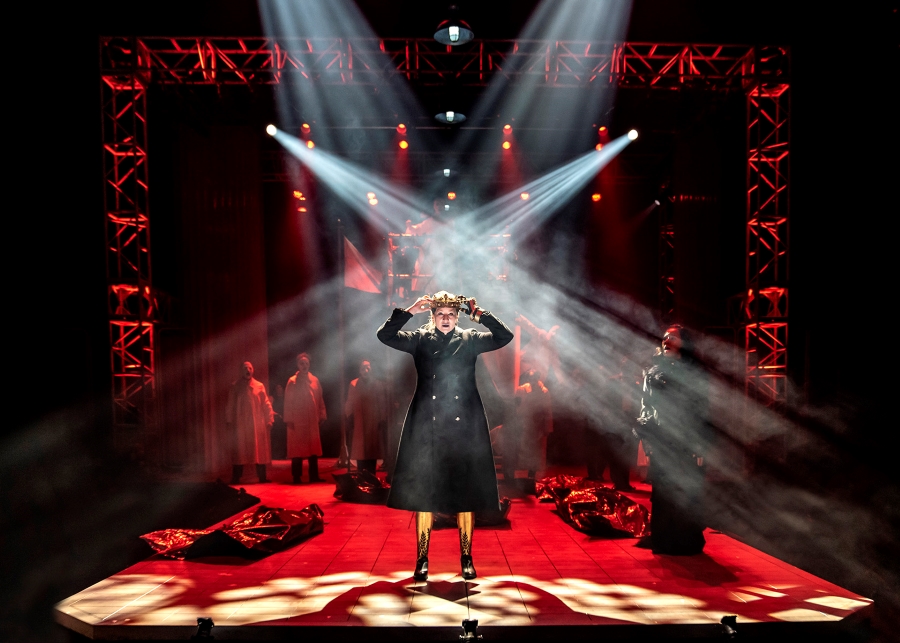
At the age of 19, I was a sophomore attending the University of Michigan in Ann Arbor and hating it. The school was far too big for me, too impersonal, too obsessed with football, too damn cold. My class was 10,000 students strong, making it almost impossible to distinguish myself, especially in the theatre department, where the faculty was focused more on achieving promotion and tenure than on quality instruction for the mass of undergraduates.
My passionate dream was to transfer to Juilliard, to train at the most prestigious program in the country, and become a professional actor. So one day, in the dead of winter, I flew to New York City armed with two contrasting monologues to show the faculty there.
For my contemporary monologue, I had prepared “the box speech” from Tom Stoppard’s Rosencrantz and Guildenstern Are Dead (1967). And for my classical monologue I’d chosen, from a mimeographed list that Juilliard sent me in the mail, Richard of Gloucester’s opening speech from Richard III:
RICHARD:
Now is the winter of our discontent
Made glorious summer by this sun of York;
And all the clouds that loured upon our house
In the deep bosom of the ocean buried…
—R3 1.1.1
Because there was no one I trusted enough at the University of Michigan to ask for help, my monologues were completely uncoached, never performed for anyone until the morning I showed them to three stoic auditors in a rehearsal studio at Juilliard. So I made a lot of rookie mistakes.
I understood that the Richard speech was written to be performed “direct address,” so that’s how I rehearsed it—talking to an imaginary audience in my dorm room. But that morning at Juilliard, I made the amateurish error of speaking to the auditors behind the table, making direct eye contact with them as I acted. One sour-faced, grey-haired gentleman behind the table, irritated by my choice, pointed an index finger above his head, as if to say, “Don’t talk to me.” Flummoxed, I quickly shifted my focus to the wall above my auditors’ heads. But that adjustment threw off my rhythm, making me horribly self-conscious.
The second rookie mistake I made was to speak the speech in a British accent. Having seen the 1955 film version with Laurence Olivier, I thought that was the way it was supposed to be done. I thought that all Shakespeare was to meant to be performed that way! How phony I must have seemed, how naïve!
The third mistake I made was to physically create Richard’s deformity—by squeezing my right shoulder up to my right ear, twisting my right hand into an upturned fist and pressing it hard against my sternum. At 19 years of age, I’m sure I looked absolutely ridiculous. And yet…
They called me back!
I’d booked a ticket to see a matinee of A Chorus Line that afternoon, not quite realizing that it might conflict with a same-day callback. So, in the middle of the big choral finale, with a kick line of glittery dancers still singing “One,” I ran up the aisle, dashed out of the theatre, turned north, and strode up Broadway, arriving at Lincoln Center sweating and out of breath, just in time to find the studio in which callbacks were being held.
I showed my pieces again, this time to a completely different set of auditors who stared stony-faced at me, making no attempt to put a petrified teenager at ease.
I remember two requests that were made of me by that second group. The first was to “be a snake.” So, with zero hesitation, I got down on the floor and slithered, wrapping myself around the leg of a chair before they mercifully stopped me.
The e second request was “let me see inside your mouth.” An older woman, with what to me sounded like an English accent, approached me, looked in my gaping mouth, said “hmm,” turned, and went back to her seat. Then they dismissed me. Only later did I come to realize that the gentlewoman was none other than the legendary Edith Skinner, whose speech system I would later master and teach for many years. What was she looking for in my mouth? I have no idea. But if I had to guess, I’d say that she was looking for the source of my stuffy, de-nasal resonance, which was caused by chronic allergies.
A month or so later, I received a thin envelope in the mail—a letter telling me that I would not be offered a spot in Juilliard’s incoming cohort. I was shattered, of course, hoping that, somehow, I had beaten the absurd odds. But, like so many hopefuls, I had been rejected.
For years, I kicked myself for choosing to audition with Richard of Gloucester’s opening monologue. But now, 50 years later, I’m actually proud of the young man who chose to show that piece, who took that risk. As I say constantly to my students, bring your passion. And at 19, I was passionate about the hunchbacked king. Even then, I knew I was a transformational character actor, not a traditional juvenile. No Romeo or Orlando or Bassanio for me! Give me the villainous sociopath, a man with a visible deformity and a deadly grudge, and let me loose. So, even though I didn’t get in, I know I showed them who I was, and who I could be.
My first professional production of the play came 15 years later, at Oregon Shakespeare Festival in 1993, directed by James Edmondson. Ironically, a Juilliard-trained actor, Marco Barricelli, played Richard III that season, using his towering presence, basso profundo tones, and God-given charisma to command the Bowmer stage.
To transform himself into the character, Marco dressed entirely in black leather and strapped a heavy metal brace to his left leg. The device stretched from his upper thigh to the heel of his shoe, its joint bending mechanically at the knee. He also wore a wire hump fastened to his left shoulder and an elaborate black glove on his left hand, further exaggerating the character’s deformities.
If Richard’s objective, from the very first speech, is to enlist the support of the audience by confiding in us, Marco was like a wizard casting a spell on 600 people at once. With his irresistible charm, we were thrilled to be included when he spoke to us, telling us, upfront, about his lethal intentions, thereby making us complicit in the suffering of other human beings.
Some things I didn’t notice about the opening speech when I approached it as a 19-year-old actor: Structurally, though it runs for 40 lines, it’s just five sentences. Another helpful observation: The speech is best broken down into three “movements” of similar length—each beginning, like a lawyer’s opening statement, with a word or words that moves his argument forward: “Now”…”But”…“And therefore…”
I also hadn’t noticed how the entire play is foreshadowed by the imagery of the speech: the ongoing, primal battle of love versus hate, peace versus war, sun versus shadow, envy versus gratitude, goodness versus evil, truth versus lies, loyalty versus treachery. Not that it would have changed any of my choices at the time. But, in retrospect, it’s fun to see how much imagination is required to establish the world of play.
One of Marco’s best scenes was the “wooing scene,” where Richard, despite his claim that he “cannot prove a lover,” manages to seduce the Lady Anne. Never mind that he murdered her husband, Edward, Prince of Wales, and assassinated her husband’s father, King Henry VI, whose guarded corpse Anne was, just moments before, transporting to Chertsey. Marco’s glee at winning over a woman under these improbable circumstances was simply delicious. So much so, that he earned a laugh when he asked us: “Was ever woman in this humor wooed?”
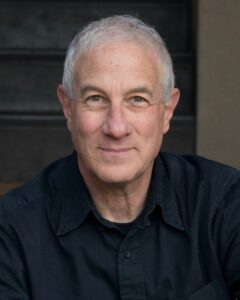
Scott Kaiser is a nationally recognized master teacher of acting and voice, as well as a director, playwright, and author. For 28 seasons, Scott served as a member of the artistic staff at the Oregon Shakespeare Festival in Ashland. He is also the author of 25 books, and has directed in theatre training programs across the country, including Carnegie-Mellon University, the University of Washington, Duke University, Santa Clara University, Seattle University, the University of Oregon, and Southern Oregon University.