You’d think I’d be better at answering this question, but when folks ask me what shows I’ve seen recently that I’d recommend, I often fumble for an answer, and, even when I come up with a title, often qualify or equivocate (“I mean, if you like this sort of thing…”).
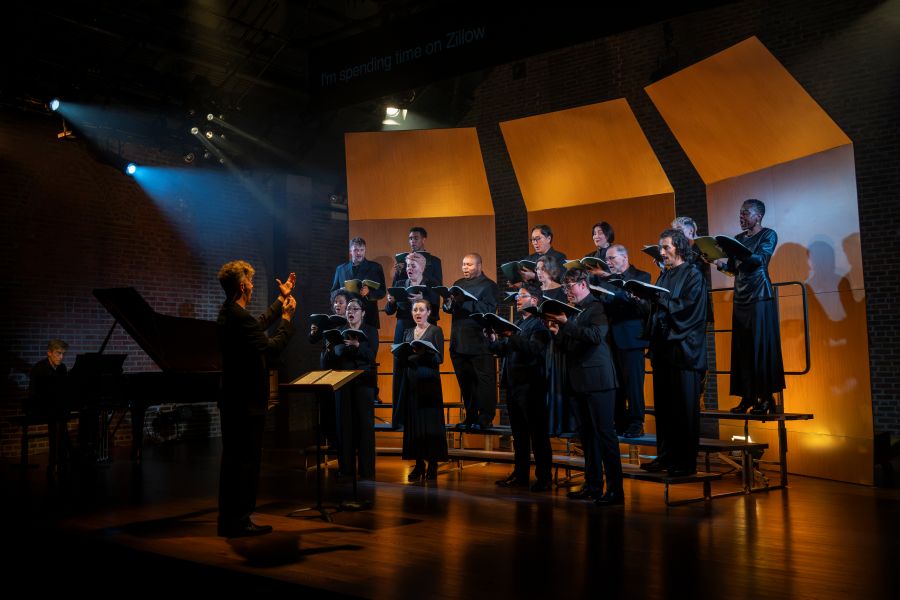
 That has not been the case since I saw I Became We at the Atlantic Theater (which runs for another week there). In this case, my recommendation has been, and is, unqualified. Indeed I count this utterly disarming show as one of the wittiest and most affecting I’ve seen in many a moon. Its appeal, at least partly but hardly entirely, is in its unique form, which can most succinctly be described as a monologue for a 16-piece choir.
“I’m fine with the word ‘gimmick,’” said playwright Mona Pirnot in a recent Zoom interview I conducted with her and composer Jack D. Coen, whose score for choir and piano is a marvel, its classical decorum contrasting deliciously, and surprisingly movingly, with Pirnot’s pointedly contemporary diction. “I don’t necessarily think that’s a bad word if it’s paired with absolute commitment.”
That was certainly the case with two of her previous plays. In I Love You So Much I Could Die at New York Theatre Workshop in 2024, Pirnot was onstage with her back turned to the audience, cuing a laptop to deliver a monologue about her sister’s mysterious illness in an impassive computerized voice, and occasionally performing plaintive songs on guitar. In I’m Assuming You Know David Greenspan, at the Atlantic last year, the electric indie-theatre star of the title performed a four-character dialogue about Mona and her fellow insecure playwright friends. Now I Became We, directed by Sarah Benson, summons a choir in formal wear to come out onto risers, open their binders, and sing in exquisite harmony about Adam Sandler movies, Brooklyn coffee meetings, Zillow listings, and, eventually, whether the narrator should or shouldn’t have children with her “jumpy and nervous” husband.
“There’s an element to all of my plays where I like that at first it’s a disorienting sort of thing to process, where the audience might go, Is it really going to be this the whole time?” Pirnot said. “Yes, it’s really going to be this the whole time—but hopefully it’s not an experiment that wears out, but an experience that deepens.”
I can heartily attest that in this case it does, and a big reason why is the perfect yin-yang marriage of Pirnot’s digressive text with Coen’s buttoned-up music.
“In the very beginning, we were listening to contemporary choral music and more experimental stuff,” said Coen, whose other musical projects are similarly quirky and accomplished. “As time went on, we realized that the more the music goes old school, and the more contemporary the text, the more effective that juxtaposition—that friction is really propelling the thing forward.”
So it is that Coen’s score evokes a range of influences, from Handel to Rachmaninoff, and is especially indebted to 19th-century hymnody and choral music—traditions Coen knows intimately, as music director at Church of the Epiphany. “I’m a huge Bach nerd,” he added, “so I tried to get as many fugues in there as I could.” Overall, he said, “I would say the score sits in sort of this late Romantic era, with one foot occasionally dipping into 20th-century harmony and one foot occasionally dipping into Baroque sensibilities.”
Pirnot first got the idea at a benefit concert for Hear Your Song, a NYC nonprofit that pairs songwriters with kids facing physical and mental illnesses, for whom Pirnot was volunteering. At one point, a choir got up to sing a kid-authored ode to a favorite amphibian. “It was just a sweet little song about axolotls,” Pirnot recalled, “and the plain-spoken language of the child, sung by this choir, was so moving to me.”
The experience also ticked another one of her boxes, she said.
“Often I’ll see things that are theatrical but are not theatre, and I’ll just love the form—like a town hall or a puppet show, or, in this case, a choir. I thought, I want to do something with all those voices. I also liked the experience of getting attached to individuals in the choir: They were performing, but they weren’t acting. I found myself staring at this person and that person and wondering about their inner life. And I just really liked the experience as an audience member.”
After she proposed the idea of writing a whole piece in this form with Coen, it took some trial and error to land on the right tone and shape—to strike the precise balance of irony and sincerity, contemporary and classical. She started out writing monologues that Coen would set to music. For a while they differed over rhyming: He was pro, she was con, with the happy compromise that maybe 15 percent of the final text has gracefully rhymed couplets, and rest has a deceptively loose but carefully sculpted barrage of free verse, repetition, and dialogue.
Eventually, they realized, they had to work in the same room and hash out every note and syllable together. The first piece they wrote that way unlocked their partnership, and is now the show’s indelible opening: a Handel-esque recounting of a person-on-the-street segment of Jimmy Kimmel Live titled “What Do You Know About the Female Body?” I could try to describe its many musical and lyrical felicities, but your best bet is just to watch it:
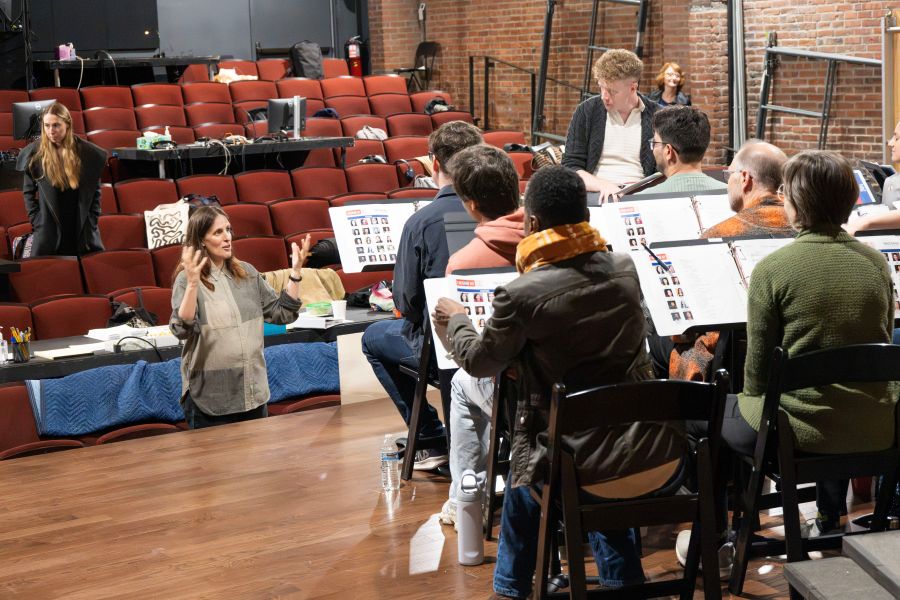
To cast this unique project, Coen gave credit to the show’s choral contractor, Marjorie Daley, who found singers who could learn the score and get the show on its feet with just six days of rehearsal. “It’s 210 pages of music and it’s not easy,” Coen said. The 16 choir members, he added, are “choral music people by trade” who’ve been doing this kind of work for decades, so the musical challenges weren’t unfamiliar. What was new was the frank contemporary content of the text, not to mention the eight-show-a-week grind. But their response to the work has meant as much as the applause and rave reviews. Said Coen, “The biggest reward for me of this whole process is what this piece has meant to the singers. They’ve said stuff to us like, ‘This feels like the culmination of everything I’ve wanted to do as a choral singer,’ or, ‘Finally, I’m singing something that people are moved by.’”
Or, Pirnot chimed in, “Finally I’m singing in English!”
While most popular musicals set their eyes on Broadway, the obvious next step for I Became We is to be sung by choirs anywhere and everywhere.
“That is the dream,” said Pirnot. While the aforementioned gimmicks of her two previous plays made them essentially unrepeatable, I Became We is her first major work “that can be licensed. It really thrills and excites us to picture choirs all over the world, amateur choirs, school choirs—I mean, anyone could do it, and it would give me such joy.” Coen said he has also envisioned a full-orchestra version that could fill a concert hall.
Wherever it goes, Pirnot is particularly happy that it’s starting out at a theatre. “I like that the first production is called ‘a world premiere play,’ because I like that it stretches the definition of what a play could be.”
Hallelujah to that.
Seen Around Town
Reviews for the Roundabout’s new production of The Imaginary Invalid seem very evenly divided between raves and pans. Which leads me to a quasi-existential, if-a-tree-falls-in-a-forest kind of question: If a comedy is this divisive, not in terms of controversy over its content (à la Slam Frank or You Can See Everything), but simply over whether it’s funny or not, can it be counted a success? For my own part, I had a total blast: With the exception of the even-keeled Rachel Bloom as Toinette, who functions as our still point in the storm, the performances here all aim for and nail a rarefied register of over-the-top, of competitive but not cutthroat scene-stealing, abetted handily by Karen Perry’s witty costumes (and Nikiya Mathis’s hair and wigs). Brandon J. Dirden’s directorial hand is not light, by any means, but the effect, on me at least, was a sense of capering lightness, nigh a helium high. I would have gone just for the chance to watch the peerless clown Bill Irwin, whose adaptation this is, but to me at least this Invalid delivered a delicious charcuterie board of artisanal ham. On the other hand, I have a colleague who told me she sat in stony silence throughout. And other colleagues of mine seem to have preferred last year’s Red Bull production, in an adaptation by Jeffrey Hatcher, about which I talked to him but didn’t get a chance to see. Take this doctor’s prescription with a grain of salt, then…
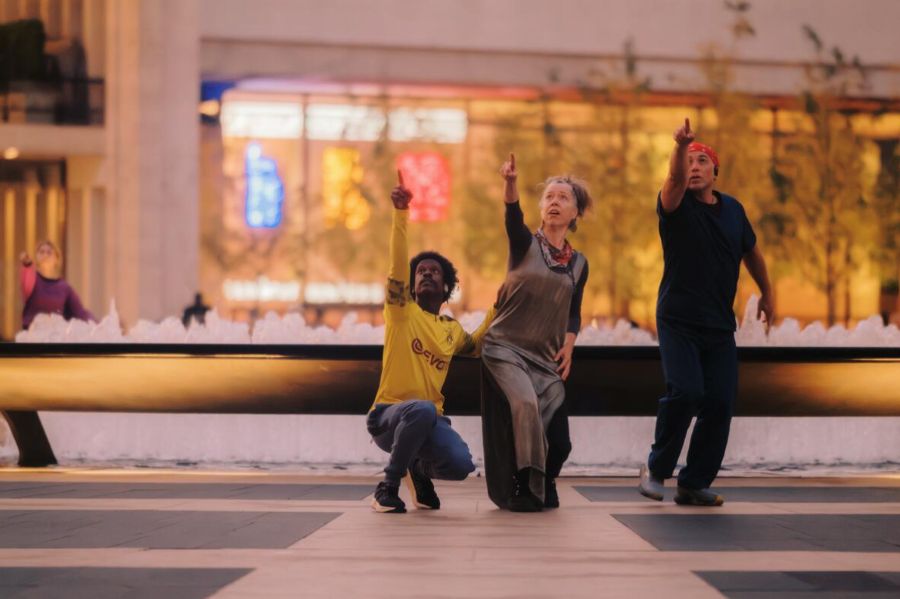
Last month, one weekday night near dusk, I stood among a group of earbudded observers on Lincoln Center’s Josie Robertson Plaza while Andrew Schneider’s voice guided us on a contemplative audio tour of the culture center, starting at its famous Revson Fountain and circling around the area, with a glance up at the Center’s surroundings and back into its history as the diverse Lincoln Square, and even before that to its history as a Native American trading post. This was Plaza, an hourlong piece that Lincoln Center commissioned from Schneider (Youarehowhere), which he created along with Curtis Thomas, Ivey Lowe, Ryan Gamblin, Brad Davis, and Saúl Ulerio & Co. The piece culminated in a metastasizing swirl of choreography, as a few dozen folks who’d been circulating among us the whole time sprung into action, flash mob-style, for an extended dance piece around the fountain. I’ll never see this culture hub, or the folks who gather there and circulate around it, in quite the same away again. Among my fellow audience members, I couldn’t help but notice Becky Ann Baker, who I saw in a Richard Greenberg play at Lincoln Center Theater two decades ago, and David Byrne, who helped create an immersive theatre experience of his own, now running in Chicago…
On another recent weekday evening, I went to Teatro LATEA on the Lower East Side for a unique presentation of scenes from The Reckoning, a play by Anastasiia Kosodii and Josephine Burton that depicts the everyday indignity and terror of life in wartime Ukraine. Produced by the U.K.-based Dash Arts in collaboration with the Reckoning Project, a Ukraine-based effort to document Russian war crimes in that country, the play had an acclaimed run at London’s Arcola Theatre last year, and plans more U.K. dates. The recent U.S. bow, staged as part of the Ukrainian Cultural Festival, hoped to drum up interest in a U.S. run. Based on a few scenes, powerfully acted by Sasha Odesa and Petro Ninovskyi, it is a promising prospect—though I must confess that the most riveting moments of the evening came during a discussion with Maksym Butkevych, a human rights activist, journalist, and soldier who was a Russian prisoner of war for more than two years. With clear eyes and quiet conviction, he said, “This is not a war for territory; it’s a war of values. People ask me, Do I want revenge? I want justice. ” One way to insure that: to collect the stories and preserve the memory of the war’s atrocities. Clearly, plays like The Reckoning can be powerful deposits in that memory bank…
I’m one of the few people I know who didn’t really feel The Heart, an extremely well-made new musical at the Roundabout’s Laura Pels that tells the story of a heart transplant in terms as human as they are medical. I can’t fault Kait Kerrigan’s deft book; it may simply be a matter of taste that I did not connect with the EDM-inflected score by Anne Eisendrath and Ian Eisendrath. It certainly represents a big opening swing by incoming Roundabout artistic director Christopher Ashley, who directs what is the first musical in the theatre’s Off-Broadway space in many a moon (though word on the street is that the show has already found a Broadway theatre for a transfer)…
I felt similarly disconnected from Steven Pasquale’s staging of Waiting for Lefty at Classic Stage Company. I’d seen and admired a production of this early Odets work at a theatre in Downtown Los Angeles more than 30 years ago. I got very few glimpses of what I remember as a fiery if episodic play from this new rendition, which puts most of its energy into a series of lovely but overly precious musical and choreographic interpolations. Folk and old-time music are definitely more up my alley than EDM, but I wasn’t feeling this…
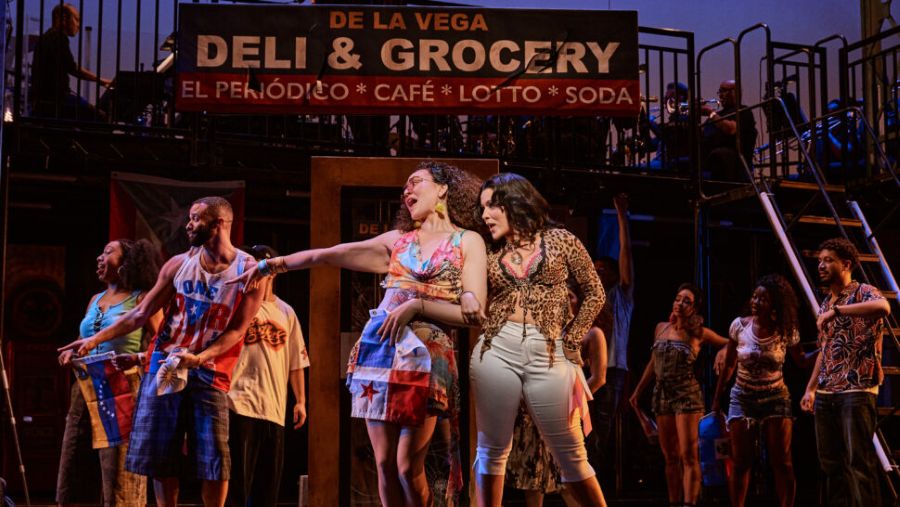
I confess I may be one of those terrible hipsters who likes to say they prefer the original Off-Broadway version, but for years this was how I felt about In the Heights, which in its 2007 run at 37 Arts felt like a scrappy, scruffy little-musical-that-could, but which on Broadway felt (to me at the time) like a big ad for itself. I enjoyed the movie a few years ago, even if I felt like it drained an already low-conflict musical of much of its drama. But the recent City Center gala presentation, directed by David Mendizábal, kind of changed my mind about the show. The obvious affection and identification of performers who’d grown up with this musical gave it all an extra poignance. And I had definitely taken for granted its sensational score, which is both as well-built as any in the musical theatre canon and bursting with its own unique vitality and vision. Will this production transfer to Broadway, as so many City Center stagings have? That partly depends on whether Lin-Manuel Miranda wants to compete for both the revival and the new musical Tony (for Warriors) next year…
Speaking of taking talent for granted, while I’ve never been a Billy Crystal stan, I relished his way with a tale, and his warm handle on the audience, in his standup-lite Broadway show 860. I admit I’d wondered whether I really needed to see a show about a rich Hollywood star who lost his home in the Palisades fires. I had underestimated both Crystal’s adeptness with the storytelling conventions of the solo show form, and, frankly, my own soft spot for the L.A. landscape (even if in my time there I was more of an Eastsider). While your mileage may vary, I feel like Crystal has an uncanny barometer for what constitutes just the right dose of pandering: how many fellow celebrities he can imitate or name-drop, how many video clips he can lean on to illustrate his points, etc. Given the show’s themes of mortality and temporality, I came away thinking of a quality not normally associated with his profession: humility…
Meanwhile, modesty and matter-of-fact quirkiness would be the qualities I’d attribute to Fred Armisen, based on his “Comedy for Musicians But Everyone Is Welcome” tour, which I caught at the Beacon. Part prop comedy with musical instruments, part observational musicological comedy, the show’s high points both had an international flair: One was a diverting tour of how different countries use the guitar, the other a series of texts Armisen once exchanged with the legendary rock producer Steve Albini in which they traded merciless critiques of the flag designs of various nations…
I returned to the Todd Haimes Theatre, where Invalid is playing, on an off night for this year’s 24-Hour Plays presentation on Broadway (full disclosure: Mark Armstrong, the company’s artistic director, is a personal friend). This year’s iteration honored director Thomas Kail, a veteran of the 24-Hour Plays who started working the company, and finding invaluable colleagues in the bargain, well before he found success with In the Heights and Hamilton. Accepting the honor, Kail described the 24-hour-play-making process—in which a motley cast and crew of various levels of industry experience gather to quickly turn out sketch-length plays, then present them with adrenaline-drenched panache for an audience of friends and fans that same night—as a kind of microcosm of every play’s gestation, birth, and ephemeral existence. He also memorably compared it to “all of high school in a day.” But tell me, at what high school could you see Busy Philipps and Daphne Rubin-Vega play tittering drinking buddies on an Amtrak?…
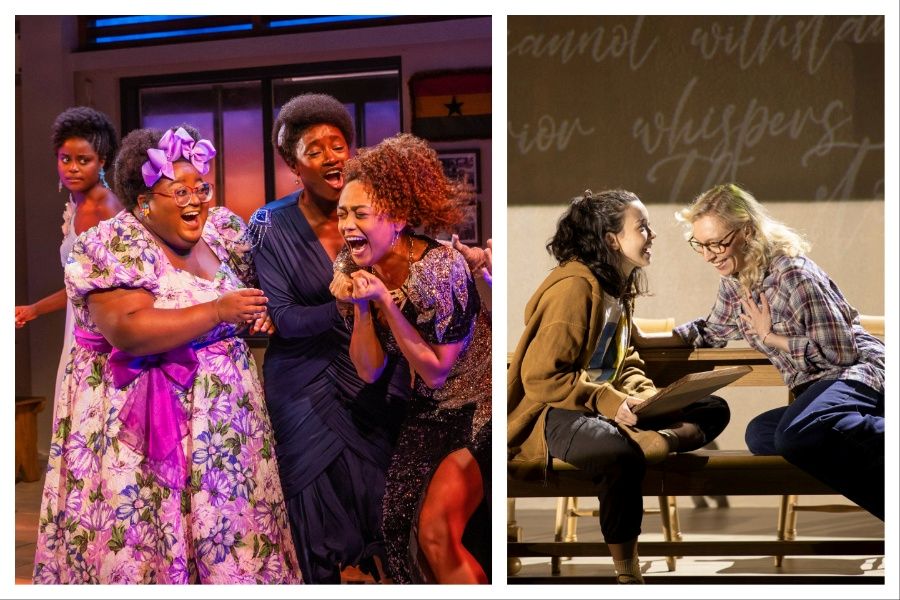
The new Broadway musical Wanted is worth seeing for the performances, particularly that of the powerhouse Solea Pfeiffer, and the songs, especially the transfixing “The Way I Am,” which Pfeiffer delivers definitively through an unseen mirror directly to us. I don’t have much else to say about this one, except to note that it does seem to be yet another entry in a trending genre of shows about colorism and “passing” that include Buena Vista Social Club, Schoolgirls, or the African Mean Girls Play, and the forthcoming Lynn Nottage/John Legend musical of Imitation of Life…
The new Broadway staging of The Fantasticks is a total charmer, and I confess went in with some trepidation—not about its same-sex makeover (an innovation we covered in its Flint Rep debut in 2022) but about the scale-up of this small, delicate Off-Broadway staple (which I reviewed when it opened in midtown in 2006) to a Broadway house (albeit the Main Stem’s smallest, the Helen Hayes). I shouldn’t have worried. Christopher Gattelli’s production is both impish and sincere, and more than fills the space with feeling. Also: I had forgotten how much the show’s broken two-act structure resembles Into the Woods, and how much its second-act opening tableau evokes Sunday in the Park With George. When I Googled to see if anyone else had noticed this or written about it, I stumbled upon a doozy of a chapter for the fiery-Sondheim-letter files, courtesy of Austin Tichenor…
I made the train trip up to Philipstown Depot Theater in Garrison, New York, to catch The Glorious Death of Comrade What’s-His-Name, a musical adaptation of Nikolai Erdman’s 1928 play The Suicide by David Bridel, Raymond Bokhour, and Simon Gray. Bokhour is an old friend, so I can’t be remotely objective about this, but I can say that I especially love the spicy, invigorating score—he wrote the lyrics, Gray the music—for this rueful, absurdist farce about the depredations of Soviet life…
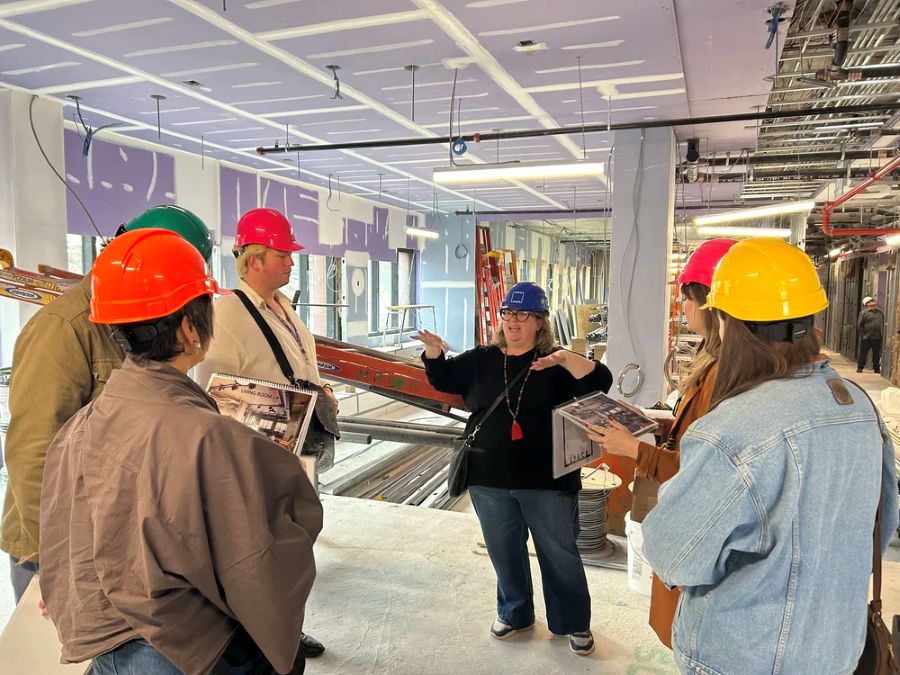
Finally, I was heartened by the hard-hat tour I recently took through IndieSpace Hell’s Kitchen, a community arts space in the ground floor of a new affordable housing building on the corner of 49th Street and 10th Avenue. As she showed us through the low-ceilinged, 5,500-square-foot space, IndieSpace executive director Randi Berry effusively labeled the project “a home run,” naming the bases as “affordable housing, an arts space, and green space,” gesturing to the dirt pile outside the arts space’s west-facing windows, which will become Lorraine Hansberry Park when the new space opens to the public in April 2027. This will be record time for such a project, she added: What could have taken 10 years of approvals and construction will have taken just 18 months. The key was to move the project out of the purview of NYC’s Department of Cultural Affairs (DCLA) and into that of the city’s Housing Preservation and Development (HPD). Construction of the new space—which includes a large meeting area that can be halved to accommodate both meetings and performances—will run about $8 million. Berry, whose IndieSpace was founded in 2016 to support the work of independent New York theatremakers with funding, development, and advocacy, characterized the new arts space as “a soft landing place for artists.”