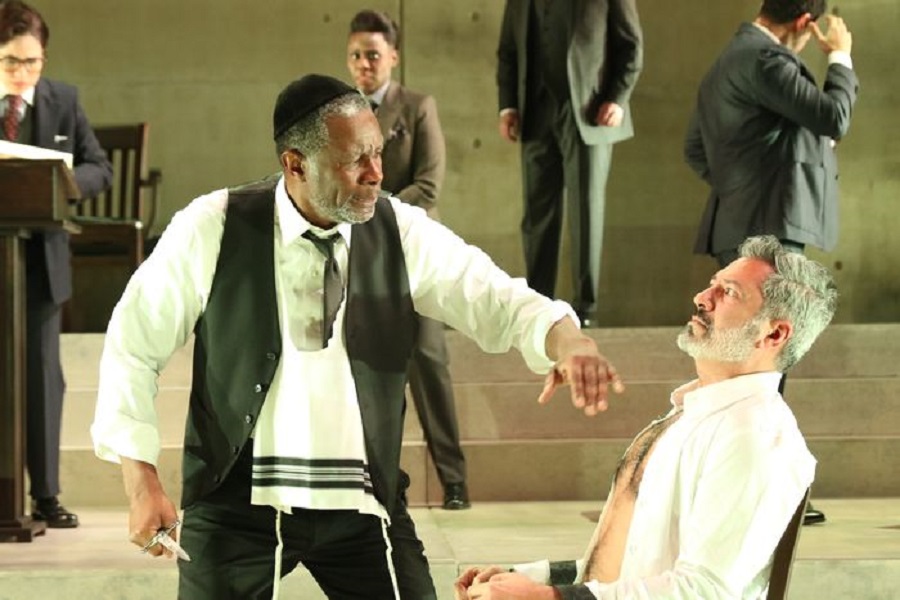
I would say that Olivia Bernábe is giving the performance of their lifetime in Slam Frank, the controversy-courting Off-Broadway sensation that remixes the well-worn Holocaust tale of Anne Frank and her famous diary into a catastrophically cringey multicultural musical. But of course, the singing/acting/rapping role of Anne Frank/Anita Franco—which gives Bernábe only a single short breather from the spotlight—is just the first major role for this Memphis native, who clearly has a great career ahead of them.
Over a chai latte recently near the Orpheum Theatre in New York City’s East Village, where Slam Frank opened last month and has just extended through Jan. 4, 2027, Bernábe—dressed in the plaid schoolgirl outfit they thrifted and wore for the video audition that landed them the role—talked with thoughtful animation about their background and their evolving feelings about the provocative show they’re the star of. I didn’t ask them to answer for or fully explain the show’s thorny politics, which could use both a trigger warning and a spoiler alert, since they didn’t write it (the concept and songs are by the incorrigibly trollish Andrew Fox, the book by Joel Sinensky; the director is Sam LaFrage).

One thing was clear from our chat: For all the irreverent, frolicsome comic commitment Bernábe brings to the demanding role, they don’t take the show’s heavy themes—or its mixed reception among some audience members—lightly. You might even say they take it personally.
“There was a weekend where there were three walkouts in a row, at three different shows,” Bernábe recalled ruefully. One of them made it into the lede of the New York Times review, quoting Bernábe as telling a departing couple, “You should wait it out,” and the woman replying, “No, thank you.” Said Bernábe, “I so badly wanted to be like, ‘Hey, it’s okay. I know this is really hard and uncomfortable, but it’s okay.’” That weekend’s hat trick of departures, they confessed, “punched me in the gut a little bit. It hurts. And I don’t want to hurt people. I know that in doing this show, inherently, people’s feelings will be hurt. That’s inevitable. But as a performer, to know that the work that I’m doing is so divisive can be difficult and emotionally challenging. Because I see the look on these people’s faces and I’m like: I am sorry, I’m so sorry.”
I should quickly add here that Slam Frank has also been wildly popular with many audiences and critics, and that Bernábe also said they’ve seen plenty of repeat audience members, including some who clearly know all the words to the songs (“I kind of love seeing that,” they marveled). So what’s prompting the walkouts and the outrage, you may wonder? It is not the show’s lightly transgressive goofing on woke sensibilities and concerns over cultural appropriation. The real sticking point is a moment about two thirds of the way into the show, when the authors take the implications of their attention-grabbing satirical premise—that Anne Frank’s historically specific story of antisemitic persecution can or should be adapted to make it relevant to the struggles of other persecuted minorities—to a logical, or possibly an illogical, extreme.
The debate over Jewish representation in stories about antisemitism is a familiar one; I’m thinking of Philly critic Wendy Rosenfield’s objection to the “All Lives Mattering of Anne Frank” in a few local productions back in 2018, including one at People’s Light, or Untitled Theater Company artistic director Edward Einhorn’s op-ed in these pages about Theatre for a New Audience’s casting Shylock with a Black actor in their 2022 production of The Merchant of Venice. Slam Frank takes this reasonable concern a huge and polarizing step further. Beyond simply skewering the way some liberals and progressives may arguably erase Jewish identity from stories where it properly belongs, the show imagines that the fictional progressive theatre troupe staging the Slam Frank play-within-the-play, as led by Anne/Anita, makes the eleventh-hour decision to turn the Franks’ story into a crude, button-pushing debate over Zionism that has predictably divided commentators on the left and the right.
Indeed, this is another level on which Bernábe’s dazzling performance, and those of their fellow castmates, is operating. Bernábe isn’t just playing Anne Frank, styled in the show’s play-within-a-play as a sassy Latina named Anita Franco; they’re also playing a well-meaning, possibly confused young performer who makes the fateful decision to blow up the play from the inside.
“Sometimes I’ve tried to come up with a name for her, or for them—in real life, I use they/them pronouns, but I bet you my character, the person playing Anne-slash-Anita, uses some form of she/they,” said Bernábe, who went to Sarah Lawrence College, where they said they appreciated the way that environment embraced their intersectional identity as a queer Latina. “I think she probably does see parts of herself in Anita or in Anne, maybe to a fault. And then over the course of the show, she absolutely loses herself in it.” Bottom line: “I feel like I am playing someone who is playing Anita or Anne.”
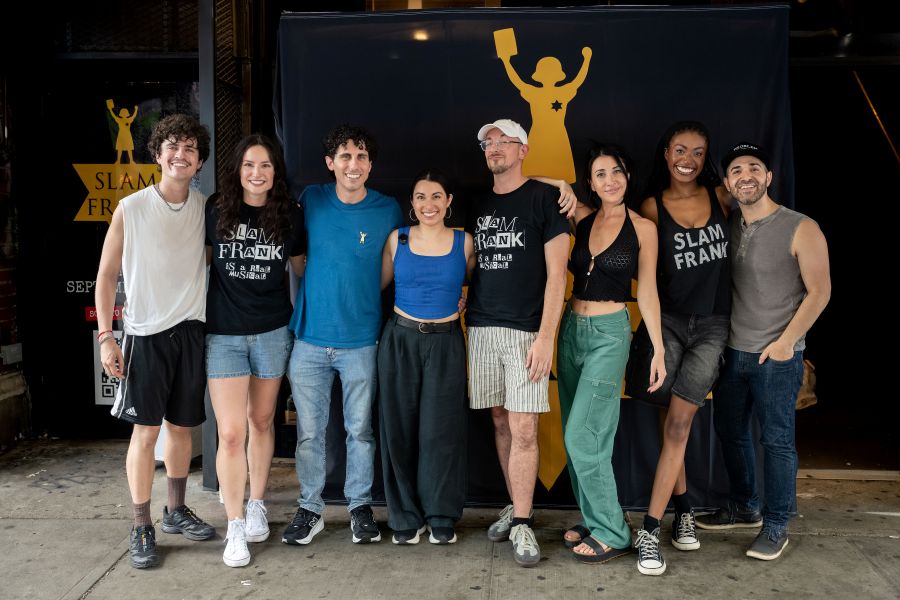
All the actors in the Slam Frank cast are first-rate (in particular Austen Horne, as Anita’s Black activist mother, and Rocky Paterra as her fey, nuerodivergent dad), and all walk the show’s intentionally fuzzy meta-theatrical line with grace and playful aplomb. (On the night I saw the show, Horne confiscated a theatregoer’s candy.) But it is Bernábe who most convincingly, even movingly, blurs these distinctions. In “Anne’s Decision,” a soliluqoy in song that might count as the show’s 11 o’clock number, this layered character, Anne/Anita/unnamed actress, fuses her/themself into one to make a fateful choice. Though the show’s perspective only darkens from there, Bernábe’s utter conviction makes us believe, at least for a moment, that all will be well.
“That’s the one time we actually quote her in the entire show,” Bernábe said, meaning Anne Frank, whose diary—in a Spanish translation one of their aunts bought in Mexico—rests on the dresser by their bed. “It’s a privilege to say those words.” The quotes, turned by Fox into lyrics, are the famous, “In spite of everything, I still believe that people are good,” and a slight paraphrase version of: “I can feel the sufferings of millions and yet, if I look up into the heavens, I think that it will all come right, that this cruelty too will end, and that peace and tranquility will return again.”
In the context of Slam Frank, of course, this lesson is disastrously mislearned and misapplied by Anne/Anita/actress. But I felt like I had to ask Bernábe: Do they personally believe that, in spite of everything, all people are good?
“I have to believe that—or that at least there are more good people than there are bad people,” they said. “I also think it’s complicated, because someone with complete opposite beliefs to me would probably say that I’m in the wrong, and that they are the ones that are good-natured and good-hearted. It’s just this crazy thing about being human: that we maybe want the same things, but for what we consider to be our people.”
For his part, Fox said he knew that Bernábe was one of his people from their audition tape, in which they followed a rendition of one of the show’s rapid-fire, Hamilton-esque raps with a quick flash of the title they’d given to Anne’s diary: I’m a Survivor by Anita Franco, with the final “O” styled as a Star of David. “I thought to myself, either I will never hear from these people again and I have canceled myself,” Bernábe recalled, “or they will think it is so funny and ballsy and out there that I will at least get a callback.”
That choice cinched the deal, according to Fox, who effused to me, “It was like discovering a fucking diamond. You know in The Producers, where they say, ‘That’s our Hitler!’ Every time we found exactly the right actor, we’d say, ‘That’s our Hitler!’” Beyond simply being right for the part, though, Fox recognized the central role Bernábe’s unique mix of impish sass and utter sincerity would play in making the show work. “I remember that I finally was able to breathe easy for the first time in weeks after I saw their audition,” Fox said. “If we had not found Olivia, we’d be fucked.”
Their background partly explains their facility with the show’s mix of tones: In addition to standard-issue musical theatre training, Bernábe had done Theatre for Young Audiences shows (Eric Carle Story Show, The Very Hungry Caterpillar Show, and Sesame Street: The Musical at the Kennedy Center) and puppetry (The Smack Dab Show). While they said they think their TYA training “adds this little crispy layer—a pop of color” to their work, Fox went further, saying, “The greatest sin of what we will call quote-unquote woke theatre is not the politics, it’s that it treats its audiences like fucking children. Olivia is swimming in that tone that we were going for.” A puppetry background, he continued, “makes an actor very aware of how much a small movement or a different angle can totally affect the audience’s experience. Olivia is both very, very spontaneous and in the moment, and yet so deliberate with their body, with their eyes, with how they stand.”
Are they as deliberate about where Slam Frank stands, I wondered? They admitted that their views of what the play is saying about Israel/Palestine and antisemitism have evolved since last fall’s run at Asylum NYC—but insisted that ambivalence is part of the show’s design.
“It is a bit of a Rorschach test or a mirror,” they said. “Some people are like, ‘Wow, it’s so pro-Palestine,’ and then I’ve talked to other people who are like, ‘Wow, it’s so pro-Israel.’ It is just crazy to me that two very different groups of people can see the same show and come out with extremely different views of what they’ve just seen—which is the point.”
Given the show’s divisive politics, did anyone advise them against taking the role?
“There was only really one person who was like, ‘I don’t know if you should do that,’” they said, adding sheepishly that it was someone they were dating—and that in the interest of keeping the relationship going, they seriously considered not taking the part. Thankfully for the fortunes of Slam Frank, that budding relationship faded.
So now, for eight shows a week (five of those on weekends), Bernábe has the job, alongside their fearless castmates, of administering the show’s Rorschach test and holding up its warped mirror—and of embracing both glee and the discomfort of audiences for nearly two uninterrupted hours.
“Everyone has their own capacity or threshold for how much satire, how much prodding, how much discomfort that they can sit in and that they can take,” Bernábe said. They’re sure they have their own limit too. “But I don’t know what it is—I haven’t hit that wall yet.”
Rob Weinert-Kendt is editor-in-chief of American Theatre.