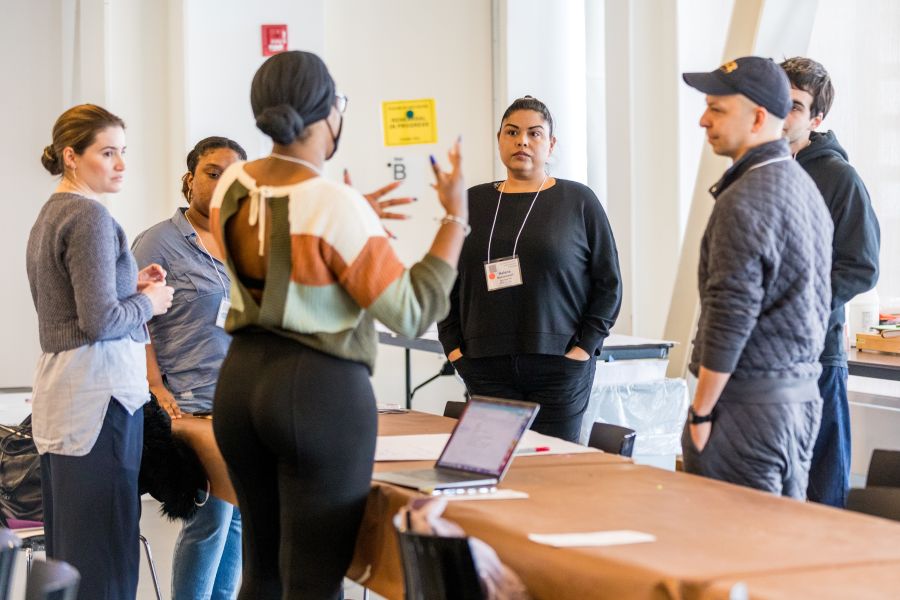
Over the past three years, more than 40,000 migrant students have entered New York City’s public schools. Now, amid a rise in immigration raids and political uncertainty, the challenge of meeting students where they are—linguistically, emotionally, and creatively—has grown even more urgent and complex. In February, Lincoln Center Theater hosted a day-long convening focused on sharing strategies for finding and training teaching artists, supporting multilingual learners, and measuring classroom impact. The timing of this first-of-its-kind gathering proved prescient, as the spring brought greater upheaval and change across schools and communities.
This convening was something Lincoln Center Theater had been dreaming up since the advent of its Learning English and Drama (LEAD) Project in 2004, which facilitates in-school residencies for multilingual learners in 15 middle and high schools across New York City. Last school year, the LEAD Project supported 1,112 students speaking 35 different languages, aiming to build intelligibility, physical expressiveness, and collaboration.
“Over the course of the 20 years of the LEAD Project’s existence, more and more arts organizations have started to think about how they can serve the range of folks in their education and community programs,” said Kati Koerner, LCT’s director of education.“ As theatre companies, how are we using our spaces in different ways? How can we use them to bring people together to help advance the work that we all do?”
For its part, LCT invited 32 peer organizations, spanning a wide range of sizes and artistic disciplines, to its space. The event kicked off with an activity: 60 arts administrators quietly folded, accordion-pleated, and crumpled colorful cardstock. Tables were strewn with paper, scissors, and pots of glue for making imaginative puppets. I created a bug-like creature with jagged wings and zigzag legs. The artmaking, while joyous and meditative, served a deeper purpose: It demonstrated teaching strategies for multilingual learners and students with disabilities.
This creative workshop was led by Studio in a School teaching artists Matt Mahler and Belinda Bloom, who guided the group through puppet making using visual cues, gestures, and repeated instructions in different ways. It wasn’t at all pedantic. As Bloom put it, “We’re simplifying, not amplifying.” These teaching strategies are inclusive for multilingual learners and students with disabilities, but also for general population students—and, it turns out, a room full of adults.
Teaching, of course, extends beyond providing instructions for creative projects. Educators must communicate in ways to support students’ emotional well-being and create a safe, inclusive classroom—especially as the world outside the classroom feels increasingly unsafe.
An afternoon workshop called “Creating Beyond Words: A Translanguaging Workshop for Art Educators” explored how educators can create safe spaces through the titular practice. The workshop was led by Marcus Artigliere, a clinical lecturer at Hunter College, and Dr. Samantha Chung, an assistant professor at Lehman College. Attendees were split into two groups: one group had to explain how recent changes in funding and the immigration climate in the U.S. are affecting their organizations and students using only English words. The other group had to respond to the same prompt through their art discipline, without using any words. Both groups felt restricted.
Translanguaging, as I learned, occurs when multilingual speakers draw on all of their language resources to process and communicate information. In other words, embracing translanguaging in the classroom challenges the traditional English-only approach. Non-native speakers in these settings often feel isolated and struggle to fully express their understanding, which can diminish their sense of culture and identity. Immersion or English-language-only programs remain common, and often exclude English-language learners from creative opportunities. The pressure for students to “test out” of English as a New Language programming also limits opportunities for students to participate or engage in the arts.
Artigliere and Chung emphasized the importance of honoring mutli-modalities in the classroom, then put this into practice when the two groups revisited the original prompt—this time with the freedom to use all the tools in their linguistic and creative toolbox.
The result was a beautiful expression of movement, with an outer circle reaching over to protect a crouched inner circle. A music teacher provided a propulsive beat with a water bottle, and the onlookers, as instructed, shouted out words that came to mind as the group moved. “Power,” “protection,” “unity,” and “creciendo”—Spanish for “growing”—were among the words shared as the inner circle began to stand tall and reach for the ceiling.
The other group created a spiral jetty out of paper, with “community” written in the center, and words like “belonging,” “student joy,” and “paz” (peace) written along the circle pathway. “This is a way of thinking about spiraling as a positive path forward,” one participant explained. “Spirals evoke ripples and the expansion of effect and impact.”
In the room, which included several participants who had once been English-language learners themselves, the impact of translanguaging and meeting students where they are was clear.

Measuring impact, however, is always a challenge. In a concurrent session, Chris Heller, director of LCT’s LEAD Project, and Dr. Leigh McCallen, deputy executive director of research and evaluation at the NYU Metropolitan Center for Research on Equity and the Transformation of Schools, led a workshop on measurement. Any teacher can attest to seeing students stand a little taller and engage more as a result of the arts, but translating that growth into measurable impact for funding remains an uphill battle.
One new challenge is the reduction of funding for diversity and equity programs under the Trump administration, which traditionally supported initiatives like social-emotional learning. Educators now must pinpoint the hard skills students gain through arts education when applying for funding and measuring success. The attendees worked through strategies for building logic models and defining outcome evaluations.
This workshop proved especially valuable for smaller organizations, such as The Painted Cloud, a community-focused arts nonprofit run by just two people. “It was really helpful to get guidance on how to get the wheels turning—how we can more simply implement these practices within what we’re already doing, because it’s all about supporting us to do more of what we’re already doing,” said The Painted Cloud’s Sarah Conarro.
In another room, Madeline Calandrillo, director of education, and Frank Ruiz, education program manager at New York City Children’s Theater, shared strategies for recruiting, training, and supporting teaching artists. They emphasized the importance of trauma-informed care and establishing guidelines to best support both resident teaching artists and classroom teachers.
The fear surrounding the potential dismantling of the Department of Education—a fresh threat at that point, which has only sharpened in the months since—was a hot topic during the lunch break. Attendees discussed concerns about potential budget cuts, Immigration and Customs Enforcement (ICE) entering classrooms, and how best to support teaching artists in preparing for such situations.
In the months since, the Department of Education has provided guidance for educators if law enforcement officers like ICE or the FBI come to a public school. Essentially, access is only allowed in emergencies and with proper legal documentation, and school staffers must contact their Senior Field Officer before taking action.
This spring, The Painted Cloud, which partners with DOE schools, began developing an action plan and establishing a clear chain of command before launching any artist residency programs. The threat of ICE raids has impacted involvement in their programs, which celebrate diversity and include family engagement workshops. This year, participation numbers have dropped. “You can connect the dots of people not feeling safe in certain spaces, and I understand the apprehension around that,” said Conarro.

“As someone who is the child of immigrants, just the sense that having legal status doesn’t matter right now is really scary,” said Juan Manzo, director of teaching and learning for Roundabout Theatre Company.
The reduction in federal funding for special education programs and Title 1 schools is also a big concern. “Are the students going to continue to get the support that they need, or is that going to go away? Are schools going to be less willing to take on these students?” Manzo wondered.
Luckily, of the programs I polled, none have lost any funding yet, though some grants have been renamed to reflect a changing landscape. For his part, Manzo remains focused on what he can control. In addition to running a five-borough education program with a robust network of teaching artists, he works to have fresh food available for students when possible.
During a lunchtime “Ask Me Anything” session, Monica Suarez, a social worker at a school in Harlem, shared her experience working in a school that offers on-site laundry and other services for migrant students experiencing homelessness—extra support that is helping to make some classrooms safe spaces.
Manzo mentioned a student at a Staten Island school who is going through a hard time at home, and who, despite an hour-long commute to and from school, attends afterschool arts programming in Manhattan, because, as the student says, fantasy is better than real life right now.
“What are the barriers that you can remove so that they can have a soft place to land every once in a while and just be creative? That’s what I can control,” said Manzo.

In the afternoon, the New York City Department of Education shared statistics highlighting how these soft places to land in schools can also serve as launching pads for multilingual learners. Alexa Fairchild, the program manager of the NYC Office of Arts and Special Projects, asked the audience how many languages are spoken in New York City public schools. The answer, a whopping 180, surprised me. The next facts did too. Christina Foti, deputy chancellor of the division of inclusive and accessible learning, shared that more than 40 percent of New York City public school students have a primary language at home other than English.
Maria Friedland, the senior director of social studies in the Office of Multilingual Learners, presented data showing that English-language learners consistently score higher than native speakers in both math and English language arts. Furthermore, graduation rates for former English-language learners who achieved proficiency are higher than for native speakers. In 2023, former English language learners graduated at a rate of 91 percent, compared to 85 percent for native speakers.
The final session was a PechaKucha presentation highlighting the work of three attending organizations. A PechaKucha is a fast-paced, structured presentation style that originated in Japan. “We wanted there to be an opportunity for people to talk about their work in relationship to other people’s work,” said Kati Koerner. “It’s a playful device and it makes things sort of fun and energetic.”
Justin Daniels, the director of programs at Opening Act, which serves 53 of New York City’s most high-need high schools through its 22 programs, talked about the program’s impactful work, including its programs with Haitian students studying nursing at the Clara Barton High School in Brooklyn and with District 79, the city’s alternative school district.
Luciana Farias, senior program manager of arts education at Flamenco Vivo Carlota Santana, used her few minutes to talk about the organization’s 41-year-old Project Olé!, which brings the dance, music, and song of flamenco into the classroom.
Dale Novella Anderson-Lee and Autumn Tilson of the Community-Word Project, which operates in neighborhoods where 70 percent of residents live in poverty, spoke about building creative residency curriculums, relating different cultures in the classroom to each other, and the power of translating all communications with parents and guardians into their native languages.
The event wrapped up with a round of speed “dating,” where attendees got to share quick takeaways and learnings from the day and share contact information, as a fun way to network build. I, for one, left glad to have so many more education programs on my radar.
“Ever since we started doing this work, we’ve wanted to get together with other people who are also doing this work, and just have an opportunity to learn from each other, figure out how we can collaborate and support each other, and just know that there are other people out there doing what it is that we all do,” said LCT’s Kati Koerner.
In that regard, the event was a big success. “I was so grateful for this convening—we need more of these opportunities to learn from each other,” Justin Daniels shared after the convening. “Often teaching artists can feel isolated, experiencing the work through their own lens, but not often witnessing best practices from other educators in the field. The event was an opportunity to peel back the curtain on great tools and techniques for educators to use in their own practice.”
One ripple effect of the LCT convening was a collaborative presentation by Studio in a School and Flamenco Vivo at the NYC Arts in Education Roundtable’s annual Face to Face conference in April. In addition to presentations, the convening spurred coffee conversations about ICE and best practices among the attendees, which will continue as administrators and educators navigate the coming school years.
Looking ahead, Lincoln Center Theater plans to partner with other arts organizations to host a follow-up event during the 2025-26 academic year, potentially focused specifically on teaching artists. It’s safe to say that there will as much, and most likely more, to talk about then.
Allison Considine is a former editor of this magazine and contributes a monthly column on arts education. Based in Brooklyn, she works at a mission-driven tech startup by day and moonlights as a theatre critic.