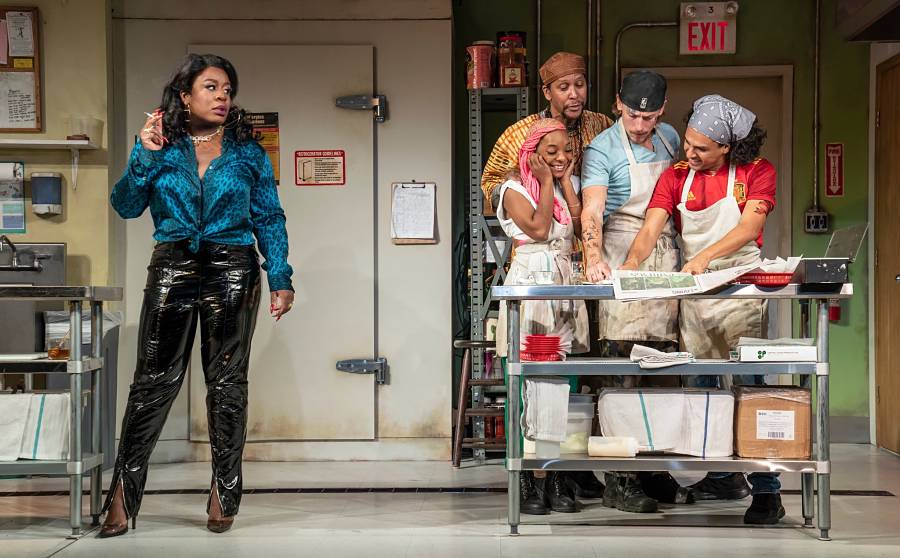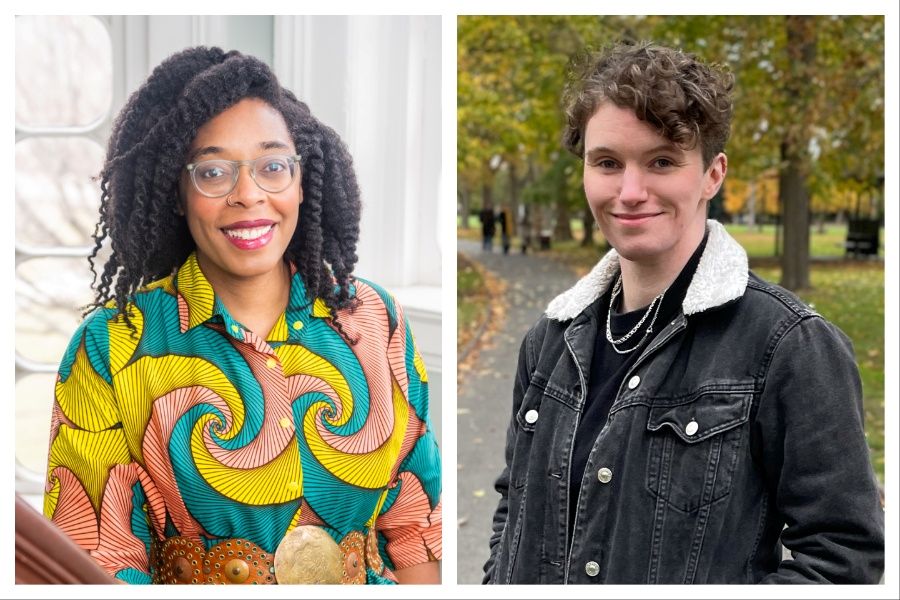
ROB WEINERT-KENDT: Congratulations to you both! Having read (but not seen) your plays, I can testify that they’re very different. But they do have a few things in common: Both are set in New York state (Syracuse and Brooklyn, respectively) at workplaces (a butcher shop, a roller-skating rink) that are also somewhat faltering family businesses. Both are seen somewhat through the eyes of a young woman: a precocious 10-year-old, Meek, in Cold War Choir Practice, and an early-20s young ex-convict, T, in Meat Kings! And both plays are very much about the state of America. While Hannah’s is set in the present, Ro, yours is set in 1987, at the twilight of the Reagan era, which in many ways feels very far away from us and in other ways feels like it very much shaped the world we live in now. I don’t want to presume about your age, but were you around for that time, as I most definitely was?
RO REDDICK: Oh, yes, I’m definitely a child of the ’80s. I’m a little younger than the 10-year-old protagonist in the play; I made her older so she could have adventures. But when I was a kid, when I was very young, I was in children’s choir called Peace Child. We sang songs about nuclear war, and, “Please don’t let the world be destroyed,” and “Let’s find peace and connection across cultures and across languages.” It was a very particular kind of experience. I still remembered the songs as an adult, and I would tell people about them, and they would giggle. Then Putin invaded Ukraine, and it came up a lot more.
Do you remember any of the lyrics from the anti-war songs you sang as a kid?
RO: One of the songs in the show is inspired directly by a song we sang. I didn’t want to license those songs, so I was like, I’ll try to make my own version. One of the songs I sang when I was a kid was like, “Oh, Mr. President, is it true what they say / The world will be over in less than a day?” So there’s a song in the play called “Lay Down Your Arms,” where they’re like, “Mr. President, Mr. Gorbachev, lay down your arms,” that’s inspired by the songs that my children’s choir sang.
One thing that struck me about your play was how much the people in it feel surveilled, like the eyes of the state are on them. Is that part of your memory of that era, or is that something you’re thinking about as you look back on it?
RO: I think it’s two things. It was looking back, just revisiting the history of it and all the spycraft that was happening in a very particular way in the ’80s. And then also the feeling I have now—a lot of this is me processing current-day feelings through ’80s-me experiences, if that makes sense. I certainly feel, I feel the eye of Big Brother very intensely right now. So that’s why it’s in the play, and it’s echoed through the current production, in the design and in how things work in the play.
Someone has a line, “There are no private things,” which is wild to read in an era long before social media and smartphones.
RO: One of the things I was interested in was this idea, more sort of in the mid-century, in the early part of the Cold War, where Americans were convinced that we could look at the artwork that was coming out of the Soviet Union, at pieces of culture, and use that as a kind of shibboleth to understand what the Soviets are thinking, and then we could sort of predict what they would do next. There was this idea that you could actually get ahead of the other person and know them so well that you could predict their next action, which felt essential at the time. That was really an interesting thought to me: Can you actually know someone else’s mind?
Hannah, you’re a British-Irish playwright, but your play is set in Brooklyn. How did that happen?
HANNAH DORAN: It’s the question on everyone’s lips, truly. I worked in a butcher’s in Brooklyn. I went to grad school at NYU for playwriting and then could not get a job, of course, so I ended up working cutting meat. And I’m a vegetarian! I was this 5’ 3” British woman flung into this world with these big Queens boys. I knew the second I stepped in there, like, I wasn’t sure how long I would last, but I knew it would be a play.
That does sound like a play, but it’s not quite the play you wrote. The young woman who comes into the male-dominated workplace isn’t a British playwriting student, and the place itself is run by a woman.
HANNAH: Well, I started out in a small shop—I won’t name it, but it was rough, and I ended up leaving and went to a big Whole Foods meat department. In the play, I’m really interested in the dynamic of what happens when you have a team of men and a female boss, especially when she’s queer and butch, and what that does to the power dynamic. The play looks at what we mean by discrimination, and different people’s experiences of disenfranchisement. I hope it’s a play that looks into the intersectionality of disenfranchisement in America today.
Right, in addition to gender and culture, there’s economic class and immigration status—one of the meat cutters is a DACA recipient, or Dreamer. Both of these plays have big things on their minds, so I want to ask both of you, when you’re writing a play like this, do you start with your subject or with characters?
RO: I don’t always start with characters. I usually start with whatever the question is—It’s different for every play, but just like a prompt or a question or an impulse, and then I follow that to find the world first, and then the characters kind of climb out of the grout.
HANNAH: I love that image of the characters climbing out of the grout. For me, this particular play started with: I just want to put butchers onstage. It was so visceral and so theatrical. The characters came second. I was taking inspiration from the people I worked with and all these mad customers. The immigration plot really came later and was character-driven.
Your play, Hannah, is pretty naturalistic, and yours, Ro, is very much not. I’m wondering if you think about staging and style as you write, or whether you leave that to the director you’ll eventually work with.
RO: I prioritize finding a director who thinks about how things look. Every director is a little different, but I wanted someone who was super visual and who would take the invitations I offer in the play and do what they will with them. That’s what led me to Knud Adams; he’s got a really specific vision and vibe, and I love everything that he’s bringing to the piece. Does that answer your question?
Yeah, I guess I’m also asking, do you like to write things are basically unstageable?
RO: Yeah, that’s part of the joy of it. That’s what’s fun for me. But what’s happening between the family is very grounded.
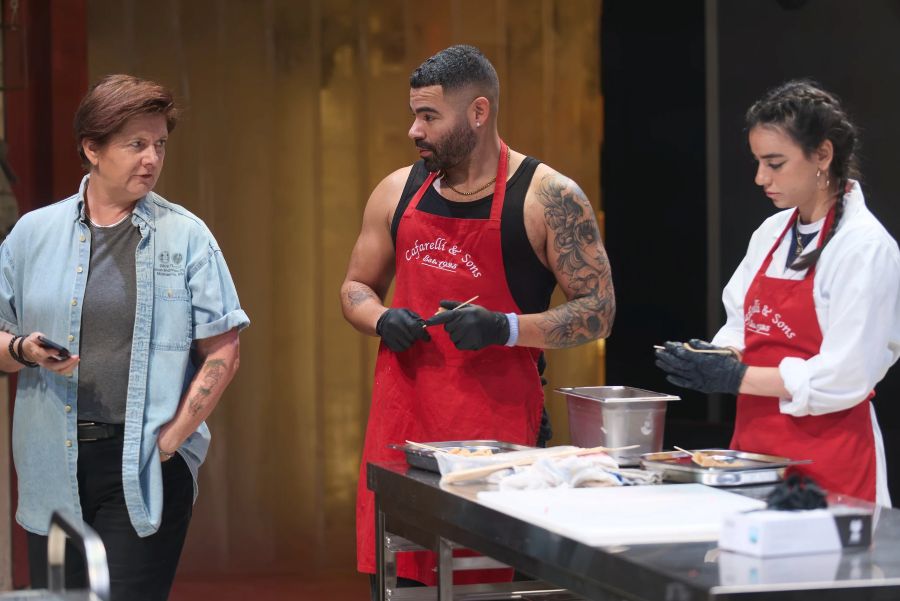
Hannah, the plays that came to mind as I read Meat Kings were Clyde’s, because it’s a business run by a woman who hires folks out of prison, and Glengarry Glen Ross, as a few desperate workers conspire to rip off their employer while screwing over their co-workers.
HANNAH: It’s interesting, a lot of reviews also compared it to A View from the Bridge, which I’ve actually never read or seen. I love Arthur Miller, but that particular play, I guess I’d better go and read. In my case, I really put the story first, and because I had such a clear idea of the world, everything else kind of fell into place. The production we did in London was actually kind of non-naturalistic. We staged it in the round, and there was a lot of crossing the stage. There was the setup of the play with a big proper butcher’s with this machinery and a white tile wall. But we just had two metal cutting tables and the bare brick wall of the theatre, which was kind of atmospheric. The director, George Turvey, was also the dramaturg. As for the unstageable, the meat was a real pain in the ass for our producers and stage managers; they spent months trying to figure out how to put meat onstage. But I like to write stuff like that and just go, Okay, I’m gonna write it, and then it’s someone else’s problem.
Yeah, reading your play, I felt like I could smell all that raw meat. How did you handle that?
HANNAH: We went down the route of making fake meat, because the thought of real meat under the stage lights, and the ethics of it, was just…So we had a whole dressing room backstage dedicated to these bain-maries with cooking gelatin that was then molded into meat shapes and dyed. Some of it was preset for every show, and you could cut through it, and then it would be melted back down and remolded throughout the run.
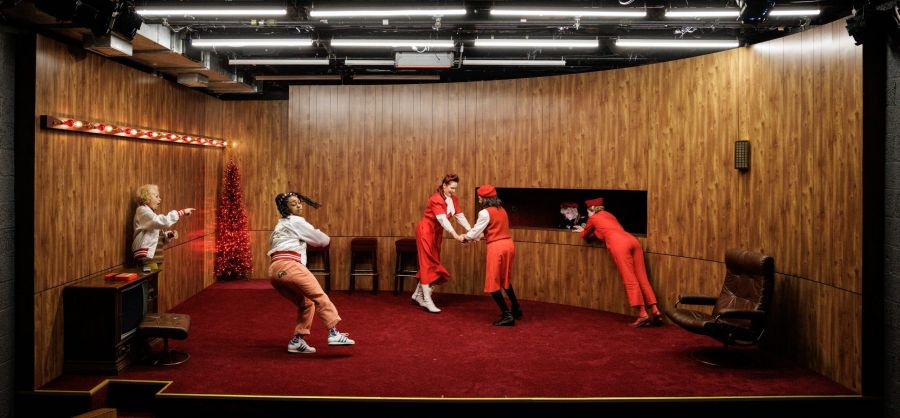
Ro, your show is set in a roller rink but the script says there’s no actual skating. Can you tell me what it looks like?
RO: There are gestures toward it. The set by Afsoon Pajoufar designer is so amazing—it’s like wood paneling in almost two little semi-circles, so it is sort of suggestive of a ring. But then there’s like a deep red carpet, so it’s not like a hardwood floor, or any kind of floor you would skate on. We have two movement directors, Baye & Asa, and they designed a movement vocabulary that suggests skating without it being kind of like bad pantomime. It’s really beautifully choreographed. It’s less about the spectacle of people on skates on a stage, and more about that swag, that energy, that flow, that comes from skating. That’s what I was more interested in.
So I checked on this: You two are not splitting the Blackburn Prize, you’re each getting a whole prize to yourselves, including the de Kooning print. Can you tell me about the impact of this honor?
HANNAH:This is my debut play, the first show I’ve ever had, so it means so much. Benedict Lombe, who was one of the judges this year and who won the prize a few years ago, said something about how the prize was just a really great indicator that she’s on the right track and doing what she needs to do. For all of us, we have so much rejection and writer’s block and all of that that makes you think, What am I doing? Should I do something else? It’s just a really nice affirmation, a validation that the thing that you’ve committed to making is doing what it’s meant to do.
RO: I feel similarly. This is also my debut play, and I didn’t think it would ever get produced, because there are 5 million people in it and 10 million elements, and people just aren’t doing shows like that. So I feel lucky that it exists in the world. And then getting this prize—I’ve always looked up to the playwrights that have won this prize, so it’s kind of crazy to be a finalist, and then to win is just bananas. I have a warm feeling toward London, because when I was an undergrad, I went to London for a semester and saw a ton of theatre. At the Royal Court I saw Sliding With Suzanne, and I still love that play. So to go there and to be celebrated in this way with Hannah is such an honor.
HANNAH: And that we’re sharing. I’m so happy that there are two of us.