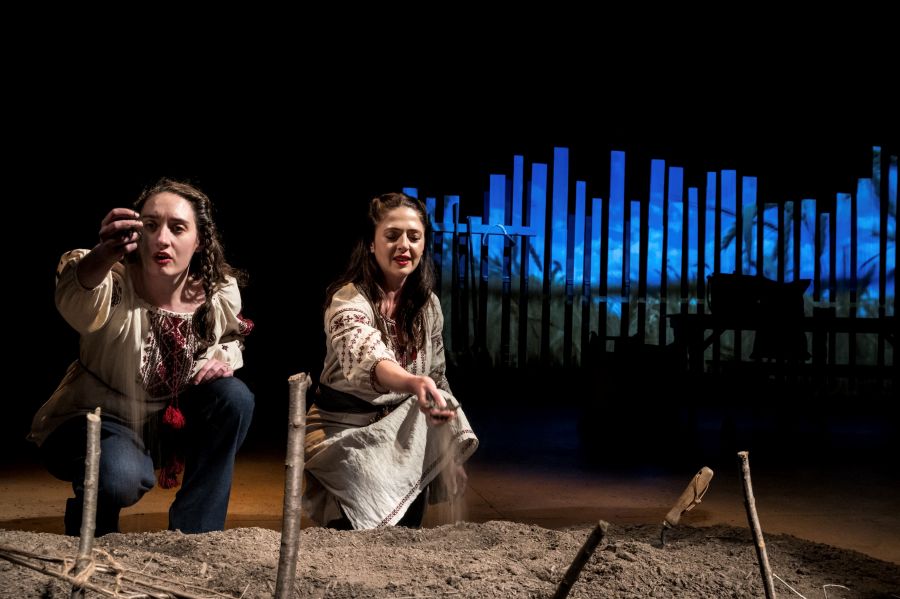
Earlier this spring, I had the good fortune to attend the biannual meeting of the League of Resident Theatres (LORT) in Minneapolis, where I was also lucky to catch the opening night of Theatre Novi Most’s Sickle in its Minnesota premiere at Mixed Blood Theatre. Written by Abbey Fenbert, Sickle tells the inspiring story of Ukrainian resistance during the 1930s Holodomor famine and genocide. The play interweaves stark scenes and the characters’ impossible choices with the enduring melodies and language of traditional Ukrainian songs. Under the nuanced direction of Novi Most’s co-founders, Lisa Channer and Vladimir Rovinsky, the fine-tuned company of seven women conjured a moving tribute to the strength and resilience of all those—past and present, in Ukraine and beyond—who preserve a rebellious spirit while fighting for survival under occupation.
As it happened, that opening night in early May was also the evening that hundreds of theatres and arts organizations throughout the U.S. were notified that their previously awarded grants from the National Endowment for the Arts had been terminated, or that their award offers for the upcoming year had been rescinded. Channer announced at curtain call that during Sickle’s performance that night, Novi Most—like many of their local and national colleagues—had received an email from the NEA cancelling their grant. Surrounded onstage by the full cast of actors and singers, she invited all of us in the audience to join in a Ukrainian song of resistance, calling out, “And now, we sing!” Our spirited communal chant rose through the room, and the collective heartbeat of our rhythmic clapping and pounding stomps pulsed and reverberated out into the night.
As we navigate a political and cultural moment rife with ICE raids, questionable deportations, and exclusionary ideology, I am delighted to share with joy and intention that this summer issue of American Theatre proudly centers immigrant and international theatremakers. With this issue’s focus, we reaffirm TCG’s commitment to inclusion, belonging, and open exchange—and to the “just and thriving theatre ecology” that is at the heart of our mission. The health of our beautiful yet fragile arts ecosystem, much like that of our civic society, is fortified when a diverse range of elements is encouraged to cross-pollinate and coexist in mutually beneficial and supportive interdependence.
We have much to learn from our international colleagues, whose grassroots efforts the world over have demonstrated the power of cultural resistance when fueled by the hands, hearts, and imaginations of artists working in broader coalitions for change. One particular highlight from this issue, for me, is the introduction to several contemporary Brazilian theatre collectives through the contextually grounded understanding of Rad Pereira, a cultural worker and change maker who is steeped in ensemble practice—and who I had the pleasure of collaborating with over the last few years of my work at the Network of Ensemble Theaters, prior to joining the TCG staff this past January. In Rad’s article, they reflect on their experiences at Teatro de Contêiner Mungunzá (Container Theater), a community-rooted space that hosts ensembles intent on “unsettling dominant practices by re-membering cooperative ways of making.” Similar to Novi Most’s Ukrainian-centered production in Minneapolis, the performances Pereira witnessed in shipping containers in urban São Paulo were focused on “storytelling and survival across imposed colonial borders.” And both are examples of theatre used as a tool for resistance, reclamation, and transformation, in active opposition to its potential co-opting as authoritarian or colonized propaganda.
Much as historic patterns of colonization have worked to erase language, story, culture, and the power of community, the attacks we face from the current U.S. administration reach beyond the theatre and arts ecology. Executive orders targeting education, immigration, the environment, healthcare, and the nonprofit sector as a whole, alongside attacks on DEI and the trans community and acts to defund the humanities, libraries, and museums, are all designed to threaten our country’s foundational values of civic responsibility and to dismantle our national infrastructure for community care.
In response, I find myself among a growing number of practitioners and theatres in our field that are interested in ways to use our work—our artistry, our skills in event production and community engagement, and our spaces—to foster connection in these divisive times. In his reporting on How to Make a Home, writer Jim Farmer shines a light on one such example: Out of Hand Theater’s “Shows in Homes” series, a successful arts-based community engagement model that brings the company’s work into home-hosted events throughout Atlanta to bridge divides and spark dialogue across difference. By collaborating with non-arts partners to build community support, Out of Hand has not only become a powerful catalyst for lasting change, they’ve generated a stable revenue base that has spurred substantial organizational growth and continues to sustain the company.
As you encounter these and other approaches in the following pages, we invite you to join us in imagining what new or more deeply engaged roles each of us might step into as artists, as storytellers, and as cultural conveners in our communities—and how TCG can best help to support, organize, and lead these field-wide efforts. With my fellow co-executive directors, Emilya Cachapero and LaTeshia Ellerson, we have been leaning into these questions, and are engaged in ongoing conversations with our sister service organizations in the theatre field, the arts sector, and beyond to explore ways to share resources and work together to amplify our impact. The way forward may be in reaching back, and reaching wide, to the reverberating Indigenous wisdom that the many cultures of the global majority have never forgotten: to connect through our shared stories and collaboration, working in community to build broad coalitions toward collective action.
And now, we sing.