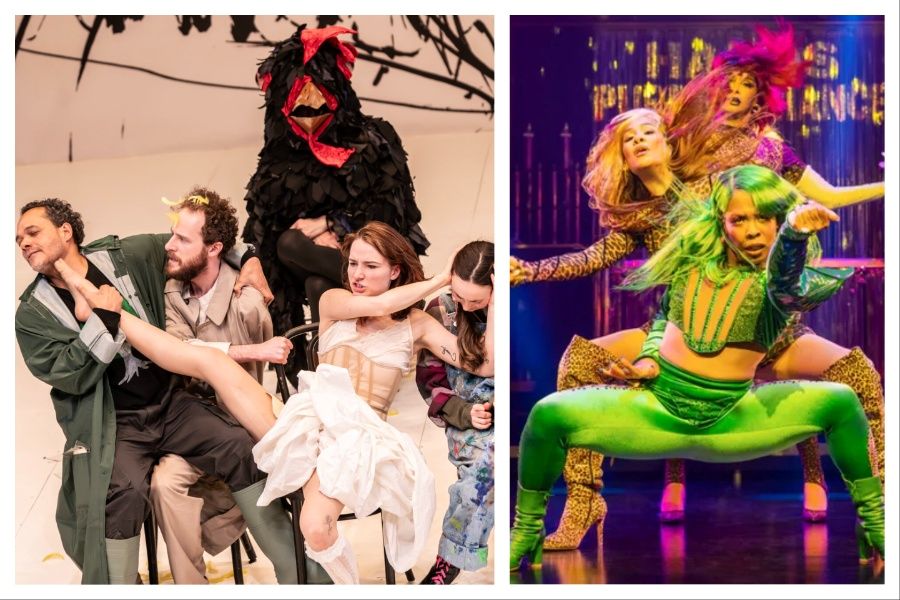
“We’re going to produce Chekhov to calm down,” is how the Russian director Dmitry Krymov characterized what he sees as the attitude informing many American productions of the work of his country’s greatest dramatist. In the U.S. and the U.K., Krymov told me in a recent interview, Chekhov’s plays are often performed as if they’re a matter of “pronouncing certain prayers, like a sacred text, and it calms down the soul and it makes you feel peaceful. It’s like meditation more than anything.”
 That is not, to put it lightly, how Krymov approaches the good doctor’s work. “For me, Chekhov is a totally different feeling,” he explained. “I feel that I’m looking at a mirror that shows us the ugliest parts of our lives.”
Indeed, his work both in his native Russia and in the U.S. has made his point. In the lavish promenade Ta-ra-ra Boom-de-Boom (which I was fortunate enough to see in Moscow in 2012), Chekhov’s characters were disaggregated into a kind of historical pageant both festive and absurd. And Krymov’s Cherry Orchard at the Wilma Theater in 2022 was a chaotic excavation of that valedictory masterwork, given extra poignance by the Russian invasion of Ukraine, which occurred just before Krymov flew from Moscow to direct it, and which has effectively stranded him here since. And his wild, impassioned new Uncle Vanya, scenes from country life, now at NYC’s La MaMa through April 12, is, as Helen Shaw put it succinctly, “not your uncle’s Uncle Vanya.”
To wit: In Krymov’s version, Yelena, the bored young bride of the aging professor Serebryakov, is this version’s central figure, beset in turn by insects, chickens, and the assorted humans who congregate at a country estate one languid summer. There is blood, profanity, lazzi involving sliding chairs, a waltz to Shostakovich, and scattered interpolations from other texts and much meta-commentary, amid a generally rearranged text. If you know the play, you’ll recognize many of the words but may be surprised at where, and in whose mouths, they land. And you definitely won’t see the end coming.
Developed with his U.S. company, the Krymov Lab, this is, surprisingly, Krymov’s first stab at Vanya—he’s staged all of Chekhov’s other major works before. The idea for it came to him “at once, like I was struck by lightning…I bring this sophisticated woman from the city, she appears in the middle of the country, not knowing anything, and all of a sudden, all the people and animals or whatever come to her with their problems, their unresolved desires, all the things that they carry inside of them, and they pile it up on her, as if she is this new priest who is listening to all the confessions over and over again. Eventually she goes mad, because it’s absolutely impossible to tolerate. She is the thing that shows that people go mad because of their problems…They’re just eating themselves up, and eventually it causes tremendous problems.”
That said, Krymov, a very youthful 71, stressed, “I must tell you, both the countryside and Yelena—they’re not the most important things. The first and the most important thing for me right now is how to express in the theatre this crazy, mad world that we’re living in right now.”

Mad indeed: After he criticized the Russian invasion of Ukraine, Krymov became a pariah in Moscow, with most of his productions there shut down and the two that remained in repertory for a time continuing with his name removed from the posters. That’s similar to what happened to Alexander Molochnik, the 33-year-old Russian director whose glittering Russian career—credits at the Moscow Art Theater and the Bolshoi—was derailed by his opposition to the invasion of Ukraine, and who is the director of playwright Eli Rarey’s Chekhov-inspired riff Seagull: True Story at NYC’s Public Theater through May 3.
“Basically, directors had to either flee or stay and shut up and join this horrible pro-war shout, which some did,” Molochnikov told me. “Lots of people chose to leave Russia, and I did too, and the character of Seagull does as well.”
That would be Kon, a young Russian director whose avant-garde production of The Seagull is jeopardized when he posts a drunken, irreverent takedown of the “murderers” running his country, then flees to New York City to create a new Seagull at a warehouse in Bushwick, feeling all the culture clash you might imagine with American theatremaking foibles while keeping tabs on his colleagues and family back home. Rarey’s play is in most ways even less The Seagull than Krymov’s is not Uncle Vanya. And, like his directing elder, Molochnikov comes at his nation’s biggest theatrical brand name from a personal angle.
“I love Chekhov’s plays and have directed them,” Molochnikov said, while making clear that this Seagull is not Chekhov’s but Rarey’s. “I also feel that there is some stereotype about Chekhov, because he is staged in such a boring way usually. Actually, this play is about a hot evening in a summer house where people crazily want each other—characters that just want to fuck, that are excited, obsessed, going crazy, shooting at each other. It’s a blockbuster if you look at it that way, and you just need to open it up.”
Opening Chekhov up, while also handily belying the trope that American theatremakers don’t know how to do so, is New American Ensemble’s vibrant, compelling new staging of Chekhov’s early, infrequently staged full-length drama Ivanov, now at the West End Theatre through April 12. In a recent conversation, director Michael DeFilippis took the point that Chekhov may too often be performed with more attention to subtext than to conflict and drama, but said it doesn’t have to be that way. Indeed, his production stands as proof that these plays need not be cut up or remixed, as Krymov and Rarey/Molochnikov do, to expose their beating heart.
“We’ve long suffered in the West from a kind of Victorianization of Chekhov,” said DeFilippis, 28, who is also NAE’s artistic director. “The early translations almost read like bad Shaw plays.” By contrast, in the work of St. Petersburg’s Maly Drama Theatre, led by Lev Dodin, DeFilippis said he found an inspiring model for the way an ensemble, properly directed, can give life to the full range of roiling drama and boisterous comedy within Chekhov’s work. Maly’s Vanya, he said, is “somehow spacious, even calm in some ways, but it doesn’t for a moment lack an ounce of the life that it requires,” DeFilippis said.
Of course, if he’s aiming for directness, DeFilippis has an ally in Ivanov, which often feels like a table setter for Chekhov’s whole playwriting career, outright stating and staging many of the themes and actions he would sublimate or sidestep in his later masterpieces. (An obvious contrast: The fatal duel in Three Sisters, and Konstantin’s suicide in The Seagull, happen offstage; the violence in Ivanov most assuredly does not.) But DeFilippis is no less fired up than his Russian peers about the way his production can speak to the moment.
“I started to listen to what it was saying,” the director said. “The things that Ivanov is going through—this burnout, fatigue, this exhaustion, this loss of his sense of self—I know something about this, and I know so many people, young people right now in particular, who are experiencing just this.” Though he pointedly excised the words “depressed” or “depression” from Paul Schmidt’s translation, DeFilippis feels that the title character’s drifting, soul-sick despair—a kind of excruciatingly intense quarter-life crisis—captures something “so real, so present right now. That drew me in.”
It drew me in too. I would second every word of Sara Holdren’s rave review (including her recommendation to seek out Yury Butusov’s buck-wild staging of The Seagull, another piece I had the privilege to witness in Moscow 14 years ago). And I take heart from the multiplicity of approaches to Chekhov’s work, from faithful to furious. They make me think of a great coinage of music critic Alex Ross’s, which he used to describe the director Peter Sellars’s approach to religious themes and sacred texts: “devotional irreverence.” That paradoxical phrase encompasses the full spectrum of attitudes I think are best brought to the so-called classics. If we love great plays for their humanity, not their pristine perfection, of few authors’ work is that more true than Chekhov’s.
‘Cats’ and Categories
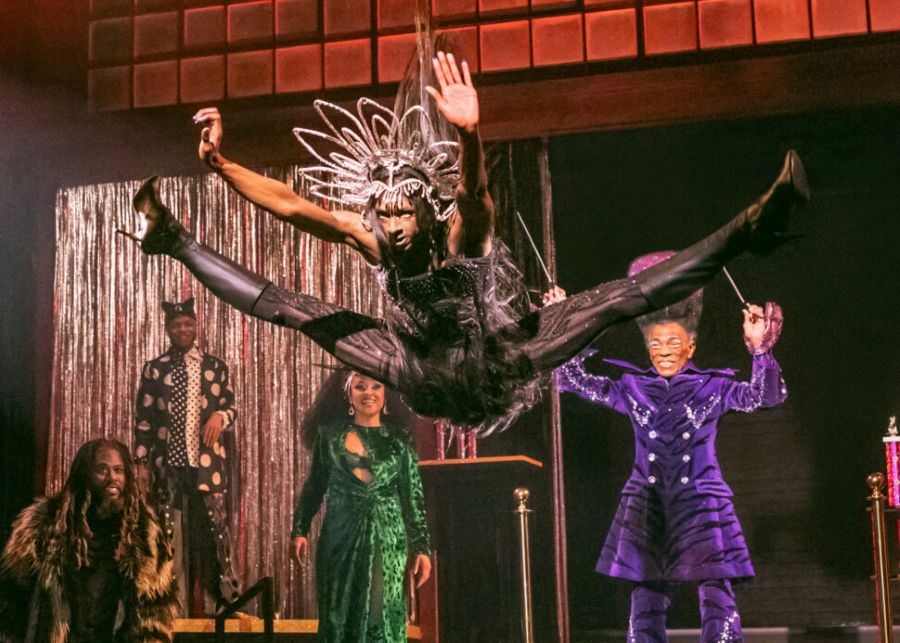
In fact, come to think of it, a kind of devotional irreverence—a resistance to received traditions in favor of fresh rigor and intention—has also characterized the work of director Bill Rauch, who I’ve been following (and been personally friendly with, full disclosure) for more than three decades, first at Cornerstone Theater Company, the theatre-in-community organization he co-ran around the U.S. and the Greater L.A. area for decades, and then at Oregon Shakespeare Festival, which he ran from 2007 to 2019. He now runs the multidisciplinary Perelman Arts Center in lower Manhattan, which is where in 2024 he first staged, with co-director Zhailon Levingston, a radically reconceived queer-ballroom version of the Andrew Lloyd Webber confection Cats, with the added subtitle The Jellicle Ball.
That Cats is now gloriously strutting its stuff at Broadway’s Broadhurst theatre and collecting nearly unanimous bouquets; many critics who are otherwise lukewarm at best on Lloyd Webber’s musical feel that it makes a strange new kind of sense when situated in the glamorous world of ballroom—an underground LGBTQ culture that sprung up, as the original Grizabella, Betty Buckley recently noted, concurrently with the 1980s rise of Cats. It’s a historic convergence, yes, but it’s also a huge party that seems to unlock something that was always waiting to be discovered in this material—its deep and inscrutable singular name, if you will.
This is not Rauch’s Broadway debut (that was 2014’s All the Way, the Robert Schenkkan-penned drama about LBJ that Oregon Shakes had commissioned as part of its American Revolutions series), but it could properly be thought of as a new milestone for him. Not because he is co-directing (which he’s done only a few times before), or because he’s bringing back to Broadway a popular-but-divisive property, or because it definitely has the largest budget he’s ever come close to. No, for Rauch part of what sets Cats: The Jellicle Ball apart, as he’s been telling me for some time now, is that it it’s “the most Cornerstone show I’ve worked on since I was with Cornerstone.”
That may not sound like a startling claim if you don’t know Cornerstone. Started by a group of Harvard grads in 1986, including Rauch, Alison Carey, Rauch’s husband Christopher Liam Moore, and Amy Brenneman, among others, this scrappy company traveled the country in a battered blue van to stage freely adapted classics in rural communities, casting locals alongside their own acting troupe and demonstrating the power of grass-roots theatre to both reflect and create community, before settling in L.A. and applying this ethos to under-served populations throughout the Southland (Pacoima, Watts, Boyle Heights), and training or inspiring generations of theatremakers in their ethos (Lincoln Center Theater’s Lear deBessonet is just one who cites their work as an influence). Los Angeles is where I first encountered their work, and among the many things I cherished about Cornerstone is that it helped me see my adopted city, and the medium of theatre, in new and invigorating ways.
To give the most vivid example, 1995’s The Central Avenue Chalk Circle, a free contemporary adaptation of Brecht by Lynn Manning which culminated Cornerstone’s years-long Watts residency, brought together audiences and actors of all ages and many backgrounds into one of the best nights of theatre I’ve had the privilege to see. And I say entirely without condescension that, from its poor-theatre production values to its pay-what-you-can ticket prices, not to mention its location in a former Watts labor hall, it was about as far from the lights of Broadway as you could imagine. (This has remained true of Cornerstone’s ongoing work, as we’ve reported over the years.)
So what could my friend Bill possibly mean when he says that Cats, of all shows, is like a Cornerstone production?
“I feel like Cats: The Jellicle Ball is the ultimate piece of community-based theatre, in that it’s taken artists from the theatre world and artists from the ballroom world and made a play together,” Rauch said recently over a meal. “So it’s had all the glorious mess of trying to find a process that constantly invents a meeting place between two different worlds, right? It’s been a very chaotic and deeply rewarding process for everybody. That has also reminded me a lot of a Cornerstone show.”

I know from covering (and in a few cases appearing in) Cornerstone shows what he’s talking about, from the scheduling headaches of working with non-professional actors with pressing outside commitments, to the creative challenges involved in working with folks doing theatre for the first, possibly only time. It can indeed be a crazy-making process, but it holds the exquisite promise of producing beautiful, syncretic art that otherwise wouldn’t exist. In resetting Cats in the ballroom world, Rauch and co-director Levingston were adding a level of difficulty, and presumably interest, to what could otherwise have been just another Broadway retread. And their task was to bring together not pros and amateurs, as in Cornerstone’s work, but two different kinds of pros, seasoned Broadway triple threats and ballroom unicorns, among whom the friction arose less from disparate levels of commitment or stage experience than the “unspoken rules and traditions in each world that are foreign to the other world.” As examples, Rauch mentioned “the fact that the show is freezing so critics can come,” a practice ballroom performers aren’t familiar with. Another: “How and when you comment on somebody else’s performance is different in each world.”
The juice has been worth the squeeze, he said, because the end goal was always in sight.
“In the best of any Cornerstone project for the 20 years I was part of it, the spirit of whatever community we were collaborating with was at the heart of the project,” he said. “This is a Broadway musical, originally created in the commercial marketplace, and at the heart of it, it’s a piece about ballroom.”
This alignment wasn’t just about the cohesion of the performing company; it began with the adaptation he spent months developing with Levingston and two other key collaborators, co-choreographer Omari Wiles and dramaturg Josephine Kearns, whose collective tinkering continued up to the Broadway opening.
“Our mantra was that any choice we made had to be equally good for Cats and for ballroom,” Rauch said. “Like, if we thought of something that was really authentic to ballroom but it made no sense in Cats, it was a bad choice, and if something was really good for Cats but it had no context in ballroom, it was a bad choice. So we had to keep pushing ourselves collectively to find choices that were exciting in both worlds.”
The solutions involved finding ballroom categories to fit each Cats song and character: Rum Tum Tugger in Realness, which tests how well contestants can pass as straight; Mungojerrie and Rumpleteazer in Tag Team; Mistoffelees in Runway; Bustopher Jones in Body, and so on. Presiding over the proceedings are elders from both communities: veteran Broadway hoofer Andre De Shields as Old Deuteronomy, and ballroom icon Junior LaBeija as Gus, the old “theatre cat” who mostly watches the proceedings from a box seat, like visiting if superannuated royalty.
These layers of earnest dramaturgical detail pay off in ways both observable and intangible. We can see it in Qween Jean’s eye-popping costumes and the choreography by Wiles and Arturo Lyons, and we can witness it embodied in all the performances. But we can also feel a level of joy and celebration coursing through the show that is probably best explained by deep community investment—a lot like the euphoric, we’re-all-here-together feeling uncorked by a good Cornerstone show, I must in fact concede.
“Hopefully what the show does,” Rauch said, “is allow everybody to unleash the energy they would unleash at a ball, whether you’ve been to a ball before, whether you’re a 20-year veteran of balls, or whether it’s your first time attending anything resembling a ball.”
Seen Around Town
In addition the shows above, I also took in the oddball Aussie import Burnout Paradise, in which four performers must execute various assigned tasks while on treadmills within time limits or they offer patrons’ money back. Now at the Astor Place Theatre, where Blue Man Group ruled for decades, it has some of that show’s sui generis indeterminacy and feral extra-theatricality, if not quite the same transfixing power…
Encores’ ambitious staging of Michael John LaChiusa’s The Wild Party had a sensational cast and a knockout orchestra led by Daryl Waters, though I have to say overall that this felt like one of those intermittently brilliant, over-torqued hothouse pieces that is roughly equal parts impressive and oppressive…
I had trouble tracking every beat of Jeena Yi’s Jesa, a Ma-Yi Theater production at the Public Theater through April 12, but its quartet of killer performances (Tina Chilip, Christine Heesun Hwang, Laura Sohn, Shannon Tyo) make this story of millennial Korean American women facing intergenerational ghosts (occasionally literally so) worth seeing…
On Broadway, I saw in quick succession, and reviewed for America magazine, the inspiriting Every Brilliant Thing, the crackling, substantive Giant, and the largely disappointing Dog Day Afternoon. I also saw Cats, noted above, and Gina Gionfriddo’s Becky Shaw, a nasty relationship comedy designed to stick in your craw, arguably to a fault, though I was mostly thrilled to go along for the ride, much as I was for the original Second Stage production in 2008. As good as that one was, Trip Cullman’s new revival surpasses it…
In the world slightly beyond theatre, I happened to take in Dies Irae, a stunning, semi-staged concert curated by violinist Patricia Kopatchinskaja at Princeton Chapel, which enlisted a small orchestra and a choir to sample sacred and/or enraged works from a wide range of centuries, with the centerpiece being Galina Ustvolskaya’s harrowing take on the title text, for which Kopatchinskaja put down her violin to hammer powerfully on a sort of coffin alongside eight double basses and piano. It was one of those pieces that isn’t all that long in actual running time but feels durational in the best way—i.e., takes you out of time and seems to give a glimpse of the eternal…
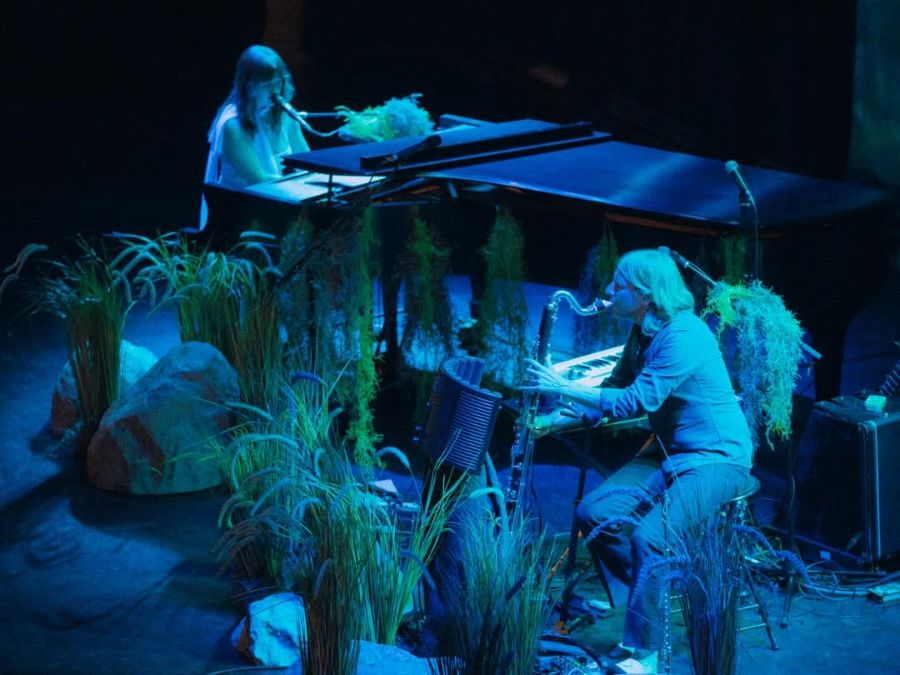
Similarly ageless: the genius of singer-songwriter Madison Cunningham, whose April 1 show at Town Hall saw her jettisoning a backing band to join just multi-instrumentalist Jesse Chandler on a kind of marshy stage set for a program of mesmerizing, introspective tunes. Felt a bit like theatre to me.
What Else Is New
To close, as usual, here’s my survey of April world premieres nationwide. (If you’ve got one coming up, please alert me at rwkendt@tcg.org)
South
The centerpiece of Actors Theatre of Louisville’s Storytelling Revolution Festival is Benjamin Benne’s Wave After Wave, about the intertwined lives of two cousins over a century. Directed by Amelia Acosta Powell, it runs April 1-12.
Lies, Spells and Old Wives’ Tales is a new musical comedy paying tribute to generational wisdom, adapted and created by Nate Jacobs and Michael Jacobs and directed by the former. It runs at Westcoast Black Theatre Troupe in Sarasota, Florida, April 8-May 17.
The rolling world premiere of Steve Yockey’s Venus, a dark rom-com about two women who are having a hard time breaking up, kicks off at a theatre where Yockey has been premiering his work for decades, Atlanta’s Actor’s Express, April 9-May 3, with Melissa Foulger directing. Future productions will be at Dallas’s Kitchen Dog Theatre in June and a two other partner theatres yet to be announced.
In S. Asher Gelman’s The Zionists: A Family Storm, a prominent Jewish family fractured by politics in the aftermath of Oct. 7 gathers for a fragile reunion at a luxury Caribbean resort. Under Chloe Treat’s direction, it runs at Miami New Drama April 11-May 3.
Brad Erickson’s The Ocean We Swim In, at Charleston, South Carolina’s PURE Theatre April 15-May 9, follows a canceled art critic seeking refuge and finding drama in SC’s Lowcountry. PURE artistic director Sharon Graci directs.
Spare a thought for the copy editors having an aneurysm over the title of Robert Schenkkan’s new play, ReCON$truXion, which tells the remarkable post-Civil War story of the first Black Speaker of Mississippi’s House of Representatives, John Lynch. Commissioned by Montgomery’s Alabama Shakespeare Festival for its New Southern Canon, it runs there April 23-May 3.
AGUARDIENTE: Where Magic Transcends Borders is a new musical about immigrant writers from Colombia and Puerto Rico from the similarly derived team of Luis Salgado and Daniel Alejandro Gutiérrez: Salgado, who also directs and choreographs, wrote the book and co-wrote the lyrics with composer Gutiérrez. It runs at Washington, D.C.’s GALA Hispanic Theatre April 30-May 31.
In Gracie Gardner’s new play Saturn Return, at Dallas’s Undermain Theatre April 30-May 24, a group of 30-something friends who grew up together as “theatre kids” reunite for a friend’s funeral. Direction is by Christina Cranshaw.
Midwest
In The Official Biography by Kurt McGinnis Brown, a young journalist/critic squares off with a curmudgeonly writer who may be hiding a big secret. A production of Her Story Theater, it’s directed by Richard Shavzin and runs at the Den Theatre in Chicago April 1-19.
A commission from St. Paul, Minnesota’s Theater Mu, Katie Ka Vang’s Hmong Futures: The Future of Us was in the works long before the Twin Cities were subjected to the notorious and deadly ICE raids of early 2026, in which the cities’ Hmong communities were among those targeted. This intergenerational story of healing among three generations of Hmong American women is certain to resonate even more strongly in its April 9-May 3 run at Mu.
Awoye Timpo directs Windfall, Tarell Alvin McCraney’s new play about a Chicago man offered a cash settlement by the city after his son is shot by the police. It runs at Steppenwolf Theatre Company in Chicago, April 9-May 31.
Out Here, a new musical about a woman with a husband and family who would like to also make her ex-girlfriend part of their lives, has a book and lyrics by Leslie Buxbaum, music and lyrics by Erin McKeown, and dramaturgy by David J. Levin, and is based on a concept by Buxbaum, Levin, and McKeown. Directed by Chay Yew, it runs at Chicago’s Court Theatre April 10-May 10.
Also at Chicago’s Steppenwolf Theatre April 11-May 10 is Teatro Vista’s production of Both by Paloma Nozicka, about a woman whose mysterious twin resurfaces after an absence. Georgette Verdin directs.
The Fiancé by Emily Bohannon follows a woman who meets the man of her dreams when she moves into a retirement home. Directed by Adam Knight, it runs at Riverside Theatre in Iowa City, April 16-May 3.
Upstream Theater artistic director Philip Boehm has adapted Austrian Jura Soyfer’s 1936 interplanetary satire Weltuntergang into a new work titled The End of the World Cabaret. Directed by Lizi Watt, it runs at Upstream in St. Louis, April 17-May 3.
When three kids are fighting, a Chinese grandmother takes the opportunity to teach them about the origin story of the Chinese Zodiac animals in Wai Yim’s The Great Race, which runs at Omaha, Nebraska’s Rose Theater April 17-May 3.
Sarah Aptilon’s The Signer, billed as “an intimate and powerful theatrical experience exploring communication, identity, and the many ways human beings connect beyond spoken words,” runs at Spinning Tree Theatre in Overland Park, Kansas, April 17-26.
It’s always a history worth remembering, but Habib Yazdi’s dark comedy Ajax—about the CIA-backed coup that helped install the Shah of Iran in 1953—is certainly going to hit different now. Directed by Kareem Fahmy, it runs at Idaho’s Boise Contemporary Theater April 22-May 9.
At the Solidarity and Truth Summit depicted in Hanna Kime’s The Targeted, the world’s most persecuted individuals plot their next steps. Directed by Grace Dolezal-Ng, it runs at Chicago’s A Red Orchid Theatre April 23-May 31.
Loki: The End of the World Tour, a playful rock musical based on Norse mythology, has a book by Christina Calvit and music and lyrics by George Howe. Directed by Heather Currie, it runs at Chicago’s Lifeline Theatre April 24-June 14.
West
In Gabriel Rivas Gómez’s Level Up!, a trans tween faces the challenges of coming out in both the real and virtual worlds. Directed by Fidel Gomez, it runs at Los Angeles’s Latino Theatre Company through May 3.
Anita, a new pop-and-cumbia-inflected musical by Milta Ortiz and Quetzal Guerrero, tells the story of a girl in a youth shelter scheming to reunite her family. It runs at Borderlands Theatre in Tucson, Arizona, April 2-19, with Chach Snook as the director.
E.M. Lewis closes her Mellon residency at Portland, Oregon’s Arists Repertory Theatre with Apple Hunters!, about an adult reunion of bros striving to revive their childhood closeness. With direction by Zeina Salame, it runs April 4-26.
Developed in Latino Theater Company’s Circle of Imaginistas playwriting group, Evelina Fernández’s The Storyteller of East L.A. is about memory loss, caregiving, family conflict, and the sustaining power of love. Directed by Jose Luis Valenzuela, it runs at LTC in Los Angeles, April 9-May 17.
At their new space in Santa Monica, California, the Ruskin Theatre Group will stage Stephen Fife’s Blue Kiss, a drama about an SAT tutoring session that takes an unsettling turn, April 10-May 17. The director is Mike Reilly.
Amadeus Never Gives Me the Blues, written and performed by Amy Bouchard, follows an opera singer torn between career and family. It runs at the Marsh in San Francisco, April 11-May 23, under David Ford’s direction.
Talene Monahan’s Eat Me, at South Coast Rep in Costa Mesa, California, April 12-May 3, follows a group of rabid foodies and looks at what’s really behind their obsession. Directed by Caitlin Sullivan, it runs April 12-May 3.
Monster Party, an interactive play devised by Matt Dorado, places audiences amid the sociopolitical drama of the Lavender Scare in 1950s-era Washington, D.C. The show runs April 16-25 at Rita House in Los Angeles.
In Tom Jacobson’s Hell Mouth, a young Midwesterner faces a culture clash when he happens to discover an unknown Caravaggio painting. It’s at the Road Theatre Company in North Hollywood, California, April 17-May 24. Ann Hearn-Tobolowsky directs.
Amy Berryman’s comedy Alien Girls traces a friendship that falters over public and private revelations, with Jaki Bradley directing an April 18-May 10 run at the Old Globe in San Diego, California.
Shades of Albee’s The Goat: In Olivia Dufault’s For Want of a Horse, a man implores his wife to open their marriage to an equine partner. Directed by Elana Luo, it runs at Echo Theatre Company in Los Angeles, April 18-May 25.
In Warsaw, a septuagenarian near the end of her life is visited by the people she means the most to. Written by Paul Webb and directed by caryn desai, it runs International City Theatre in Long Beach, California, April 29-May 17.
Northeast
Tim McGillicuddy’s Fanny, a Fantasy in G tells the story of Fanny Mendelssohn, Felix’s talented but under-sung composer sister, as she struggles for recognition in 19th-century Berlin. Directed by George Abud and produced by Off-Brand Opera, it runs through April 19 at A.R.T./New York Theatres in New York City.
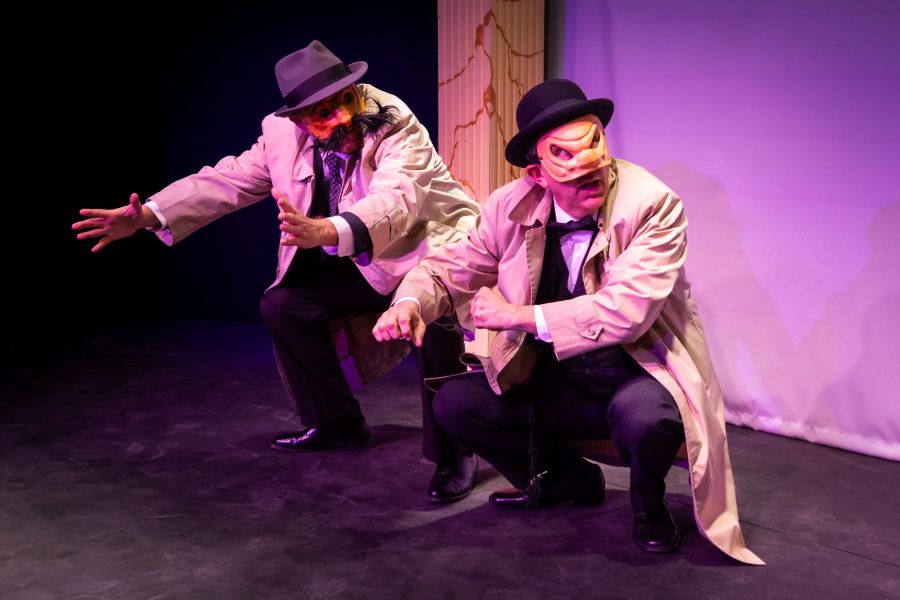
Sacco & Vanzetti: A Tragedia dell’Arte, written and directed by John Bellomo, is about the early-20th-century anarchist immigrants executed for sedition. It runs at Philadelphia’s Curio Theatre Company April 1-18.
Call it Bullets Over Boston: In Matthew Lombardo’s new comedy, a writer’s Broadway-bound play is in jeopardy when he’s forced to work with an impossible diva in When Playwrights Kill, running at Beantown’s Huntington Theatre under Noah Himmelstein’s direction, April 3-18.
A few big names are attached to The Pushover, a new comedy “about three bad-ass women who collide and collude at a spa in New Mexico and a bare-bones Asian restaurant in Queens,” which premieres at the Chain Theatre in New York City April 3-26: lead actor Rebecca DeMornay and the playwright, none other than John Patrick Shanley. The director is Kirk Gostkowski.
Commissioned by Art2Action, James Scruggs and Thomas Giovanni’s Off The Record: Acts of Restorative Justice, billed as a “performance, intervention, and invitation to walk an energizing path from despair to agency,” runs April 5-19 at HERE Arts Center in NYC. It’s directed by Michael Rohd and Annalisa Dias.
Kyle Bass’s The Black Nationals doesn’t just happen to be running in New York’s Syracuse Stage, April 7-25—it’s set in that very city in the 1950s, as two Black NBA players navigate their sport’s color barrier. The director is Gilbert McCauley.
Angkor Dance Troupe presents A Khmer Swan Lake, a blend of Western ballet and Cambodia’s Robam Kenore traditional dance, directed by Phousita Huy, at Merrimack Repertory Theatre in Lowell, Massachusetts, April 8-26.
Wilderness Generation is the newest effort from Pulitzer winner James Ijames. Directed by Taibi Magar at Philadelphia Theatre Company April 10-May 3, it’s about a Southern family reunion that goes from a celebration to a reckoning.
It’s about time we had a sea-shanty musical, which is exactly what’s promised by The Chequerboard Watch, at Wilmington’s Delaware Theatre Company April 15-May 3. It has music by Jack Denman, a book by Selena Seballo, and a story credited to them alongside Eyakeno Ekpo and Mimi Warnick, who conceived the whole thing.
Cumulo is a non-verbal puppetry piece by Emily Batsford about “the accumulation of self and the experiences that shape us,” presented at MITU580 in Brooklyn, April 15-May 3.
Sir Ranjit Bolt translated Molière’s final play and titled it The Hypochondriac (it’s often called The Imaginary Invalid in English) more than 20 years ago, and Philadelphia’s Quintessence Theatre was set to give it its U.S. debut this year. Their plans hit a snag when Bolt contacted the theatre to report that he’d lost the translation due to hard drive fire—then, a week later, wrote to tell them he’d written up a new translation. Does this make it a world premiere? It’s such a great story, I’ve got to allow it. It runs at Quintessence April 15-May 10, under Trey Lyford’s direction.
Norwegian playwright Monica Isakstuen’s Beyond That, Nothing Is Certain, billed as “a deconstructed melodrama—a theoretical tear-jerker,” gets its English-language premiere at the Cherry Arts in Ithaca, New York, in Neil Howard’s translation and under Samuel Buggeln’s direction, April 17-26.
Saymoukda Duangphouxay Vongsay, commissioned by Philadelphia’s InterAct Theatre Company to write one of the three plays in its Philly Cycle, based Seng’s Hair Salon on interviews with members of the local Lao community. Directed by Chongren Fen, it runs at InterAct April 17-May 10.
Comedy Tonight! is the theme of the one-act evening presented by Connecticut Repertory Theatre in Storrs, April 23-May 3. The offerings include David Ossman’s stage adaptation of The Firesign Theatre: The Further Adventures of Nick Danger, Third Eye, directed by Sandy Carroll, and Jillian Blevins’s The Polycule, A Comedy of Manners, with direction by Michael Samuel Kaplan.
The title is Love Story, but the description of Aurora Stewart de Peña’s new play sounds closer to a ghost story, as a dead actor gets trapped in a show she can’t stop repeating. Directed by Rose Burnett Bonczek, it runs at the Tank in New York City, April 23-May 17.
She Gets Around is Jennifer Childs’s new solo comedy, in which a dive into her closet shows that every outfit has a story. Directed by Harriet Power, it runs at 1812 Productions in Philadelphia, April 24-May 17.
Last but not least, Talking Band’s newest production, The Door Slams, A Glass Shatters, a Thomas Mann-inspired play about two planes of reality that meet onstage to reflect on mortality and complacency, runs at La MaMa April 24-May 10. Paul Zimet is the writer and director, and Talking Band co-founder Ellen Maddow has written the music.