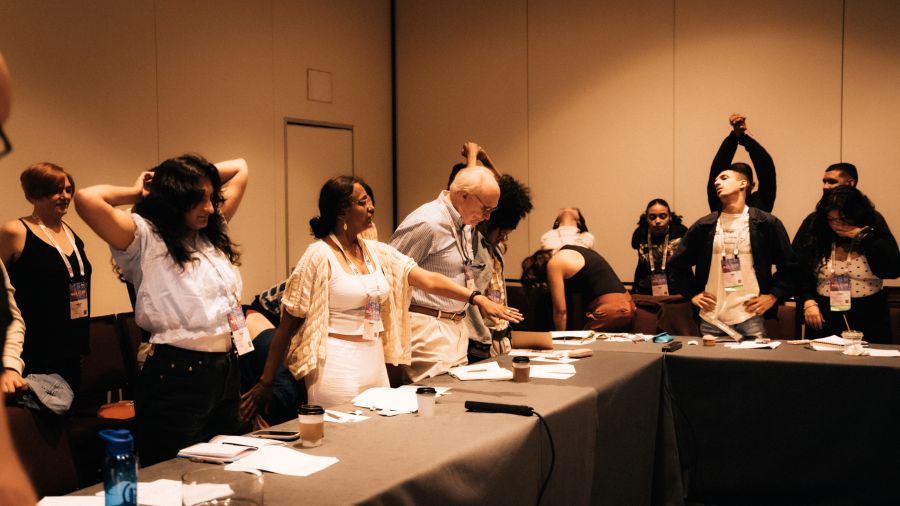
The first thing we did was pour a libation, but instead of water or rum, we poured names.
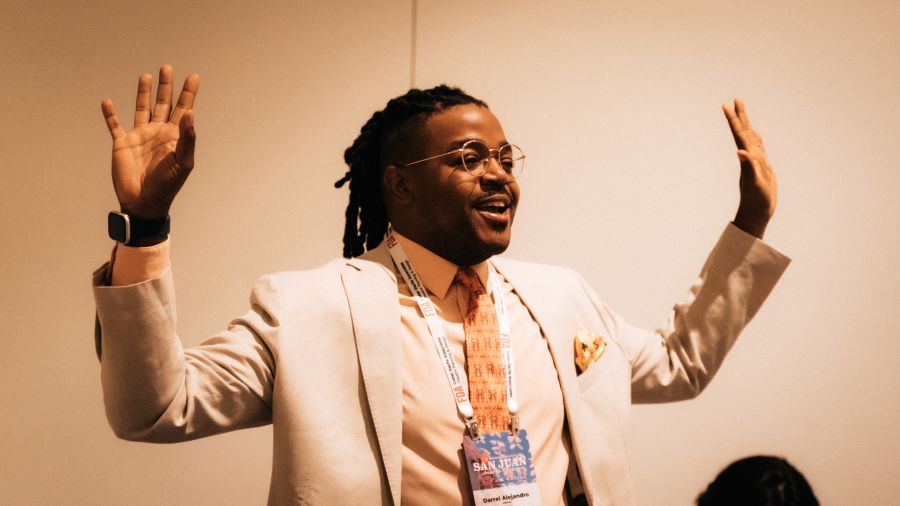
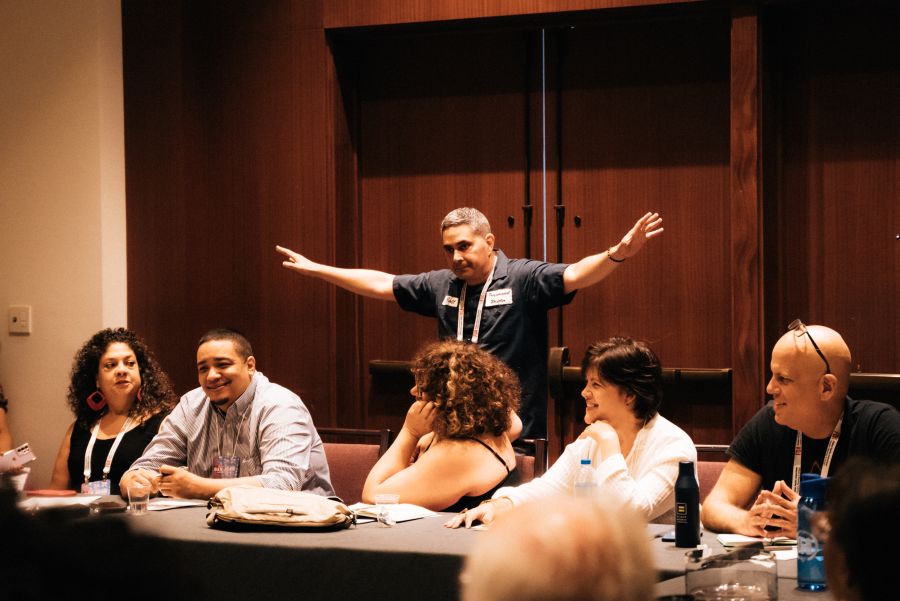
It was morning in San Juan. I had come to TCG’s National Conference to lead a practice lab called “Writing as Ritual: A Candela Workshop,” and I wanted the room to begin the way so much of the African diaspora begins its gatherings: by honoring the ones who came before. Puerto Rico felt like the right ground for it. A Caribbean crossroads, it is a place that has always held more than one inheritance on a single island, which is also a fair description of every writer who walked in that door.
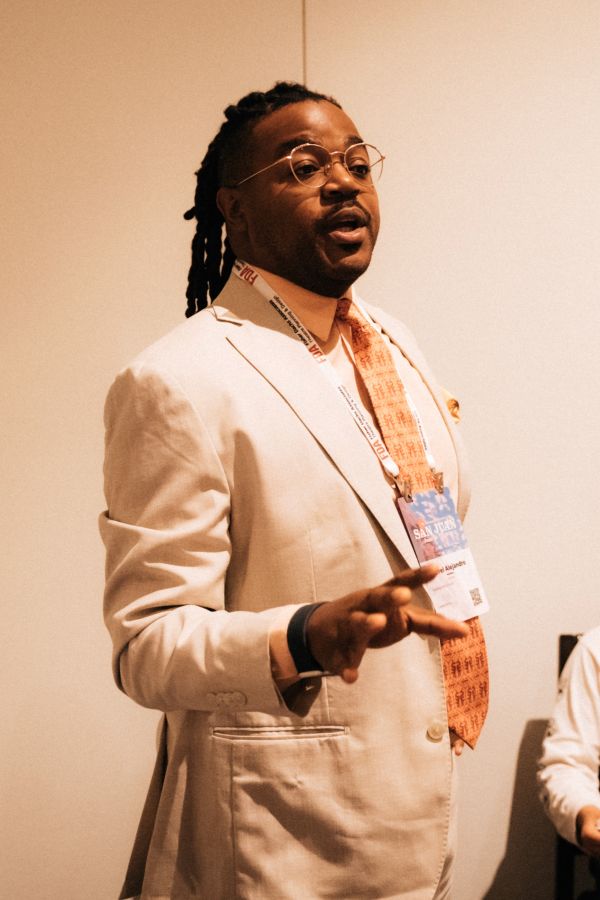
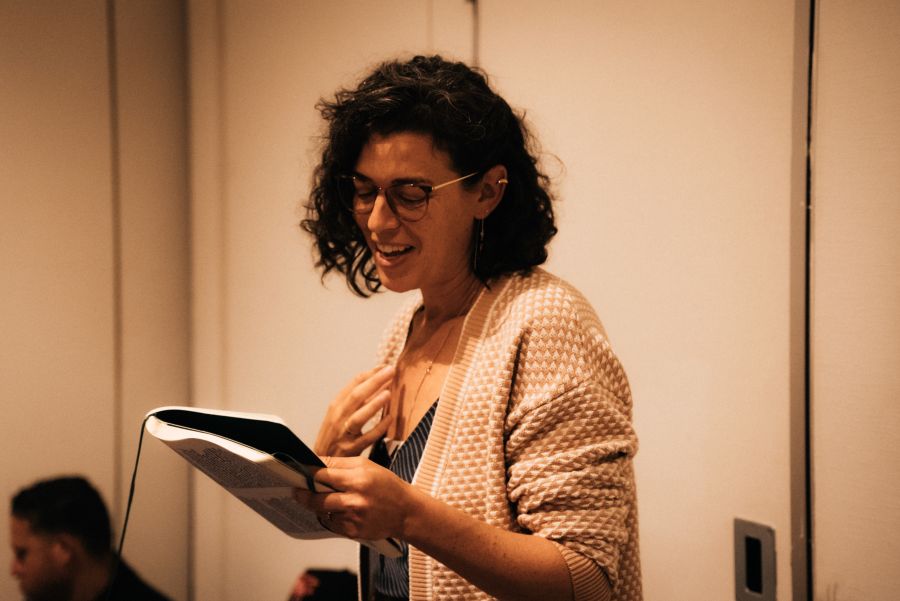
So I gave everyone a sheet of paper and asked them to write the names of those they write in the company of. Ancestors. Teachers. Places. The particular spirits each of us carries into the work whether we admit it or not. Then the names needed a bowl to gather in, and a conference does not hand you a bowl—it hands you a tote bag. So the tote bag became the bowl, which is about as concise a summary of how Candela does everything as I could give you. The names went in, the bag traveled the circle, and as it moved, the room whispered the names aloud, all of them at once, until the whispering sounded like rain.
The last step is always fire. In my own practice I burn the paper and let the names lift into smoke and go where names go. The transformation is the point. A hotel ballroom has opinions about open flame, so we improvised. On a count of three the whole room said the word at once, poof, and lit the names in the air between us, and then we applauded the blaze we had agreed to see. No match, no smoke, no alarm. The offering still went up.
Nobody in that room was performing yet. And yet everybody was. We were deciding to believe something together. Repetition would make this ritual, but what we had was ceremony. And ceremony is where you start.
That is the wager of Writing as Ritual, and it is the same wager I have built a fellowship around. Theatre people know intuitively what a page of craft advice can spend a thousand words failing to say: The conditions we write in shape the writing. We stretch before we dance. We warm up before we sing. We build a callboard, a green room, a ghost light. Yet when we sit down to generate new pages, many of us do it cold; we feel alone, and slightly ashamed, as if the summoning of language were supposed to require no ceremony at all. You don’t have to feel that way. You can make a different choice and at least be open to seeing what ceremony, and through its repetition, ritual can bring.
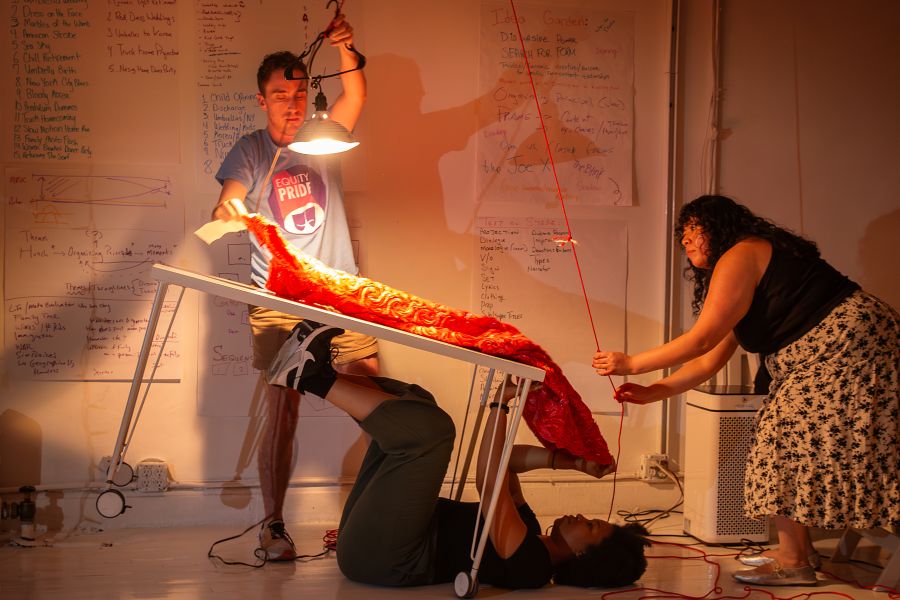
Ritual is how we start each day at Candela, the week-long theatre education program I founded, which has for four summers welcomed 62 musical theatre writers, playwrights, librettists, and choreopoets from around the world, to join faculty from across Broadway and the industry at large to learn and exchange both ancient and innovative practices that are inclusive of cultural and artistic traditions from Latin America and the Caribbean. (This year’s runs July 12-19 in New York City.)
This ritual was an opener and a closer for the workshop. In between, Candela faculty Quiara Alegría Hudes (My Broken Language, In the Heights) and Kristoffer Diaz (Hell’s Kitchen) presented their own writing as ritual exercises and discussed their own individual beliefs around writing as ritual practice.
Object, Action, Transformation
Here is the working definition I gave the room, and the one I will give you. It is a formula: a ritual = an object + an action performed with intention + a transformation. Rinse and repeat. In practice, you take an object, use it in an action charged with special intention, and then transform that object. The names were the object. Writing them and speaking them was the action. The fire was the transformation.
It helps to have a witness, and the witness does not have to be alive. The ancestors whose names you just called are watching. The teachers, the spirits you wrote down in reverence—they are your audience now, and you make the ritual for them. Even alone at your desk, someone sees it done, if only the part of you that keeps watch. There is always at least an audience of one.
Say that slowly and you will notice you have also described theatre. A play is repeated nightly. It is shaped by intention down to the placement of a toaster on the stage. Object, action, transformation, and by the end of the night something up there, or in the house, is not what it was. None of it happens without witness. The audience is not decoration; the audience is the ritual’s final ingredient, whether they sit in the dark in front of you or stand just behind you, where the dead keep watch.
So when I ask a playwright to build a small ceremony around the act of writing, I am not asking them to add something foreign to their practice. I am asking them to bring the same seriousness to the making that they already bring to the made. The blank page deserves a ghost light too.
I built Candela to set a larger table and to refuse, on principle, to seat anyone at its edge. That means centering the writers our own communities have a long habit of pushing to the margin: the Black and Afro, the Indigenous, the Indo-Caribbean, the Brazilian, the ones whose first languages fall outside a single Spanish colonial inheritance. Ritual is where a Candela day begins. Before dramaturgy, before the hard and joyful labor of revision, we pour the names. We locate ourselves. We remember we are not the first to sit down and try to turn breath into structure, and we will not be the last.
The name carries the rest: Candela is an ancestral word for candle, for flame. The fellowship exists to light a fire in each writer so they can go their own way, and in turn light the path for whoever comes next. Which is why the ceremony I am about to hand you begins the same way the word does.
You do not have to come to Candela to practice this. That is the whole point of ritual: It belongs to the people who repeat it. It is a way of making your own 10-minute Candela at home. Here it is, four movements, adapted so you can keep it at your own desk, alone or with a few others who write.
The Ceremony at Home
- One: Say their names. Light a candle. Write, by hand, the names of those you write alongside you or have written so you could write, so that you could spell: ancestors, teachers, writers you look up to, the spirits you carry. Do not curate. If a name arrives, it belongs. You need no special bowl for this. A hat, a mixing bowl, a tote bag, anything that gathers will consecrate itself in the using. Then say the names aloud. Speak them into the room. If you are with others, let everyone read theirs at once, overlapping, until it sounds like rain. The speaking is the blessing. These names travel with you into everything you write that day.
- Two: Set intention. One sentence, on a small piece of paper: What did I come here to write, or to release? Then fold the paper small and put it on your body, in a pocket, against your heart. Do not share it. Carry it. Something planted in the morning wants to be harvested at the close, and the carrying is how it stays alive in you while you work.
- Three: Write to a prompt. You can free-write for 15 minutes here, but I would point you toward a prompt instead. Here is one that students have enjoyed: Tell the story of an element. Water, fire, wind, whichever one is already in the room with you. Give it a setting. Give it a threat it must face, an origin, a handful of characteristics no other element can claim. Take it from a beginning to an end. What you make can be the first few lines of a story, a monologue in the element’s own voice, or simply a list of story elements you carry into a play, a musical, an opera, a poem, whatever form comes to claim them later. The point is to look at the natural world through a human lens, and to practice working with these story elements while the stakes are low. For readers who want an additional challenge and who have more time, make sure the science behind your story is sound. It is the hardest part and can be the most fun.
- Four: Say farewell. When the writing is done, do not simply stand up and walk away. Say thank you and say goodbye. Pull language directly from what you made that day and complete three lines: I leave behind…I carry with me…I promise my next page… Then unfold the intention you have carried since morning and read it against those three lines. See what kept its promise. See what changed.
In the workshop, each voice offers a single closing line aloud and the room composes a poem it did not plan. At home, offer your line to the candle as a means of offering it to the ancestors, or offer it to a living friend, or to the notebook. Many voices, one song, even when the voice is only yours.
- Five: Close it out. Just as you can pour a libation to start, you can also close out the ceremony with a libation of some sort—offering a drink to ancestors, guides, or muses whose meal you just ate, whose ideas just moved through you, who shared their bits of inspiration. Alternatively, if you’ve been burning a candle throughout your writing process, this can be a time for you to put out the candle and take what you can of the ash to bury it and return it to its source: the Earth. A fun alternative is to take a mini marshmallow and roast it over the candle’s flame and consume it when you put the candle out. Eating is another way to transform an object and to end the life of a thing, transitioning its matter from one function—nourishing your artistic practice—to another: nourishing your body and appetite.
That is the ceremony. It costs nothing. It fits in a lunch break. And it will change what the writing knows about itself.
Come Write in Our Company
Candela exists because I believe these practices deserve a room, a week, and a company of makers to hold them, at no cost to the writer. If you are an emerging theatre- or performance-maker with heritage in Latin America and the Caribbean whose work carries more than one country, more than one language, more than one inheritance, consider applying. The program is free, and every fellow leaves with a year of Dramatists Guild membership, so the day you finally say what your work is worth, real weight is standing behind you. The program is co-directed by Dr. Daphnie Sicre and presented in partnership with the Dramatists Guild of America and the Latinx Theater Commons.
And if you are reading this as an artistic director, a professor, a literary manager, or a friend, please send the eligible writers in your life our way. The people who most belong in a room like this are often the ones least likely to nominate themselves.
Darrel Alejandro Holnes is an Afro-Panamanian American playwright and theatre auteur, and the founder and program co-director of the Candela Playwrights Summer Fellowship. He teaches at Medgar Evers College, CUNY, and at the Gallatin School of Individualized Study at New York University. For more information check out candelafellowship.com, and darrelholnes.com.
Support American Theatre: a just and thriving theatre ecology begins with information for all. Please join us in this mission by joining TCG, which entitles you to copies of our quarterly print magazine and helps support a long legacy of quality nonprofit arts journalism.