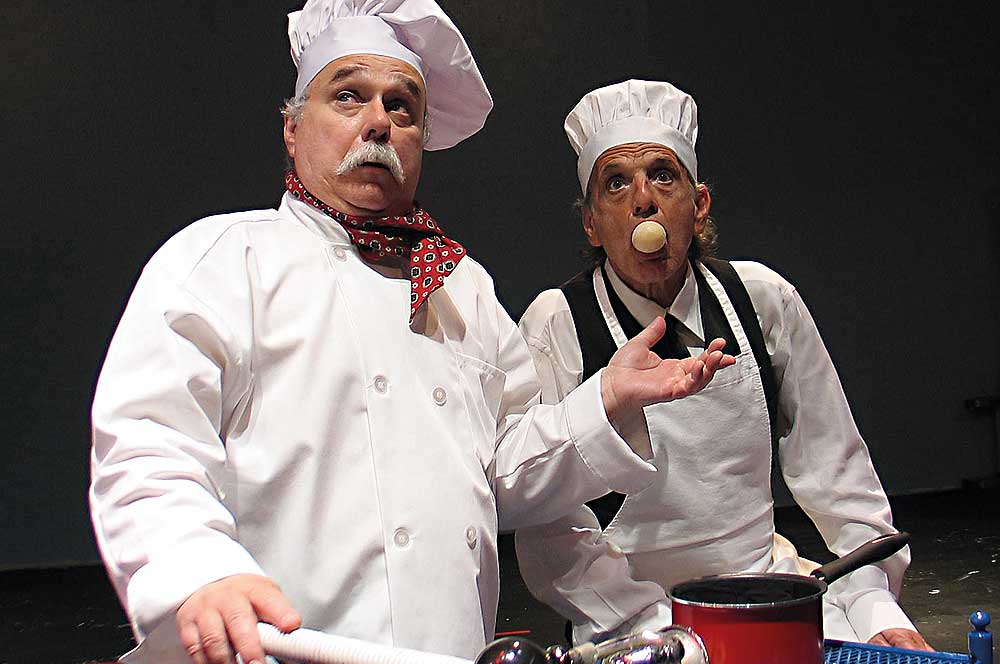
“When I was a young man in Romania…I remember how everyone around me converted to fascism, till it seemed to me that I was the only one left in the world,” the playwright Eugène Ionesco told an interviewer in 1961. “It seemed to me at the time that although I was the most insignificant of creatures, a terrible responsibility had befallen me, and that, somehow, I would have to do something, or rather everything. Isn’t this the plight and privilege of the modern hero?”
He dramatized the plight of the “modern hero”—or the “hero in spite of himself,” to borrow Ionesco’s own phrase—in his 1959 play Rhinoceros. Its lead, Bérenger—a recurring protagonist who also appears in Ionesco’s The Killer and Exit the King—is hardly a conventional hero. Habitually disheveled, prone to drinking, and vaguely disengaged from his own life, Bérenger initially seems the least likely person to resist anything. Yet when those around him succumb one by one to an epidemic of “rhinoceritis,” it is this rumpled Everyman who retains his human form.
Born of the playwright’s experience watching political fanaticism spread across Europe, it is probably Ionesco’s most well known play, but it has been infrequently mounted in the U.S. After premiering in France in 1960 and reaching Broadway the following year, it has appeared on American stages only sporadically. This year, however, the play has enjoyed an unusual resurgence, with a March production at Yale Repertory Theatre, and, beginning this month, at American Repertory Theater in Cambridge, Massachusetts (it runs Aug. 21-Sept. 27). Directed by Diane Paulus and starring John Turturro, Paul Giamatti, and Tatiana Maslany, the ART production arrives at a moment when public life feels increasingly defined by ideological polarization, competing realities, technological upheaval, and anxieties about what it means to remain fully human.
“I think what makes it so timeless is the fact that Ionesco used this metaphor,” Paulus explained in a recent interview. “It makes all of us ask: What is the rhinoceros, and how do we become rhinoceroses?”
The headlines of 2026 may differ from those of 1959, but the underlying questions have hardly disappeared. What happens when entire communities begin accepting what once seemed unthinkable? How does an ordinary man like Bérenger go from being a spectator to a “spect-actor,” to borrow Augusto Boal’s phrase?
Those questions were hardly abstract for the Romanian-born playwright, who witnessed friends and acquaintances embrace the fascist Iron Guard in his native country. He was especially disturbed by the ease with which individuals could surrender independent thought to the seductions of collective certainty. As he wrote in a preface to his play, the work is “mainly an attack on collective hysteria and the epidemics that lurk beneath the surface of reason and ideas but are nonetheless serious collective diseases passed off as ideologies.”
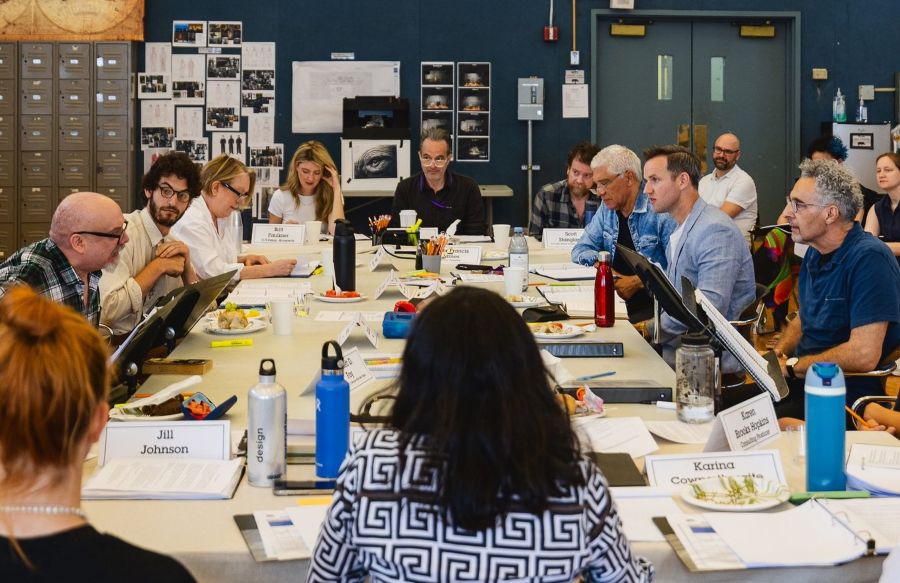
Before rehearsals began for the ART production, Paulus and Turturro—who plays Bérenger—spent nearly a year reading and discussing the play. The seeds for the project were planted in 2024, when Paulus was searching for a classic text to direct after working on Romeo and Juliet. Around the same time, Karen Hopkins, the longtime former president of the Brooklyn Academy of Music, reached out to say that Turturro was looking for a theatrical project to sink his teeth into and had become interested in Rhinoceros.
Working with Ionesco’s estate, ART has created a new adaptation, based on Derek Prouse’s celebrated English translation but with repeated recourse to Ionesco’s original. Paulus, who speaks French, has kept a French-language edition of the play beside her throughout rehearsals, consulting the original whenever a line demanded closer attention. The adaptation also incorporates, with the blessing of the playwright’s estate, passages from Ionesco’s Fragments of a Journal. (A Boston production earlier this year of Ionesco’s Delirium, by Arlekin Players, which will play in Brooklyn in September, also wove parts of the playwright’s letters and diaries into their script.)

The new production, according to Paulus, has been an effort to rediscover the play from the inside. The rhinoceros, she said, is “a force that comes in and is destroying humanity,” but what that force looks like inevitably changes, with the audience bringing their own anxieties into the theatre. Where one person may think immediately of authoritarian politics, another may see the rhinoceros takeover as a stand-in for artificial intelligence, or climate catastrophe, or online radicalization, or the constant acceleration of modern life.
“We get all of that in the news,” Paulus said. “We’re overwhelmed with it. We’re deadened by it.” If not exactly an antidote, theatre can approach those same anxieties indirectly. By nudging reality slightly off its axis, it becomes possible to see familiar fears from an unexpected angle.
That openness is also shaping the production’s visual language. While many stagings have emphasized elaborate prosthetics or lumbering costumes, Paulus has largely resisted that impulse. The actors have studied videos of rhinoceroses during rehearsals for inspiration, and the transformations are intensely physical, but the production, she said, will avoid a “literal interpretation.”
And rather than treating Ionesco’s dialogue as stylized absurdist rhetoric—“Theatre of the Absurd” spoken in quotation marks—Paulus and Turturro want the language to feel immediate, conversational, “from their gut.” That approach has found ideal collaborators in Turturro and Giamatti, who have deftly balanced comedy and psychological depth across film, television, and theater. (Neither was available for this article.)
This production of Rhinoceros marks Paulus’s final production at the Loeb Drama Center before the company moves into the new David E. and Stacey L. Goel Center for Creativity & Performance. “It’s definitely a culmination,” said Paulus, who began directing at the Loeb in 1987, when she was an undergraduate at Harvard. Yet she sees the move less as a farewell than as a bridge. The Loeb’s intimacy and creative energy have shaped generations of artists, and many of those qualities informed the design of ART’s future home.
“In many ways, we’ve outgrown the Loeb,” Paulus reflected. “We’ve never had a rehearsal studio in our building.” The Goel Center, though, promises to “bring everything that we love about the Loeb,” plus rehearsal halls, convening space the lobby, and outdoor yard studios—and a certification from the eco-friendly Living Building Challenge. A transformation that, unlike Ionesco’s, might be worth embracing.
Rhoda Feng (she/her) is a critic based in Washington, D.C., who has written for 4Columns, Artforum, frieze, The Paris Review, The Nation, Dissent, The New Republic, The Times Literary Supplement, Foreign Policy, and more.