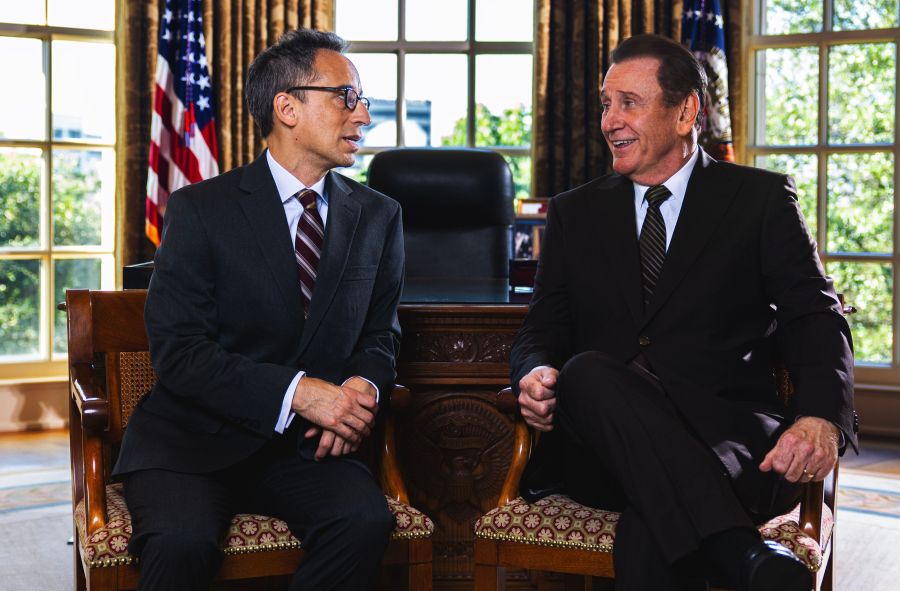
Where better to end a Cold War than in Iceland? That’s one way to spin the summit that climaxes Reykjavik86, Gabe McKinley’s new play at Dallas Theater Center, Sept. 11-27. It follows the unlikely events of 40 years ago, when U.S. President Ronald Reagan and Soviet leader Mikhail Gorbachev met in that frozen capital with hopes not only of thawing relations between the world’s two superpowers but, incredibly, eradicating nuclear weapons altogether.
“There’s something beautiful about this lost moment, and it’s been forgotten by history,” said McKinley, in whose Midwestern family both leaders were demonized at the time. In researching the era’s events, though, he came to a different conclusion.
“Obviously no one ever called Reagan a peacenik, but he did despise nuclear weapons,” McKinley said. “He’s of the generation that lived through the Second World War, and he saw what they actually wrought; it wasn’t a hypothetical thing.” Gorbachev likewise could bear fresh witness to the nuclear devastation, as the Chernobyl disaster had occurred earlier the same year in Ukraine. Both leaders, though, fronted hawkish coalitions whose interests, both ideological and economic, lay in keeping the arms race going. McKinley’s play dramatizes the skeptical machinations of these outside stakeholders, while also spending time with the leaders and their spouses, Nancy Reagan and Raisa Gorbacheva. The play culminates in the leaders’ fateful face-off.
The upshot (can we spoil 40-year-old history?): While the dream of scaling down nuclear arsenals to zero within a decade ultimately crumbled, thanks in part to Reagan’s insistence on continuing to build defensive systems (the Strategic Defense Initiative, a.k.a. SDI, a.k.a. “Star Wars”), the Reykjavík talks did lead to the following year’s Intermediate-Range Nuclear Forces Treaty (INF), a groundbreaking arms control agreement that stayed in place between the U.S. and the Russian Federation, as McKinley pointed out, “until Trump came along.”
Indeed, while McKinley isn’t interested in lionizing these historical figures, he does note a telling contrast.
“Reagan extended the talks and really pushed to get to yes, which has kind of gone by the wayside in diplomacy today,” McKinley said. “You watch JD Vance in the Iran negotiations, and it’s night and day. These were serious people trying to deal seriously with real-world problems.”
For DTC artistic director Jaime Castañeda, for whom Reykjavik86 is his directorial debut at the theatre he recently took the reins of, programming McKinley’s play “felt like a good way to launch a new era for the theatre. It’s a big American play, and it’s all the things that excite me about theatre: It makes you laugh, makes you think, and I find it moving too.”
And, McKinley was quick to note, it’s a big American play by an American, pointing to David Hare’s Stuff Happens, Stefano Massini’s The Lehman Trilogy, and Lucy Prebble’s Enron as examples of trans-Atlantic writers beating Yanks to the punch. “American playwrights have to tackle some of our own history.” A sentiment even Reagan might endorse.
Rob Weinert-Kendt is editor-in-chief of American Theatre.



Support American Theatre: a just and thriving theatre ecology begins with information for all. Please join us in this mission by joining TCG, which entitles you to copies of our quarterly print magazine and helps support a long legacy of quality nonprofit arts journalism.