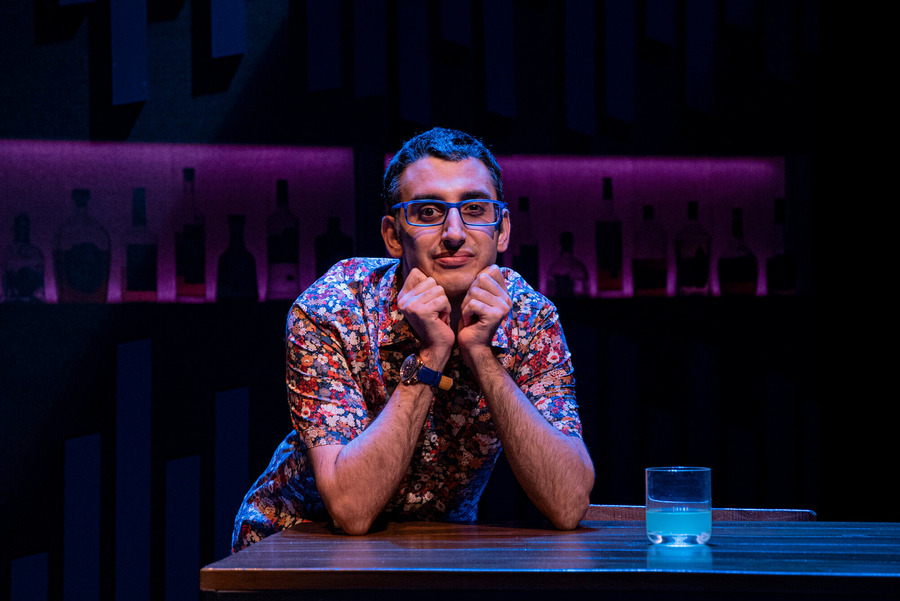
Ryan J. Haddad is known for such monologue-based plays as Dark Disabled Stories, Hold Me in the Water, and Hi, Are You Single?, in which he explored his relationship to his disability—Haddad has cerebral palsy—and his unique perceptions of the world. In Haddad’s first ensemble work, Good Time Charlie, at New York City’s Public Theater through Oct. 25, he tackles a subject that’s even more personal: how a close family connection led him to the stage.
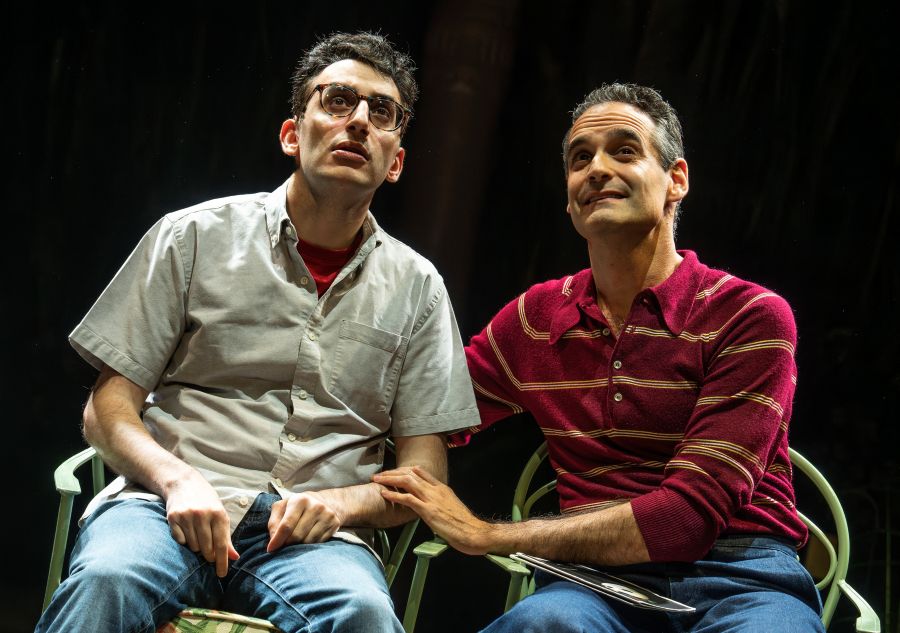
In process since 2018, Charlie explores the origins of Haddad’s love for theatre by way of his extended family in Cleveland, Ohio, specifically his second cousin, more like an uncle due to his age difference: Charlie Haddad, a musical theatre fan who once aspired to acting but who instead became a dentist. The play interweaves the experiences of Charlie and Ryan coming of age, in the late 1980s and mid-2000s, respectively, as both grapple with their homosexuality and what to do with their love of theatre. Does a passion have to become a profession? the play wonders. While Charlie’s life has been characterized by rigidly conventional expectations, both professionally and personally, Ryan’s is the result of increased acceptance and tolerance, in response both to Charlie’s story and social progress. Told across the two decades, the show not only recounts a family story, but offers an (honest) love letter to theatre—as well as a squeeze for anyone looking, sometimes hopelessly, for true love.
Danny Sharron, who directs the production and also directed Hold Me in the Water, has been attached to the production since the start.
“It was sort of everything that I ever want a play to be,” Sharron told me in a conference room at the Public in mid-September, on a break from a rehearsal. Seated around the table with us were cast members Jonathan Raviv, who plays Charlie and who has been involved in the project since the start (“I read some of these scenes in early draft and they meant so much to me”); Tim Bagley, making his New York theatre debut in the role of Charlie’s partner, Lou (“This came across my desk, and I was in right away,” he said); and Ryan, who plays both himself and a quasi-stage manager. One of the archival posters on the wall of the Public stood out: Fun Home, in part because a star of that ground-breaking musical, Beth Malone, also plays Janice, Ryan’s lesbian aunt, in Good Time Charlie, and in part because Haddad specifically cites Fun Home as a show that reckons with sexuality in the context of family.
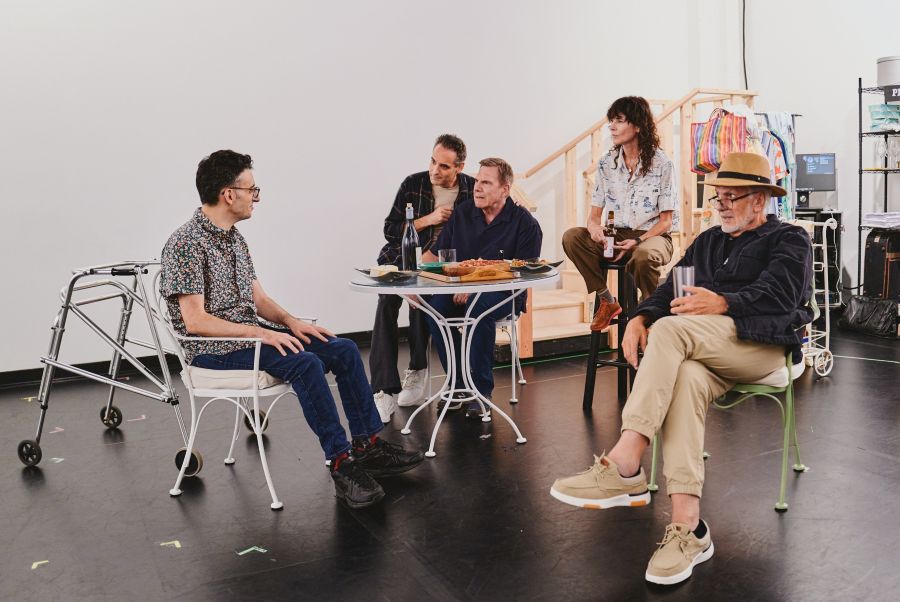
Also like that musical, Good Time Charlie leans into metatheatrical storytelling. Much of the writing process, according to Haddad and Sharron, focused on maintaining the tone of Haddad’s solo work, while expanding it to uphold dialogue. And so Haddad has made much of the play itself about the writing of it—i.e., the attempt to theatricalize a story with so many people, in this case seven actors playing nine roles. (He credits his dramaturg, Sarah Lunnie, for encouraging this meta impulse.)
Haddad’s attraction to theatre was instinctual, but the pathway wasn’t inevitable. The close-knit family he grew up in included his father’s cousin, Charlie, and Charlie’s partner Lou, a couple who traveled to New York regularly to see theatre and opera. Independently of this cultivated duo, Haddad had been putting on productions in his parents’ backyard, including a staging of Cinderella when he was just 6-year-old; he eventually started a family troupe called the Haddad Theatre Company. It wasn’t until Charlie took 9-year-old Ryan to see Phantom of the Opera in Cleveland that a real cross-dialogue emerged, and Charlie saw the role he could have in young Ryan’s life.

“Ryan, beginning when he was a child, said this is what he wanted to do, and the whole family surrounded him and encouraged him,” the real-life Charlie told me over the phone last month. His own experience was more solitary. Despite his demonstrated interest in the theatre, his parents encouraged him to go to dentistry school. Whenever he entertained the possibility of living his dreams onstage, the tension it brought into his relationship with his parents was too great, he recalled—tension that was soon intermingled with his parents’ disapproval of his sexuality. Through his partner, Lou, Charlie met a man named Sheldon, an art-house cinema owner, who became Charlie’s cultural mentor, in much the same way Charlie did for Ryan.
It would be easy to see Good Time Charlie as a play all about comparison: Haddad got to have the career and social acceptance that Charlie missed. But Charlie is too self-aware to be that simple. Haddad said he’d always wanted to write about his relationship with Charlie, but that it wasn’t until he saw how Charlie became a caretaker to his aging parents that he got a window into his hero’s humanity.
“He was entering this very challenging chapter in his life and still trying to put on a good face for everybody, and there was a real human behind his persona,” said Haddad. That awakening to his subject unlocked the play for Haddad. While he’s written a play about a person who wanted to be centerstage and never got to, he writes into that gap by exploring Charlie’s successful relationship with Lou. Meanwhile, Haddad notes, his own commitment to the creative life has left him without a partner.
And Haddad is able to supply something of an answer to Charlie’s life-long quest for the stage, putting him centerstage by way of the boy who learned from him.
“I was in the bathroom, one of those fabulous individual bathrooms at the Intercontinental Hotel on 44th,” Haddad told me, displaying his attention to detail. “And I heard Charlie talking to a stranger, telling him, ‘There’s a play about me coming up at the Public Theater this September, you should come and see it.’” Or, as Charlie put it to me, “If I can’t do it myself, at least my doppelgänger will be able to do it.”
Eve Bromberg is a critic and writer from Brooklyn. She is currently working as part of American Theatre’s editorial team and completing an MFA in Dramaturgy at Columbia.