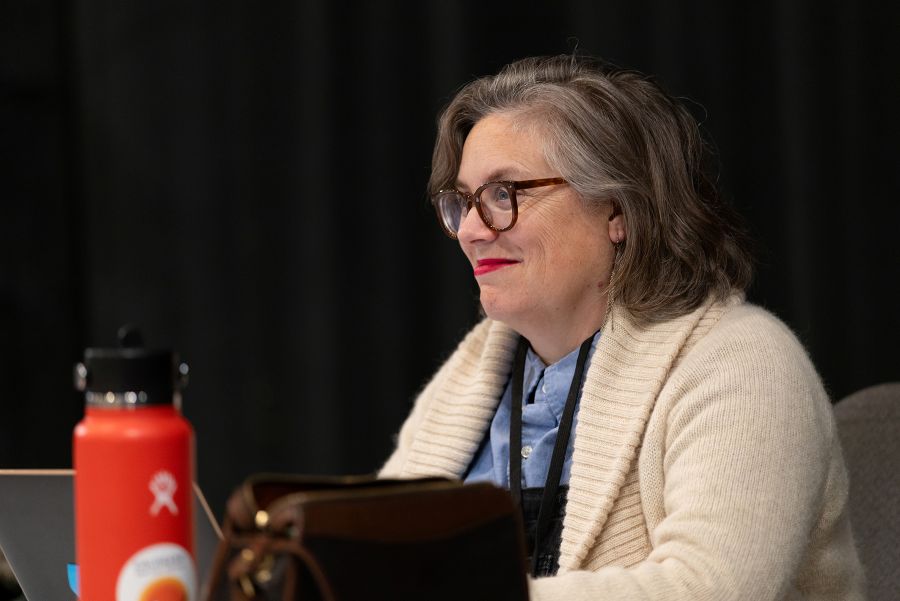
Stephanie Alison Walker’s mom, who has been selling real estate since 1980, always told her daughter that she’d make a good realtor too. Walker was convinced she’d never want to do that, and instead pursued writing. Her undergraduate degree from the University of Colorado is in creative writing (with a double major in Spanish), her graduate degree is a masters of professional writing, and, after a stint as an assistant for Fox Theatricals in Chicago led her to taking a Chicago Dramatists writing workshop to “just see if I like it,” writing for theatre hooked the native Chicagoburbian (to borrow her bio’s parlance).
“It was the best thing ever, and I just didn’t ever want to go back,” Walker said of the workshop, which brought in local actors to read the participants’ writing. “I just was like, ‘Oh, this is what I want to do. This is great.’”
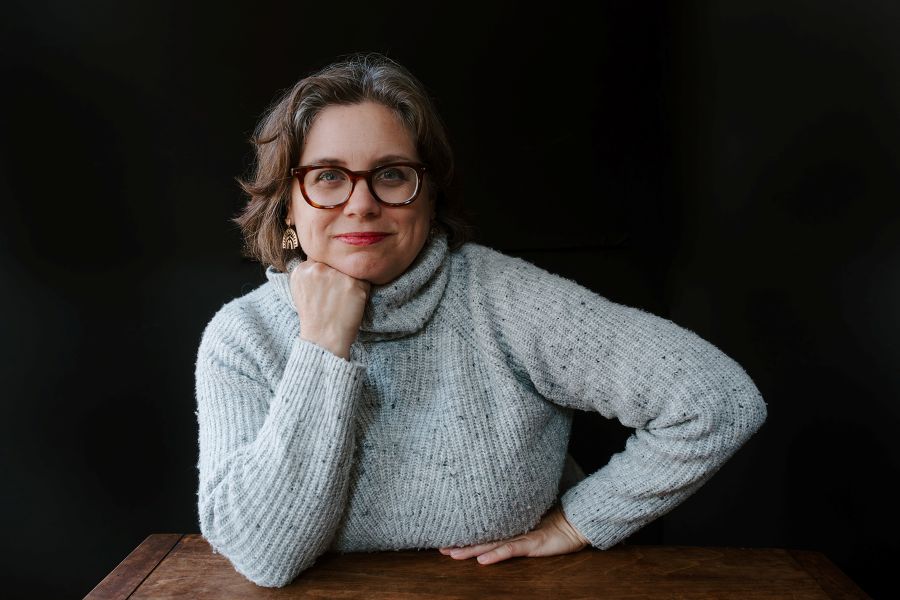
Since then, Walker has had some success, including her play The Madres receiving a National New Play Network Rolling World Premiere. But a stint in Los Angeles trying to establish her theatre and TV career there didn’t go well, and she recalled wondering, “What have I done? I’ve wasted my life trying to be a writer, and now I’m unemployable.”
So in 2020, Walker moved back home to Barrington, Illinois, a suburb of Chicago, and joined her mom to create a mother-daughter real estate team. While real estate is helping her pay the bills as a single mom, her heart never left playwriting. Now her play Adirondack Chair Circle is in its world premiere at Steppenwolf Theatre Company (through Dec. 13).
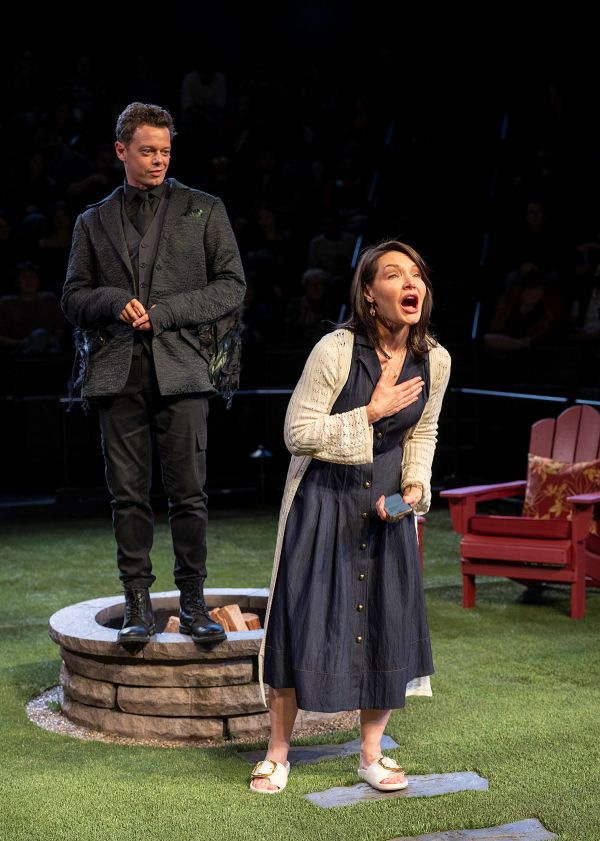
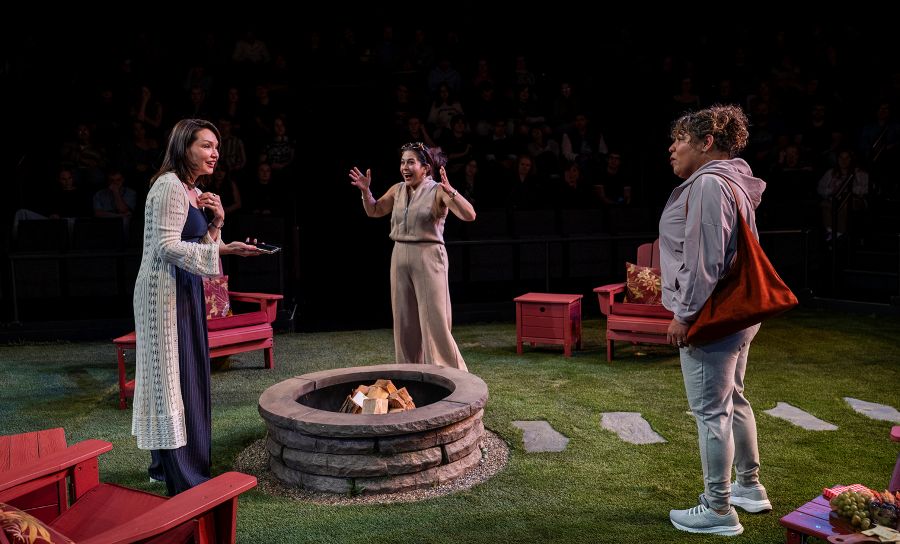
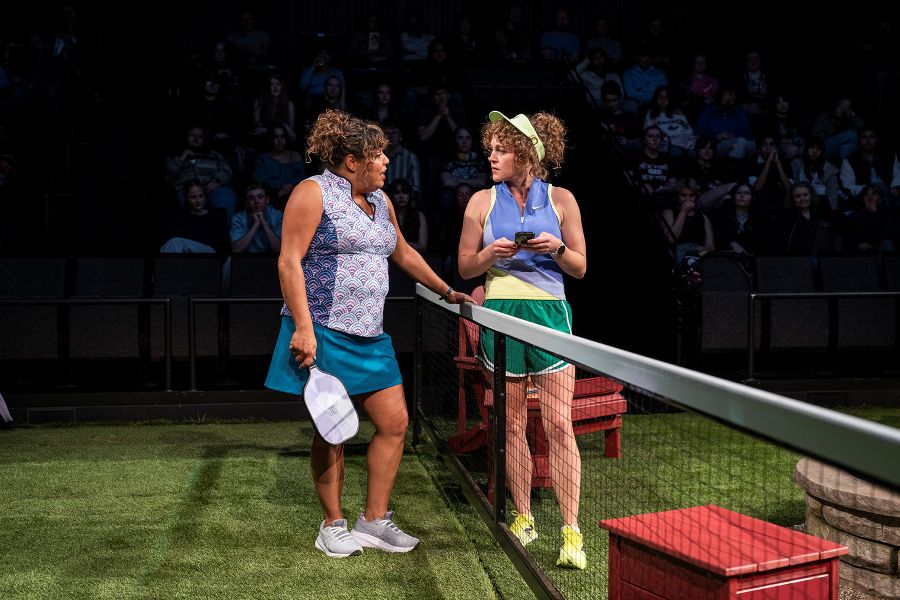
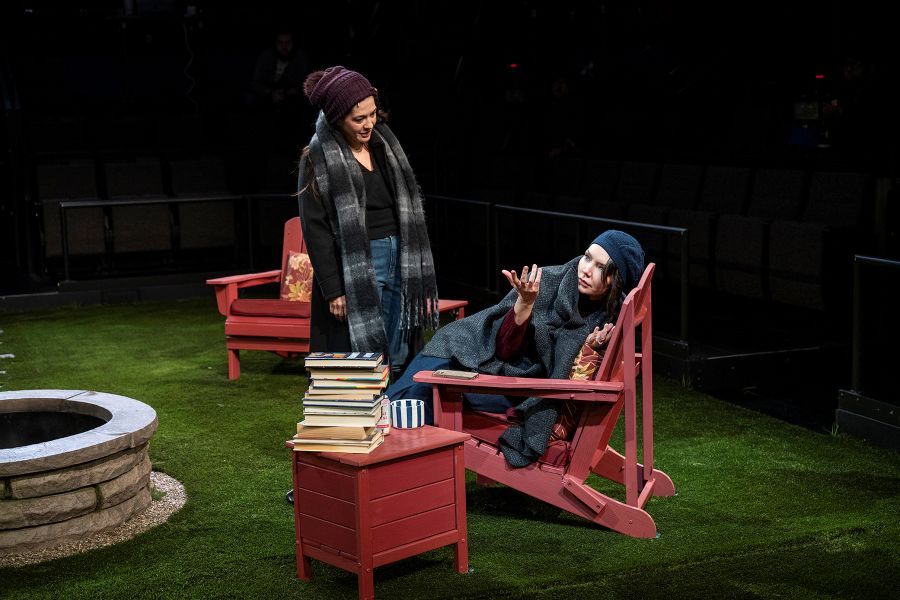
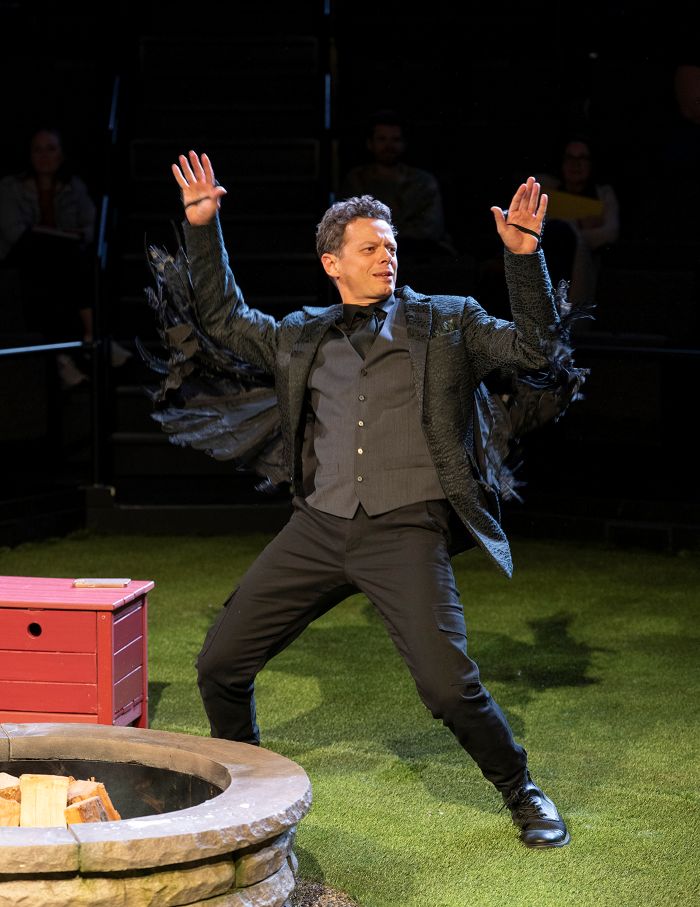
The dark political comedy follows a group of suburban moms battling their local school board. Stationed around the backyard fire pit of Banna (Katrina Lenk), compatriots Winona (Wendy Mateo) and Libby (Sadieh Rifai) join Banna in the fight to get the school board to ban books that they feel are inappropriate for kids. Tensions rise as Winona befriends the liberal Evelyn Grace (Caroline Neff) over their shared pickleball chemistry. All the while, we’re guided by Crow, a crow who serves as both narrator and Banna’s mortal enemy. Walker describes herself as a writer who personalizes the political and finds humor in the darkness, and both traits appear in this production, which has felt like it was decades in the making.
“This whole production came about in a way that I never ever expected, but I had hoped for for 26 years,” Walker said. “I’ve always wanted to be produced at Steppenwolf, because this is the theatre I grew up seeing plays and dreaming about.”
Earlier this month, tucked away in a quiet library at Steppenwolf, I sat down with Walker to chat more about her career journey, her perspective on the new-play development landscape, and what went into her newest play.
What was the original inspiration for Adirondack Chair Circle?
I lived in L.A. for 15 years—combined total. But in 2020, I moved back to my hometown, Barrington, Illinois. I moved back because of making life easier, being closer to family, and wanting something more affordable than the cost of living in L.A. at the time.
I started to get involved in the community once we were coming out of the pandemic. One day, one of my friends called and said that people needed to get to the school board meeting because there was a group of moms trying to ban books. That was my first school board meeting, and I spoke at it. Then I immediately started learning more about what was going on, and things got really divisive and pretty extreme. The Proud Boys showed up at a meeting. Police had to escort the school board members out for their own safety—things like that. School board members were being called pedophiles. It was very extreme and severe, and I couldn’t believe this was happening. Then the school board voted to keep the books, and that was a reason why a lot of these people who were angry ran for school board in the next election the following spring.
A year later, I was still thinking about what happened. I had this instinct right away that I could write a play about this, but I didn’t think I wanted to because it was still so raw. Then the Dramatists Guild was doing their “End of Play” challenge, to write a play in the month of April. I wrote maybe a quarter or a third of the play during that month. By then, it had hooked me.
I finished writing it and immediately felt like I had something, because I was also bringing pages to a group I’m a part of called Studio at A Red Orchid Theatre, and I was getting really good feedback. The whole idea for me was really pushing myself to write a play that was going to examine the dynamics in the groups we choose to align ourselves with, through the lens of myself as a middle-aged woman and a parent—why we seek out these causes, what causes we choose, and whether we have more in common than not.
How you describe the school board meeting you attended, as well as how scenes from the play feel, makes this seem like such visceral material. How did you approach organizing and finding the full world of this story?
I had to really ground it in the characters. I am a character-driven playwright for sure. I tend to write about political issues from the personal perspective. I never thought I was a political playwright at first until one of my friends was like, “What are you talking about?” I’m like, “Okay, fine, I guess I am.” But my goal is to start off with character and what’s personal to their lives, making it very specific and grounded.
In this case, I started with the Adirondack chair circle. It’s such an iconic thing that you see on every suburban lawn nowadays, and even in city lawns as well. I was looking for a physical manifestation of: What if we are more similar than we’re not, or what could be the thing that unites us? In suburban worlds, it’s the Adirondack chair circle around a fire pit.
So then it was about wanting to make the characters really specific. I didn’t want to make it about the founders of Moms for Liberty. I wanted to create my own characters. Looking at Banna, I was really looking at this idea of what would cause her to want to start a group like this and feel like this is the way to make a difference. Banna isn’t liking what she sees happening in the school board and lives next to the superintendent. I find her to be somebody who is very lonely and in need of something bigger than herself or something to connect to, and her own ideals about the world are really sabotaging what her personal needs are in terms of connecting with her own family. That dichotomy is very interesting to me as well. The other two characters in the group were easier once I had Banna—it was easier to figure out who else would be there and why.
Where did the idea for the crow narrator come from?
The crow really just came because I’m in this yard and I’m looking, and the crow just appeared. When I’m writing a first draft, I made a rule for myself a few years ago that the first draft should be fun and that I should follow the fun when writing a first draft. I don’t outline first drafts. So Crow just kind of popped up and I followed him because he was fun. I was like, “Oh, this actually could work really well.”
On a personal level, during the pandemic, my son was really interested in befriending a crow, so I read a lot about crows and how you go about doing that. It was just this information I had in my brain that I was like, “Oh, this could be fun to explore in the play with this character.”
I have to ask: What’s your favorite fun fact that you learned about crows during that research?
Oh gosh, so many good ones. Okay, this is a fun one: They have facial recognition. They can memorize faces, and if you piss off a crow, they will not forget, and they can hold a grudge throughout generations because they pass that information down through generations.
And when we have the dead crow onstage, we don’t want Winona to go near it, but Libby can. Because if crows see a human near a dead crow, they associate that human with having caused the crow’s demise, and then they become their enemy, essentially. That was another thing. I was like, Winona cannot go near the crow because if the other crows see her, she’ll be targeted.
Zooming out a bit: One of the big conversations over the last few years has been around the dwindling landscape for new-play development, with previously major institutions and opportunities disappearing. As you look back at your 26 years, but especially recently, how are you looking at the new-work landscape for playwrights right now?
It’s always sad and upsetting when something goes away. That said, I didn’t know about a lot of these opportunities when I was coming up, when I was first writing, and I probably wouldn’t have been ready for them anyway at the time.
I think that you have to create your own opportunities. I mean, we produced my first play because my friend read it—she’s an actor, and she’s like, “I love this, we have to do this.” And I’m like, “Do you know how hard it is to get a production?” She’s like, “Well, we should do it ourselves.” And I’m like, “That’s not how things are done.” And she was like, “Okay, when you get over yourself, come back to me.”
It’s hard; it takes a lot of work. But I think that what is important to think about is creating your own opportunities is also a way of creating a way to express your art. So even if that’s just inviting friends over to read your play in your living room, that alone can be something that feels really good and helps with the development of the play, because hearing it out loud helps, and then that will give you the encouragement that you need to keep going.
Do you have advice for young playwrights who may be taking their first class or going to grad school themselves and trying to navigate this world?
Something probably everybody says is: See as many plays as you can, read as many plays as you can. Plays are expensive. This is one of those things that went away that is frustrating: the Ovation Awards in Los Angeles. I was an Ovation voter. You can apply to be an Ovation voter, and I was an Ovation voter, and you had to see, at the time, like 35 plays a season. And you get a free ticket every time you go. So I was able to see plays that way.
Another way would be finding a theatrical home where you’re taking classes or you get involved somehow and you learn about what it is to produce a play. I think my production experience was very helpful for me as a writer as well. Early on I took an acting class and that helped my writing a lot, and I did it just because I wanted to have a different perspective on the work.
Classes can be really expensive, though. I would say there were a lot of new companies in Chicago, at least, that are very inviting. Go see shows at places where the doors open, where there are invitations, where your work is aligned.
When you’re working on something new, what does helpful feedback look and feel like, whether it’s from dramaturgs, actors, or directors?
I could answer that really specifically, because in Studio at A Red Orchid we do the Liz Lerman feedback method. First, the question is: What do you as a playwright want to hear right now in terms of feedback? Do you want people to just write notes and hand them to you? Do you want to hear from the room? Do you have specific questions? I usually do not have a specific question before we read pages that I want people to look for.
What’s helpful to me is: What was confusing? What do you want to know more about? What popped out for you, and where did you get lost? What took you out of the play? Those are things that are very specific and helpful.
Then, in the production process, we have so many smart actors in the play. When they ask a question like, “I don’t understand why I’m saying this right now,” and I try to answer it, and then I realize I don’t think I really answered that. I try again, and I can still see that it’s not landing. I’m like, “I just need a second, let me look at this.” Several times that’s happened. Sometimes I’m too reactive of a writer, because I’m also a people pleaser. Pam would ask me a question, and she caught onto that pretty quickly—she’d be like, “I’m not asking for a rewrite, I’m just asking.”
Is there anything else you’d like readers to know?
This whole thing with Steppenwolf—I didn’t have an agent. I did have an agent for a period, but I was like, “Steppenwolf is interested in my play, can you follow up with them?” and they just never did. I didn’t hear anything, so I’m like, you know what? I need more communication. This doesn’t work for me, because it makes me crazy. So I’m like, I’d rather just do this on my own.
Then I got the production, and I talked to the Dramatists Guild when it was time to do the contract, and they were so helpful. I’m telling everybody this because the Dramatists Guild has this incredible resource where they will look a contract over before you sign it, and they turned it around for me in 24 hours. They had all of these different things that they had questions about that they flagged. Then I sat down with Tom Pearl and we went through the whole thing together. I work with contracts every day in real estate, so I’m not afraid of contracts as a thing, but to me it was really empowering to fully understand what I was signing and why those things were there and ask those questions. I just encourage people to not be afraid of doing that and also utilize the Dramatists Guild, because that’s such an incredible resource. They have attorneys on staff for a reason.
I have an agent now that I didn’t then, and I think that’s the other thing I’d say to younger playwrights: Use your time developing your craft and making connections. You make connections by even just cold-calling people at the theatres or sending an email, “Can I take you out for a cup of coffee?” or “Can I bring you a cup of coffee and get 15 minutes of your time just to understand what kind of plays you’re looking for?” Sometimes they’ll say yes, and then suddenly you’re in touch with a literary manager at a theatre you’re interested in. There are a lot of ways to advocate for yourself as a writer without waiting for somebody else to do it for you.
Jerald Raymond Pierce is managing editor of American Theatre.