A little over 17 years ago, Todd London, then the artistic director of New Dramatists, began work on a study for the Theatre Development Fund (TDF) on the state of the field for new plays and the people who write them. This kind of intensive research “wasn’t really something they did,” he recalled, but there were major questions about the lives of playwrights that had never been answered with real data. How much money did playwrights actually make? How bad was the diversity problem in American theatre? How much was the average commission? Setting out to systematically answer some of these questions, London and TDF brought in Zannie Giraud Voss of SMU Data Arts to gather the data and Ben Pesner to help London conduct interviews and write up their findings.
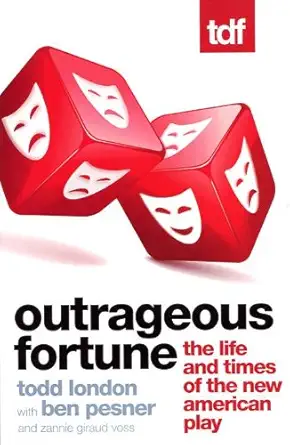
The end result was the book Outrageous Fortune: The Life and Times of the New American Play. It was the rare study that had a transformative effect on the field and the issues it documented, both because it backed up its arguments with data and because it contained the viewpoints of both playwrights and administrators. As Victoria Bailey, TDF’s executive director at the time and the originator of a study that had originally been envisioned by the late John E. Booth, wrote in her introduction, there are new plays happening all over America, but “the ecosystem in which the new play is produced is not healthy.” Playwriting afforded only a small handful a living from their work. Artistic directors were overwhelmed by the number of stakeholders they needed to please to keep the lights on. Nonprofit and commercial theatre were becoming more and more alike. Perhaps worst of all, Bailey wrote, “Language is failing us. Writers and those who produce their plays are not talking honestly with each other…with their audiences, or with funders,” making solutions to the field’s problems all the harder to find.
The major findings of Outrageous Fortune can be roughly divided into two different, largely overlapping categories: the artistic and the financial. On the artistic side, too many theatres were taking new-play grant money to program readings and workshops but not full productions, trapping writers in an endless and inescapable hall of mirrors, a.k.a. “development hell.” While a small handful of graduate programs—Yale, Brown, Brooklyn College, and Juilliard chief among them—helped position writers to be discovered and have careers, they only took a handful of writers a year each. The same was true for the big new-play organizations like Ojai, Sundance, and the O’Neill. The field over-emphasized the idea of the “emerging writer,” which meant that mid-career writers often found funding and development opportunities evaporating at the exact time in their lives when they needed more financial stability.
Many writers complained that they had no artistic home, and that they seldom could have authentic conversations with artistic directors or literary managers. For women and writers of color, these problems were compounded by the same biases that greet them at every corner of American life. Black playwrights, for example, would often only see interest in their plays in February, a.k.a. Black History Month, and then only if the rights to an August Wilson script were not available. Playwright Lauren Yee recalled conversations with theatres early in her career where “they would read a play that called for specific casting, and they’re like, ‘Great play. We’re never going to do it because we don’t know who those actors are.’ As a kid, I was like, there’s no way I could write a story with Asian American characters and get it produced.”
On the financial front, the picture painted by Outrageous Fortune was so bleak that even London was surprised by it. “The real wake-up for me was that the payment of playwrights was based on a commercial royalty model,” London said. That model was decades out of date and premised on open commercial runs. “Once you take that same royalty basis and you apply it to three and a half weeks in a 200-seat theatre, there is no way of making a living at that.”
London was shocked when he interviewed a playwright “who by all estimates was wildly successful. She’d had productionsat two or three major regional theatres and the Public that year.” She told him that she’d never made more than $40,000 a year from writing. According to the study itself, surveyed playwrights made only 15 percent of their annual income from theatrical work, and only 3 percent of their annual income came from royalties. Or, as Pulitzer-winning playwright Doug Wright told me, “I have had six shows on Broadway. That’s not braggadocio. That is to share the staggering fact that if I were reliant on theatre royalties, I would be broke.”
Outrageous Fortune’s most chilling statistics focused on commissions. The average commission received by surveyed playwrights was between $3,000 and $5,000 dollars, with a third of all commission rates below that range. When you take into account that a play can take years to write—or, in the case of Wright’s I Am My Own Wife, a decade—these paltry amounts felt like a cruel joke.
I attended the plenary at the 2009 TCG Conference where London and David Dower presented their findings, and the room was as spellbound as at a Broadway show. We had all known for a long time that things needed to change. The study named concrete problems and pointed the way toward solutions. Perhaps we could move, as one oft-repeated phrase at that conference put it, “from scarcity to abundance.”
Over the years that followed, many initiatives blossomed in the quest to fix the lot of the new American play and playwright. The result, for the decade prior to the pandemic, was what the agent Di Glazer calls a “golden age of new-play funding.” It was also inarguably a golden age for new plays themselves. How else should one describe a decade-plus that gave us the plays of Jackie Sibblies Drury, Amy Herzog, Annie Baker, Branden Jacobs-Jenkins, Rajiv Joseph, Danai Gurira, and more? Many of the pipeline and development problems were, if not solved, then addressed in the past decade with commissions, residencies, and new programming.
Much of what was built in those years, though, now lies in tatters since the pandemic lockdown. And the financial problems have not gone away. If anything, the price of housing in most American cities means that the bleak financial picture for playwrights has only gotten worse. This wasn’t for lack of trying. If we failed as a field to make it possible for more people to make a living playwriting, it is because that problem may not actually be solvable.
In the face of these contractions, how can we protect what we built, and continue to develop new pathways for both plays and playwrights, particularly playwrights who are women, genderqueer, or people of color? We must first face two hard truths.
First, when Outrageous Fortune was published, similar crises affected other theatrical artists, particularly directors. Almost nothing was done to address their problems during this time of relative largesse for writers. The most reliable path to a substantial freelance directing career remains building a relationship with a writer who gets discovered, and hoping they don’t toss you over for a bigger name as soon as one is dangled in front of them. If that works out for you, then “success” looks like paying an exorbitant rent for an apartment in New York City so that you can take a large pay cut to work in New York’s nonprofit theatres, all for the hope of making more money on the road. You might be able to put together a middle-class annual income, if you’re willing to live out of a suitcase for much of the year, directing in LORT A and B-sized theatres. Unlike the work of writers, actors, and designers, your skills do not easily transfer to television or film, so your other options for making money are few and far between, especially as your travel schedule will make teaching that much harder to book.
Second, there are simply too many writers in the market (too many directors and actors too, if we’re counting). To give one metric: Last fall the Public Theater’s Emerging Writers Group accepted 10 new playwrights out of a reported 1,000 applicants. Even when things were going well, there were not enough production slots, and not nearly enough money. Theatres failed to make the case that the people who make art deserve to be funded, and so major building projects sucked up much of the available cash in the field. Now, and for the foreseeable future, those trends are only worsening.
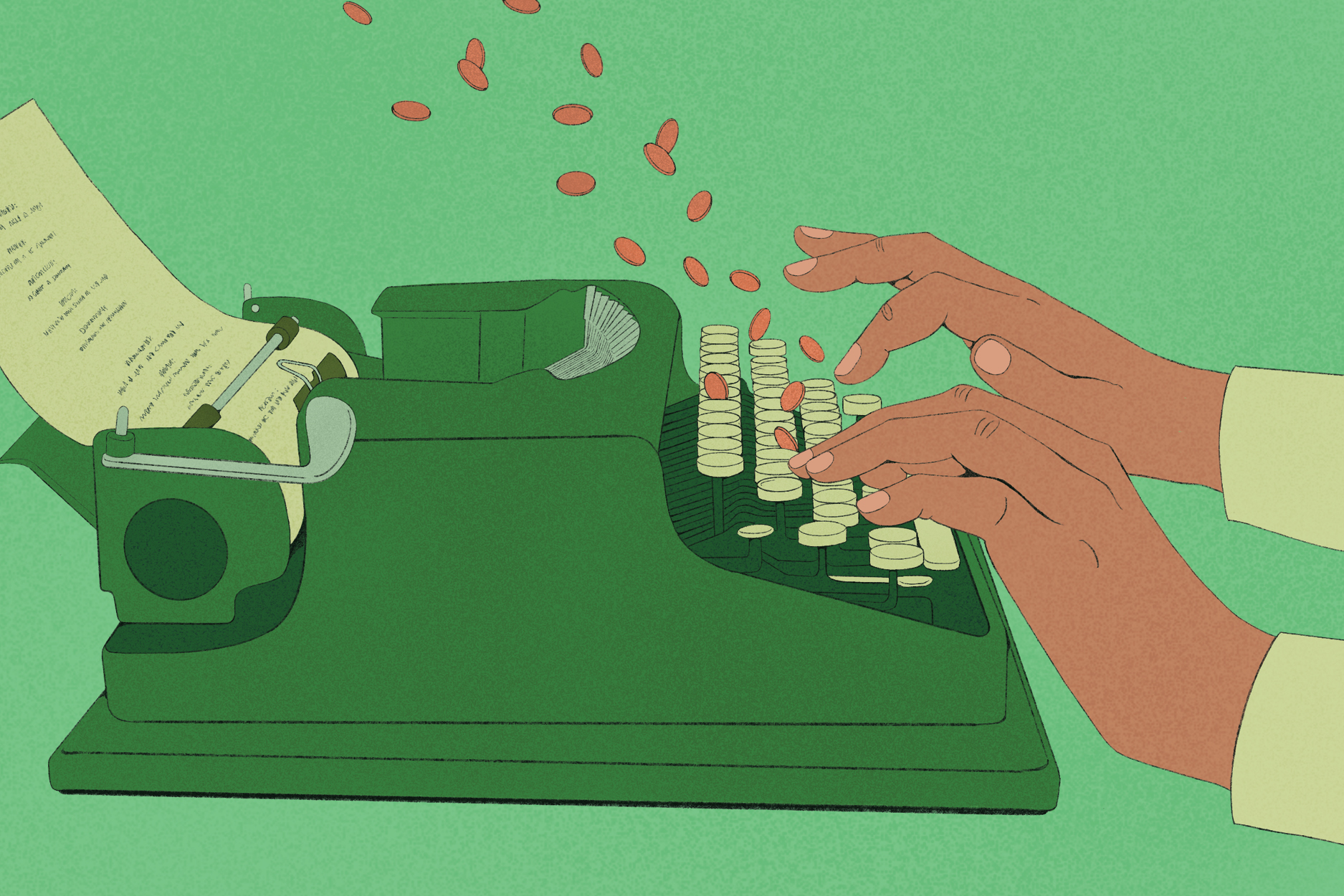
There’s no question that we have built a system that creates brilliant art, as the recent golden age of American playwriting showed. But it simply has not been able to support the lives of the people who make that art for decades now—and the resources that could provide that support are not expanding but instead are beginning to dwindle. “Everyone’s demanding a slice of the pie,” Doug Wright said. “The ugly reality is: There’s no pie! It’s just crumbs. We’re really fighting over crumbs at this point. It’s not a remunerative profession. It’s not even a tenable profession.”
Every year, there are some who make a living from playwriting, but it is the rare writer who can stay in that elite group over the long term. Yee, for example, managed to make a living from playwriting for “one or two years, where I had a series of plays that were all coming out, and I got a publishing contract for those plays and the advance was good.” Other writers can make money in commercial theatre: with a long-running musical, say, or with a mix of productions and options and licensing that can sustain them for a while. But we are decades removed from the era when a play could run for multiple years and tour to provide a hefty long-term income for its writer. And since playwrights’ status as copyright holders means they cannot form a union (the Dramatists Guild creates standards but can’t enforce them), there is always the looming fear that future contract negotiations could lead to writers taking a major hit on their commercial income.
If we are to build something worthwhile out of these shambles, we must start by accepting the full scope of the problem and figuring out what new ideas could emerge. What would a healthy theatre ecosystem within the realm of the possible actually look like? I asked Emily Morse, who runs New Dramatists today, to sketch out her ideal world. It would, she said, “offer writers a home base, agency in their process and within the theatre—engagement with the different departments, for example, and development that serves their writing process, time to swim in the unknowns for longer, and more flexibility in both development and production schedules. I also think we could do a better job acknowledging (and supporting) the interdependence of development and production organizations.” Her most “not realistic, I know” wish: that theatres would ditch the season model and “program more dynamically…building the experience from the ground up.”
There are also some practical changes the people I spoke to for this article would like to see: less money spent on physical production and more on people, less pay for those at the top, particularly the major artistic and executive directors, and more for artists. A recognition that what money buys a producer is our time, and that our time is valuable. For some artists this may simply mean accepting the industry’s flaws and working outside of it, even if that means keeping a day job for the foreseeable future.
It would also require a far more decentralized industry, one in which regional theatres orbit New York City less, and invest for the long term in local artists and audiences. It means rethinking our models for how artists are hired and paid, which are still based on assumptions from the early days of the regional theatre movement. It means more collectives like 13P, and more use of less traditional spaces. The emergence of so-called artificial intelligence, which leverages wide-scale theft of our art in order to devalue it in the marketplace, makes the hard work of creating something more alive, more local, and more human that much more necessary.
We must also recognize that the theatre and its interests are not separate from America and its interests. We are part of America, and a reflection of it. None of our struggles is unique to us. If we, as theatre artists, can find common cause with each other, we can hopefully find common cause outside of our artform with our fellow Americans. We can fight alongside them for our communities, for a robust safety net, for a nation that believes in a common good again, and for the value of free expression.
The American theatre in its current form is a holdover from the post-World War II era, in which we believed the arts meant something in the daily life of the American people. We have a National Endowment for the Arts because the government believed the arts could serve a nationalistic purpose in defining and communicating Americanness in all its thorny complexity. Neither belief is widely held anymore. Now, with every fiber of our being, we must make the case—in our work, in our lives, and in the way we treat each other—that theatre and the people who make it are valuable parts of our society.
It’s an old couples-therapy maxim that arguments about money are really arguments about values. If you truly believe that theatre is important—and I’m guessing if you’re reading this magazine, you probably do—then you must also value the artists who actually make it. That means valuing us, specifically, with money.
The field as it is currently constructed probably can’t make it possible for large numbers of artists to make a living from their theatre work. But it can make it easier for us to live. It can signal that we matter: to the organizations we work for, to the field at large, and to the nation.
Isaac Butler is a theatre director, cultural historian, and author of The Method: How the Twentieth Century Learned to Act, winner of the 2022 National Book Critics Circle Award for nonfiction. His next book, The Perfect Moment: God, Sex, Art, and the Birth of America’s Culture Wars will be out in June from Bloomsbury Publishing.