This summer, one of the most powerful men in the American nonprofit theatre stood up and pronounced it dead. Oskar Eustis told The New York Times that the American nonprofit theatre movement is over. Not struggling. Not ailing. Over.
The field did what a grieving field does: It wrote elegies and then rebuttals. One of the theatre’s most thoughtful writers answered inside a week. The sentence traveled to every place a certain kind of theatre person gathers.
In the towns where I spent 30 years building theatres—the mill cities, the crossroads, the places this country long ago agreed did not count, 21 of those years in a converted 1917 firehouse in Norwich, Connecticut—no one knew what he was talking about. That silence is the most important thing Eustis said. He just didn’t know he was saying it.
In northern Minnesota at Lake Itasca State Park, you can walk through a stream of cool water, running from a glacial lake—the beginning of a 2,340-mile journey to the Gulf of Mexico. This headwater for the Mississippi River runs so shallow that a child can enjoy it as an escape from the heat, and yet the whole thriving downstream river—every barge and levee and flood—begins here, in running water you would walk past if you were not looking for it.

Culture runs the same way. It rises in out-of-the-way places too small to draw attention and gathers, eventually, into the few wide places no one can miss: a voice on the steps of the Lincoln Memorial, a stage on Broadway, a museum whose closing makes national news. We have trained our national attention on those wide places—not because they are broad enough to see, but because we were taught they are the only ones that matter. In doing so, we mistake the ocean for the river and forget there was a source of it all. A source no one is watching is a source no one will defend.
John Adams understood that journey from the headwaters to the sea, and he knew exactly where on it he stood. Writing home to Abigail Adams in 1780, from Europe, the Revolutionary War still unwon and the years away from her the price he was paying for it, he set down what the whole enterprise was for: “I must study politics and war that my sons may have liberty to study mathematics and philosophy…in order to give their children a right to study painting, poetry, music.” Adams is not putting art at the source. He is naming himself the source. His politics and his war are the cold, shallow water at the top—the labor no one travels upstream to see. His grandchildren’s painting and poetry are the wide, bright mouth downstream—the plenty the whole country will one day take for granted and forget it ever had to be fed. Adams did not stand at the destination and call it his reward. He stood at the headwaters, upstream and unseen, doing the work the whole river depends on, so that the art at the mouth could exist at all.
To his credit, Eustis said far more than the headline carried. No individual theatre is finished, he was careful to add. Each will have to make its own case now, invent its own model, and most that survive will drift toward the commercial. He was precise about what he was burying. The movement, as he defined it, was a mid-century consensus: underwritten by the Ford Foundation, marked by the founding of the National Endowment for the Arts, carried through state arts agencies and corporate giving. It was a belief, broadly and quietly held, that Americans deserved serious art that did not have to pay for itself at the box office. That is the whole of what he means. Eustis defines the movement as its funding: the subsidized, institutional, ratified structure that was already in place before he ever arrived.
Define the movement that way, and the theatre the money never reached was never inside it. Which means “the movement is over” says something narrower, and stranger, than it sounds. It says that the part of the river his vantage was built to see has finally reached the sea. He is standing at the mouth, watching the water go brackish where it meets the tide, and calling the whole river dead.
Even the rebuttals stayed at the mouth. The most searching of them came from Howard Sherman, who argued—persuasively, and with real care for the history—that there was never one movement but a succession of them: an expansion, an institutionalization, a reckoning, each one cresting and passing, the field changing shape and surviving through all of it. A movement may be over, he wrote, but the nonprofit theatre lives. It is a generous case, and a smarter one than the obituary it answers.
What is telling is what Sherman is counting: conferences, resident theatres, the trade magazine, purpose-built houses, a professional class. His roll call of the recent dead is a list of institutions. He and Eustis disagree fiercely about the prognosis and agree completely about the patient, and it is a family argument, carried on among the theatres with budgets big enough to argue about. Neither of them is talking about the theatre that was never in the conference program, never got the foundation’s money, never had a purpose-built anything: the company in a converted firehouse, the summer playhouse on a working farm, the stage in the town that never once made the trade magazine.
To his credit, Sherman glances upstream. He grants that the nonprofit theatre is a broader community than the regional institutions, that there are surely many more of them out there. Then he walks past it and spends the rest of his essay on the big houses. Even the most careful eye makes its whole argument by where it chooses to rest.
This is the property line the whole debate is standing on without seeing it. The theatre that does the load-bearing work was never enrolled in the movement—which means it cannot die with the movement and cannot be saved by the movement reinventing itself. It simply keeps going. Upstream, unseen, doing the work, invisible for the very reason it is essential. My rural colleagues are not mourning. You cannot mourn a thing you were never counted into.
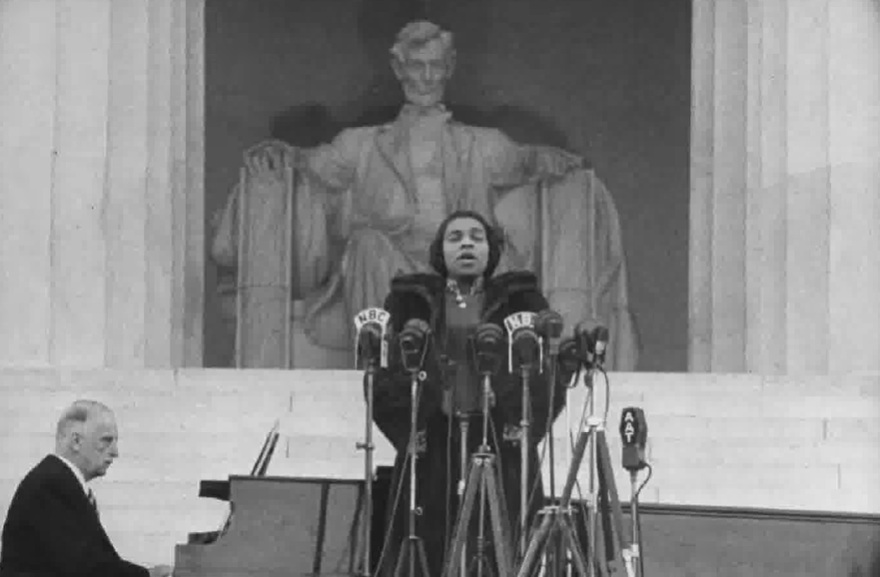
This is not only a story about theatre, and it did not begin with theatre. On Easter Sunday, 1939, Marian Anderson sang from the steps of the Lincoln Memorial to some 75,000 people, because the Daughters of the American Revolution had chosen to keep their stage white and barred her from Constitution Hall. Eleanor Roosevelt resigned from the DAR in protest. The concert moved to the federal steps, and Anderson opened with “My Country ’Tis of Thee.” It is one of the fixed, visible places in American memory: an ocean, a moment no one could miss.
Marian Anderson did not begin on those steps. She was the destination, not the source. The current that carried her there had been running upstream for three centuries: through Reconstruction, through slavery, through every church basement and front porch and uncounted room where that music was kept alive by people no one was watching and no one thought to count. The steps are only where the river finally ran wide enough to see. The reason it reached them at all was everything upstream.
Every budget this current administration has authored has proposed eliminating the National Endowment for the Arts. In the spring of 2025 the endowment abruptly rescinded, by the grantees’ own count, some 560 grants already made, representing roughly $27 million. Every time, though, a bipartisan Congress has refused, funding the endowment at two hundred and seven million dollars for 2026, keeping the federal-state partnership intact and the requirement that a large share of the money be handed down to the states. The administration’s 2027 budget revives the demand once more.
You will hear that this is symbolic: that $207 million, in a budget measured in trillions, is a rounding error. But the dollar amount was never the point. The point is the direction. Money flows downhill on its own—to the places already wide enough to see—and it takes a deliberate act to send any of it back up. The law is that act: It requires the NEA to send roughly 40 cents of every grant dollar up through the state arts councils and their local partners, toward the people farthest upstream. That reversal is real. What defeats it is not the amount but the design. The grants are built for institutional capacity: the matching funds to apply, the staff to run the reporting, the paid infrastructure the process quietly assumes. Those are the marks of an established institution downstream, not a place farther upstream—so the money is claimed on the way up, by the institutions already built to meet those terms. By the time it reaches the farthest, smallest places, it is a trickle of a trickle, and we cannot even say for certain it arrived. When the endowment last looked, in 2017, it admitted that the data on rural arts had proved “inadequate for elementary fact-finding.” We send the money upstream and then never build the means to see where it lands.
Consider what that downhill flow built. The institutions at the center of this argument grew to the size they now defend because the water always ran their way—and because they answered the same logic every American enterprise answers: Grow or be counted as failing. That was a choice, and a rational one. No one should be faulted for drinking from the river they were handed. Scale, though, must be fed. A good year becomes the new floor. A flat year becomes a crisis. The organization that once made-do now needs more, and more, and more, simply to stay alive. That is not greed. It is what dependency does to anything, and the system taught it: rewarding size, mistaking growth for health.
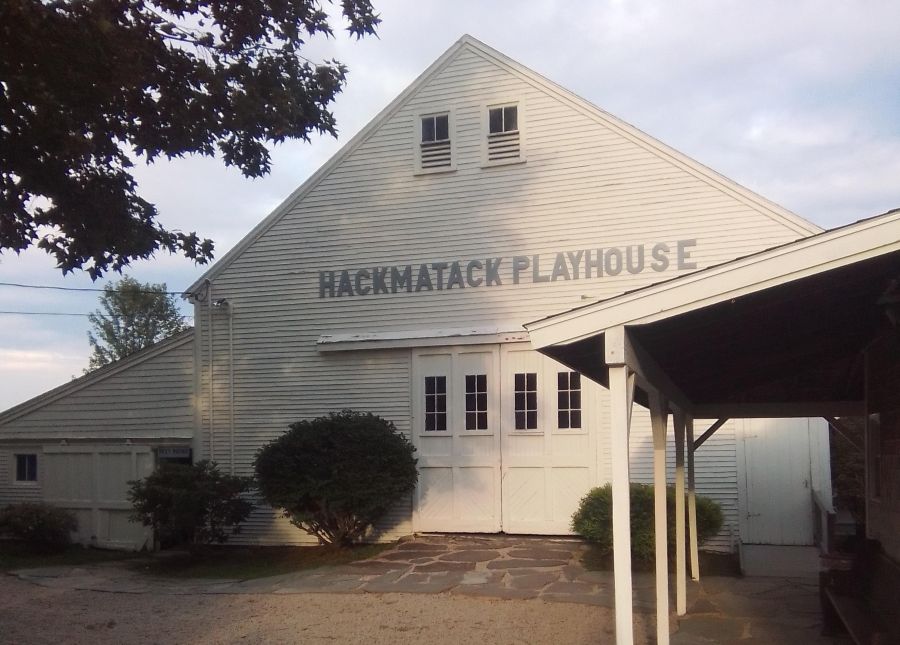
Upstream, where the water rarely reached, the opposite discipline took hold, for the opposite reason. People there learned to make culture without the money. A rural arts organization can make a thousand dollars do the work of a million—not because scarcity is noble, but because scarcity was the only teacher who ever showed up. On a working farm in Berwick, Maine, a summer playhouse called Hackmatack runs a full season outside the grant system entirely. What grew in the dry places was not dependency but its opposite: resourcefulness, self-reliance, the plain stubborn resilience of people long used to being passed over. In a storefront studio in Red Hook, New York, Mary Rotella—who performed on Broadway in Cabaret and Jerome Robbins’ Broadway, and toured nationally and abroad—chose, after all of it, to teach adults in a Hudson Valley town of a couple thousand to act, sing and dance. Two cultures, drawn from the same river and shaped by how much of it ever arrived: one that cannot survive a lean year, and one that has never known anything but.
Which is why Eustis, without meaning to, served the very people his announcement was never meant for. The change he named was already here. The tide had been going out across the sector for years: the whispered conversations, the quiet arithmetic, the institutions doing math they would not say out loud. What Eustis did was say it where the whole country could hear. He put it on the centerstage of the American theatre. He mistook the end of a funding arrangement for the end of the culture that funding once carried—and yet, in mourning the wrong death, loudly, he did the one useful thing. He turned the house lights on in a place we had all quietly agreed not to look. This moment was never unseen. It was ignored. Eustis is simply the man who stopped ignoring it—and then, standing at the mouth, turned and stared out to sea, his back to the river that fed him.
I have watched what arrives. In Phoenicia, New York—a Catskills hamlet of a few hundred people—the Phoenicia Playhouse puts up some 65 events a year: plays, musicals, films, new-work readings, workshops for the town’s children, free community nights. One capacity-building grant pays for the single dedicated hand who runs the lights and the sound across all of it. The playhouse is not where the money ends. It is where the town begins to see itself.
An hour south, in New Paltz, a grant to the Unison Arts Center bought something even plainer: two mini-split air-conditioning units, so that a room a dozen local artists had filled all summer could hold a winter too. Cut funding to either, and the work goes back to being something the town does quietly, uncounted, the way it always did before anyone thought to look.
A few places—the ones for whom that trickle was the only lifeline—do go dark for good. Most do not. They simply return to the silence they were always in: a source still running, unseen. I sit on the board of one of the groups that hands that money back out—county and state dollars, routed upstream—and I watch where it goes and where it never does. Which places stay lit, and which go dark.
A consensus is dying, and yes, we should be frightened—not because the river is ending, but because we have forgotten it has a source at all, and a forgotten source is an unprotected one. When a theatre goes dark in a county we long ago stopped counting, no one resigns in protest. There is no Marian Anderson on the steps. There is no one left even to see the door close. We did not stop making the culture. We only stopped being able to see where it starts.
So go and look for the place you would walk past if you were not looking for it. Follow the river upstream—because the smaller and the farther the source, the more the whole river depends on it. This is the country Adams was studying war to reach: a right to study painting, and poetry, and music, held not at the mouth but at the headwaters, in the towns that never once made the map.
America was never only the country we inherit. America is the country we make.
Brett Bernardini has spent 30 years building theatres in small-town and rural America. He is at work on the book The Country We Make.